Starting at $5, Decided in Hours: DeriW Trading Competition Edge Hour Officially Launches

Odaily星球日报2026-04-07 tarihinde yayınlandı2026-04-07 tarihinde güncellendi

Özet

DeriW has launched Edge Hour, a competitive trading product designed to offer a fast-paced, skill-based challenge for crypto traders. With a low entry fee starting at just $5 and multiple time options (1-8 hours), participants trade with 10,000 USDT in virtual funds, aiming to hit a profit target without breaching a maximum drawdown limit. Successful challenges yield rewards of 2-10x the entry fee, while losses are limited to the initial cost. The platform emphasizes fairness by eliminating the advantage of large capital, ensuring outcomes depend on trading skill and risk management. Rules such as minimum trade duration (60 seconds), trade count requirements, and caps on single-trade profits prevent gambling-like behavior. All transactions and settlements occur on-chain via DeriW Chain, ensuring transparency and efficiency with high throughput and zero gas fees. Edge Hour addresses a gap in the market by offering a prop trading-like experience with shorter cycles and lower barriers, appealing to traders seeking to validate strategies quickly. It combines competitive trading with social features, allowing users to invite friends for extra benefits. This innovation reflects a shift toward more interactive, gamified, and skill-centric trading experiences in the crypto ecosystem.

With the rapid development of on-chain derivatives trading, the demand for competitive and gamified trading products among Crypto traders is continuously growing.

More and more traders, in addition to simply seeking profits, also hope to validate their strategies and risk management capabilities in a fair environment. However, there is still a significant gap in the current market for competitive trading products—traditional trading competitions are inherently biased towards large capital players, while Prop Trading Challenge platforms often require longer evaluation cycles with higher participation barriers, making it difficult to meet the fast-paced needs of the Crypto market.

Against this backdrop, the decentralized contract trading platform DeriW officially launched Edge Hour on March 24—a competitive product centered around "time-limited trading challenges," aiming to provide a new competitive experience with shorter cycles and lower barriers.

Hands-On Experience: Faster-Paced, More Direct Trading Competition

From a product positioning perspective, Edge Hour can be seen as the Crypto version of a Prop Trading Challenge, but with innovative upgrades tailored to the Crypto market. The entire process has a lower barrier (minimum $5), faster pace (1-8 hours), more controllable costs (losses are limited to entry fees), and more substantial profits (2-10x rewards).

In the actual experience, users first need to select the challenge duration (1, 2, 4, or 8 hours), entry fee ($5 - $500), and reward level (2-10x). After selection, the interface directly displays the profit target and maximum drawdown limit. Users can then immediately start the challenge and trade perpetual contracts such as BTC and ETH within the specified time. If the account position reaches the profit target without hitting the drawdown line, the challenge is successfully completed.
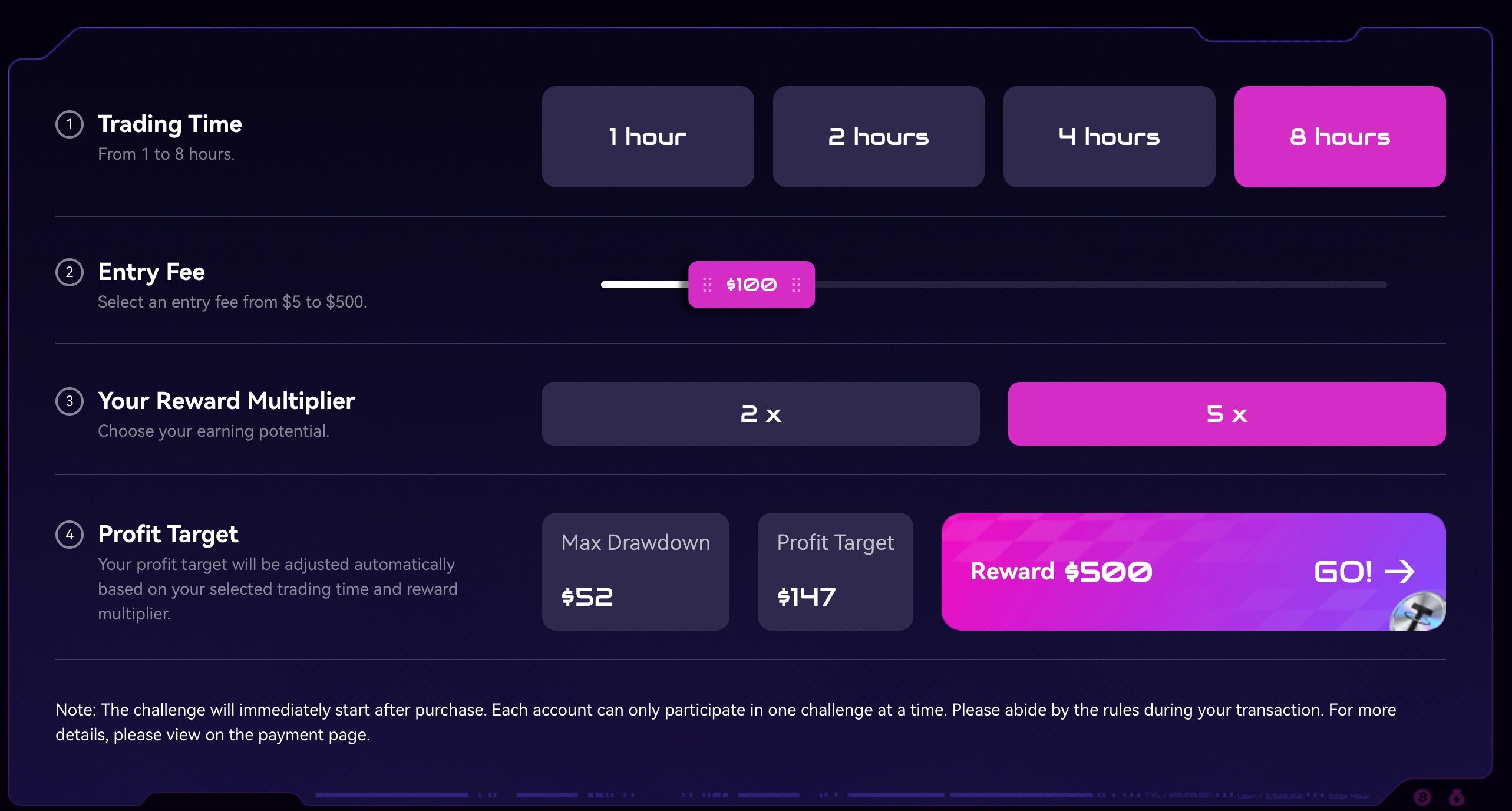
As shown in the figure above, when I selected an 8-hour challenge cycle, a $100 entry fee, and a 5x reward, Edge Hour automatically provided a profit target of $147 and a drawdown limit of $52. This means that if I succeed in the challenge, I can receive a $500 reward; if I fail, I only lose the $100 entry fee.

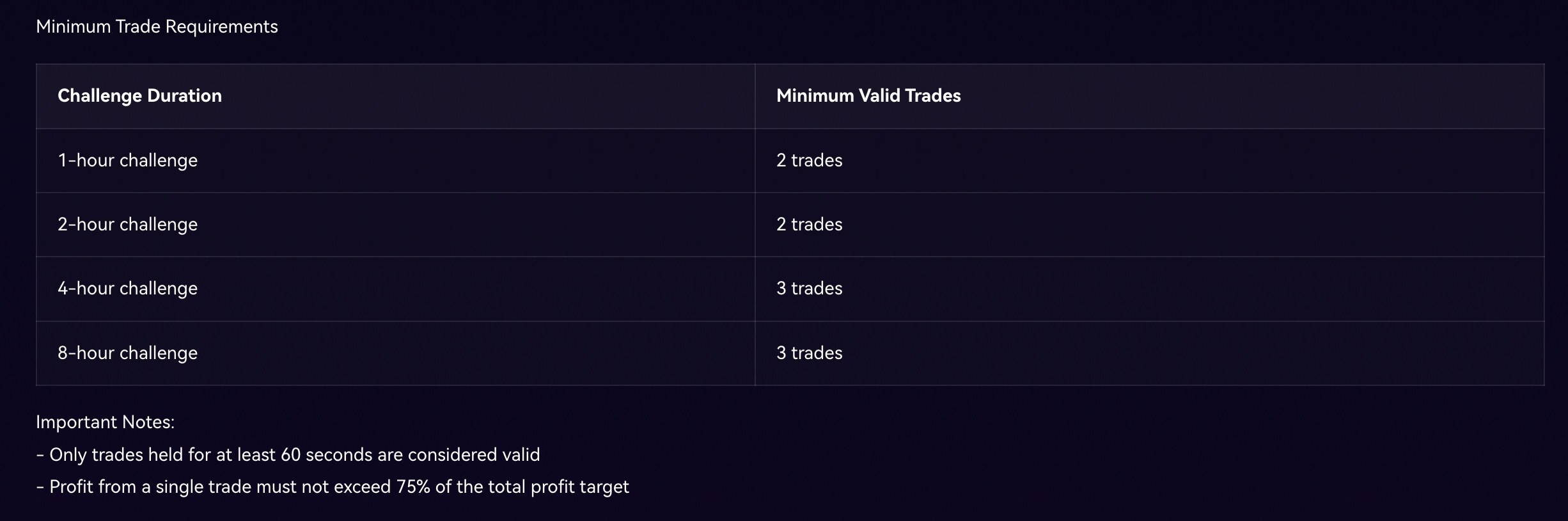
It is worth noting that to minimize speculative users and mere "luck-based" participants, Edge Hour requires users to hold each position for at least 60 seconds. Additionally, users with different challenge durations have different minimum trade requirements (as shown in the figure below), and the profit from a single trade cannot exceed 75% of the total profit target.
As for the reward mechanism, Edge Hour's challenges and settlements are executed publicly and transparently on-chain. After the challenge ends, rewards are directly distributed to the user's wallet, and all transaction records are verifiable.

Overall, the participation process and profit structure of Edge Hour are very clear—"Investment ➡️ Challenge ➡️ Success ➡️ Multiplier Returns." The logic is intuitive and full of competitive fun.

Six Core Advantages: Rewarding True Skill Players

Around Edge Hour, DeriW has designed the product across multiple dimensions to provide traders with a competitive environment where they can best demonstrate their trading abilities while ensuring fairness and transparency, and rewarding true "experts" with超额 rewards.

Specifically, Edge Hour's core advantages are reflected in the following six points.

  • Fair Competitive Environment: Edge Hour provides all participants with the same virtual trading capital of 10,000 USDT, eliminating unfair factors caused by differences in capital scale. Under this mechanism, victory or defeat is entirely determined by trading skills and risk control capabilities. Compared to traditional leaderboard-type trading competitions, large capital users no longer have a natural advantage, and small capital traders also have a fair chance to compete. At the same time, all transaction data is recorded on-chain and verifiable, further ensuring transparent and trustworthy results.
  • Low Barrier, High Return: Edge Hour lowers the participation barrier to an extremely low level, with a minimum participation fee of only 5 USDT. The user's risk is capped at the loss of the entry fee, but they can obtain reward multipliers of 2-10x. This structure allows traders to test strategies at a very low cost while having high profit potential, significantly reducing the barrier to entry.
  • Shorter Competition Cycles: Traditional trading competitions often suffer from long cycles and waiting times, while Edge Hour offers four challenge duration options: 1 hour, 2 hours, 4 hours, and 8 hours. Users can choose to participate based on their schedule and receive feedback within hours, greatly improving participation efficiency.
  • Focus on True Trading Ability: Edge Hour ensures that competition results are driven by genuine trading skills through multiple rules: each trade must be held for at least 60 seconds; single-trade profits cannot exceed 75% of the target; there are requirements for the minimum number of trades and maximum drawdown limits. These rules aim to avoid high-frequency scalping and one-time gambling behaviors, ensuring the challenge reflects complete trading strategies.
  • Social Referrals: Edge Hour supports participants inviting friends during the challenge. Inviters can receive additional rewards, while invitees can get time extensions and fee discounts, thereby driving ecosystem growth through social dissemination. This design combines trading competition with social referrals, enhancing user engagement.
  • Technical Guarantee: This is DeriW's real trump card. Edge Hour runs on DeriW Chain (a Layer3 network based on Arbitrum Orbit), featuring millisecond-level matching speed, zero Gas fees, high concurrency processing capacity (80,000 TPS), and on-chain transparent settlement, ensuring a smooth and fair challenge process.

Meeting Diverse Trading Needs, Filling Market Gaps

From a broader perspective, the launch of Edge Hour actually reflects the evolution of the Crypto trading ecosystem towards greater diversification.

In the early stages, Crypto trading mainly revolved around spot trading and long-term holdings. Subsequently, derivative tools such as perpetual contracts gradually became popular, and the market entered an era of high-frequency and leveraged trading. As the user structure changes, trading demands have further diversified—some pursue long-term investment, some prefer short-term volatility, and others hope to validate their strategic abilities in a fair competitive environment.

However, there is still a significant gap in the current market for such "trading skill verification" products. On one hand, traditional trading competitions are more inclined towards "capital scale competition." The leaderboard mechanism often gives large capital users a natural advantage, making it difficult for small capital traders with excellent strategies to stand out in long-cycle competitions. On the other hand, while Prop Trading Challenges emphasize skill assessment, their long cycles and complex rules make it difficult to meet the fast-paced nature of the Crypto market.

Edge Hour, however, carves out a new path between the two. By providing a unified starting point of 10,000 USDT in virtual capital, Edge Hour eliminates differences in capital scale, making trading skills the only variable. Through 1-8 hour challenge cycles, Edge Hour allows trading results to be quickly verified. The on-chain transparent settlement mechanism ensures the entire competition process is publicly verifiable and tamper-proof.

From this perspective, Edge Hour is not just a product feature innovation; it also introduces a new paradigm for trading competition in the Crypto market—participating at a low cost, completing challenges in a short time, and determining results based on trading ability rather than capital size.

The emergence of this model also signifies that the form of trading products is upgrading from "mere trading tools" to a comprehensive experience of "trading + competition + social interaction," and Edge Hour is a representative attempt under this trend.

A New Direction for Decentralized Trading

For DeriW, the launch of Edge Hour not only enriches its product matrix but also further strengthens its differentiated positioning in the decentralized derivatives track.

Over the past few years, competition among decentralized trading platforms has mainly revolved around liquidity, fees, and performance. As the market matures, user experience and product form innovation are becoming new dimensions of competition. In other words, whoever can provide a more engaging, fair, and entertaining trading environment is more likely to attract the new generation of trading users.

Against this backdrop, Edge Hour was born—it integrates trading skill verification, risk control training, and competitive experience, making trading no longer an isolated operational behavior but an interactive experience that can be participated in, compared, and shared. Industry trading demands will continue to细分, and user structures will keep evolving. Short-cycle, skill-oriented trading competition products like Edge Hour may become an important component of the next phase of the Crypto trading ecosystem, and DeriW will also use Edge Hour to accelerate its evolution from a "trading platform" to a "trading ecosystem."


İlgili Sorular

QWhat is the minimum entry fee for participating in DeriW's Edge Hour trading competition?

AThe minimum entry fee for DeriW's Edge Hour is 5 USDT.

QWhat are the four available challenge duration options in Edge Hour?

AThe four available duration options are 1 hour, 2 hours, 4 hours, and 8 hours.

QWhat is the purpose of the rule requiring a single position to be held for at least 60 seconds in Edge Hour?

AThis rule, along with others like limiting single trade profits to 75% of the target, is designed to prevent high-frequency scalping and gambling on a single trade, ensuring the challenge reflects genuine trading strategy and skill.

QOn which blockchain network does Edge Hour operate, and what are some of its key technical features?

AEdge Hour operates on DeriW Chain, a Layer3 network based on Arbitrum Orbit. Its key technical features include millisecond-level matching speed, zero Gas fees, high concurrent processing capacity (80,000 TPS), and on-chain transparent settlement.

QHow does Edge Hour create a fair competitive environment for all participants?

AEdge Hour provides all participants with the same 10,000 USDT in virtual trading capital, eliminating the unfair advantage of large capital. This ensures胜负 (victory or defeat) is determined solely by trading skill and risk control ability. All transaction data is recorded and verifiable on-chain, guaranteeing transparent and trustworthy results.

İlgili Okumalar

Understanding CPO (Co-Packaged Optics) in One Article: Why Nvidia Is Willing to Spend $3.2 Billion on a Fiber?

NVIDIA and Corning announced a multi-year strategic partnership on May 6, 2026, with NVIDIA committing up to $3.2 billion to support Corning's U.S. expansion. This investment will triple Corning's manufacturing plants and significantly boost its optical fiber and communications production capacity. The core driver behind this massive investment is the fundamental shift from copper to optical interconnect technology within AI data centers. As GPU clusters scale, copper wires face critical limitations: severe signal attenuation over distance, high energy consumption for signal integrity, and excessive heat generation. Optical fiber, transmitting light instead of electrical signals, solves these issues with minimal loss, near-light speed, and lower power needs. The article outlines a three-stage evolution of data center interconnect: 1. **Traditional Copper Interconnects:** The mainstream solution of the 2010s, now being phased out due to scaling bottlenecks. 2. **Pluggable Optical Modules:** The current mainstream, where modules convert electrical signals to light externally. This process still introduces energy loss and latency. 3. **CPO (Co-Packaged Optics):** The next-generation technology where the optical engine is integrated directly with the GPU chip package. This drastically reduces the electrical signal travel distance to mere millimeters, slashing power consumption and latency while boosting data density. NVIDIA CEO Jensen Huang has identified CPO as an essential core technology for AI infrastructure. NVIDIA's investment signifies a strategic shift from being a buyer to actively controlling its supply chain for critical components. With demand for specialized optical fiber far outstripping supply—evidenced by soaring prices—securing long-term manufacturing capacity has become a competitive necessity. While Corning's expansion may pressure some suppliers, a projected global fiber supply gap of 5-15% over the next few years creates a significant opportunity window, particularly for Chinese manufacturers competitive in optical preforms, chips, and modules. Ultimately, NVIDIA's move is not about chasing a trend but an engineering imperative. The transition to light-based interconnects like CPO is driven by the physical limits of copper, marking a definitive step in the ongoing AI computing revolution.

marsbit5 dk önce

Understanding CPO (Co-Packaged Optics) in One Article: Why Nvidia Is Willing to Spend $3.2 Billion on a Fiber?

marsbit5 dk önce

KOL's Perspective: Why Is SOL Set to Rise from This Point?

**Summary: Why SOL is Positioned for Growth at This Level** The article argues that SOL is poised for an upward move from its current price point, citing several key factors. Primarily, SOL has just broken out of a 4-month consolidation phase. This breakout signals a return of risk appetite to the broader crypto market, as SOL is seen as a key indicator of overall crypto health. The token's ownership has reportedly shifted from short-term traders and tourists to long-term accumulators, leading to low volume. Any meaningful increase in trading activity could thus trigger significant upward momentum. Fundamental strengths include strong institutional adoption, integration with DeFi and RWAs (Real-World Assets), and the potential benefits from the Clarity Act. Despite its high volatility—having dropped 70% from its all-time high but still up 12x from its bear market low—SOL is highlighted as one of the few tokens from the last cycle to reach new highs. It boasts a robust ecosystem of applications, users, and protocols. Future catalysts include the expected influx of AI developers following the Miami Accelerate conference, which focused on AI on Solana. Furthermore, Solana is positioned as the premier chain for memecoin activity, a trend expected to continue and drive network usage and fees. The article concludes that recent price action reflects a healthy transfer to long-term holders, setting the stage for growth.

marsbit55 dk önce

KOL's Perspective: Why Is SOL Set to Rise from This Point?

marsbit55 dk önce

Those Pre-Bitcoin PoW Protocols Have Recently Been Reimplemented

This article details a recent surge in replicating pre-Bitcoin Proof-of-Work (PoW) protocols, specifically focusing on Hal Finney's 2004 RPOW (Reusable Proofs of Work). Within five days in May 2026, multiple independent builders in the Bitcoin/cypherpunk community launched projects inspired by this early electronic cash proposal. The initiative began with Fred Krueger's `rpow2.com`, a centralized but auditable system that replaced RPOW's original IBM 4758 hardware with Ed25519 signatures. Initially a faithful replica, it later adopted Bitcoin-like features (21M supply cap, difficulty adjustment) and a controversial 5.24% founder allocation. This sparked rapid forks, including `rpow4.com` which incorporated full Bitcoin parameters, a prediction market (`rpowmarket.com`), and a DEX (`rpow2swap.com`). Concurrently, Mike In Space created a prototype of Wei Dai's 1998 b-money proposal (`b-money.replit.app`), pushing the historical exploration even further back. The article contrasts these centralized, server-dependent experiments with Bitcoin's core innovation of decentralized, trustless consensus. It also highlights a parallel development: the `HASH` project on Ethereum, which uses smart contract hooks to enable a purely fair-launch, browser-mineable PoW token with 0% allocations to team or VCs. The collective activity is framed as a meme-driven, educational exploration of cypherpunk history rather than a serious financial movement, with all projects heavily disclaiming any investment value.

marsbit1 saat önce

Those Pre-Bitcoin PoW Protocols Have Recently Been Reimplemented

marsbit1 saat önce

South Korean Exchanges 'Battle' Regulators, Challenging the Boundaries of Enforcement and Legislation

South Korea's cryptocurrency industry is engaged in a rare, direct confrontation with regulators. The Financial Intelligence Unit (FIU), the primary anti-money laundering (AML) watchdog, has recently imposed heavy penalties on major exchanges like Upbit and Bithumb for alleged violations involving unregistered overseas VASPs and AML procedures. However, exchanges are now actively challenging these actions in court and through industry associations. In a significant shift, the Seoul Administrative Court ruled in favor of Upbit's operator, Dunamu, overturning part of an FIU-ordered business suspension. The court found the FIU's penalty criteria and justification insufficiently clear. Similarly, the court suspended the enforcement of a six-month business suspension against Bithumb pending a final ruling, citing potential irreversible harm to the exchange. Beyond legal battles, the industry is contesting proposed legislative amendments. The Digital Asset eXchange Alliance (DAXA) strongly opposes a draft rule that would mandate Suspicious Transaction Reports (STRs) for all crypto transfers over 10 million KRW (~$6,800). DAXA argues this "poison pill" clause violates legal principles and would overwhelm the STR system, increasing reports from 63,000 to an estimated 5.45 million annually for major exchanges, thereby crippling effective AML monitoring. This conflict highlights a structural tension in South Korea's crypto governance: comprehensive digital asset laws are still developing, while regulators rely heavily on AML enforcement. The industry's move from passive compliance to active legal and legislative challenges signifies a new phase, pressing for clearer rules and more proportionate enforcement. While short-term disputes may intensify, this clash could ultimately lead to a more mature and sustainable regulatory framework for South Korea's vibrant crypto market.

marsbit1 saat önce

South Korean Exchanges 'Battle' Regulators, Challenging the Boundaries of Enforcement and Legislation

marsbit1 saat önce

İşlemler

Spot
Futures
活动图片




