Stargate Project Pivots: OpenAI Abandons Construction for Leasing, Wakes from 1.4 Trillion Compute Empire Dream

marsbit2026-03-17 tarihinde yayınlandı2026-03-17 tarihinde güncellendi

Özet

OpenAI has significantly restructured its ambitious Stargate project, shifting from a plan to build its own data centers to leasing computing power from cloud providers like Microsoft Azure, Oracle, and Amazon AWS. Initially announced in January 2025 with a projected investment of up to $1.4 trillion, the project's budget has been reduced by 57% to around $600 billion through 2030. The change comes after more than a year of delays, with no employees hired and no construction started, largely due to lenders' reluctance to finance the project given OpenAI’s ongoing substantial operating losses. The restructured Stargate is now organized into three teams overseeing commercial partnerships, technical engineering, and physical operations, all managed by former Intel executive Sachin Katti. Despite the shift in strategy, OpenAI still aims to deploy nearly 7 gigawatts of server capacity over three years, with investments totaling over $400 billion. The company is also developing its own AI chips in collaboration with Broadcom to reduce inference costs. Annual spending is projected to reach about $120 billion, matching Microsoft's yearly capital expenditure, even as OpenAI's revenue remains significantly lower and profitability is not expected before 2030.

1.4 trillion dollars. This was the total value of the Stargate computing blueprint presented by OpenAI CEO Sam Altman to investors at the end of 2025. Fourteen months later, that number has been slashed to 600 billion.

According to a March 16th report by The Information, OpenAI has significantly restructured the Stargate computing infrastructure project, abandoning plans to build its own data centers and fully shifting to leasing computing power from cloud service providers like Microsoft Azure, Oracle, and Amazon AWS. Stargate has been split into three functional teams, all managed by former Intel Chief Technology and AI Officer Sachin Katti.

The reason for the pivot is straightforward. Stargate was announced with great fanfare at the White House in January 2025, revealing a joint venture with SoftBank and Oracle to build large data centers, with an initial investment of $100 billion and a total investment of $500 billion over four years. However, more than a year after the project's launch, not a single employee had been hired, and no substantive development of a data center had begun. According to CNBC, lenders were unwilling to provide billions in construction financing to a company still reporting massive operating losses. OpenAI also recently withdrew from negotiations to expand the Oracle Stargate facility in Abilene, Texas.

Over a year, zero employees, zero construction started. The "build-it-ourselves" path for Stargate never truly began.
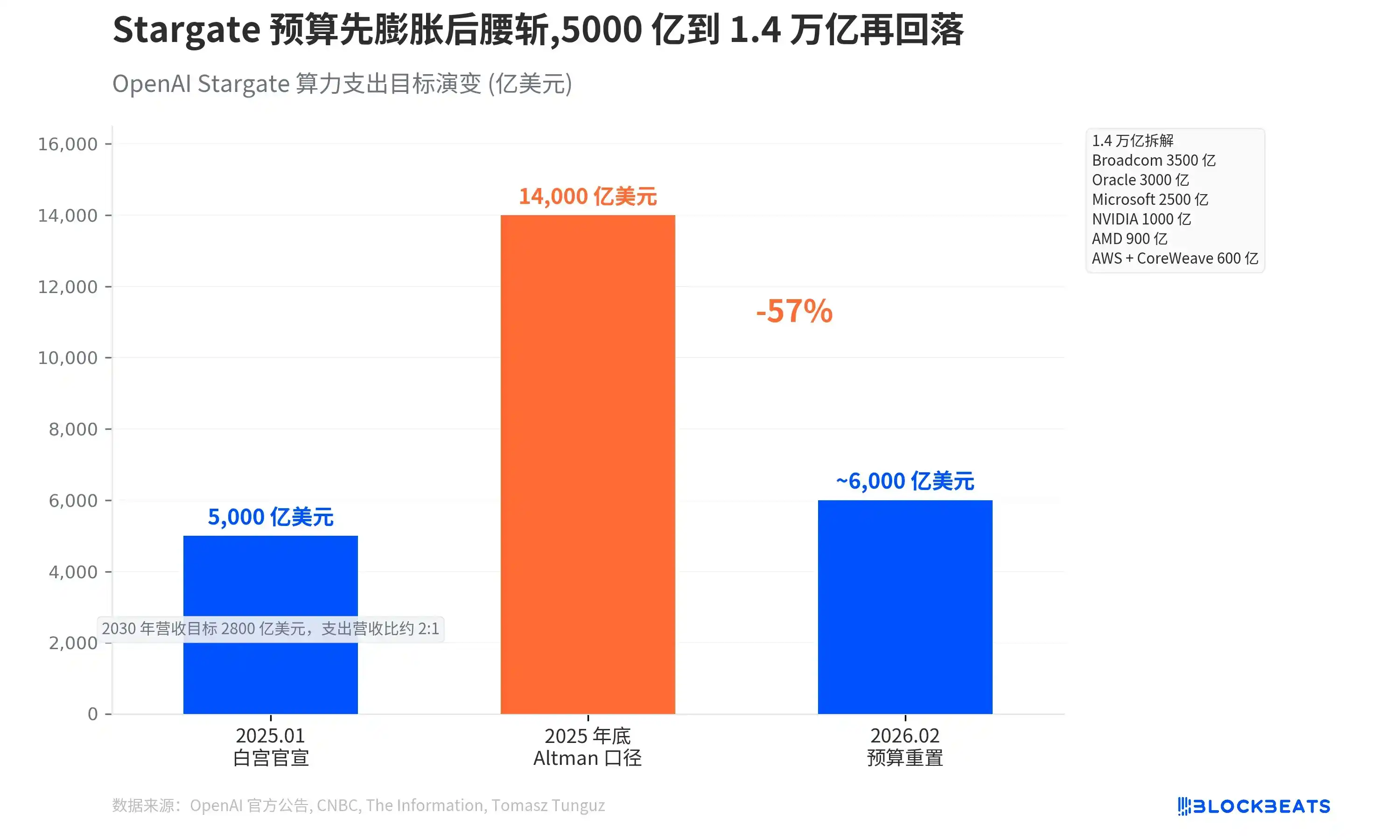
According to disassembled data from investor materials, the $1.4 trillion total commitment cited by Altman was distributed among seven suppliers. According to venture analyst Tomasz Tunguz's analysis of the investor materials, Broadcom accounted for $350 billion, Oracle $300 billion, Microsoft $250 billion, NVIDIA $100 billion, AMD $90 billion, with AWS and CoreWeave combining for $60 billion.

In February 2026, CNBC reported that this figure was reset to approximately $600 billion (by 2030), a 57% cut. The same report gave a slightly different but directionally consistent figure, with OpenAI expecting to spend $665 billion on cloud servers by 2030.

$600 billion is still a number that needs context. According to internal OpenAI forecasts, the company's revenue target for 2030 is $280 billion, meaning the cumulative spending-to-revenue ratio over five years is about 2:1. And according to internal financial data cited by ainvest, the company's projected loss for 2026 is $14 billion, with a gross margin of only 33% as reported by multiple media outlets (Note: Gross margin reflects the profitability of the product itself, while net loss is the final result after deducting all costs like R&D and management; the two can coexist).

Placing OpenAI's spending target within the panorama of the Big Tech computing arms race makes the proportions clearer.
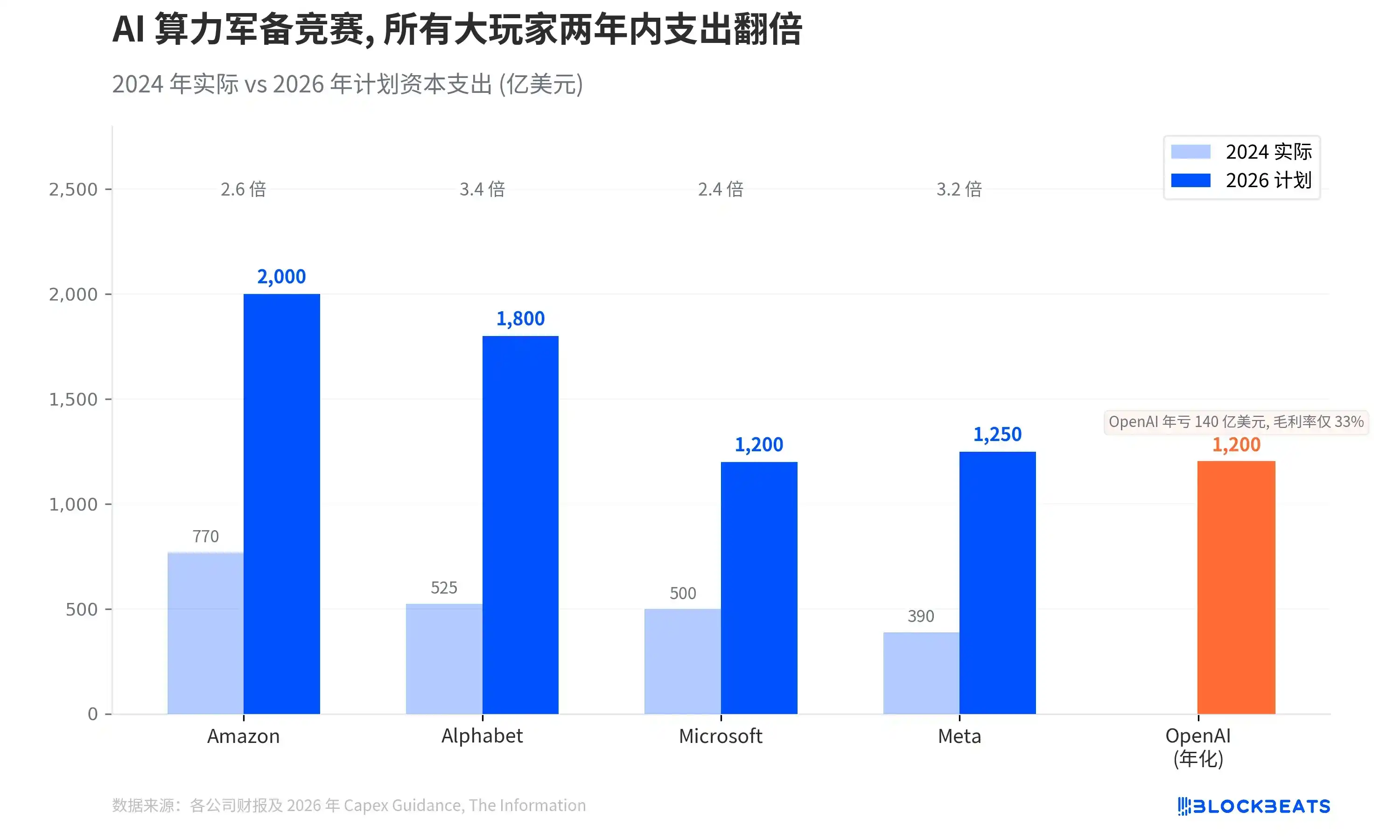
According to company financial reports and public Guidance, Amazon's planned capital expenditure for 2026 is $200 billion, Alphabet's is $180 billion, Meta's is $125 billion, and Microsoft's is approximately $120 billion. These four companies have seen their expenditures roughly double or triple within two years, totaling over $650 billion, with about three-quarters flowing into AI infrastructure.

OpenAI's $600 billion is a five-year cumulative target, annualized to about $120 billion, which is comparable to Microsoft's single-year capital expenditure. The difference is that Microsoft's annual revenue exceeds $240 billion, while OpenAI's annualized revenue has just reached $25 billion and is not expected to achieve positive cash flow before 2030.

The Stargate restructuring is more than just a change in budget numbers; the organizational adjustments reveal a deeper shift in direction.

The restructured Stargate is divided into three lines. The Epic business partnership group is led by longtime OpenAI employee and former Deloitte manager Peter Hoeschele, managing cloud contracts with Microsoft, Oracle, Amazon, and transactions with chip manufacturers. These deals include a multi-year contract with AMD (using up to 6 gigawatts of chips, costing up to 10% of AMD common stock) and an agreement with chip startup Cerebras Systems.
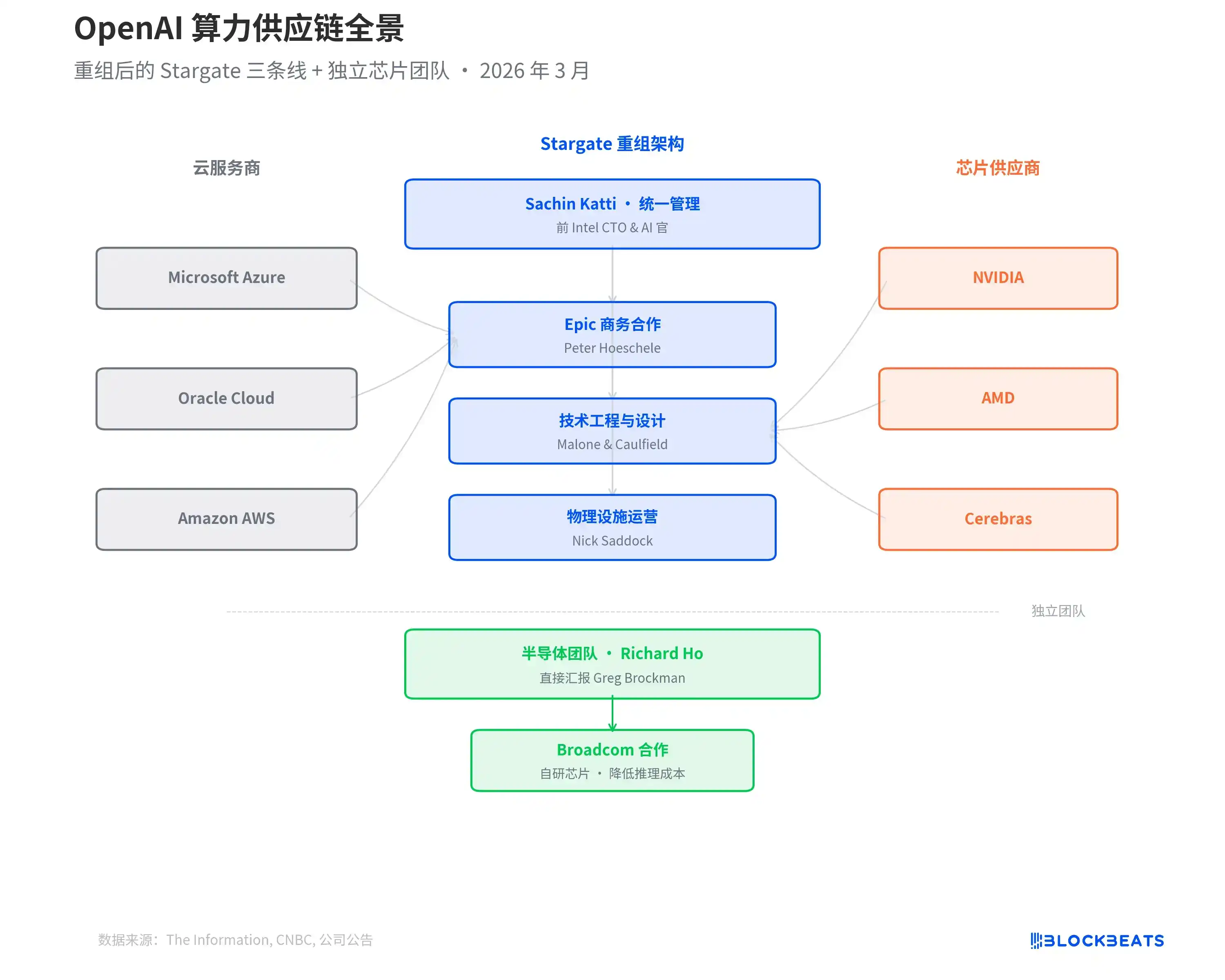
The technical engineering and design group is co-led by former Meta and Google engineer Chris Malone and former Microsoft engineering lead Adrian Caulfield, responsible for redesigning the AI server clusters used by OpenAI. The physical facilities operations group is led by former Google data center director Nick Saddock, replacing Keith Heyde who left weeks ago.

The semiconductor team led by former Google chip executive Richard Ho falls outside Katti's jurisdiction and reports directly to OpenAI President Greg Brockman. This team is collaborating with Broadcom to develop in-house chips, which OpenAI hopes will eventually reduce the inference costs of running products like ChatGPT.

The name "Stargate" remains, but what it refers to has completely changed. In January 2025, it was a joint venture with SoftBank and Oracle to build data centers. In March 2026, it is OpenAI's broad strategy for bringing gigawatt-scale server capacity online. It has gone from "I want to build my own power plant" to "I want to sign the best leases." The total planned capacity for all sites remains nearly 7 gigawatts, with a three-year investment total still exceeding $400 billion. OpenAI is shifting its computing direction towards NVIDIA's Vera Rubin platform, aiming to achieve the first gigawatt-scale capacity online in the second half of 2026.


İlgili Okumalar

7 Months After the Collapse of Huiwang, Southeast Asia's Escrow Platforms Undergo a Major Reshuffle

Following the collapse of Huione Pay—dubbed the "Alipay of Southeast Asia"—seven months ago, the region's underground financial guarantee platform sector is undergoing a significant reshuffle. This power vacuum has been swiftly filled by emerging platforms such as XinBi, Tiger/Navigator, JinBei (renamed JinBo), Dali/Tiancheng, and FullyLight. These platforms, operating largely via Telegram and offering services like escrow for illicit transactions, have absorbed the vast user base and markets left behind by Huione. While positioning themselves as "trust intermediaries," their primary clientele consists of networks involved in online scams, money laundering, illegal gambling, and even human trafficking. For instance, the Tiger/Navigator platform explicitly provides "escrow" services for kidnapping-for-ransom operations ("强押车交易"). Data underscores the immense scale: Huione alone processed over $103 billion in cryptocurrency payments and facilitated over $31 billion through its escrow market before its downfall, linking it to Cambodia's notorious Prince Group. Since its collapse, competitors have seen explosive growth. For example, the XinBi platform has accumulated over $1.6 billion in total USDT revenue, while platforms like NewPay, OkPay (under Dali), and FullyLight Wallet collectively processed over $4.8 billion in USDT in a single year. This ecosystem thrives in regions like Cambodia and Myanmar, where regulatory gaps allow these platforms to act as critical financial infrastructure for sprawling cybercrime industries, from scam compounds to online casinos. The article concludes that the moniker "Southeast Asian Alipay" is a misnomer, obscuring the platforms' fundamental role in enabling serious criminal enterprises rather than representing legitimate financial innovation.

Odaily星球日报37 dk önce

7 Months After the Collapse of Huiwang, Southeast Asia's Escrow Platforms Undergo a Major Reshuffle

Odaily星球日报37 dk önce

The Changing Landscape: What Are Crypto VCs Experiencing?

Title: The Shifting Landscape of Crypto Venture Capital The era of dedicated crypto venture capital funds is undergoing a significant transformation. Once essential for navigating the sector's complexity and high risk, these specialized funds are now facing an identity crisis as the market matures. This shift mirrors historical patterns in other specialized investment classes like cleantech and SPACs, where initial information advantages dissipate as technologies become mainstream and integrated into existing industry frameworks. The article argues that crypto is reaching a critical inflection point, transitioning from a "building phase" to an "integration phase." Major players like Stripe, BlackRock, and Visa now engage with crypto not for its novel mechanics but as a foundational financial infrastructure. Their needs—regulatory compliance, banking partnerships, distribution channels—align with traditional fintech, a domain easily understood by large, generalist funds like Sequoia and Founders Fund. This evolution creates a "barbell effect" within the VC landscape. On one end are massive, diversified platforms that can incorporate crypto as one vertical among many. On the other are small, nimble funds focused on niche, experimental projects. The middle ground—medium-sized dedicated crypto funds—is being squeezed out. Their typical fund size makes it impossible to generate sufficient returns solely from early-stage crypto bets, yet they cannot compete with giants for later-stage deals. Consequently, leading crypto-native firms like Paradigm and Framework Ventures are expanding into AI, robotics, and other sectors, driven partly by LP pressure for better returns amid a broader VC DPI crisis. Others, like Dragonfly and a16z, have narrowed their crypto focus predominantly to financial infrastructure like stablecoins, reframing the sector's core narrative. For crypto entrepreneurs, this consolidation presents challenges. While generalist funds offer larger checks and broader resources, crypto projects now compete fiercely with AI for attention and capital within these firms. Furthermore, the long-term, non-commercial foundational work that built the ecosystem—funded by dedicated crypto VCs—is less likely to attract generalist capital focused on direct returns. The conclusion is that "crypto investor" as a standalone category is becoming obsolete, akin to "internet investor." Crypto is becoming a baseline infrastructure layer. The future will see a barbell structure: large-scale growth financing handled by generalist funds, while pioneering, speculative projects are funded by small, specialized vehicles. The dedicated crypto funds of the 2017-2021 boom, which incubated core infrastructure, are giving way to this new, bifurcated reality.

Foresight News54 dk önce

The Changing Landscape: What Are Crypto VCs Experiencing?

Foresight News54 dk önce

As Consensus Accelerates, What Are Young Investors Betting On?

Title: As Consensus Forms Faster, What Are Young Investors Betting On? In the rapid evolution of tech investment, a new generation of young investors is navigating a landscape where AI, robotics, commercial aerospace, and quantum computing are advancing simultaneously. Traditional investment logic based on financial models is giving way to a need for deep technical understanding and the ability to act before industry consensus forms. An analysis of trends from the "WAIC FUTURE TECH" list of young investment leaders reveals key shifts in focus. The first major trend is the movement of AI from the digital screen into the physical world. Investment is shifting from large language models and chatbots towards embodied AI, robotics, AI hardware, and edge computing. While demonstrations generate excitement, the real challenge lies in achieving scalable, reliable, and cost-effective delivery in complex real-world environments like factories and logistics. Success depends not just on algorithms but on the integration of sensors, actuators, and control systems. Second, the competitive focus for large models is moving beyond raw capability toward building an "intelligence flywheel." The goal is to create self-reinforcing systems where user interaction generates data, improving the model, which in turn enhances the user experience and attracts more engagement. Companies that successfully embed AI into workflows to create these closed-loop systems can build lasting value that isn't easily erased by the next model upgrade. Third, facing a potential bottleneck in high-quality human-generated data, investors are looking at new underlying technologies. Reinforcement learning and self-play, as demonstrated by AlphaGo Zero, offer paths for AI to generate its own experience. Scientific foundation models, which aim to build general AI capabilities for fields like life sciences and materials discovery, represent a non-consensus direction that could unlock new frontiers of knowledge and data. Finally, in deep-tech areas like quantum computing, commercial aerospace, and space-based infrastructure, patient capital is essential. These fields have long, uncertain development and validation cycles involving complex engineering, supply chains, and regulations. Investment here requires a long-term view, focusing on foundational team capabilities and the eventual emergence of market demand, even if commercial returns are distant. Collectively, these trends illustrate how young investors are adapting to a new era. They are learning to make earlier, technically-informed judgments, balance hype with real-world viability, and provide the patient capital needed to build the deep-tech foundations of the future.

marsbit1 saat önce

As Consensus Accelerates, What Are Young Investors Betting On?

marsbit1 saat önce

İşlemler

Spot
活动图片



