Stargate Project Pivots: OpenAI Abandons Construction for Leasing, Wakes from 1.4 Trillion Compute Empire Dream

marsbit2026-03-17 tarihinde yayınlandı2026-03-17 tarihinde güncellendi

Özet

OpenAI has significantly restructured its ambitious Stargate project, shifting from a plan to build its own data centers to leasing computing power from cloud providers like Microsoft Azure, Oracle, and Amazon AWS. Initially announced in January 2025 with a projected investment of up to $1.4 trillion, the project's budget has been reduced by 57% to around $600 billion through 2030. The change comes after more than a year of delays, with no employees hired and no construction started, largely due to lenders' reluctance to finance the project given OpenAI’s ongoing substantial operating losses. The restructured Stargate is now organized into three teams overseeing commercial partnerships, technical engineering, and physical operations, all managed by former Intel executive Sachin Katti. Despite the shift in strategy, OpenAI still aims to deploy nearly 7 gigawatts of server capacity over three years, with investments totaling over $400 billion. The company is also developing its own AI chips in collaboration with Broadcom to reduce inference costs. Annual spending is projected to reach about $120 billion, matching Microsoft's yearly capital expenditure, even as OpenAI's revenue remains significantly lower and profitability is not expected before 2030.

1.4 trillion dollars. This was the total value of the Stargate computing blueprint presented by OpenAI CEO Sam Altman to investors at the end of 2025. Fourteen months later, that number has been slashed to 600 billion.

According to a March 16th report by The Information, OpenAI has significantly restructured the Stargate computing infrastructure project, abandoning plans to build its own data centers and fully shifting to leasing computing power from cloud service providers like Microsoft Azure, Oracle, and Amazon AWS. Stargate has been split into three functional teams, all managed by former Intel Chief Technology and AI Officer Sachin Katti.

The reason for the pivot is straightforward. Stargate was announced with great fanfare at the White House in January 2025, revealing a joint venture with SoftBank and Oracle to build large data centers, with an initial investment of $100 billion and a total investment of $500 billion over four years. However, more than a year after the project's launch, not a single employee had been hired, and no substantive development of a data center had begun. According to CNBC, lenders were unwilling to provide billions in construction financing to a company still reporting massive operating losses. OpenAI also recently withdrew from negotiations to expand the Oracle Stargate facility in Abilene, Texas.

Over a year, zero employees, zero construction started. The "build-it-ourselves" path for Stargate never truly began.
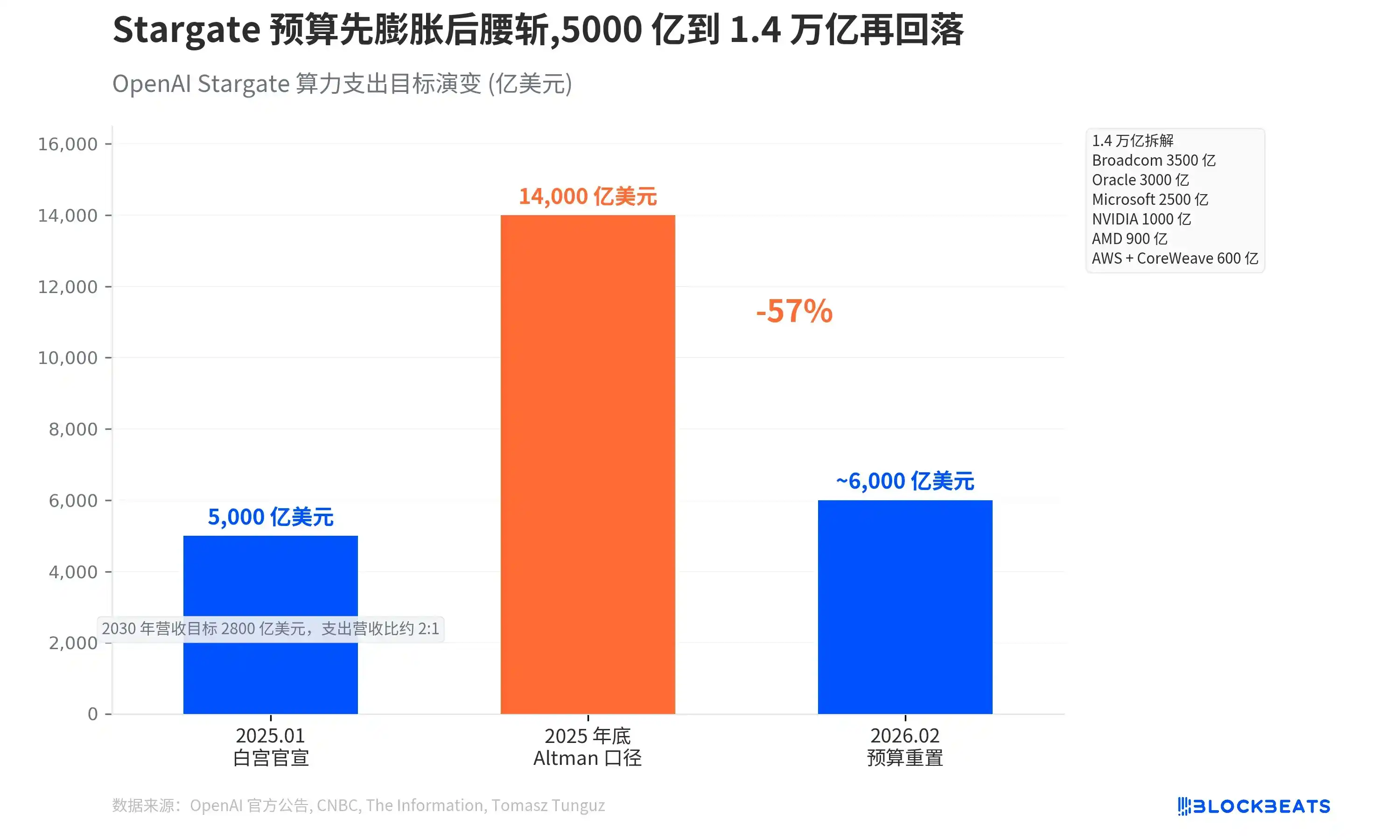
According to disassembled data from investor materials, the $1.4 trillion total commitment cited by Altman was distributed among seven suppliers. According to venture analyst Tomasz Tunguz's analysis of the investor materials, Broadcom accounted for $350 billion, Oracle $300 billion, Microsoft $250 billion, NVIDIA $100 billion, AMD $90 billion, with AWS and CoreWeave combining for $60 billion.

In February 2026, CNBC reported that this figure was reset to approximately $600 billion (by 2030), a 57% cut. The same report gave a slightly different but directionally consistent figure, with OpenAI expecting to spend $665 billion on cloud servers by 2030.

$600 billion is still a number that needs context. According to internal OpenAI forecasts, the company's revenue target for 2030 is $280 billion, meaning the cumulative spending-to-revenue ratio over five years is about 2:1. And according to internal financial data cited by ainvest, the company's projected loss for 2026 is $14 billion, with a gross margin of only 33% as reported by multiple media outlets (Note: Gross margin reflects the profitability of the product itself, while net loss is the final result after deducting all costs like R&D and management; the two can coexist).

Placing OpenAI's spending target within the panorama of the Big Tech computing arms race makes the proportions clearer.
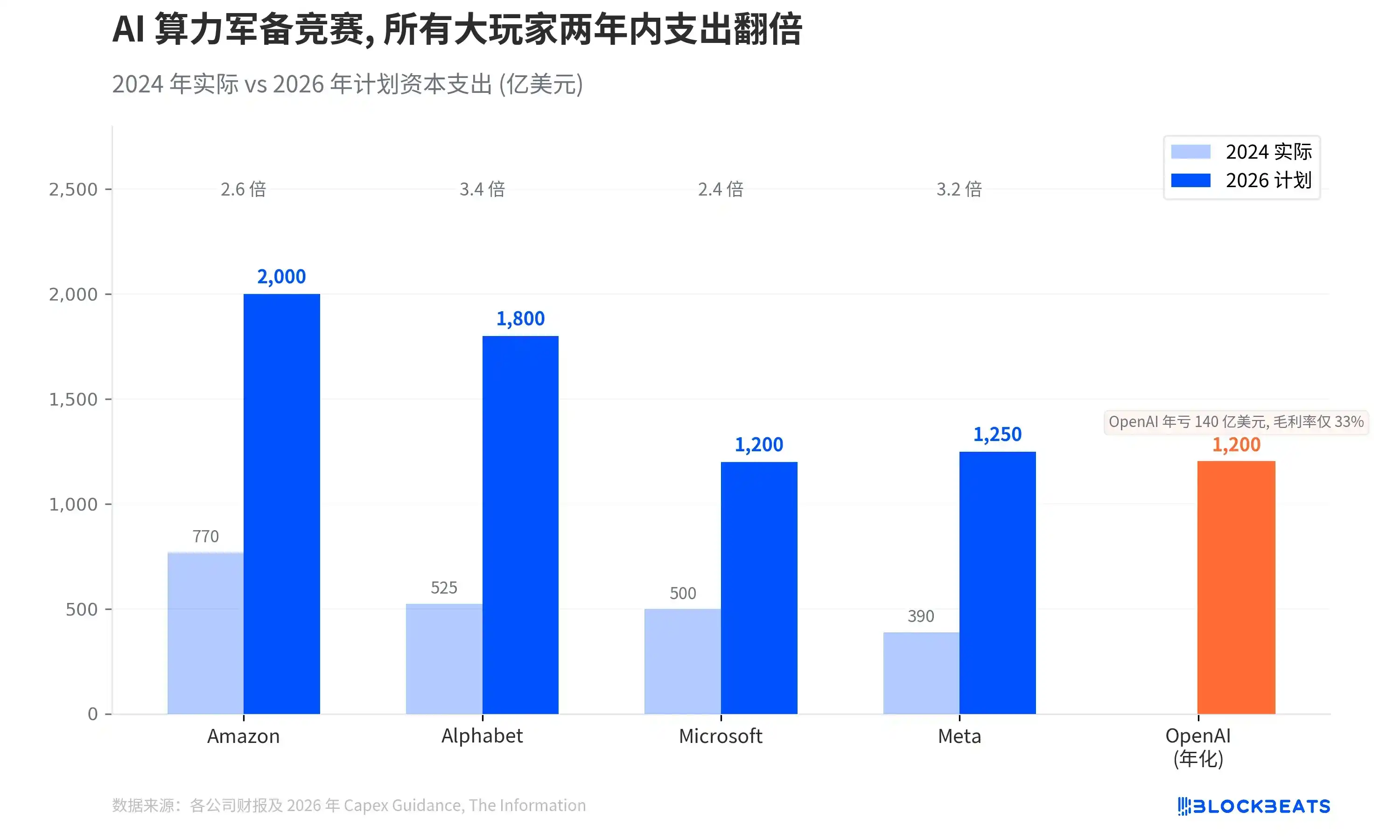
According to company financial reports and public Guidance, Amazon's planned capital expenditure for 2026 is $200 billion, Alphabet's is $180 billion, Meta's is $125 billion, and Microsoft's is approximately $120 billion. These four companies have seen their expenditures roughly double or triple within two years, totaling over $650 billion, with about three-quarters flowing into AI infrastructure.

OpenAI's $600 billion is a five-year cumulative target, annualized to about $120 billion, which is comparable to Microsoft's single-year capital expenditure. The difference is that Microsoft's annual revenue exceeds $240 billion, while OpenAI's annualized revenue has just reached $25 billion and is not expected to achieve positive cash flow before 2030.

The Stargate restructuring is more than just a change in budget numbers; the organizational adjustments reveal a deeper shift in direction.

The restructured Stargate is divided into three lines. The Epic business partnership group is led by longtime OpenAI employee and former Deloitte manager Peter Hoeschele, managing cloud contracts with Microsoft, Oracle, Amazon, and transactions with chip manufacturers. These deals include a multi-year contract with AMD (using up to 6 gigawatts of chips, costing up to 10% of AMD common stock) and an agreement with chip startup Cerebras Systems.
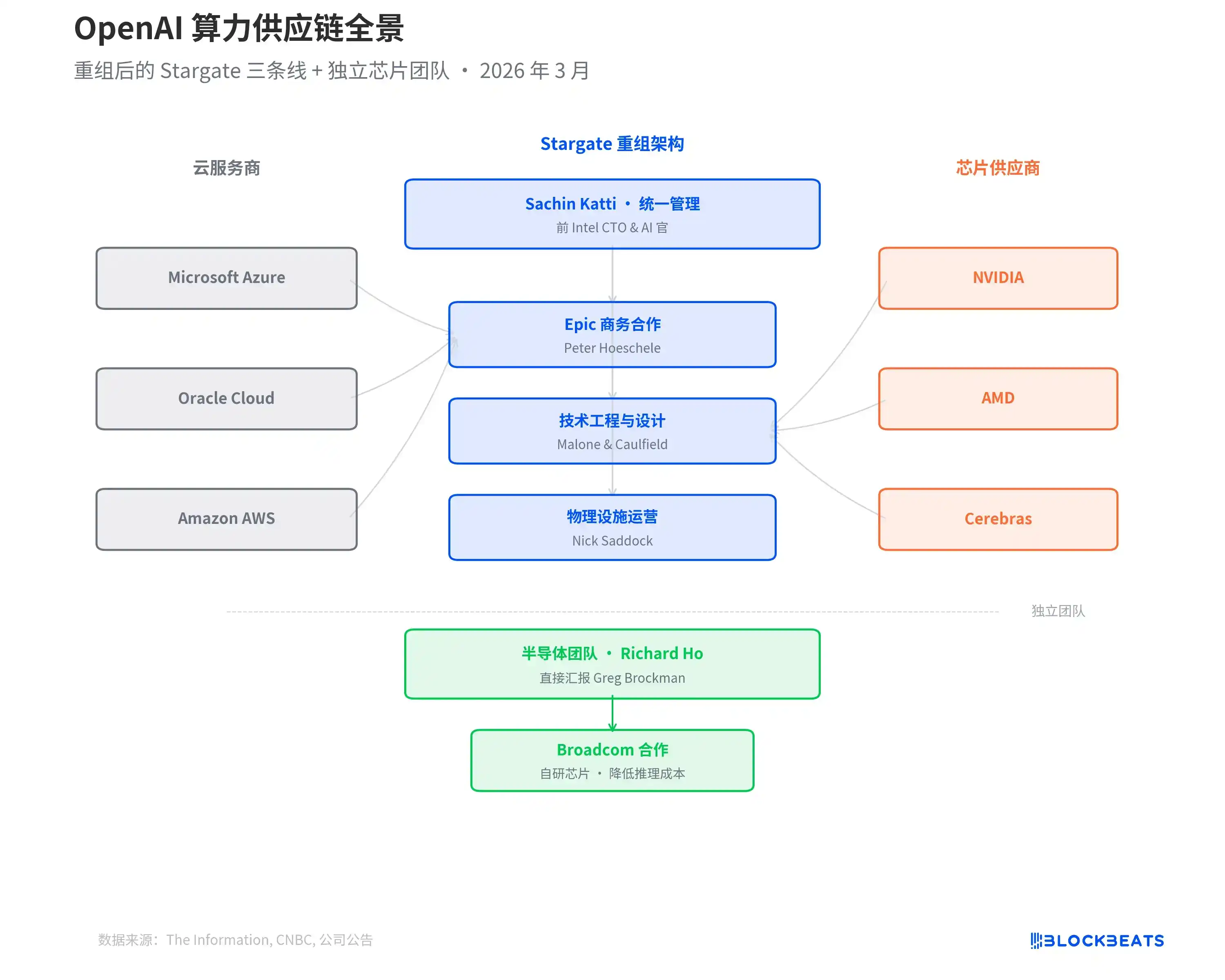
The technical engineering and design group is co-led by former Meta and Google engineer Chris Malone and former Microsoft engineering lead Adrian Caulfield, responsible for redesigning the AI server clusters used by OpenAI. The physical facilities operations group is led by former Google data center director Nick Saddock, replacing Keith Heyde who left weeks ago.

The semiconductor team led by former Google chip executive Richard Ho falls outside Katti's jurisdiction and reports directly to OpenAI President Greg Brockman. This team is collaborating with Broadcom to develop in-house chips, which OpenAI hopes will eventually reduce the inference costs of running products like ChatGPT.

The name "Stargate" remains, but what it refers to has completely changed. In January 2025, it was a joint venture with SoftBank and Oracle to build data centers. In March 2026, it is OpenAI's broad strategy for bringing gigawatt-scale server capacity online. It has gone from "I want to build my own power plant" to "I want to sign the best leases." The total planned capacity for all sites remains nearly 7 gigawatts, with a three-year investment total still exceeding $400 billion. OpenAI is shifting its computing direction towards NVIDIA's Vera Rubin platform, aiming to achieve the first gigawatt-scale capacity online in the second half of 2026.


İlgili Okumalar

The Value Distribution of Stablecoins

**Summary: The Value Distribution of Stablecoins** The article argues that stablecoins are evolving from mere trading tools into broader channels for dollar access. It divides the stablecoin ecosystem into four layers to analyze how value is distributed: 1. **Issuance Layer:** Mints stablecoins, holds reserve assets, and captures the spread between reserve yield and user costs (e.g., Tether, Circle). This layer currently earns the largest profit margin. 2. **Infrastructure Layer:** Connects stablecoins to the traditional financial system, handling fiat on/off-ramps, banking integration, compliance (KYC/AML), and asset management (e.g., Bridge, BVNK). This is the "unglamorous" but critical work, building the essential bridges between crypto and real-world finance. 3. **Acquiring/Distribution Layer:** Integrates stablecoins into merchant systems, manages payment flows, and provides enterprise financial software (e.g., Stripe, Coinbase). They act as the access point for businesses. 4. **Application Layer:** The end-users and businesses that ultimately use stablecoins for payments, settlements, or as a store of value. They benefit from convenience but have little pricing power. The core thesis is that while the issuance layer currently dominates profits, the often-overlooked **infrastructure layer holds significant long-term potential**. The real challenge and barrier to mass adoption is not the on-chain transfer of stablecoins (which is simple), but the complex "last mile" integration into existing business workflows, banking systems, and regulatory frameworks across different countries. Companies in this layer are currently in a "land grab" phase, investing heavily to build networks, secure bank partnerships, and establish compliance pathways. While their position is currently pressured by the profitable issuers above and distribution platforms below, the article suggests that if stablecoins become a default financial rail for businesses, the infrastructure providers who have done the hard work of integration will ultimately gain strong pricing power and become entrenched, essential players.

marsbit5 saat önce

The Value Distribution of Stablecoins

marsbit5 saat önce

The Value Distribution of Stablecoins

The Value Distribution of Stablecoins The article argues that stablecoins are evolving from a mere trading tool into a broad "dollar channel." It analyzes the industry's value chain through four layers: 1. **Issuance Layer (e.g., Tether, Circle):** The top layer that mints stablecoins, holds reserve assets, and captures the thickest interest rate spread. 2. **Infrastructure Layer (e.g., Bridge, BVNK):** Connects stablecoins to the traditional financial system, handling critical but complex "dirty work" like fiat on/off-ramps, banking integration, compliance (KYC/AML), and cross-border settlement. 3. **Acquiring/Distribution Layer (e.g., Stripe, Coinbase):** Embeds stablecoins into merchant systems, manages payment flows, and integrates with enterprise software. 4. **Application Layer:** End-users and businesses that ultimately use stablecoins for payments, settlement, or storing value. The author posits that while the issuance layer currently captures the most profit, the most overlooked and potentially critical layer is infrastructure. The core challenge for stablecoin adoption isn't the on-chain transfer (which is simple), but bridging the gap between blockchain and the real-world financial system. This involves solving practical problems for businesses: fiat conversion, reconciliation, tax handling, and user onboarding. Infrastructure companies are currently in a difficult "land-grab" phase—building networks, securing banking relationships, and achieving compliance country-by-country. They face pressure from both the profitable issuance layer above and distribution platforms below. However, the author suggests this layer is building a crucial moat. Once stablecoins become a default business rail, the infrastructure players who have done the hard work of integration may gain significant, durable value and pricing power.

链捕手5 saat önce

The Value Distribution of Stablecoins

链捕手5 saat önce

How to Do Research Well: Deliberately Practice the Real Skills That Matter

No one truly teaches you how to do research. You're often given a desk, a pre-selected problem, and vague instructions to "create something new." Consequently, many people reverse-engineer the job based on visible outputs—papers, posts, announcements—learning only how to *appear* like a researcher rather than how to *become* one. True research capability is built from stacking small, trainable skills, nearly all of which can be developed through deliberate practice. **Pick Your Own Problem:** Most researchers absorb problems from advisors or trends, lacking the underlying reasoning. Choosing a problem you genuinely care about, as John Schulman advises, leads to original work. Develop "taste" like a muscle: predict experiment outcomes, guess paper results from methods, and track which findings remain important over time. **Upgrade Your Inputs:** Relying on shared reading lists (arXiv hot lists, filtered group chats) leads to unoriginal conclusions. Undervalued old literature often holds crucial insights (e.g., MoE, LSTM, backpropagation). Richard Sutton's "The Bitter Lesson" or Claude Shannon's 1952 talk on creative thinking are more predictive than lengthy modern surveys. Breadth matters as much as depth: draw from neuroscience, mechanism design, hardware knowledge, and honest statistics. Read papers directly, especially appendices and limitations sections. **Write Everything Down:** As Paul Graham noted, writing exposes flaws in seemingly mature ideas. Writing is the cheapest defense against self-deception. Following Feynman's principle, Darwin programmatically wrote down facts contradicting his theory to combat memory bias. Maintain a detailed log of hypotheses, setups, predictions, results, and updated understandings. Reviewing past logs fosters essential humility.

marsbit7 saat önce

How to Do Research Well: Deliberately Practice the Real Skills That Matter

marsbit7 saat önce

İşlemler

Spot
Futures
活动图片