Staking 'Net Outflow' Ends: Can Ethereum Achieve a Strong Breakthrough?

marsbit2025-12-30 tarihinde yayınlandı2025-12-30 tarihinde güncellendi

Özet

By the end of 2025, the Ethereum network has reached a pivotal moment: the validator entry queue has surpassed the exit queue for the first time in months. This reversal indicates that more capital is seeking to stake ETH than to unstake, signaling a potential shift in market sentiment and underlying network strength. Currently, approximately 739,824 ETH are waiting to enter the staking queue, with an estimated wait time of nearly 13 days, while only 349,867 ETH are in the exit queue, requiring about 6 days to process. Total ETH staked stands at around 35.5 million, accounting for 29.27% of the total supply, with over 983,600 active validators. This change reflects reduced selling pressure and suggests growing confidence among institutional players. Key drivers include large staking moves by treasury firms like BitMine, which staked over 342,560 ETH in late December, and SharpLink, which has staked nearly all of its ETH. The Pectra upgrade—implemented in May 2025—also improved staking efficiency by raising the maximum validator balance and enabling reward compounding. Additionally, the deleveraging process in DeFi, which previously caused significant exit pressure, appears to be nearing its end. While challenges remain and the sustainability of this trend is yet to be confirmed, the shift toward net staking inflow marks a possible turning point for Ethereum’s security and capital accumulation cycle heading into 2026.

As 2025 draws to a close, the Ethereum network has reached a critical turning point: the validator "entry queue" has reversed and surpassed the "exit queue."

This means that, after months of market turbulence, the amount of capital attempting to stake Ethereum and become validators has far exceeded the amount seeking to unstake and exit.

This shift is more than just a numerical change—it is a barometer of market sentiment and network fundamentals. It signals that the sustained selling pressure of recent months is gradually easing and indicates that, driven by factors such as the return of institutional confidence, optimizations from the Pectra upgrade, and the clearing of DeFi leverage, the Ethereum network is entering a new cycle of enhanced security and capital accumulation.

Reversal of Ethereum Validator Queues

According to the latest data from Ethereum Validator Queue, approximately 739,824 ETH is currently queued to enter the network, with an estimated wait time of 12 days and 20 hours. The exit queue holds only 349,867 ETH, which would take about 6 days to clear.
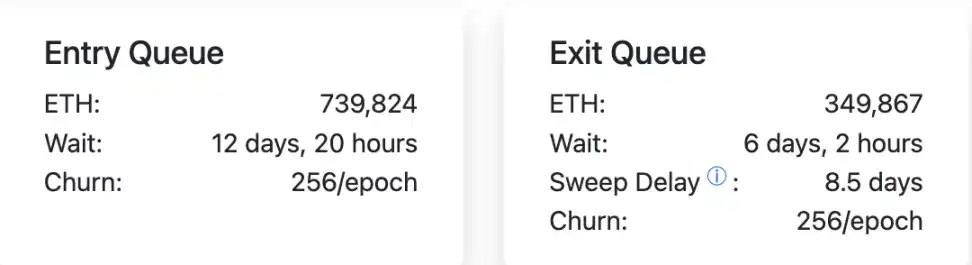
Additionally, the total amount of ETH staked is currently around 35.5 million, accounting for 29.27% of the total supply, with the number of active validators reaching 983,600.
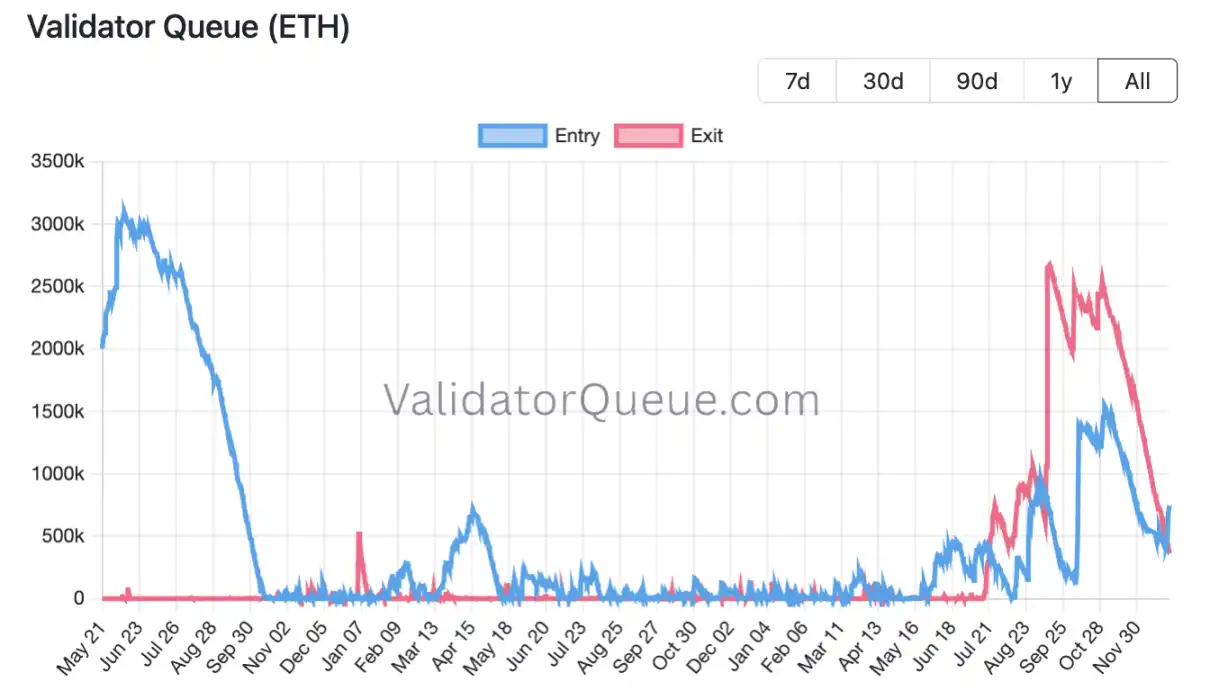
What is the Validator Queue? Why is it Important?

Under Ethereum's Proof-of-Stake (PoS) mechanism, to ensure consensus stability, the protocol stipulates that nodes cannot join or leave at will. Instead, it regulates this through a "Churn Limit" mechanism.

Currently, the maximum number of validators that can be activated or exited per epoch (approximately 6 minutes and 24 seconds) is set at 256 ETH, equivalent to a daily processing capacity of about 57,600 ETH.

· Entry Queue: The queuing channel for staking 32 ETH to apply to become a validator. Growth in this queue indicates strong staking demand and long-term bullish sentiment.

· Exit Queue: The queuing channel for applying to withdraw funds. Growth in this queue typically signals selling pressure, liquidity needs, or deleveraging activities.

Therefore, the validator queue is not only an indicator of network health but also a barometer of market sentiment.

How Did the Validator Queue Change in 2025?

Throughout 2025, the Ethereum validator queue experienced significant fluctuations:

· First half to Autumn: The exit queue repeatedly reached record highs, primarily due to institutional rotation, profit-taking, DeFi deleveraging (e.g., soaring Aave lending rates triggering the unwinding of stETH looped borrowing positions), and isolated security incidents (such as Kiln exiting all its validator nodes in September).

· Mid-September: The exit queue peaked at 2.67 million ETH, with a waiting time of up to 46 days at that point.

· September-October: The "entry queue" briefly surpassed the exit queue but was later dominated by the "exit queue" again.

· November: The "entry queue" grew again to over 1.5 million ETH, but the "exit queue" once reached over 2.5 million ETH.

· End of December: The "entry queue" reversed the trend. Currently, approximately 739,824 ETH is queued to enter the network, while only 349,867 ETH is in the exit queue.

Four Core Drivers Behind the December Reversal

This reversal is not accidental but the result of the combined effect of capital, technology, and the macro environment:

Large-Scale Staking by Treasury Companies like BitMine

Just two days before the reversal occurred (December 25-27), BitMine staked a cumulative 342,560 ETH (approximately $1 billion), directly pushing the queue to reverse.

Furthermore, BitMine had previously stated its plan to launch dedicated staking infrastructure—the Made in America Validator Network (MAVAN)—in the first quarter of 2026, demonstrating its long-term commitment to the Ethereum staking ecosystem.

Simultaneously, another leading treasury company, SharpLink, has staked nearly 100% of its ETH holdings, further adding momentum to the capital inflow.

Although the crypto treasury sector currently faces severe challenges, with some institutions slowing their ETH accumulation pace or even seeing cases like ETHZilla reducing holdings for cash, the significant moves by key players like BitMine and SharpLink have largely stabilized the fundamental landscape of Ethereum staking.

Pectra Upgrade Optimizes Staking Experience

The Pectra upgrade implemented in May 2025 introduced key improvements via EIP-7251: increasing the maximum effective validator balance from 32 ETH to 2048 ETH and enabling reward compounding and validator consolidation. This reduces the operational costs for institutions managing thousands of validator nodes, providing technical convenience for large capital entry.

Kiln's Restaking Reopening

Kiln exited validators on a large scale following a security incident in September 2025. Although it's unclear exactly when Kiln resumed staking, according to Beaconcha.in data, Kiln currently holds a 1.68% share in the Ethereum staking ecosystem.

DeFi Deleveraging Nearing Completion

Previously, in June and July, rising lending rates on Aave forced the unwinding of stETH looped strategies, triggering阶段性 selling pressure. Recently, as the deleveraging process has largely cleared, related exit demand has gradually subsided, allowing market inflow demand to dominate.

Some Institutions Buying the Dip

The market has been adjusting for many days, and some institutions are bullish on ETH's long-term value. Trend Research is preparing to use $1 billion to continue accumulating ETH. On December 25th, Ai Yi confirmed with Jack Yi himself that the actual cost basis for the 645,000 ETH accumulated by Jack Yi's Trend Research since November is around $3,150, meaning the current floating loss on the holding is approximately $143 million. After the subsequent $1 billion investment, the expected average cost of ETH is projected to be controlled at around $3,050.

Summary

The reversal of the Ethereum validator "entry queue" surpassing the "exit queue" marks the initial formation of a net staking inflow-dominated格局 for the first time since July. This change is far more than a mere numerical crossover; it is a crucial signal of rebuilding market confidence. Of course, whether this leading trend can be sustained and solidified remains to be tested by time.

Although Ethereum spot ETFs have not yet shown significant net inflows, the improvement in on-chain fundamentals is evident. As SharpLink Gaming Co-CEO Joseph Chalom stated this month, the surge in stablecoins, tokenized RWA, and growing interest from sovereign wealth funds could potentially drive Ethereum's TVL to grow 10-fold in 2026.

Standing at the tail end of 2025, is Ethereum ready to gather momentum for a breakthrough in 2026? The answer will be revealed in time.


İlgili Sorular

QWhat does the reversal of the validator queues on the Ethereum network signify?

AThe reversal, where the entry queue surpasses the exit queue, signifies a key shift in market sentiment and network fundamentals. It indicates that the selling pressure from the past few months is easing and that the network is entering a new cycle of enhanced security and capital accumulation, driven by factors like returning institutional confidence, the Pectra upgrade, and the clearing of DeFi leverage.

QWhat are the 'Entry Queue' and 'Exit Queue' in Ethereum's Proof-of-Stake mechanism?

AThe 'Entry Queue' is the waiting channel for staking 32 ETH to apply to become a validator. Its growth indicates strong staking and long-term confidence. The 'Exit Queue' is the channel for validators to apply to withdraw their funds. Its growth typically signals selling pressure, liquidity needs, or deleveraging activity. Both are managed by a 'Churn Limit' to ensure consensus stability.

QWhat was a major driver behind the validator queue reversal in December?

AA major driver was the large-scale staking by treasury companies, particularly BitMine's accumulation of 342,560 ETH (approx. $1 billion) on December 25-27, which directly pushed the entry queue to overtake the exit queue. This was part of their long-term strategy, including plans to launch a dedicated staking infrastructure network (MAVAN) in Q1 2026.

QHow did the Pectra upgrade contribute to the change in Ethereum's staking dynamics?

AThe Pectra upgrade, implemented in May 2025, introduced EIP-7251, which increased the maximum effective validator balance from 32 ETH to 2048 ETH and enabled reward compounding and validator consolidation. This significantly reduced the operational costs for large institutions managing thousands of validator nodes, making it easier for substantial capital to enter the staking ecosystem.

QWhat does the current state of the validator queues suggest about the future of Ethereum's Total Value Locked (TVL)?

AThe shift to net staking inflows, as indicated by the queue reversal, suggests an improvement in on-chain fundamentals. While spot ETF inflows are not yet significant, industry leaders like Joseph Chalom of SharpLink speculate that the surge in stablecoins, tokenized RWA, and growing interest from sovereign wealth funds could potentially drive Ethereum's TVL to grow 10x in 2026.

İlgili Okumalar

Google and Amazon Simultaneously Invest Heavily in a Competitor: The Most Absurd Business Logic of the AI Era Is Becoming Reality

In a span of four days, Amazon announced an additional $25 billion investment, and Google pledged up to $40 billion—both direct competitors pouring over $65 billion into the same AI startup, Anthropic. Rather than a typical venture capital move, this signals the latest escalation in the cloud wars. The core of the deal is not equity but compute pre-orders: Anthropic must spend the majority of these funds on AWS and Google Cloud services and chips, effectively locking in massive future compute consumption. This reflects a shift in cloud market dynamics—enterprises now choose cloud providers based on which hosts the best AI models, not just price or stability. With OpenAI deeply tied to Microsoft, Anthropic’s Claude has become the only viable strategic asset for Google and Amazon to remain competitive. Anthropic’s annualized revenue has surged to $30 billion, and it is expanding into verticals like biotech, positioning itself as a cross-industry AI infrastructure layer. However, this funding comes with constraints: Anthropic’s independence is challenged as it balances two rival investors, its safety-first narrative faces pressure from regulatory scrutiny, and its path to IPO introduces new financial pressures. Globally, this accelerates a "tri-polar" closed-loop structure in AI infrastructure, with Microsoft-OpenAI, Google-Anthropic, and Amazon-Anthropic forming exclusive model-cloud alliances. In contrast, China’s landscape differs—investments like Alibaba and Tencent backing open-source model firm DeepSeek reflect a more decoupled approach, though closed-source models from major cloud providers still dominate. The $65 billion bet is ultimately about securing a seat at the table in an AI-defined future—where missing the model layer means losing the cloud war.

marsbit4 saat önce

Google and Amazon Simultaneously Invest Heavily in a Competitor: The Most Absurd Business Logic of the AI Era Is Becoming Reality

marsbit4 saat önce

Computing Power Constrained, Why Did DeepSeek-V4 Open Source?

DeepSeek-V4 has been released as a preview open-source model, featuring 1 million tokens of context length as a baseline capability—previously a premium feature locked behind enterprise paywalls by major overseas AI firms. The official announcement, however, openly acknowledges computational constraints, particularly limited service throughput for the high-end DeepSeek-V4-Pro version due to restricted high-end computing power. Rather than competing on pure scale, DeepSeek adopts a pragmatic approach that balances algorithmic innovation with hardware realities in China’s AI ecosystem. The V4-Pro model uses a highly sparse architecture with 1.6T total parameters but only activates 49B during inference. It performs strongly in agentic coding, knowledge-intensive tasks, and STEM reasoning, competing closely with top-tier closed models like Gemini Pro 3.1 and Claude Opus 4.6 in certain scenarios. A key strategic product is the Flash edition, with 284B total parameters but only 13B activated—making it cost-effective and accessible for mid- and low-tier hardware, including domestic AI chips from Huawei (Ascend), Cambricon, and Hygon. This design supports broader adoption across developers and SMEs while stimulating China's domestic semiconductor ecosystem. Despite facing talent outflow and intense competition in user traffic—with rivals like Doubao and Qianwen leading in monthly active users—DeepSeek has maintained technical momentum. The release also comes amid reports of a new funding round targeting a valuation exceeding $10 billion, potentially setting a new record in China’s LLM sector. Ultimately, DeepSeek-V4 represents a shift toward open yet realistic infrastructure development in the constrained compute landscape of Chinese AI, emphasizing engineering efficiency and domestic hardware compatibility over pure model scale.

marsbit5 saat önce

Computing Power Constrained, Why Did DeepSeek-V4 Open Source?

marsbit5 saat önce

İşlemler

Spot
Futures

Popüler Makaleler

WL Nedir

I. Proje TanıtımıWorldLand, Ethereum ekosistemini geliştirmek için tasarlanmış, Ethereum'un L2 veya yan zinciridir.II. Token Bilgileri1) Temel BilgilerToken adı: WL (WorldLand)III. İlgili BağlantılarWeb sitesi:https://worldland.foundation/Keşif Araçları:https://bscscan.com/address/0x8aaB31fbc69C92fa53f600910Cf0f215531F8239Sosyal Medya:https://x.com/WorldLand_space Not: Proje tanıtımı, resmi proje ekibi tarafından yayımlanan veya sağlanan materyallerden gelmektedir, yalnızca referans amaçlıdır ve yatırım tavsiyesi niteliği taşımaz. HTX, ortaya çıkan doğrudan veya dolaylı kayıplardan sorumluluk kabul etmez.

165 Toplam GörüntülenmeYayınlanma 2026.03.28Güncellenme 2026.03.28

WL Nedir

WL Nasıl Satın Alınır

HTX.com’a hoş geldiniz! WorldLand (WL) satın alma işlemlerini basit ve kullanışlı bir hâle getirdik. Adım adım açıkladığımız rehberimizi takip ederek kripto yolculuğunuza başlayın. 1. Adım: HTX Hesabınızı OluşturunHTX'te ücretsiz bir hesap açmak için e-posta adresinizi veya telefon numaranızı kullanın. Sorunsuzca kaydolun ve tüm özelliklerin kilidini açın. Hesabımı Aç2. Adım: Kripto Satın Al Bölümüne Gidin ve Ödeme Yönteminizi SeçinKredi/Banka Kartı: Visa veya Mastercard'ınızı kullanarak anında WorldLand (WL) satın alın.Bakiye: Sorunsuz bir şekilde işlem yapmak için HTX hesap bakiyenizdeki fonları kullanın.Üçüncü Taraflar: Kullanımı kolaylaştırmak için Google Pay ve Apple Pay gibi popüler ödeme yöntemlerini ekledik.P2P: HTX'teki diğer kullanıcılarla doğrudan işlem yapın.Borsa Dışı (OTC): Yatırımcılar için kişiye özel hizmetler ve rekabetçi döviz kurları sunuyoruz.3. Adım: WorldLand (WL) Varlıklarınızı SaklayınWorldLand (WL) satın aldıktan sonra HTX hesabınızda saklayın. Alternatif olarak, blok zinciri transferi yoluyla başka bir yere gönderebilir veya diğer kripto para birimlerini takas etmek için kullanabilirsiniz.4. Adım: WorldLand (WL) Varlıklarınızla İşlem YapınHTX'in spot piyasasında WorldLand (WL) ile kolayca işlemler yapın.Hesabınıza erişin, işlem çiftinizi seçin, işlemlerinizi gerçekleştirin ve gerçek zamanlı olarak izleyin. Hem yeni başlayanlar hem de deneyimli yatırımcılar için kullanıcı dostu bir deneyim sunuyoruz.

210 Toplam GörüntülenmeYayınlanma 2026.03.28Güncellenme 2026.03.28

WL Nasıl Satın Alınır

BASED Nasıl Satın Alınır

HTX.com’a hoş geldiniz! Based (BASED) satın alma işlemlerini basit ve kullanışlı bir hâle getirdik. Adım adım açıkladığımız rehberimizi takip ederek kripto yolculuğunuza başlayın. 1. Adım: HTX Hesabınızı OluşturunHTX'te ücretsiz bir hesap açmak için e-posta adresinizi veya telefon numaranızı kullanın. Sorunsuzca kaydolun ve tüm özelliklerin kilidini açın. Hesabımı Aç2. Adım: Kripto Satın Al Bölümüne Gidin ve Ödeme Yönteminizi SeçinKredi/Banka Kartı: Visa veya Mastercard'ınızı kullanarak anında Based (BASED) satın alın.Bakiye: Sorunsuz bir şekilde işlem yapmak için HTX hesap bakiyenizdeki fonları kullanın.Üçüncü Taraflar: Kullanımı kolaylaştırmak için Google Pay ve Apple Pay gibi popüler ödeme yöntemlerini ekledik.P2P: HTX'teki diğer kullanıcılarla doğrudan işlem yapın.Borsa Dışı (OTC): Yatırımcılar için kişiye özel hizmetler ve rekabetçi döviz kurları sunuyoruz.3. Adım: Based (BASED) Varlıklarınızı SaklayınBased (BASED) satın aldıktan sonra HTX hesabınızda saklayın. Alternatif olarak, blok zinciri transferi yoluyla başka bir yere gönderebilir veya diğer kripto para birimlerini takas etmek için kullanabilirsiniz.4. Adım: Based (BASED) Varlıklarınızla İşlem YapınHTX'in spot piyasasında Based (BASED) ile kolayca işlemler yapın.Hesabınıza erişin, işlem çiftinizi seçin, işlemlerinizi gerçekleştirin ve gerçek zamanlı olarak izleyin. Hem yeni başlayanlar hem de deneyimli yatırımcılar için kullanıcı dostu bir deneyim sunuyoruz.

227 Toplam GörüntülenmeYayınlanma 2026.03.30Güncellenme 2026.03.30

BASED Nasıl Satın Alınır

Tartışmalar

HTX Topluluğuna hoş geldiniz. Burada, en son platform gelişmeleri hakkında bilgi sahibi olabilir ve profesyonel piyasa görüşlerine erişebilirsiniz. Kullanıcıların A (A) fiyatı hakkındaki görüşleri aşağıda sunulmaktadır.

活动图片













