Stablecoins Don’t Meet Core Requirements Of Money, BIS Says

bitcoinist2026-04-21 tarihinde yayınlandı2026-04-21 tarihinde güncellendi

Özet

The Bank for International Settlements (BIS) General Manager, Pablo Hernández de Cos, stated that existing stablecoins fail to meet the core requirements of money, specifically "singleness" and "interoperability." Singleness refers to the need for different forms of money to be interchangeable at par value, which is ensured by central banks in traditional finance but not in decentralized stablecoins. Interoperability means seamless cross-platform transactions, which stablecoins currently lack due to fragmentation across multiple blockchains. These shortcomings limit stablecoins' network effects and widespread acceptance, keeping them a "niche" payment instrument. However, de Cos acknowledged their potential to improve cross-border payments, though he also warned of risks to financial stability and monetary policy. Despite a bearish crypto market, the stablecoin market cap has reached a new all-time high of over $320 billion.

The BIS General Manager has said that existing stablecoins fall short of the requirements for a widely accepted and used payment instrument.

Stablecoins Remain A “Niche” Payment Instrument

Pablo Hernández de Cos, General Manager at the Bank for International Settlements (BIS), spoke on the topic of stablecoins at a Bank of Japan seminar in Tokyo on Monday. The BIS is an international financial institution that serves as a bank for central banks. It’s owned by constituent central banks, of which there are 63 in total at the moment. The institution has been vocal about its concerns regarding stablecoins in the past.

Stablecoins are cryptocurrencies that have their price tied to a fiat currency. In recent years, these tokens have gained popularity, inviting regulation from major economic hubs.

Since stables run on blockchain technology, they naturally offer relatively cheap 24/7 transactions. This has made their main use, besides being a store of value, as a mode of payments.

Stablecoins try to mimic fiat currencies, but do they count as “money”? de Cos has discussed the two features that decide the “moneyness” of an instrument: singleness and interoperability.

First, singleness is the idea that different forms of money should be perfectly substitutable at par across financial intermediaries and platforms. In fiat economics, this is facilitated by central banks. For the decentralized stablecoins, there is no such central settlement so deviations can emerge.

Though, these differences tend to be relatively modest. “Yet confidence shocks can widen discounts abruptly and, when they do, users may refuse to accept certain stablecoins, as seen on several occasions in the past,” said de Cos.

The other property, interoperability, means that users can send and receive funds seamlessly across platforms and networks. Today, stablecoins are distributed across a wide range of blockchains, so even versions of the same token that run on different blockchains aren’t interoperable by default.

The BIS General Manager explained:

Together, these features undermine the network effects that are key to money – the use of money begets its acceptance, and acceptance begets wider use. It is therefore conceivable that under current designs stablecoins remain a “niche” instrument.

While current stablecoin systems may fall short of the requirements of a widely accepted payment instrument, de Cos noted that they have the potential to significantly enhance cross-border payments. But the opportunities provided by fiat-tied cryptocurrencies don’t come without challenges; the BIS head cautioned that these assets can affect credit supply, financial stability, and monetary and fiscal policy.

The wider digital asset sector has faced bearish winds since Q4 2025, but the stablecoin market has managed to hold up relatively well as its market cap has seen a slight uptrend in this period, according to data from DefiLlama.
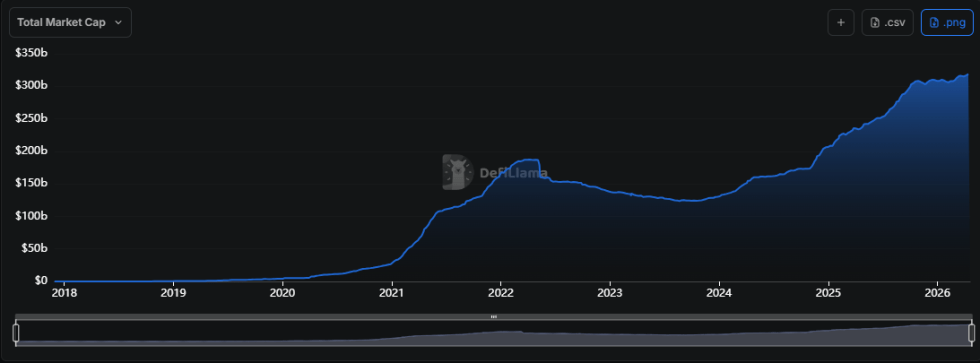
The trend in the stablecoin market cap over the last few years | Source: DefiLlama

Currently, the fiat-pegged coins have a combined valuation of over $320 billion, which is a new all-time high.

Bitcoin Price

At the time of writing, Bitcoin is trading around $75,000, up more than 6% over the past week.

The price of the coin seems to have retraced from its Friday high | Source: BTCUSDT on TradingView


İlgili Sorular

QAccording to the BIS General Manager, what are the two key features that determine the 'moneyness' of an instrument like a stablecoin?

AThe two key features are singleness and interoperability.

QWhat is the main reason the BIS believes stablecoins currently remain a 'niche' payment instrument?

ABecause they lack the network effects that are key to money, as their design undermines singleness and interoperability, which prevents wider acceptance and use.

QDespite their shortcomings, what potential benefit of stablecoins did the BIS General Manager acknowledge?

AHe noted that stablecoins have the potential to significantly enhance cross-border payments.

QWhat is the current total market capitalization of all stablecoins as mentioned in the article?

AThe combined valuation is over $320 billion, which is a new all-time high.

QWhat are the two specific risks that the BIS head cautioned stablecoins could pose?

AThey can affect credit supply, financial stability, and monetary and fiscal policy.

İlgili Okumalar

SharpLink CEO: How to Understand Ethereum Developers Just Exceeded 1 Million?

SharpLink CEO reflects on the milestone of Ethereum surpassing 1 million historical developers, emphasizing that this figure represents the largest pool of technical talent ever assembled around an open, permissionless blockchain network. While approximately 232,000 developers remain active, the key question for the crypto industry is not which chain is fastest, but where the best builders choose to build long-term. Ethereum's advantage lies in a decade-long accumulation of infrastructure, standards, tools, liquidity, and a cohesive culture, making it the default operating system for programmable finance. This developer base is tackling complex challenges: the Glamsterdam upgrade aims to enhance scalability while preserving core principles; synchronous composability seeks to unify Rollup ecosystems; and significant efforts are underway for post-quantum security. Ethereum's deeper network effects stem from composability and shared standards (like the EVM and Solidity), creating a flywheel of more developers, tools, and liquidity. Three reinforcing strengths cement Ethereum's lead: credible neutrality (secured by ~900k validators), a modular architecture with interconnected Rollups, and a culture that attracts top researchers. The ecosystem is consolidating as the trusted coordination layer for internet-native finance, favored by large institutions valuing security and liquidity. The future of Ethereum is being built by this global community of founders and architects.

链捕手8 dk önce

SharpLink CEO: How to Understand Ethereum Developers Just Exceeded 1 Million?

链捕手8 dk önce

A Clod of Chinese Soil Chokes Two Japanese Giants

"Chinese Soil Chokes Japanese Giants" The production of a key electronic specialty gas, tungsten hexafluoride (WF6), vital for manufacturing AI chips, was halted by two leading Japanese producers—Kanto Denka and Central Glass. Their shutdown was not due to a technological failure but a sudden, critical shortage of a raw material they had long taken for granted: ultra-high-purity (6N-grade) tungsten powder, which is almost entirely sourced from China. Following a quiet Chinese export announcement in January 2026, tungsten powder shipments to Japan dropped to zero for months. Despite frantic efforts, Japanese companies found no viable alternative; imported powder was three times more expensive and lacked the required purity. Their existing stockpiles were exhausted by mid-2026. WF6 is essential for depositing tungsten into the microscopic contact holes of High Bandwidth Memory (HBM) chips, which are crucial for advanced processors like those from Nvidia. While Japanese firms had mastered producing ultra-pure WF6 gas, their entire supply chain relied on China's 6N tungsten powder—a dependency now revealed as a fatal vulnerability. China's dominance in this "soil" results from decades of painstaking R&D by companies like Xiamen Tungsten and China Tungsten & Hightech. They overcame immense technical hurdles, such as separating chemically similar molybdenum from tungsten, to achieve mass production of the world's purest tungsten powder. With their primary suppliers gone, Kanto Denka and Central Glass announced a permanent halt to WF6 production starting July 1, 2026. This immediately created a supply crisis for major semiconductor manufacturers like Samsung and SK Hynix, forcing them to urgently seek and certify new Chinese suppliers for WF6 itself. The reversal marks a dramatic shift: China has moved from exporting low-value raw materials to controlling the high-purity foundation of a critical global tech supply chain, upending a long-established industrial hierarchy.

marsbit39 dk önce

A Clod of Chinese Soil Chokes Two Japanese Giants

marsbit39 dk önce

Without Tencent, What's Left for Suiyuan?

The article centers on the crucial question posed in the title: what is Seyond Technology really worth if its dominant customer, Tencent, were to stop purchasing its AI chips? As the last of China's "Four AI Chip Dragons" to secure approval for a public listing, Seyond's IPO filing reveals a profound and controversial dependency. In 2025, 74.9% to over 80% of its revenue came from Tencent. The piece argues that this extreme customer concentration is not merely a vulnerability but a strategic outcome of China's AI industry evolution. It contrasts Seyond's path with its peers (Moore Thread, Biren Technology, and MetaX), noting that while others raced to market with ambitious stories, Seyond focused first on securing and delivering for a major client. Its explosive revenue growth—with Q1 2026 up 1474.85% year-on-year—is driven by concentrated orders from Tencent, which itself faces massive, escalating AI compute demands for products like its Yuanbao and Hunyuan models. The relationship is framed as a deliberate, symbiotic cultivation of a supply chain. As both a major shareholder (20.26%) and primary client, Tencent is actively fostering Seyond to build a controllable, stable alternative to NVIDIA, similar to how global tech giants historically nurtured key suppliers. The high switching costs—involving software stacks and deployed systems—create a deep "ecological moat" for Seyond within Tencent's ecosystem. The analysis positions the AI chip landscape in three tiers: NVIDIA as the global leader, Huawei's Ascend as the state-backed player, and commercial firms like Seyond competing for market orders. Seyond is increasingly seen as "Tencent's compute foundation," with its product roadmap closely aligned with the tech giant's needs. The conclusion is that the industry's metric for success is shifting from fundraising and technical specs to real orders, delivery capability, and ecosystem binding. Seyond's value, therefore, lies not just in its chips but in holding a massive, multi-year procurement order from China's largest internet company—a tangible asset arguably more telling than any technical whitepaper in the current climate. The core insight is that for domestic chips, the ultimate challenge isn't just catching up technologically with NVIDIA, but earning the trust, scenarios, and recurring orders from a major anchor client.

marsbit1 saat önce

Without Tencent, What's Left for Suiyuan?

marsbit1 saat önce

İşlemler

Spot
Futures

Popüler Makaleler

CORE Nasıl Satın Alınır

HTX.com’a hoş geldiniz! CORE (CORE) satın alma işlemlerini basit ve kullanışlı bir hâle getirdik. Adım adım açıkladığımız rehberimizi takip ederek kripto yolculuğunuza başlayın. 1. Adım: HTX Hesabınızı OluşturunHTX'te ücretsiz bir hesap açmak için e-posta adresinizi veya telefon numaranızı kullanın. Sorunsuzca kaydolun ve tüm özelliklerin kilidini açın. Hesabımı Aç2. Adım: Kripto Satın Al Bölümüne Gidin ve Ödeme Yönteminizi SeçinKredi/Banka Kartı: Visa veya Mastercard'ınızı kullanarak anında CORE (CORE) satın alın.Bakiye: Sorunsuz bir şekilde işlem yapmak için HTX hesap bakiyenizdeki fonları kullanın.Üçüncü Taraflar: Kullanımı kolaylaştırmak için Google Pay ve Apple Pay gibi popüler ödeme yöntemlerini ekledik.P2P: HTX'teki diğer kullanıcılarla doğrudan işlem yapın.Borsa Dışı (OTC): Yatırımcılar için kişiye özel hizmetler ve rekabetçi döviz kurları sunuyoruz.3. Adım: CORE (CORE) Varlıklarınızı SaklayınCORE (CORE) satın aldıktan sonra HTX hesabınızda saklayın. Alternatif olarak, blok zinciri transferi yoluyla başka bir yere gönderebilir veya diğer kripto para birimlerini takas etmek için kullanabilirsiniz.4. Adım: CORE (CORE) Varlıklarınızla İşlem YapınHTX'in spot piyasasında CORE (CORE) ile kolayca işlemler yapın.Hesabınıza erişin, işlem çiftinizi seçin, işlemlerinizi gerçekleştirin ve gerçek zamanlı olarak izleyin. Hem yeni başlayanlar hem de deneyimli yatırımcılar için kullanıcı dostu bir deneyim sunuyoruz.

282 Toplam GörüntülenmeYayınlanma 2024.12.13Güncellenme 2026.06.02

CORE Nasıl Satın Alınır

Tartışmalar

HTX Topluluğuna hoş geldiniz. Burada, en son platform gelişmeleri hakkında bilgi sahibi olabilir ve profesyonel piyasa görüşlerine erişebilirsiniz. Kullanıcıların CORE (CORE) fiyatı hakkındaki görüşleri aşağıda sunulmaktadır.

活动图片












