Stablecoins could reach $1.5 quadrillion by 2035 – Here’s how

ambcrypto2026-04-09 tarihinde yayınlandı2026-04-09 tarihinde güncellendi

Özet

Stablecoin usage has surged over the past decade, with significant growth accelerated by the passage of the GENIUS Act in 2025, pushing the stablecoin value to $319 billion. According to Chainalysis, adjusted volume rose 133% from 2023 to reach $28 trillion in 2025, with monthly volume hitting a record $7.2 trillion—surpassing major traditional payment channels like U.S. ACH and Visa. Transaction volume exceeded 8.1 trillion through March 2026, and active addresses grew to 51.6 million. Chainalysis projects that, if current growth continues, stablecoin volume could exceed $1.5 quadrillion by 2035, driven by generational wealth transfers ($80–100 trillion moving to crypto-friendly younger generations) and point-of-sale adoption. This would surpass the estimated $1 quadrillion in global cross-border payments. Further adoption, including real-world asset tokenization and supportive legislation like the Clarity Act, could accelerate this trajectory.

Stablecoin usage has surged over the past decade with rising adoption and mainstream acceptance. The passage of the GENIUS Act by the U.S. Congress in 2025 accelerated this growth, pushing stablecoin value to $319 billion.

This global financial shift is driving the integration of traditional and decentralized finance, with stablecoins at the center of market transformation and projected to outpace traditional finance.

Stablecoin monthly volume hits $7.2T

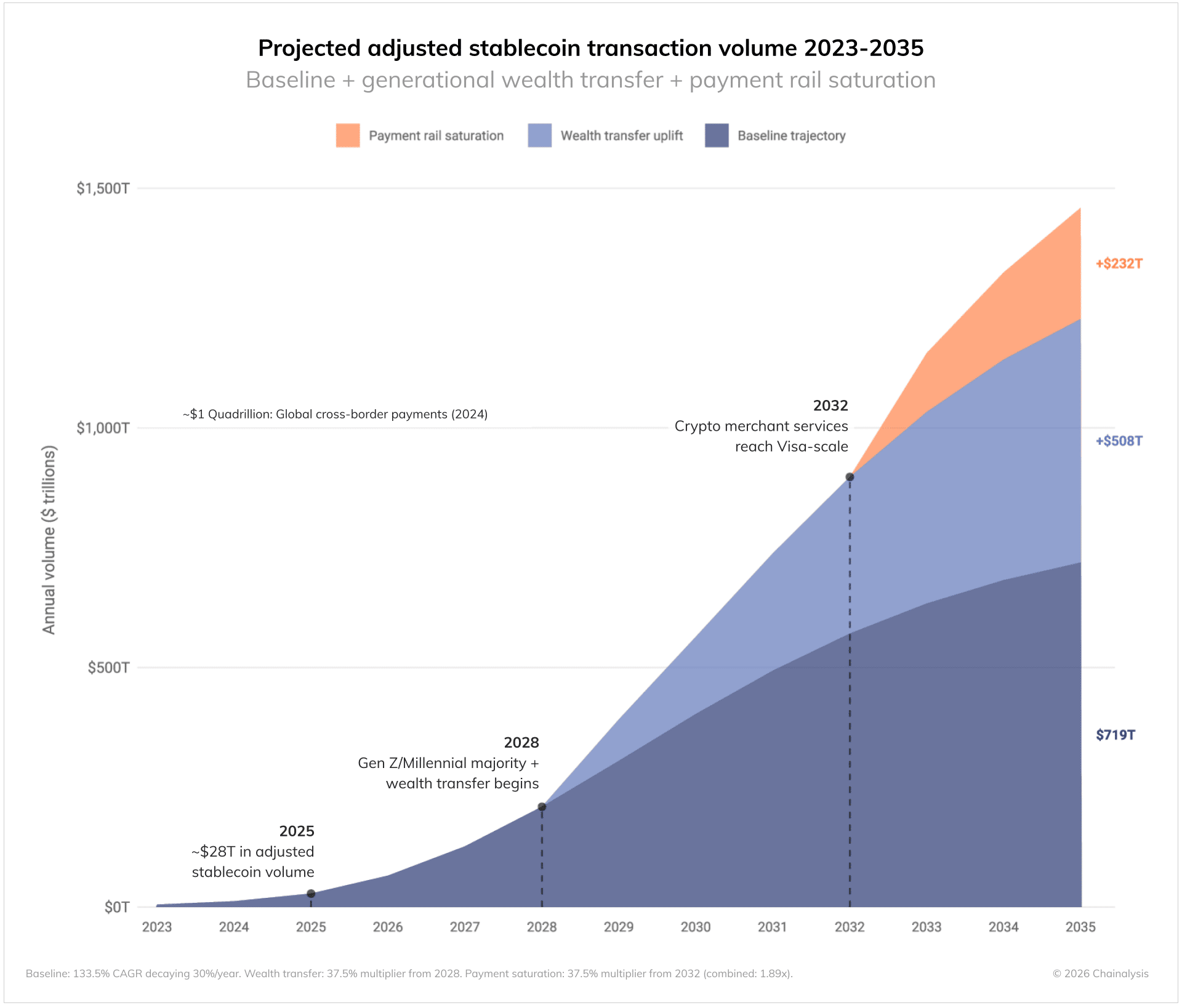
According to the Chainalysis report, Stablecoin Adjusted Volume rose 133% from 2023 to hit $28 trillion in 2025. This showed extensive growth in the economic value of stablecoins.
Source: Chainalysis

At press time, monthly volume reached a historical high of $7.2 trillion, surpassing major traditional payment channels such as U.S. ACH and Visa.

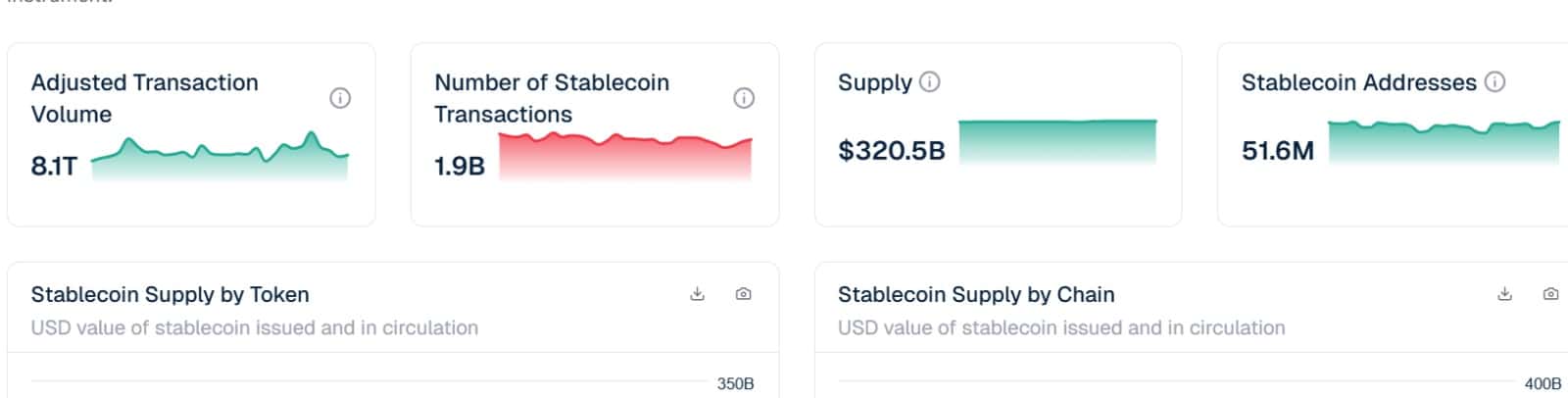
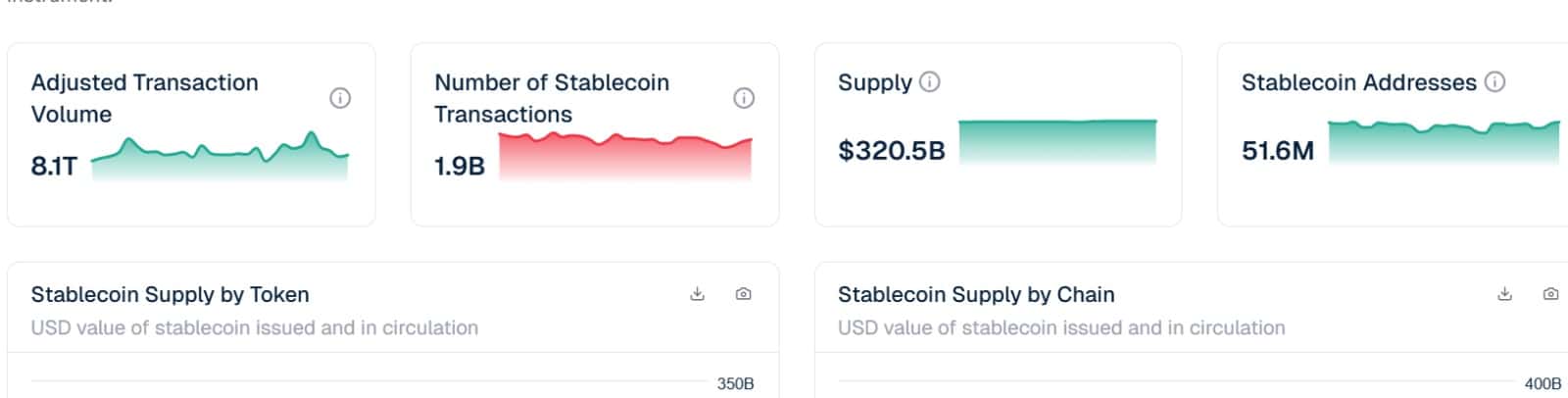
The growth has indicated the extensive usage of stablecoin in everyday life across all walks of life. In fact, Artemis data showed that both transactions and addresses have also risen significantly.
Source: Artemis

Adjusted Transaction Volume exceeded 8.1 trillion through March 2026, with the number of transactions nearing 2 trillion. At the same time, Stablecoin Addresses have surged to 51.6 million over the last 30 days, reflecting this sustained usage.

Usage to surpass $1.5 quadrillion by 2035

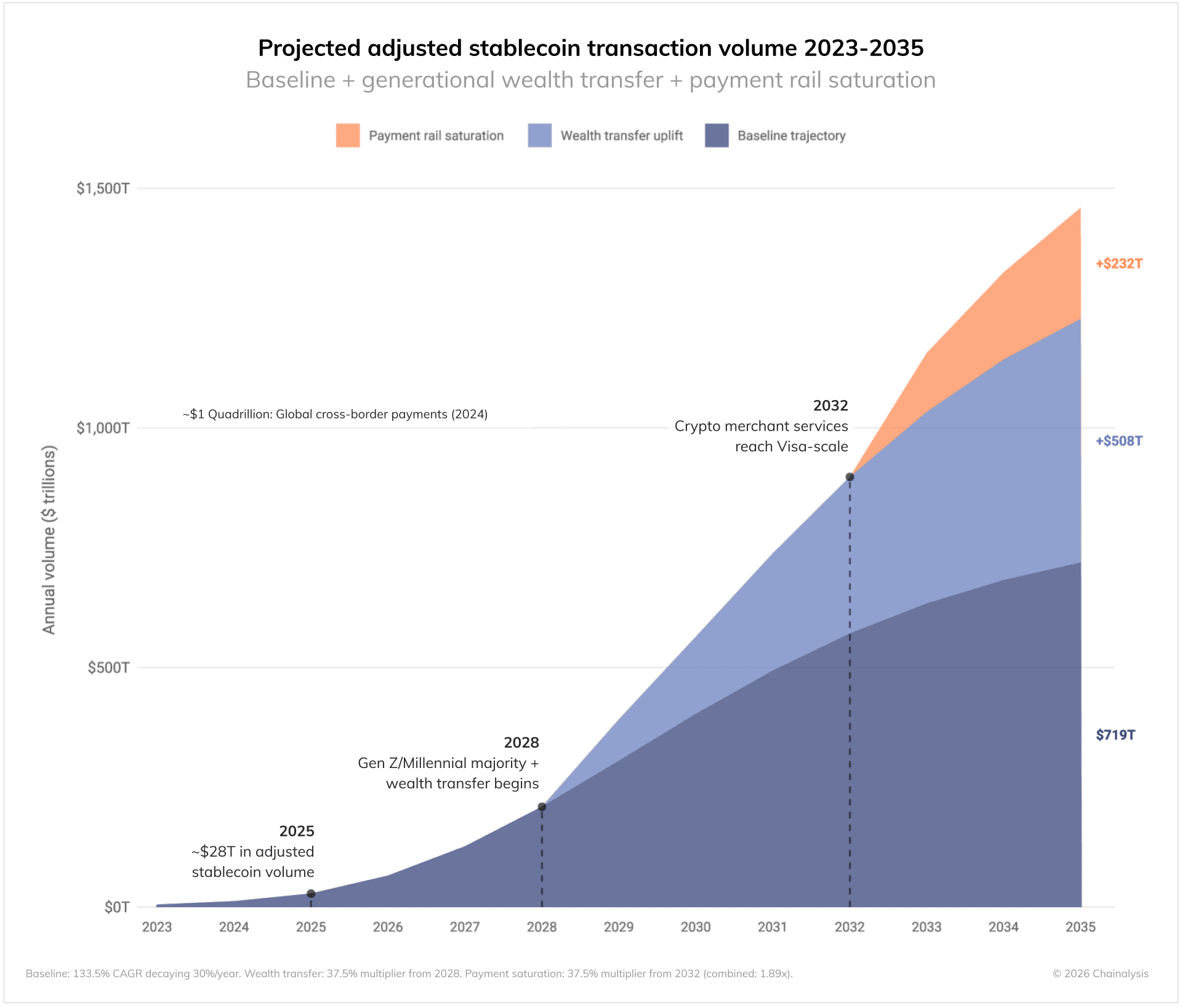
Chainalysis projects that if current growth continues, stablecoin volume could exceed $719 trillion by 2035. Notably, two key drivers are generational wealth transfers and point‐of‐sale adoption. Between $80 and $100 trillion in wealth is expected to move from boomers to millennials and Gen Z, nearly half of whom already hold crypto.

This transition alone could add more than $508 trillion in stablecoin transaction volume. At the same time, stablecoins may become default payment systems, further accelerating growth. Together, these forces could push stablecoin volume to $1.5 quadrillion by 2035, surpassing the estimated $1 quadrillion in global cross‐border payments.
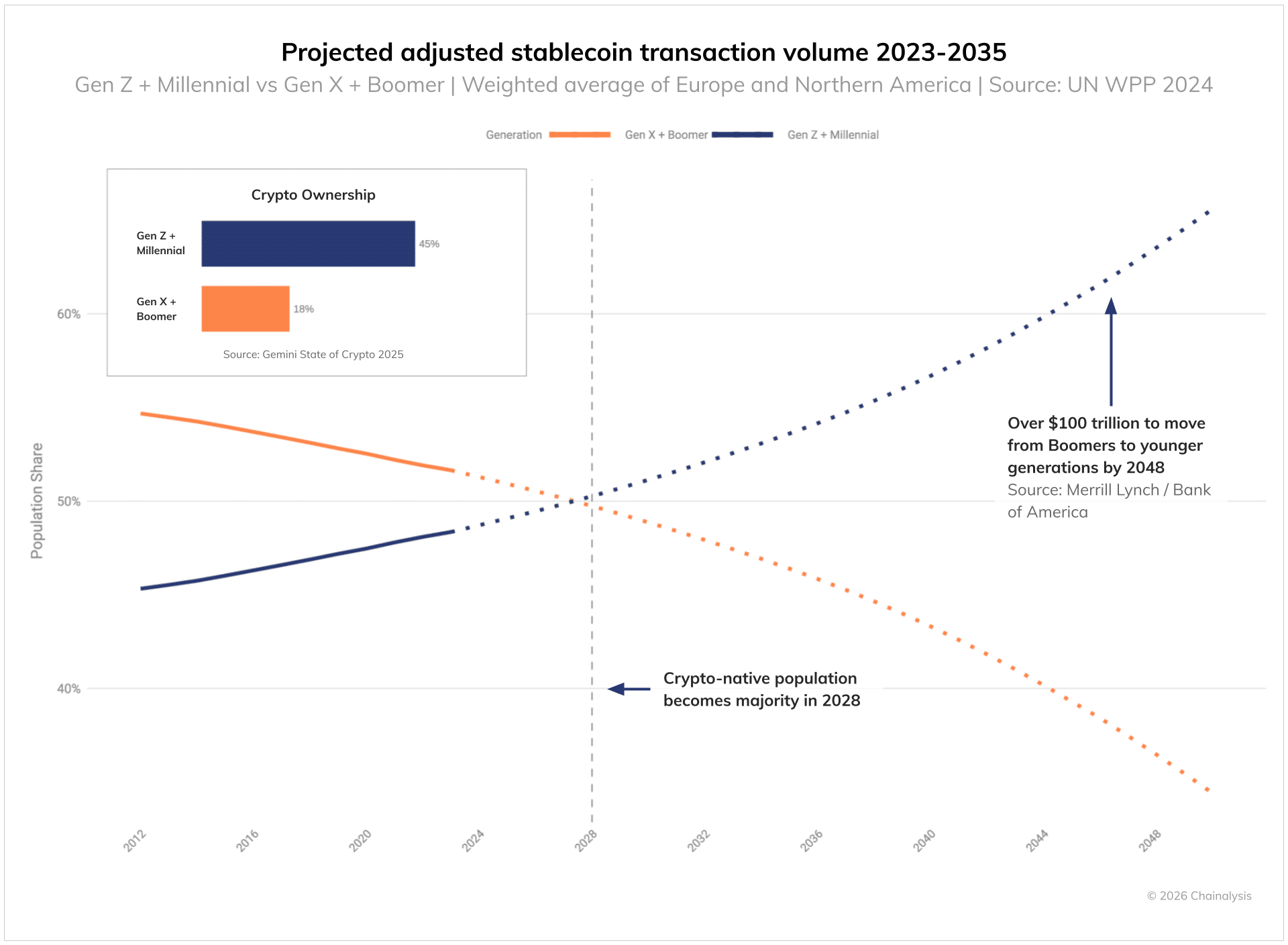
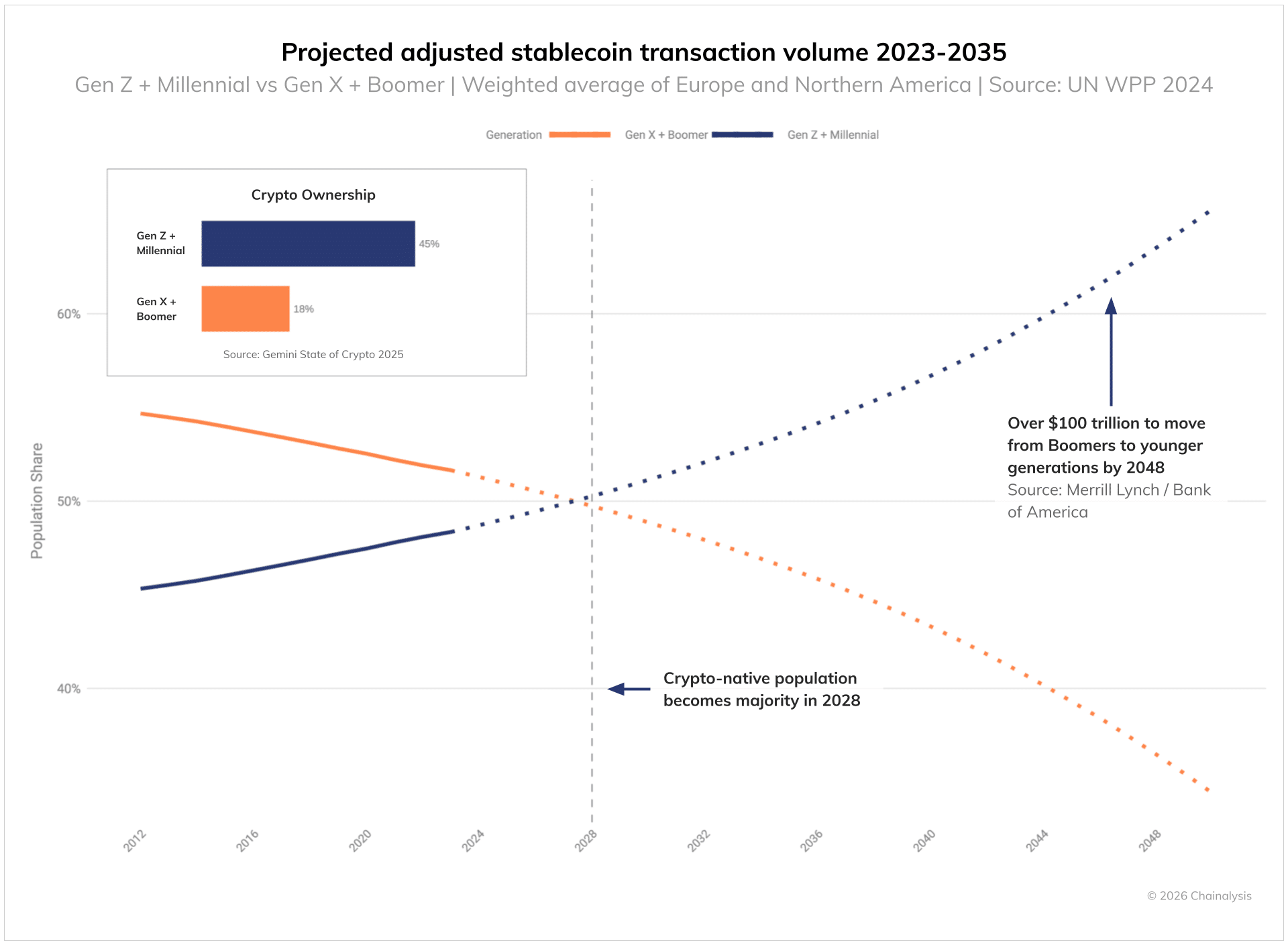
Source: Chainalysis

Even more importantly, intergenerational wealth transfers and shifts in payment infrastructure could accelerate adoption. This will see a surge in real-world asset tokenization, prediction markets, and other TradFi-to-crypto products.

Institutions and other players in TradFi will be left at a crossroads: either fully embrace crypto or see assets migrate. As many users continue to adopt stablecoin, the growth is barely starting.

Finally, if the Clarity Act, currently stalled in the U.S. Senate, is passed, stablecoins will gain a clearer growth path.


Final Summary

  • Stablecoin Adjusted Volume rose 133% from 2023 to hit $28 trillion in 2025, with a monthly volume of $7.2 trillion.
  • Stablecoin volume is projected to hit $1.5 quadrillion by 2035, surpassing the estimated $1 quadrillion in global cross-payments


İlgili Sorular

QWhat was the percentage increase in Stablecoin Adjusted Volume from 2023 to 2025, and what was the total value reached in 2025?

AStablecoin Adjusted Volume rose 133% from 2023 to hit $28 trillion in 2025.

QWhat is the projected total stablecoin transaction volume by 2035, and how does it compare to the estimated value of global cross-border payments?

AStablecoin volume is projected to reach $1.5 quadrillion by 2035, surpassing the estimated $1 quadrillion in global cross-border payments.

QWhat are the two key drivers identified by Chainalysis that could push stablecoin volume to $1.5 quadrillion by 2035?

AThe two key drivers are generational wealth transfers (from boomers to millennials and Gen Z) and the adoption of stablecoins as a default payment system at the point-of-sale.

QWhat recent U.S. legislation is credited with accelerating the growth of stablecoins, and what is the name of the act currently stalled in the Senate that could provide further clarity?

AThe GENIUS Act, passed by the U.S. Congress in 2025, accelerated stablecoin growth. The Clarity Act is currently stalled in the U.S. Senate and could provide a clearer growth path if passed.

QWhat does the article state about the current monthly stablecoin volume compared to traditional payment channels like U.S. ACH and Visa?

AAt press time, the monthly stablecoin volume reached a historical high of $7.2 trillion, surpassing major traditional payment channels such as U.S. ACH and Visa.

İlgili Okumalar

Has Hook Summer Truly Arrived? sato, Lo0p, FLOOD Ignite the New Uniswap v4 Narrative

With the broader market showing signs of recovery, a new wave of interest has emerged around Ethereum-based meme coins. Following ASTEROID, tokens like sato, sat1, Lo0p, and FLOOD, built upon the Uniswap v4 Hook protocol, are capturing market attention. Their market capitalizations range from millions to tens of millions of dollars, injecting much-needed focused liquidity into a market lacking narratives. This article explores whether this trend signifies an incoming "Hook Summer" and its potential impact on UNI's price. Hooks are essentially plug-in smart contracts for Uniswap v4 liquidity pools, allowing developers to inject custom logic at key points in a pool's lifecycle (like initialization, adding/removing liquidity, swaps). This transforms the AMM into programmable building blocks. Key highlighted projects include: * **sato**: Peaked over $38M market cap. It utilizes a v4 curve for minting/burning; buying locks ETH as reserve to mint new tokens, while selling redeems ETH from the reserve and burns tokens. * **sat1**: Market cap briefly exceeded $10M, promoted as an "optimized sato," but later declined significantly. * **Lo0p**: Reached nearly $6.6M. It's a lending AMM protocol where buying LO0P tokens locks them as collateral, allowing users to borrow ETH from the pool reserve at 40% LTV, aiming to improve capital efficiency for idle ETH in LPs. * **FLOOD**: Peaked near $6M. Its mechanism directs asset reserves from buys into Aave v3 to generate yield, with fees and interest retained in the pool to potentially influence the token's price long-term. In the long term, the development of the Hook ecosystem can attract users and liquidity to Uniswap v4, benefiting UNI's fundamentals—especially combined with the recent activation of the protocol fee switch, where a portion of fees is used to burn UNI. However, in the short term, these Hook-based tokens are unlikely to directly drive significant UNI price appreciation. Their impact is moderated by factors like token sustainability, price volatility, and broader market and regulatory conditions. Currently, Uniswap v4's TVL ($595M) still trails behind v2 and v3, indicating adoption and growth will take time. The article concludes that while the Hook ecosystem provides long-term "nourishment" for UNI, its short-term role is more of a "catalyst" than a "booster." Readers are cautioned that these are early-stage experimental tokens and may carry unknown risks.

Odaily星球日报4 dk önce

Has Hook Summer Truly Arrived? sato, Lo0p, FLOOD Ignite the New Uniswap v4 Narrative

Odaily星球日报4 dk önce

Interview with Michael Saylor: I Did Say I Would Sell Bitcoin, But Never a Net Sale

Interview with Michael Saylor: I Said We'd Sell Bitcoin, But Never Be a Net Seller In a recent podcast, MicroStrategy Executive Chairman Michael Saylor clarified the company's stance on potentially selling Bitcoin. Following MicroStrategy's earnings call statement about being prepared to sell BTC to fund dividends for its STRC (Strategic) credit product, Saylor emphasized the distinction between selling and being a "net seller." Saylor explained the core business model: MicroStrategy sells credit instruments like STRC and uses the proceeds to buy Bitcoin, which is viewed as "digital capital" expected to appreciate around 30-40% annually. A portion of these capital gains can then be used to pay the dividends on the credit products. He stressed that even if the company sells some Bitcoin for dividends, it simultaneously buys much more with new credit issuance. For example, after raising $3.2 billion from STRC sales in April, the dividend obligation was only $80-90 million, making the company a net buyer. The clarification aims to counter market narratives questioning the value of Bitcoin on MicroStrategy's balance sheet if it were never sold, and to dismiss claims of a "Ponzi scheme." Saylor reiterated his personal philosophy for investors: "Don't be a net seller of bitcoin" and ensure your Bitcoin holdings increase each year. Saylor also discussed Bitcoin's role as the foundation for "digital credit," noting that STRC has become the largest and most liquid preferred stock issue in the U.S., offering high risk-adjusted returns (Sharpe ratio). He highlighted Bitcoin's deep liquidity, stating that even large purchases by MicroStrategy do not move the market significantly, which is driven by macro factors, geopolitical tensions, and capital flows from ETFs and credit products. Finally, Saylor reflected on his early inspiration from sci-fi books, which motivated his path to MIT, and maintained his fundamental thesis on Bitcoin remains unchanged: it is superior digital capital enabling superior digital credit.

链捕手8 dk önce

Interview with Michael Saylor: I Did Say I Would Sell Bitcoin, But Never a Net Sale

链捕手8 dk önce

Beaten SK Hynix Employees in China: Year-end Bonus Less Than 5% of Korean Staff's

"SK Hynix Chinese Staff Hit Hard: Bonuses Less Than 5% of Korean Counterparts" Driven by the AI boom, South Korea's SK Hynix is experiencing record performance, with media reports predicting massive year-end bonuses for its employees, making them highly desirable in the matchmaking market. However, this prosperity starkly contrasts with the situation for the company's Chinese employees. According to reports, SK Hynix operates under a rule allocating 10% of operating profit for employee bonuses. While projections suggest Korean employees could receive bonuses reaching millions of RMB, a Chinese employee with over a decade of technical experience revealed the disparity: "If they get 3 million, Chinese staff get less than 5% of that." After adjustments based on KPI ratings, this employee's highest bonus was slightly over 100,000 RMB. Bonuses are paid annually in Korea but semi-annually in China. During the industry downturn in 2023-2024, Chinese employees received no bonus at all. The gap extends beyond bonuses. Recruitment posts for SK Hynix's Chinese factories (in Wuxi, Dalian, Chongqing) show engineer monthly salaries ranging from 10,000 to 35,000 RMB, with a 13th-month salary promised. Chinese employees also receive standard benefits like annual leave but lack stock incentives, which are reportedly unavailable to them. Furthermore, management positions in China are predominantly held by Korean personnel, though industry observers note a gradual increase in local middle managers over time. SK Hynix has confirmed the 10% bonus rule but cautioned that specific future bonus amounts remain unpredictable. The company forecasts strong demand for HBM and other high-value enterprise products for the next 2-3 years, driven by AI infrastructure investment. This focus on business-to-business markets may continue to constrain supply for consumer products, potentially prolonging price increases for components like memory.

链捕手22 dk önce

Beaten SK Hynix Employees in China: Year-end Bonus Less Than 5% of Korean Staff's

链捕手22 dk önce

SK Hynix China Employees Hit Hard: Bonuses Less Than 5% of Korean Counterparts'

"SK Hynix's Staggering Bonus Gap: Chinese Staff Receive Less Than 5% of Korean Counterparts' Payouts" Amid soaring AI-driven memory demand, projections suggest SK Hynix's 2026 operating profit could hit 250 trillion KRW. Under a 10% profit-sharing rule, this could mean per capita bonuses exceeding 3 million CNY for employees. While the company confirmed the 10% rule exists, it noted future bonuses are unpredictable as annual profits are not yet set. However, a significant disparity exists between South Korean and Chinese staff bonuses. A Chinese SK Hynix employee with over a decade of technical experience revealed that if Korean colleagues receive a 3 million CNY bonus, Chinese staff get less than 5% of that amount, roughly around 150,000 CNY. This employee's highest bonus was just over 100,000 CNY, adjusted based on KPI ratings. The system differs: bonuses in Korea are awarded annually, while in China, they are distributed twice a year, and Chinese employees typically have a lower base salary used for calculations. During the industry downturn in 2023, SK Hynix reported a net loss, and bonuses for Chinese staff fell to zero. Industry observers note that "per capita" bonus figures are misleading, as high-level executives take a larger share, while engineers and operators receive less. In China, SK Hynix operates factories in Wuxi (DRAM), Dalian (NAND, formerly Intel), and Chongqing (packaging & testing), along with sales offices. Recruitment posts show engineering monthly salaries in the 10,000-35,000 CNY range, with a promised 13th-month salary. Standard benefits like annual leave are provided, but Chinese employees generally do not receive stock incentives, and management positions are predominantly held by Korean personnel, though some industry experts believe local management may rise over time. Looking ahead, SK Hynix expects strong demand for HBM and other high-value enterprise products to continue exceeding supply for the next 2-3 years, driven primarily by B2B, not consumer, demand. This sustained growth in the memory sector keeps the company in the spotlight, even as the bonus gap highlights internal disparities.

marsbit42 dk önce

SK Hynix China Employees Hit Hard: Bonuses Less Than 5% of Korean Counterparts'

marsbit42 dk önce

İşlemler

Spot
Futures
活动图片




