Stablecoin giant Tether makes $1B bid to buy Juventus FC

cointelegraph2025-12-13 tarihinde yayınlandı2025-12-13 tarihinde güncellendi

Özet

Stablecoin issuer Tether has made a binding all-cash offer to acquire a controlling 65.4% stake in Italian soccer club Juventus FC from the Agnelli family's holding company, Exor. The bid, which would value the publicly traded club at approximately $1.1 billion, has reportedly been rejected, with a source stating "Juventus is not for sale." Tether CEO Paolo Ardoino, a lifelong fan, expressed the company's commitment to investing 1 billion euros into the club's development. Tether, which already owns over 10% of Juventus and recently secured a board seat, has been expanding its investments beyond crypto into AI, robotics, and health.

Crypto stablecoin issuer Tether says it has launched a bid to fully acquire the Italian professional soccer club, Juventus Football Club, which has reportedly already been shot down.

Tether said on Friday that it submitted a binding all-cash proposal to Exor, the holding company of the Agnelli family, for its 65.4% controlling stake in Juventus that it has held for over 100 years.

If Exor agrees, then Tether will make a “public offer for the remaining shares at the same price.” Juventus is a public company with a market capitalization of 944.49 million euros ($1.1 billion), having closed trading on Friday up 2.3% to 2.23 euros ($2.62).

However, AFP reported that Tether’s bid has already been rebuffed, with a source close to Exor saying that “Juventus is not for sale.” Exor and Tether did not immediately respond to Cointelegraph’s request for comment.

Tether promises $1.1 billion investment

Tether said it’s prepared to invest 1 billion euros ($1.1 billion) in the support and development of Juventus if the transaction completes.

“Tether is in a position of strong financial health and intends to support Juventus with stable capital and a long horizon,” said Tether CEO Paolo Ardoino.
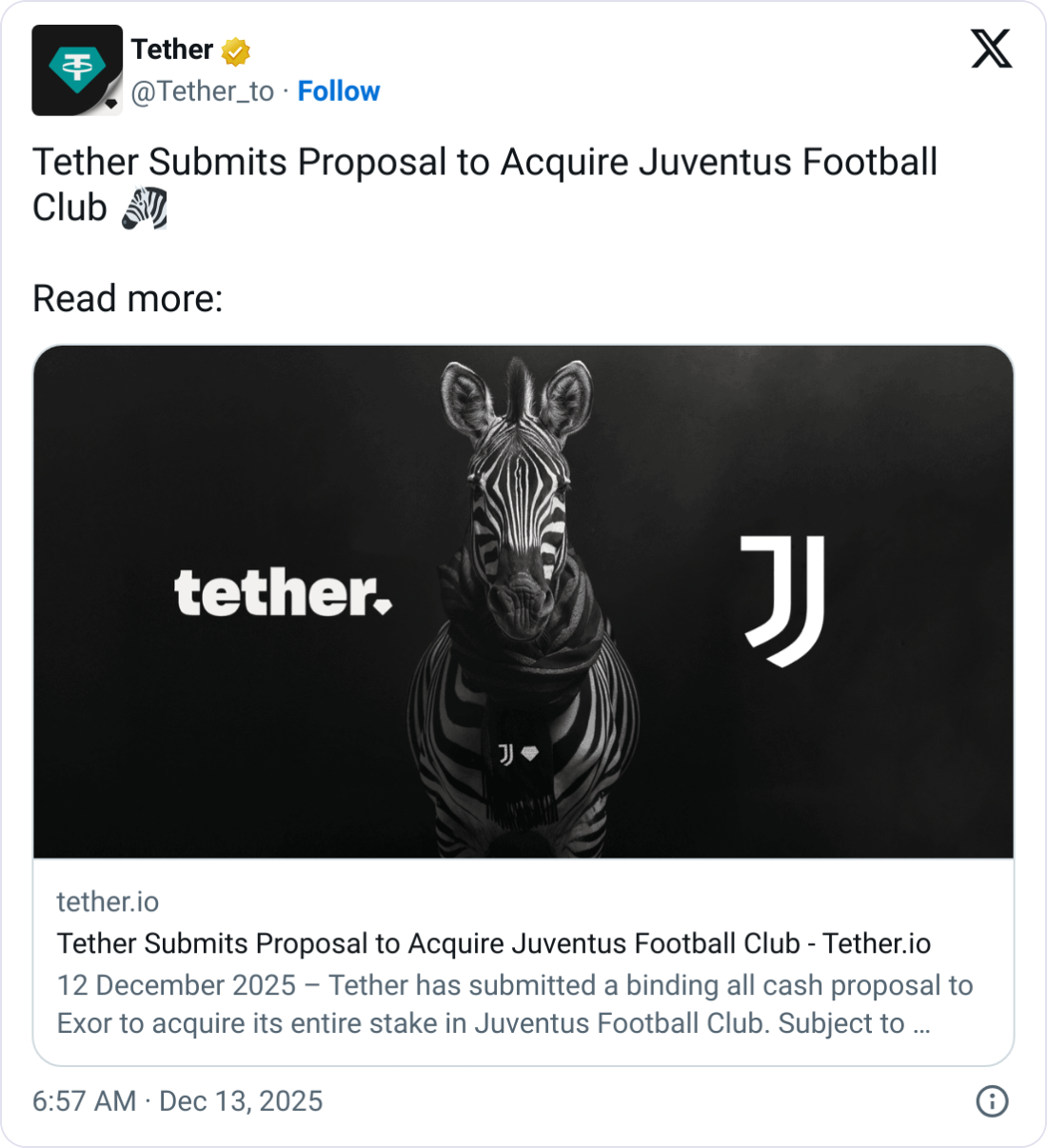
Source: Tether

“For me, Juventus has always been part of my life,” Ardoino added. “I grew up with this team. As a boy, I learned what commitment, resilience, and responsibility meant by watching Juventus face success and adversity with dignity.”

Related: Major fantasy sports operator enters prediction markets with Polymarket

Tether, which issues the self-named stablecoin Tether (USDT), has looked to expand its business beyond the token and has taken up investing in artificial intelligence, robotics and a health platform.

The company first bought a stake in Juventus in February and boosted its stake to over 10% in April.

It has since looked to boost its influence on the club and, in October, nominated its deputy investment chief, Zachary Lyons, along with Francesco Garino, to the football club’s board of directors.

The bids have paid off, as Juventus shareholders approved Garino’s appointment to the board of directors last month.

Magazine: Peter McCormack’s Real Bedford Football Club puts Bitcoin on the map

İlgili Okumalar

Understanding CPO (Co-Packaged Optics) in One Article: Why Nvidia Is Willing to Spend $3.2 Billion on a Fiber?

NVIDIA and Corning announced a multi-year strategic partnership on May 6, 2026, with NVIDIA committing up to $3.2 billion to support Corning's U.S. expansion. This investment will triple Corning's manufacturing plants and significantly boost its optical fiber and communications production capacity. The core driver behind this massive investment is the fundamental shift from copper to optical interconnect technology within AI data centers. As GPU clusters scale, copper wires face critical limitations: severe signal attenuation over distance, high energy consumption for signal integrity, and excessive heat generation. Optical fiber, transmitting light instead of electrical signals, solves these issues with minimal loss, near-light speed, and lower power needs. The article outlines a three-stage evolution of data center interconnect: 1. **Traditional Copper Interconnects:** The mainstream solution of the 2010s, now being phased out due to scaling bottlenecks. 2. **Pluggable Optical Modules:** The current mainstream, where modules convert electrical signals to light externally. This process still introduces energy loss and latency. 3. **CPO (Co-Packaged Optics):** The next-generation technology where the optical engine is integrated directly with the GPU chip package. This drastically reduces the electrical signal travel distance to mere millimeters, slashing power consumption and latency while boosting data density. NVIDIA CEO Jensen Huang has identified CPO as an essential core technology for AI infrastructure. NVIDIA's investment signifies a strategic shift from being a buyer to actively controlling its supply chain for critical components. With demand for specialized optical fiber far outstripping supply—evidenced by soaring prices—securing long-term manufacturing capacity has become a competitive necessity. While Corning's expansion may pressure some suppliers, a projected global fiber supply gap of 5-15% over the next few years creates a significant opportunity window, particularly for Chinese manufacturers competitive in optical preforms, chips, and modules. Ultimately, NVIDIA's move is not about chasing a trend but an engineering imperative. The transition to light-based interconnects like CPO is driven by the physical limits of copper, marking a definitive step in the ongoing AI computing revolution.

marsbit4 dk önce

Understanding CPO (Co-Packaged Optics) in One Article: Why Nvidia Is Willing to Spend $3.2 Billion on a Fiber?

marsbit4 dk önce

KOL's Perspective: Why Is SOL Set to Rise from This Point?

**Summary: Why SOL is Positioned for Growth at This Level** The article argues that SOL is poised for an upward move from its current price point, citing several key factors. Primarily, SOL has just broken out of a 4-month consolidation phase. This breakout signals a return of risk appetite to the broader crypto market, as SOL is seen as a key indicator of overall crypto health. The token's ownership has reportedly shifted from short-term traders and tourists to long-term accumulators, leading to low volume. Any meaningful increase in trading activity could thus trigger significant upward momentum. Fundamental strengths include strong institutional adoption, integration with DeFi and RWAs (Real-World Assets), and the potential benefits from the Clarity Act. Despite its high volatility—having dropped 70% from its all-time high but still up 12x from its bear market low—SOL is highlighted as one of the few tokens from the last cycle to reach new highs. It boasts a robust ecosystem of applications, users, and protocols. Future catalysts include the expected influx of AI developers following the Miami Accelerate conference, which focused on AI on Solana. Furthermore, Solana is positioned as the premier chain for memecoin activity, a trend expected to continue and drive network usage and fees. The article concludes that recent price action reflects a healthy transfer to long-term holders, setting the stage for growth.

marsbit54 dk önce

KOL's Perspective: Why Is SOL Set to Rise from This Point?

marsbit54 dk önce

Those Pre-Bitcoin PoW Protocols Have Recently Been Reimplemented

This article details a recent surge in replicating pre-Bitcoin Proof-of-Work (PoW) protocols, specifically focusing on Hal Finney's 2004 RPOW (Reusable Proofs of Work). Within five days in May 2026, multiple independent builders in the Bitcoin/cypherpunk community launched projects inspired by this early electronic cash proposal. The initiative began with Fred Krueger's `rpow2.com`, a centralized but auditable system that replaced RPOW's original IBM 4758 hardware with Ed25519 signatures. Initially a faithful replica, it later adopted Bitcoin-like features (21M supply cap, difficulty adjustment) and a controversial 5.24% founder allocation. This sparked rapid forks, including `rpow4.com` which incorporated full Bitcoin parameters, a prediction market (`rpowmarket.com`), and a DEX (`rpow2swap.com`). Concurrently, Mike In Space created a prototype of Wei Dai's 1998 b-money proposal (`b-money.replit.app`), pushing the historical exploration even further back. The article contrasts these centralized, server-dependent experiments with Bitcoin's core innovation of decentralized, trustless consensus. It also highlights a parallel development: the `HASH` project on Ethereum, which uses smart contract hooks to enable a purely fair-launch, browser-mineable PoW token with 0% allocations to team or VCs. The collective activity is framed as a meme-driven, educational exploration of cypherpunk history rather than a serious financial movement, with all projects heavily disclaiming any investment value.

marsbit59 dk önce

Those Pre-Bitcoin PoW Protocols Have Recently Been Reimplemented

marsbit59 dk önce

South Korean Exchanges 'Battle' Regulators, Challenging the Boundaries of Enforcement and Legislation

South Korea's cryptocurrency industry is engaged in a rare, direct confrontation with regulators. The Financial Intelligence Unit (FIU), the primary anti-money laundering (AML) watchdog, has recently imposed heavy penalties on major exchanges like Upbit and Bithumb for alleged violations involving unregistered overseas VASPs and AML procedures. However, exchanges are now actively challenging these actions in court and through industry associations. In a significant shift, the Seoul Administrative Court ruled in favor of Upbit's operator, Dunamu, overturning part of an FIU-ordered business suspension. The court found the FIU's penalty criteria and justification insufficiently clear. Similarly, the court suspended the enforcement of a six-month business suspension against Bithumb pending a final ruling, citing potential irreversible harm to the exchange. Beyond legal battles, the industry is contesting proposed legislative amendments. The Digital Asset eXchange Alliance (DAXA) strongly opposes a draft rule that would mandate Suspicious Transaction Reports (STRs) for all crypto transfers over 10 million KRW (~$6,800). DAXA argues this "poison pill" clause violates legal principles and would overwhelm the STR system, increasing reports from 63,000 to an estimated 5.45 million annually for major exchanges, thereby crippling effective AML monitoring. This conflict highlights a structural tension in South Korea's crypto governance: comprehensive digital asset laws are still developing, while regulators rely heavily on AML enforcement. The industry's move from passive compliance to active legal and legislative challenges signifies a new phase, pressing for clearer rules and more proportionate enforcement. While short-term disputes may intensify, this clash could ultimately lead to a more mature and sustainable regulatory framework for South Korea's vibrant crypto market.

marsbit1 saat önce

South Korean Exchanges 'Battle' Regulators, Challenging the Boundaries of Enforcement and Legislation

marsbit1 saat önce

İşlemler

Spot
Futures
活动图片




