Stablecoin Crime Wave? $141B In Illicit Activity Reported This Year

bitcoinist2026-02-20 tarihinde yayınlandı2026-02-20 tarihinde güncellendi

Özet

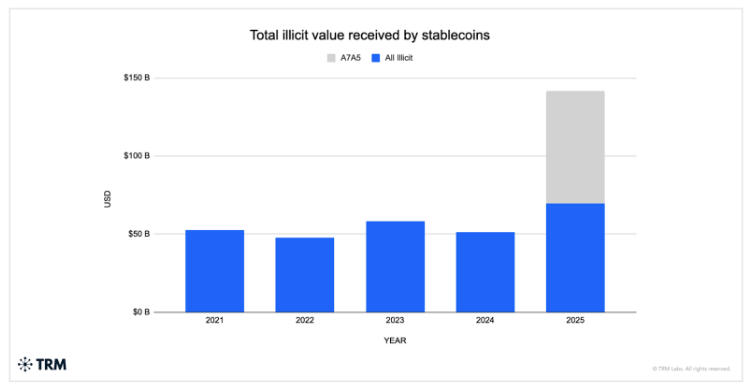
In 2025, approximately $141 billion in stablecoins was reportedly acquired by illicit actors, largely due to their predictable value and fast transaction speeds. Sanctions-related networks accounted for about 86% of these illicit flows, with $72 billion tied to a Russian ruble-pegged token. These networks also showed connections to China, Iran, North Korea, and Venezuela. Stablecoins were heavily used in guarantee marketplaces and human trafficking operations, where payment certainty and liquidity were prioritized. While scams and ransomware often start in Bitcoin or Ether, funds are frequently converted to stablecoins during laundering. The stablecoin market capitalization exceeded $270 billion in early 2026, dominated by Tether’s USDT ($180B) and Circle’s USDC ($70B), which together control over 90% of the market.

In 2025, about $141 billion in stablecoins reportedly ended up in the hands of illicit actors. Much of this activity was funneled through a few networks that favored stablecoins for their predictable value and quick transfers.

Much of that movement is tied to a small number of networks that use stablecoins for their speed and price stability. That does not mean widespread criminal use across all stablecoins. It points to concentrated channels where these tokens meet a specific need: moving value reliably outside regular banking rails.

Sanctions Linked Networks Drive The Bulk Of Flows

According To TRM Labs, sanctions-related flows made up roughly 86% of detected illicit crypto transfers last year. Around $72 billion of the stablecoin total traced back to a ruble-pegged token linked to Russian networks.

These networks are not isolated. Reports note overlaps with entities tied to China, Iran, North Korea, and Venezuela, which shows how stablecoins can act as bridges between different sanctioned systems.

The mechanics are simple: price stability matters when you need predictable settlement and low volatility risk. Stablecoins offer that.
Guarantee Marketplaces And Human Trafficking Rely On Stablecoins

Volume on certain marketplaces surged, mostly in stablecoins. Some escrow and guarantee sites — which act like middlemen for high-value transfers — saw tens of billions of dollars flow through their systems.

Reports note these venues are almost totally stablecoin-denominated, which raises red flags about their role in moving funds tied to illicit trade. Chainalysis and others have also pointed to sharp increases in flows to networks connected to human trafficking and escort services, and those operations leaned heavily on stablecoins for payments.

In these cases, payment certainty and liquidity matter more to the buyers and sellers than the chance of gains.
Different Types Of Crime Use Different Paths

Scams, ransomware, and thefts often start in Bitcoin or Ether and then shift into stablecoins later in the laundering chain. That pattern is common because attackers want an asset that holds value while they move it through fewer hands.

BTCUSD now trading at $67,833. Chart: TradingView

Market Cap

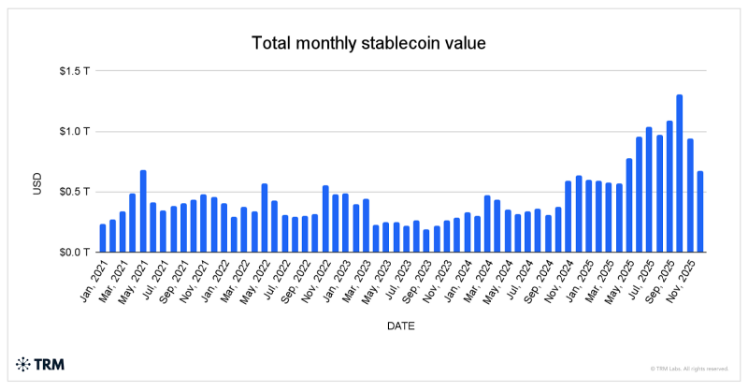
Meanwhile, the global stablecoin market has grown into a multi‐hundred‐billion‐dollar sector, with total market capitalization topping roughly $270 billion in early 2026.

According to data tracking site Stablecoin.com, the combined value of all major stablecoins consistently sits above the mid‐hundreds of billions mark, with fiat‐backed coins accounting for most of that total.

Two issuers dominate the sector. Tether’s USDT leads by a wide margin, with a market cap often reported at around $180 billion or more, and representing more than two‐thirds of the total stablecoin market.
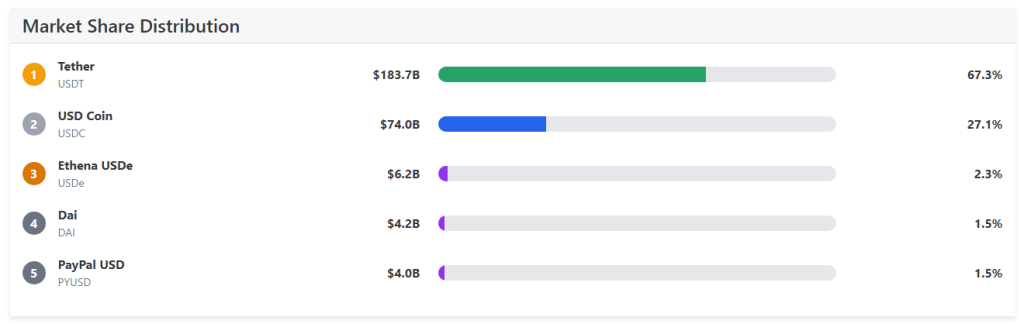
Source: Stablecoin.com

Circle’s USD Coin (USDC) sits in second place with a market cap often above $70 billion, jointly holding over 90% of stablecoin capitalization when combined with USDT.

Smaller stablecoins like Ethena USDe, DAI, and PayPal USD make up a much smaller portion of the market but signal ongoing diversification among providers, the data tracker said.

Featured image from Unsplash, chart from TradingView

İlgili Sorular

QHow much in stablecoins reportedly ended up in the hands of illicit actors in 2025?

AAbout $141 billion in stablecoins reportedly ended up in the hands of illicit actors in 2025.

QWhat percentage of detected illicit crypto transfers last year were sanctions-related, according to TRM Labs?

ASanctions-related flows made up roughly 86% of detected illicit crypto transfers last year.

QWhich two stablecoin issuers dominate the market and what is their combined market share?

ATether's USDT and Circle's USD Coin (USDC) dominate the market, jointly holding over 90% of the stablecoin market capitalization.

QWhat is a key reason illicit actors use stablecoins for transactions, according to the article?

AIllicit actors use stablecoins for their predictable value, quick transfers, and price stability, which provides reliable settlement with low volatility risk.

QBesides sanctions evasion, what other types of illicit activities are increasingly using stablecoins for payments?

AStablecoins are also heavily used for payments in illicit activities such as operations on guarantee marketplaces, human trafficking, and escort services.

İlgili Okumalar

CPU Makes a Comeback to the Table, A $170 Billion "Power Seizure" Drama Begins

A new era is dawning for the server CPU (Central Processing Unit), driven by the shift from AI model training to large-scale reasoning and the rise of Agentic AI. This article explores how the CPU is reclaiming a central role in the AI data center. For years, the focus has been on the GPU (Graphics Processing Unit) for AI training. However, as AI moves to the inference and Agent phase—where tasks involve complex, multi-step reasoning, tool calls, and data management—the workload balance is flipping. Studies show CPUs now handle over 70% of the workload in Agentic AI, up from 10-30% in training. This is because Agent tasks generate massive intermediate data (KV Cache) that exceeds GPU memory, forcing it to be offloaded to the CPU's larger, more scalable memory pools. This increased importance is translating into market changes. Major players are taking note: NVIDIA launched its first standalone CPU line, Vera, based on ARM architecture and optimized for Agent performance. AMD doubled its server CPU market forecast to over $1200 billion by 2030. Analyst reports project the total server CPU market could reach $1700 billion by 2030, with AI-driven demand being a primary driver. Furthermore, the classic ratio of CPUs to GPUs in AI servers is rapidly changing, converging from 1:8 toward 1:1 for Agent deployments. This surge in demand has led to a rare industry-wide price increase of 10-15% for server CPUs from Intel and AMD, breaking a decade-long trend of "more performance for the same price." Demand is bifurcating into high-core-count CPUs for in-rack GPU support and moderate-core CPUs for standalone Agent task orchestration. In China, this global trend presents an opportunity for domestic CPU manufacturers like Hygon (海光信息) and Huawei Kunpeng, who are bolstered by both growing AI infrastructure needs and national policies promoting technological self-reliance ("xin chuang"). The maturity of their software ecosystems is also accelerating, evidenced by faster adaptation to new AI models. In conclusion, the narrative is shifting from a GPU-centric view to one where CPU-GPU synergy is critical. The CPU is no longer a peripheral component but a performance-defining bottleneck and a key growth driver in the AI hardware stack, opening a massive new market estimated in the hundreds of billions of dollars.

marsbit10 saat önce

CPU Makes a Comeback to the Table, A $170 Billion "Power Seizure" Drama Begins

marsbit10 saat önce

TechFlow Intelligence: AMD AI Director Publicly Criticizes Claude Code for "Becoming Dumber and Lazier", Trump Claims Full Ceasefire in Hormuz But Strait Still Has 80 Unexploded Mines

TechFlow Intelligence Report: This daily digest covers key developments in AI, crypto, hardware, and geopolitics. In AI, SK Telecom faces US export control scrutiny over its partnership with Anthropic, while a Gemini user reports being misled in a scam scenario, sparking safety debates. China's Z.AI launches the GLM-5.2 model, rivaling Claude Opus without NVIDIA chips. In crypto, Bithumb lists ReProtocol, and Upbit delists KernelDAO. On the hardware front, MIT researchers build a custom OS to study chips, ASML denies US claims its advanced lithography machines are in China, and Amazon considers selling its in-house AI chips. Apple's future A21 Pro chip may use TSMC's latest N2P process. Major tech issues include 10,000 GitHub repositories distributing malware and Apple patching a critical eavesdropping flaw in Beats earbuds. US stocks rise, led by semiconductors, with Intel surging 10.6%, while SpaceX falls 3.5%. Geopolitically, despite a US-Iran deal, the Strait of Hormuz remains risky with ~80 uncleared mines, stalling 80M barrels of oil on standby tankers. Iran postpones Switzerland talks, and Trump calls the agreement an "unconditional surrender." The report highlights a contrast: temporary geopolitical calm versus the ongoing, fundamental restructuring of tech supply chains and chip independence.

marsbit10 saat önce

TechFlow Intelligence: AMD AI Director Publicly Criticizes Claude Code for "Becoming Dumber and Lazier", Trump Claims Full Ceasefire in Hormuz But Strait Still Has 80 Unexploded Mines

marsbit10 saat önce

İşlemler

Spot
Futures
活动图片