Stablecoin Crime Wave? $141B In Illicit Activity Reported This Year

bitcoinist2026-02-20 tarihinde yayınlandı2026-02-20 tarihinde güncellendi

Özet

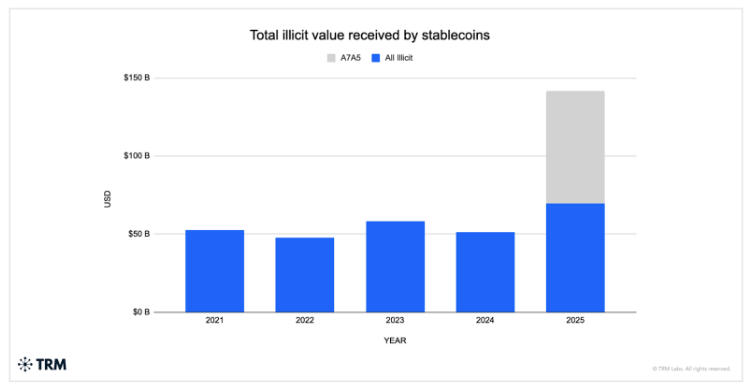
In 2025, approximately $141 billion in stablecoins was reportedly acquired by illicit actors, largely due to their predictable value and fast transaction speeds. Sanctions-related networks accounted for about 86% of these illicit flows, with $72 billion tied to a Russian ruble-pegged token. These networks also showed connections to China, Iran, North Korea, and Venezuela. Stablecoins were heavily used in guarantee marketplaces and human trafficking operations, where payment certainty and liquidity were prioritized. While scams and ransomware often start in Bitcoin or Ether, funds are frequently converted to stablecoins during laundering. The stablecoin market capitalization exceeded $270 billion in early 2026, dominated by Tether’s USDT ($180B) and Circle’s USDC ($70B), which together control over 90% of the market.

In 2025, about $141 billion in stablecoins reportedly ended up in the hands of illicit actors. Much of this activity was funneled through a few networks that favored stablecoins for their predictable value and quick transfers.

Much of that movement is tied to a small number of networks that use stablecoins for their speed and price stability. That does not mean widespread criminal use across all stablecoins. It points to concentrated channels where these tokens meet a specific need: moving value reliably outside regular banking rails.

Sanctions Linked Networks Drive The Bulk Of Flows

According To TRM Labs, sanctions-related flows made up roughly 86% of detected illicit crypto transfers last year. Around $72 billion of the stablecoin total traced back to a ruble-pegged token linked to Russian networks.

These networks are not isolated. Reports note overlaps with entities tied to China, Iran, North Korea, and Venezuela, which shows how stablecoins can act as bridges between different sanctioned systems.

The mechanics are simple: price stability matters when you need predictable settlement and low volatility risk. Stablecoins offer that.
Guarantee Marketplaces And Human Trafficking Rely On Stablecoins

Volume on certain marketplaces surged, mostly in stablecoins. Some escrow and guarantee sites — which act like middlemen for high-value transfers — saw tens of billions of dollars flow through their systems.

Reports note these venues are almost totally stablecoin-denominated, which raises red flags about their role in moving funds tied to illicit trade. Chainalysis and others have also pointed to sharp increases in flows to networks connected to human trafficking and escort services, and those operations leaned heavily on stablecoins for payments.

In these cases, payment certainty and liquidity matter more to the buyers and sellers than the chance of gains.
Different Types Of Crime Use Different Paths

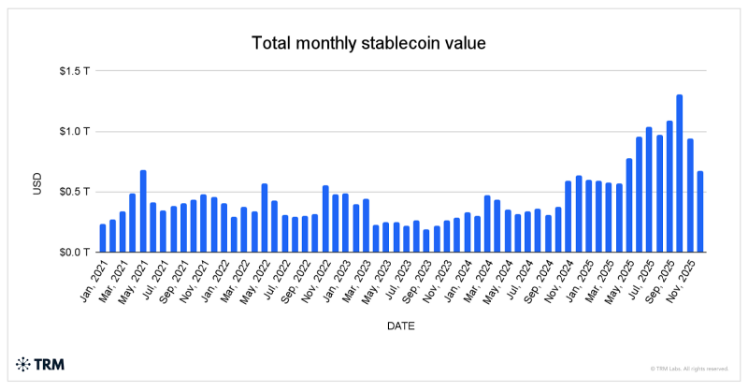
Scams, ransomware, and thefts often start in Bitcoin or Ether and then shift into stablecoins later in the laundering chain. That pattern is common because attackers want an asset that holds value while they move it through fewer hands.

BTCUSD now trading at $67,833. Chart: TradingView

Market Cap

Meanwhile, the global stablecoin market has grown into a multi‐hundred‐billion‐dollar sector, with total market capitalization topping roughly $270 billion in early 2026.

According to data tracking site Stablecoin.com, the combined value of all major stablecoins consistently sits above the mid‐hundreds of billions mark, with fiat‐backed coins accounting for most of that total.

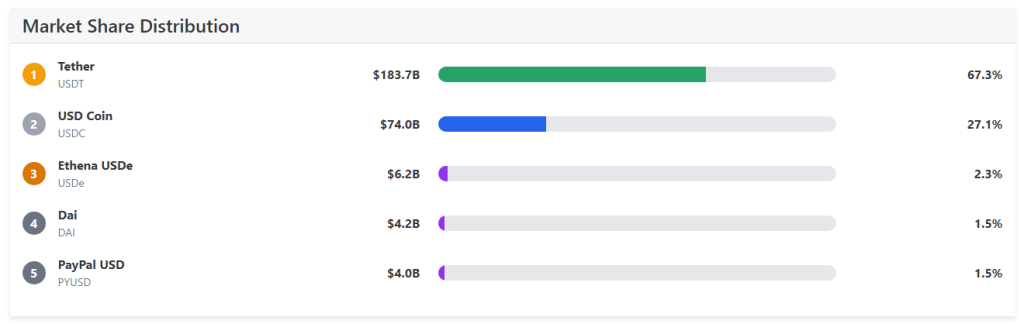
Two issuers dominate the sector. Tether’s USDT leads by a wide margin, with a market cap often reported at around $180 billion or more, and representing more than two‐thirds of the total stablecoin market.
Source: Stablecoin.com

Circle’s USD Coin (USDC) sits in second place with a market cap often above $70 billion, jointly holding over 90% of stablecoin capitalization when combined with USDT.

Smaller stablecoins like Ethena USDe, DAI, and PayPal USD make up a much smaller portion of the market but signal ongoing diversification among providers, the data tracker said.

Featured image from Unsplash, chart from TradingView

İlgili Sorular

QHow much in stablecoins reportedly ended up in the hands of illicit actors in 2025?

AAbout $141 billion in stablecoins reportedly ended up in the hands of illicit actors in 2025.

QWhat percentage of detected illicit crypto transfers last year were sanctions-related, according to TRM Labs?

ASanctions-related flows made up roughly 86% of detected illicit crypto transfers last year.

QWhich two stablecoin issuers dominate the market and what is their combined market share?

ATether's USDT and Circle's USD Coin (USDC) dominate the market, jointly holding over 90% of the stablecoin market capitalization.

QWhat is a key reason illicit actors use stablecoins for transactions, according to the article?

AIllicit actors use stablecoins for their predictable value, quick transfers, and price stability, which provides reliable settlement with low volatility risk.

QBesides sanctions evasion, what other types of illicit activities are increasingly using stablecoins for payments?

AStablecoins are also heavily used for payments in illicit activities such as operations on guarantee marketplaces, human trafficking, and escort services.

İlgili Okumalar

Why Do You Always Lose Money on Polymarket? Because You're Betting on News, While the Pros Read the Rules

Why do you always lose money on Polymarket? Because you bet on news, while the pros study the rules. This article explains how top traders ("che tou") profit by meticulously analyzing market rules, not just predicting events. Polymarket, a prediction market platform, often sees disputes over event outcomes due to ambiguous rule wording. For instance, a market asking "Who will be the leader of Venezuela by the end of 2026?" was misinterpreted by many who bet on Delcy Rodríguez, assuming she held power. However, the rules specified "officially holds" as the formally appointed, sworn-in individual. Since Nicolás Maduro was still recognized as president officially, he won the market—even being in prison. To resolve such disputes, Polymarket uses a decentralized arbitration system via UMA protocol. The process involves: 1. Proposal: Anyone can propose a market outcome by staking 750 USDC, earning 5 USDC if unchallenged. 2. Dispute: A 2-hour window allows challenges with a 750 USDC stake; successful challengers earn 250 USDC. 3. Discussion: A 48-hour period on UMA Discord for evidence and debate. 4. Voting: UMA token holders vote in two 24-hour phases (blind then public). Outcomes require >65% consensus and 5M tokens voted; otherwise, four re-votes occur before Polymarket intervention. 5. Settlement: Results are final and automatic. Unlike traditional courts, Polymarket’s system lacks separation between arbitrators and stakeholders—voters often hold market positions, creating conflicts of interest. This leads to herd mentality in discussions and non-transparent outcomes without explanatory rulings, preventing precedent formation. Thus, success on Polymarket hinges on deep rule interpretation, not just event prediction, exploiting gaps between reality and contractual wording.

marsbit51 dk önce

Why Do You Always Lose Money on Polymarket? Because You're Betting on News, While the Pros Read the Rules

marsbit51 dk önce

DeepSeek Funding: Liang Wenfeng's 'Realist' Pivot

DeepSeek, a leading Chinese AI company, has initiated its first external funding round, aiming to raise at least $300 million at a valuation of no less than $10 billion. This move marks a significant shift from its founder Liang Wenfeng’s previous idealistic stance of rejecting external capital to maintain independence. Despite strong financial backing from its parent company, quantitative trading firm幻方量化 (Huanfang Quant), which provided an estimated $700 million in revenue in 2025 alone, DeepSeek faces mounting challenges. Key issues include a 15-month gap in major model updates, delays in its flagship V4 release, and the loss of several core researchers to competitors offering significantly higher compensation. The company is also undergoing a strategic pivot by migrating its infrastructure from NVIDIA’s CUDA to Huawei’s Ascend platform, a move aligned with China’s push for technological self-reliance amid U.S. export controls. However, DeepSeek lags behind rivals like智谱AI and MiniMax—both now publicly listed—in areas such as product ecosystem, multimodal capabilities, and commercialization. The funding round, though relatively small in scale, is seen as a way to establish a market-validated valuation anchor, making employee stock options more competitive and facilitating talent retention. It also signals DeepSeek’s transition from a pure research-oriented organization to a commercially-driven player in the global AI ecosystem.

marsbit1 saat önce

DeepSeek Funding: Liang Wenfeng's 'Realist' Pivot

marsbit1 saat önce

İşlemler

Spot
Futures
活动图片





