SpaceX Plunges Below $150 on First Day of Index Inclusion, Wall Street Unanimously Bullish with Highest Target at $800?

Odaily星球日报2026-07-08 tarihinde yayınlandı2026-07-08 tarihinde güncellendi

Özet

SpaceX made history by being the fastest company ever added to the Nasdaq 100 index on July 7th. However, its stock (SPCX) fell over 6.8% to close at $149.47 that day, hitting a new low since its IPO. Analysts suggest the positive impact of the index inclusion was already priced in by the market, while upcoming insider share unlocks in August are creating downward pressure. Despite the current bearish sentiment and recent market-wide declines, major Wall Street firms have issued overwhelmingly positive ratings following the IPO quiet period's end. Targets range from $200 to $300, with Raymond James setting the most optimistic price target of $800, citing SpaceX's long-term potential in rocket launches, Starlink, and AI space data centers. In the short term, potential catalysts to support the stock price include a possible endorsement from former President Trump—following a donation of SpaceX shares to a trust he promoted—and the scheduled Starship Flight 13 test on July 14th. Nonetheless, with key support at $150 being tested and significant share unlocks looming, the near-term outlook remains challenging despite strong institutional long-term confidence.

Original | Odaily Planet Daily (@OdailyChina)

Author | Golem (@web 3_golem)

SpaceX has once again made history: on July 7th (Tuesday), SpaceX was officially included in the Nasdaq 100 Index, becoming the fastest publicly listed company ever to be added to the Nasdaq 100, with a corresponding weight of about 1.3% in the index. However, this historic achievement was not reflected in SpaceX's stock price performance. According to Gate US stock data, SPCX closed down over 6.8% on Tuesday at $149.47, hitting its lowest closing price since its listing. How will SPCX perform in the future? What judgments have Wall Street institutions made?

Index Inclusion Good News Exhausted, Only Bad News Remains, Holding $150 is Already an Achievement

Prior to SpaceX's inclusion in the Nasdaq 100 Index, JPMorgan estimated it would trigger at least about $4.3 billion in passive fund inflows, and over $800 billion in assets tracking the Nasdaq 100 Index would subsequently continue to passively allocate to SpaceX.

Although this is a significant positive, since SpaceX's IPO day, "entering the Nasdaq Index" has been constantly speculated, and market expectations had already been digested. When the expectation was realized on July 7th, market sentiment was no longer able to push the stock price higher. On the other hand, the massive buying pressure behind the Nasdaq Index did not hit the market on the day SpaceX was included; in reality, most passive fund buying had been completed ahead of July 7th.

Furthermore, historical data also shows that index inclusion does not necessarily constitute a sustained upward signal and has, in some cases, become a short-term peak.

Strategy is a typical example. On December 23, 2024, Strategy was included in the Nasdaq 100, but on that day, MSTR actually opened high and closed low, falling about 7.3% to close at $332.23. Subsequently, Strategy entered a sustained downtrend, with its stock price dropping to $255.43 in February 2025. The passive buying pressure from the Nasdaq index did not become effective support for Strategy's stock price.

And after the positive news of SpaceX's index inclusion is exhausted, the well-known negative of the share unlocking wave in August will be magnified indefinitely. SpaceX's prospectus clearly states that two days after the Q2 2026 earnings report, eligible internal shareholders can sell up to 20% of their locked-up shares. If the stock price rises 30% above the IPO price by then and meets that standard for 5 days, an additional 10% can be unlocked. 22V Research strategist Jeff Jacobson estimates that insiders may sell up to 44% of SpaceX's shares before early September.

Similar to how the positive expectations of index inclusion were digested by the market in advance, the panic brought by SpaceX's share unlocking is also bound to be reflected in the price ahead of time. This is an important factor suppressing SpaceX's stock price from a market sentiment perspective both recently and in the future. BitMine Chairman Tom Lee also specifically mentioned SpaceX's upcoming share unlock in an interview, believing that one should not chase the high on SpaceX in the short term, and that using the pullback brought by the unlock to build positions is the appropriate choice.

But this past Tuesday's US market close, SpaceX was not alone in falling. According to Gate US stock data, the three major US stock indices all closed lower: the Dow fell 0.25%, the S&P 500 fell 0.45%, and the Nasdaq fell 1.16%. AI concept stocks also fell broadly: Astera Labs fell 11.52%, Ambarella fell 9.92%, Teradyne fell 9.59%, AeroVironment fell 8.09%.

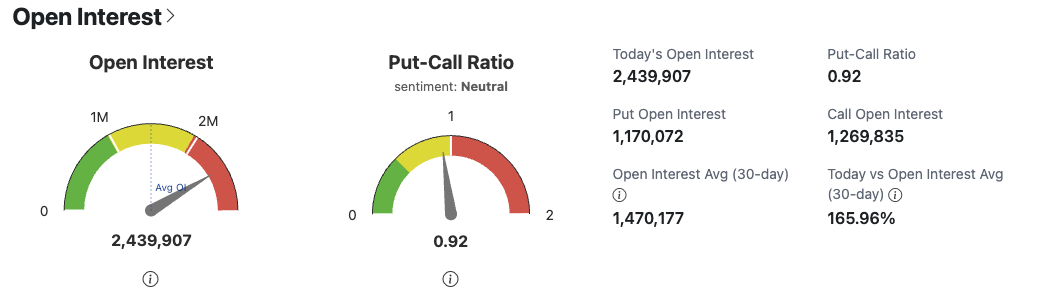
By comparison, in the context of a broad market decline and exhausted positive news leaving only negatives, SPCX still holding near $150 without breaking the IPO price is already an achievement. Meanwhile, according to OptionCharts data, the current Put-Call Ratio for SPCX is 0.92, indicating market sentiment remains neutral, not significantly bearish.
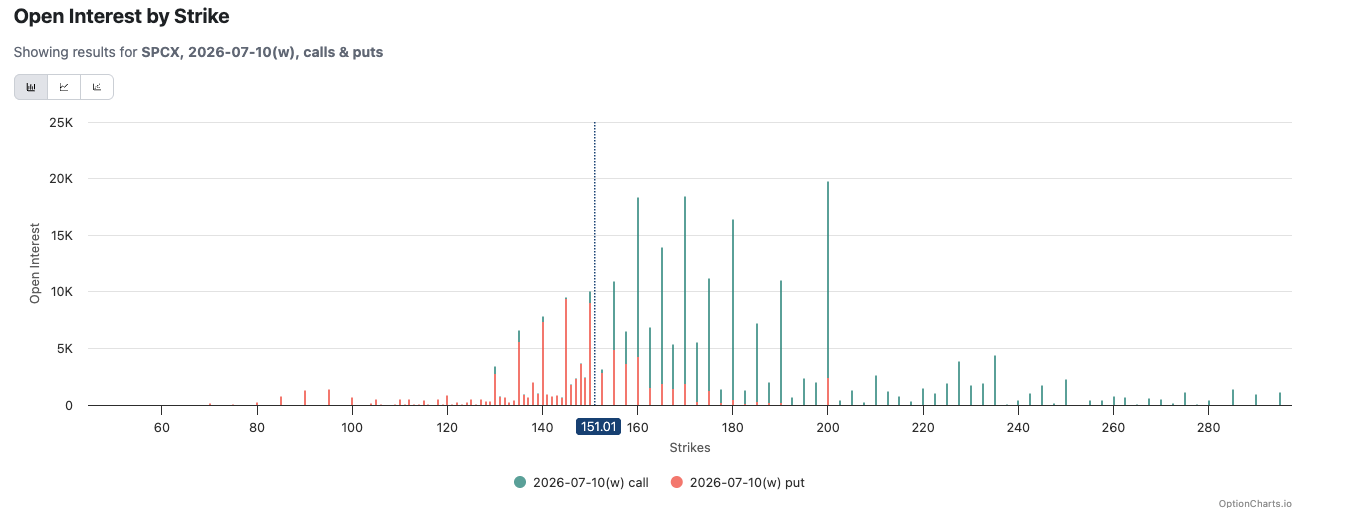
Furthermore, a large number of call options expiring on July 10th are stacked at $160 and above for SPCX, making the $150-$155 range the main battleground for bulls and bears.
Institutions Collectively Give Buy Ratings, Does SPCX Have Potential Upside?

Obviously, neither time nor market sentiment is on the side of the bulls anymore. Over the past month, SPCX has tested the $150 support level multiple times, but previously, $150 support was on the offensive side; now it is purely on the defensive. However, bizarrely, after the end of the IPO quiet period, Wall Street institutional analysts have collectively given SPCX a Buy rating.

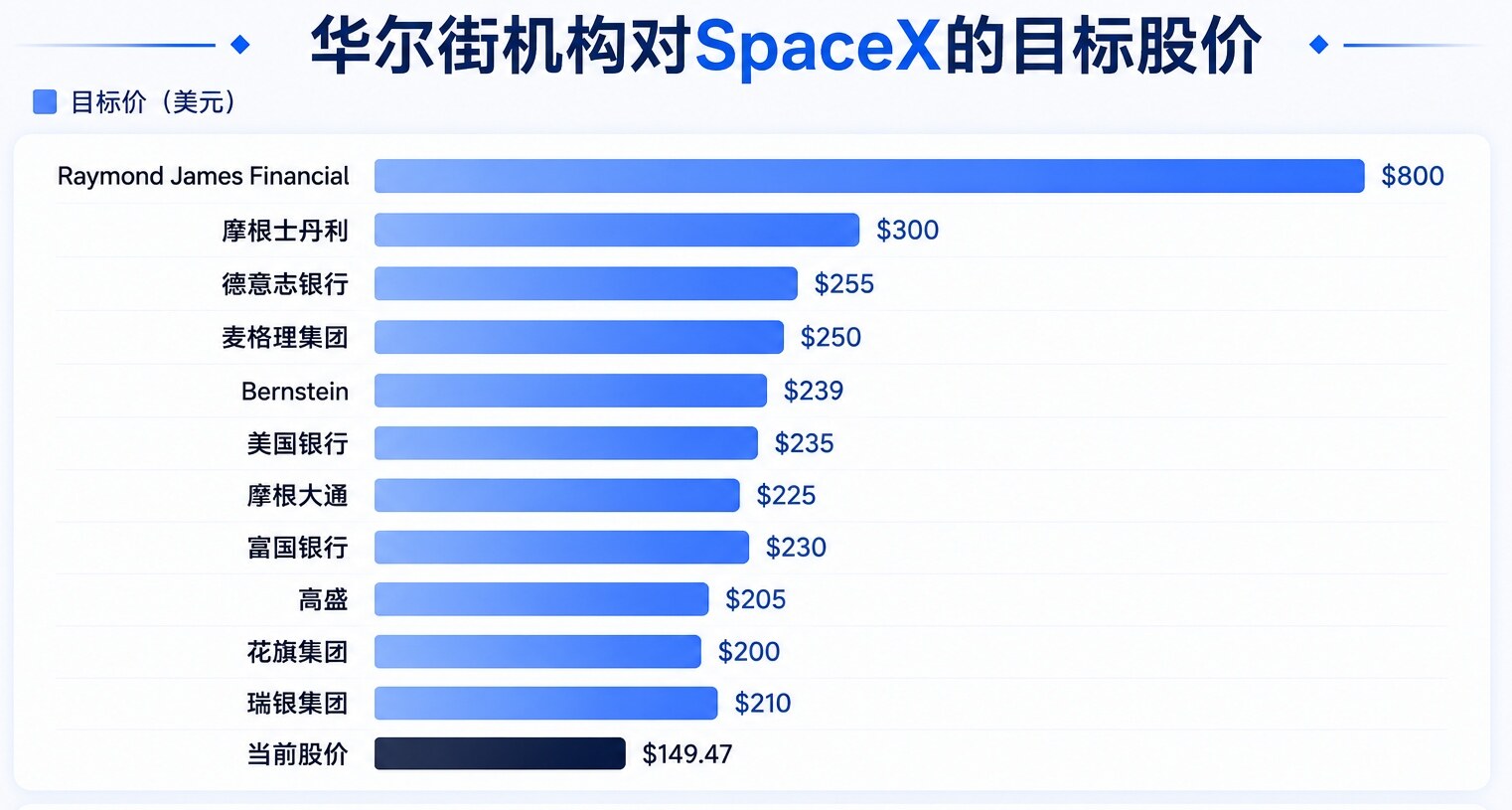
As IPO underwriters, both Goldman Sachs and Morgan Stanley gave SpaceX a Buy rating. Goldman Sachs analyst Eric Sheridan set a target price of $205, while Morgan Stanley analyst Adam Jonas gave a target price of $300. Additionally, Bank of America initiated coverage on SpaceX with a Buy rating and a target price of $235; Citigroup set a target price of $200 for SpaceX; Bernstein gave SpaceX an Outperform rating with a target price of $239; Macquarie Group set a target price of $250; Deutsche Bank set a target price of $255; JPMorgan set a target price of $225; UBS Group set a target price of $210; Wells Fargo set a target price of $230.

Raymond James Financial gave the most optimistic forecast, with analyst Brian Gesuale setting a target price for SPC as high as $800, believing SpaceX will become "one of the most iconic industrial infrastructure companies of the 21st century."
However, these institutional ratings primarily focus on SpaceX's long-term value, such as its positioning in rocket launches, Starlink, and AI space data centers. In the short term, especially before the August share unlocking wave arrives, what can SpaceX rely on to support its stock price from falling below $150 and heading straight for the $135 IPO price? The foreseeable potential positives are as follows:

First, relying on Trump's promotion. On July 7th, SpaceX President and COO Gwynne Shotwell and her husband announced participation in the Invest America plan, donating part of their SpaceX shares to over 2 million American children's "Trump Accounts," with an estimated donation of about 2 million SpaceX shares worth approximately $325 million. Trump had previously publicly urged Musk to donate SpaceX shares to the "Trump Account." Trump is a businessman who understands value exchange. After SpaceX stock enters the "Trump Account," he might promote SpaceX just as he promoted Micron and Dell.

Second, SpaceX's Starship flight test scheduled for July 14th. SpaceX's Starship's 13th flight test (Flight 13) is currently targeted for launch on July 14, 2026 (Tuesday), with a backup date of July 15th. The US Federal Aviation Administration (FAA) has issued an operational advisory confirming NET (No Earlier Than) July 14th. Rocket launches have always sparked public interest. As a world-leading aerospace company, each of SpaceX's launches garners global attention. If Flight 13 is completed successfully, SpaceX's aerospace narrative might once again briefly ignite "fan" enthusiasm, thereby boosting the stock price. Although the community and tracking sites generally consider July 14th as the primary launch target, it could be delayed by days or weeks due to technical readiness, weather, or other factors.

But ultimately, what investors most anticipate might be for Musk himself to do something to "rescue the market."


İlgili Sorular

QWhat was SpaceX's closing price and performance on its first day of inclusion in the Nasdaq 100 index?

ASpaceX (SPCX) closed at $149.47 on July 7th, the day it was included in the Nasdaq 100 index, marking a decline of over 6.8% and setting a record low closing price since its IPO.

QAccording to the article, why didn't the inclusion in the Nasdaq 100 index boost SpaceX's stock price?

AThe article states that the positive impact of index inclusion was already priced into the stock well before the official date. Much of the expected passive fund buying had already occurred pre-inclusion. Furthermore, history shows index inclusion can sometimes mark a short-term price peak rather than guarantee a sustained rally.

QWhat major near-term risk does the article highlight for SpaceX's stock price?

AThe article highlights the upcoming stock unlock in August 2026 as a major near-term risk. Internal shareholders could potentially sell a significant portion of their locked shares, and the market is likely pricing in this anticipated selling pressure ahead of time.

QWhich financial institution provided the most optimistic price target for SpaceX, and what was the target?

ARaymond James Financial provided the most optimistic price target. Analyst Brian Gesuale set a target price of $800 per share for SpaceX.

QWhat are two potential short-term catalysts mentioned in the article that could support SpaceX's stock price?

AThe article mentions two potential short-term catalysts: 1) The possibility of former President Trump publicly endorsing or 'talking up' the stock after a planned donation of SpaceX shares to his associated 'Trump Account'. 2) The successful test flight of SpaceX's Starship (Flight 13), currently scheduled for July 14, 2026, which could renew investor enthusiasm.

İlgili Okumalar

Must-Watch Events Next Week|CLARITY Act Could Face Senate Vote; SpaceX, Circle to Report Earnings (8.3-8.9)

**Summary: Key Events and Developments to Watch (August 3-9)** The upcoming week is marked by significant financial disclosures, key legislative deadlines, and notable product updates. **Major Financial Events:** Several companies are scheduled to release their Q2 2026 earnings. American Bitcoin (ABTC) will report on August 3, followed by SpaceX and Hut 8 Mining Corp. on August 4, and Circle on August 5. Notably, a significant portion of SpaceX shares (up to 12% of total shares) will be unlocked on August 6 following their earnings release. **Key Legislative Deadline:** The U.S. Senate faces an August 7 deadline to secure 60 votes for the CLARITY Act, a bipartisan bill aiming to establish a federal regulatory framework for cryptocurrencies. The Senate may hold a full vote on the bill during the week. **Economic Data:** The U.S. July Non-Farm Payrolls report will be released on August 7, providing crucial labor market data. **Technology & Product Updates:** * **Shutdowns:** DeFi portfolio tracker Zapper and wallet app Ctrl Wallet will cease operations on August 3. * **Upgrades:** LayerZero will deprecate its v1 relayers on August 3. XRP Ledger's new version 3.3.0, featuring five new functions, is expected next week. * **AI:** Elon Musk announced that the advanced Grok 4.6 AI model is set for release around August 7. * **Bitcoin:** The BIP-110 forced signaling for a potential Bitcoin network change is scheduled to begin around August 8. **Other Notable Events:** Chinese robotics firm Unitree Tech has set its preliminary price inquiry for its IPO for August 5. South Korean exchange Upbit will delist AQT and AERGO tokens on August 3.

marsbit1 saat önce

Must-Watch Events Next Week|CLARITY Act Could Face Senate Vote; SpaceX, Circle to Report Earnings (8.3-8.9)

marsbit1 saat önce

Stocks Are Plummeting More Sharply Than Cryptocurrencies. Where Has the Money Gone?

Stock Markets Plunge Deeper Than Cryptocurrencies: Where Did the Money Go? In late July, Seoul's Kospi index triggered circuit breakers for two consecutive days, plummeting over 40% from its June high. The collapse was led by heavyweight stocks like SK Hynix, whose record profits still disappointed investors, and devastating leveraged ETFs, with one major product losing over 83% of its value. This signaled a global, forced deleveraging targeting the most crowded trades. Interestingly, while stocks exhibited extreme volatility akin to crypto markets, Bitcoin rose nearly 15% in July after a prior steep drop. Analysis shows the money fleeing equities did not flow into Bitcoin. Instead, Bitcoin had already absorbed its sell-off in May-June, when U.S. spot Bitcoin ETFs saw historic outflows. The true safe-haven beneficiary was gold, whose price rose over 20% year-on-year, highlighting a decoupling between Bitcoin and gold as "digital gold." The sell-off was a targeted unwinding of leveraged positions in tech and semiconductors, accelerated by broker-dealer risk management and shifts in the AI narrative, including new competition from Chinese memory chipmakers. The retreat path was clear: from high-valuation tech stocks to cash and U.S. Treasuries, then to gold. For Bitcoin to attract sustained institutional inflows, conditions like eased global liquidity pressure, a "soft-landing" Fed rate cut, and U.S. regulatory clarity via legislation like the stalled CLARITY Act are needed. Currently, Bitcoin is not a safe haven but an already-cleared asset. Its low correlation with tech stocks, however, makes it a potential diversification play for institutional portfolios once the storm passes. The money isn't here yet, but the positioning is underway.

marsbit1 saat önce

Stocks Are Plummeting More Sharply Than Cryptocurrencies. Where Has the Money Gone?

marsbit1 saat önce

In Conversation with Ray Dalio: We Are Currently in an AI Bubble, with 1% of My Portfolio in Bitcoin

Ray Dalio, founder of Bridgewater Associates, warns in an interview that the current AI boom shows classic bubble characteristics, which could lead to significant economic downturns as seen in past cycles like 1929 or 2000. He explains that speculative enthusiasm, fueled by debt and overvaluation, often precedes a crash when rising rates or taxation force asset sales, causing widespread losses and recession. Dalio also outlines his "Big Cycle" theory, describing an approximate 80-year pattern where widening wealth gaps, massive government deficits, and shifting geopolitical power (like China's rise) create internal conflict and global instability. He emphasizes that we are in a late-cycle, transitional phase where traditional powers like the US and UK face decline. For personal wealth protection, Dalio advises diversification beyond cash into assets like stocks, bonds, real estate, and particularly gold, which he prefers over Bitcoin. While he holds about 1% of his portfolio in Bitcoin as a non-printable hard asset, he views gold as more secure from technological or governmental threats. Regarding AI's impact, Dalio believes it will disproportionately benefit capital owners, worsening inequality by replacing both physical and cognitive labor. He suggests that human intuition and emotional intelligence, combined with AI, will be key for future workers. On taxation, Dalio argues that wealth taxes are impractical and risk triggering asset sell-offs, reducing productive investment. He points to the UK as a cautionary example of debt, low productivity, and political strife. Geopolitically, Dalio foresees a more regionalized world, with the US showing weakness in prolonged conflicts like with Iran, akin to past imperial declines. The ideal outcome, he suggests, is coexisting powerful blocs (e.g., Americas, China-Asia Pacific) without major war.

marsbit5 saat önce

In Conversation with Ray Dalio: We Are Currently in an AI Bubble, with 1% of My Portfolio in Bitcoin

marsbit5 saat önce

İşlemler

Spot
活动图片




