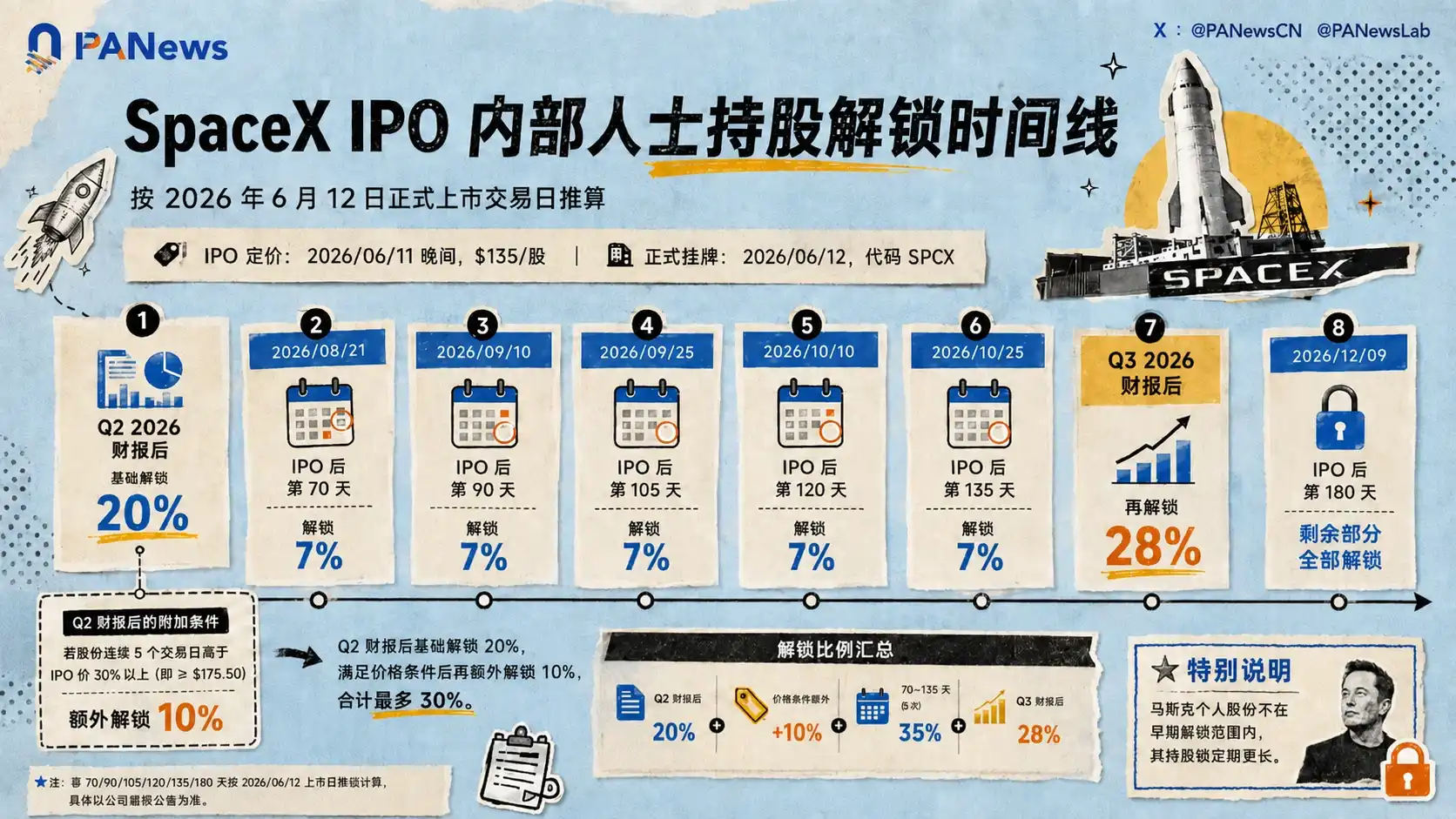
SpaceX IPO Unlock Timeline

marsbit2026-06-17 tarihinde yayınlandı2026-06-17 tarihinde güncellendi

Özet

SpaceX (stock symbol: SPCX) shares have been rising strongly since its IPO, largely due to extremely low immediate float. Currently, only about 4.2% of total shares are freely tradable, locking approximately 96% of the equity. However, a series of share unlock events are scheduled, which could increase selling pressure. After the Q2 earnings report, up to 30% of locked shares may be released. Following that, an additional 7% is set to unlock approximately every 15 days. After the Q3 earnings report, another 28% will be released. The final remaining locked shares are scheduled for full release on December 9th, which is 180 days after the IPO. It is noted that Elon Musk's personal holdings are subject to a longer lock-up period and are not included in these early unlock phases.

SpaceX (SPCX) has been continuously rallying since its listing. The reason might be simple: currently, only about 4.2% of the total outstanding shares are floating, with 96% of the shares still unable to be sold.

But the pressure of unlocking is already counting down: Up to 30% will be released after the Q2 earnings report, followed by an additional 7% unlocked approximately every 15 days. Another 28% will be released after the Q3 earnings report. The remaining portion will be fully unlocked on December 9th (the 180th day after the IPO).

Elon Musk's personal holdings are not included in the early unlock scope and have a longer lock-up period.

İlgili Sorular

QWhat is the approximate percentage of SpaceX's total shares currently available for trading after its IPO?

AApproximately 4.2% of SpaceX's total shares are currently in the float and available for trading.

QAccording to the article, what is the main reason suggested for SpaceX's post-IPO stock price rally?

AThe main reason suggested is the extremely low float, with only about 4.2% of total shares initially available for trading, creating limited supply.

QWhat is the maximum percentage of locked shares that could be released after the Q2 earnings report?

AUp to 30% of the locked shares could be released after the Q2 earnings report.

QHow often will additional share unlocks occur after the initial post-Q2 release, and what is the size of each subsequent unlock?

AAfter the initial release, an additional 7% of shares will unlock approximately every 15 days.

QAre Elon Musk's personal shares subject to the same early unlock schedule as described in the article?

ANo, Elon Musk's personal shares have a longer lock-up period and are not included in the early unlock schedule.

İlgili Okumalar

Can Japan Buy Growth with AI? Will the Bond Market Believe It?

Japan's cabinet has introduced the 2026 Basic Policy on Economic and Fiscal Management and Reform, shifting its primary fiscal target. The new framework moves away from the traditional annual primary balance goal and instead prioritizes a stable reduction of the debt-to-GDP ratio. This change is tied to a strategy of increased "responsible proactive fiscal" spending, aiming to boost long-term growth through investments in strategic sectors like AI, semiconductors, energy, and robotics. The government estimates total public and private investment in 62 key technologies could exceed 370 trillion yen by 2040. The market reaction has been mixed and cautious. While equity markets may respond to policy signals, bond markets are focused on fiscal credibility. Concerns center on whether the weakening of the clear primary balance anchor could lead to looser fiscal discipline. If investors doubt that these strategic investments will generate sufficient productivity gains, tax revenue, and nominal growth to outpace rising interest costs, they may demand higher yields on Japanese Government Bonds (JGBs). Recent volatility in the yen and JGB yields, with the 10-year yield briefly reaching 2.9%, reflects this skepticism. The success of this new framework hinges on two factors: whether Japan can achieve a nominal growth rate consistently higher than its long-term interest rates, and whether future budgets demonstrate disciplined control over bond issuance. The government's narrative is that strategic investment is essential to break Japan's cycle of low growth, aging, and labor shortages. However, the bond market will continuously assess the credibility of this plan, pricing the risk that it may represent fiscal expansion rather than a viable growth strategy.

marsbit21 dk önce

Can Japan Buy Growth with AI? Will the Bond Market Believe It?

marsbit21 dk önce

Misjudged A-Shares: Resilience, Expectations, and Confidence

China's A-share market recently faced selling pressure, especially in tech sectors, initially triggered by a global tech sell-off that began in South Korea. However, the article argues this is a case of "mistaken injury" and highlights the market's underlying resilience. This resilience stems from three main pillars: **1) Tech Sector Fundamentals:** Unlike Korea's market dominated by a few memory chip stocks, China's tech sector is diversified across computing, communications, electronics, and semiconductors, supported by dual narratives of global AI supply chains and domestic substitution. Core areas like optical modules and fiber optics continue to show strong earnings growth. **2) "National Team" Support:** State-backed institutions and large corporations have made significant market purchases and announced buybacks, providing liquidity and signaling confidence. This is seen as a stabilizing policy signal, often associated with market bottoms. **3) Broader Market Pillars:** Other major sectors are showing endogenous recovery momentum. Consumer stocks benefit from stabilizing CPI and signs of sector recovery (e.g., liquor price hikes). Cyclical sectors like aluminum have high earnings, potential price increases due to tight supply, and low valuations. The financial sector offers stable dividends and low valuations. The conclusion is that the sell-off was driven by external contagion, not a collapse in fundamentals. With strong policy support and recovering momentum across key sectors, the A-share market possesses the toughness to regain stability.

marsbit52 dk önce

Misjudged A-Shares: Resilience, Expectations, and Confidence

marsbit52 dk önce

İşlemler

Spot
活动图片