Source: Ben Felix Podcast
Compiled by: Felix, PANews
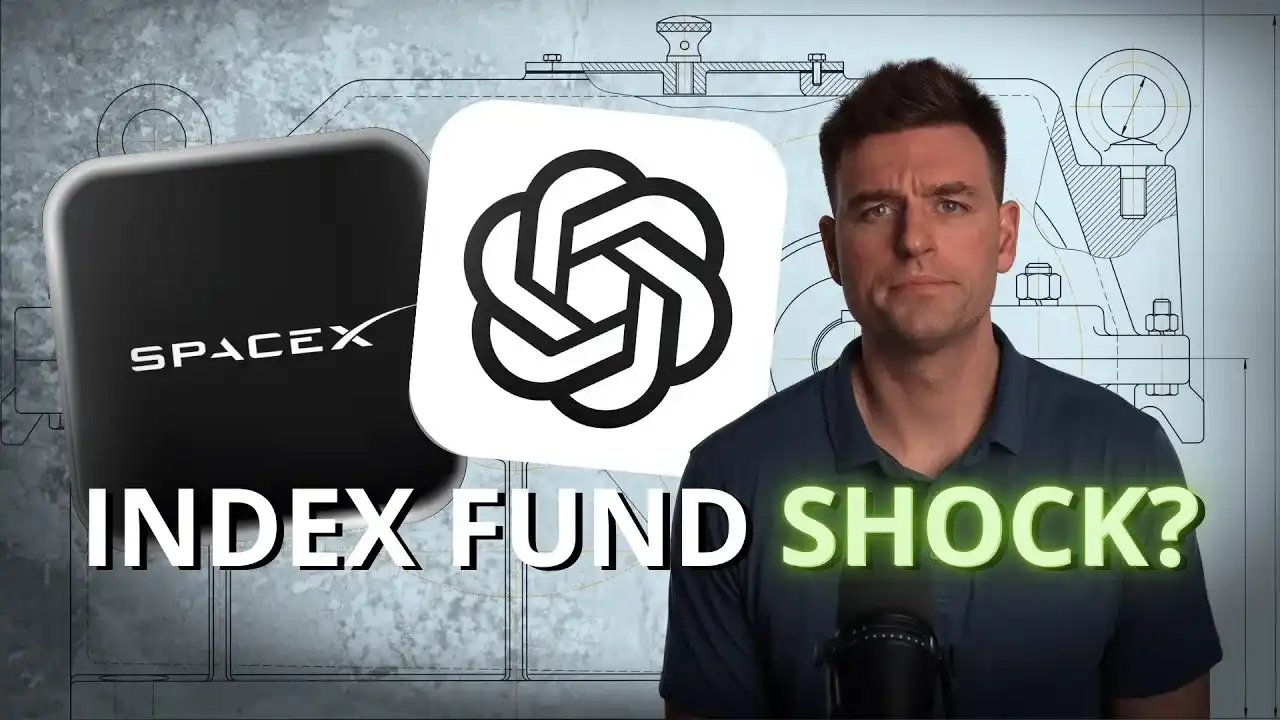
Editor's Note: Recently, SpaceX, under Elon Musk's leadership, has secretly filed IPO registration documents with the U.S. SEC, targeting a listing as early as June. The company plans to raise $50-75 billion, with a target valuation of approximately $1.75 trillion, potentially making it the largest IPO in history.
Amid the market's excitement, some have pointed out that such super IPOs are a 'disaster' for retail investors, especially index fund investors. Ben Felix, Chief Investment Officer at PWL Capital, recently stated in a podcast that super IPOs like SpaceX and OpenAI are a carefully designed 'scam' and shared what the upcoming super IPOs mean for retail investors and their portfolios.
PANews has compiled the highlights of the podcast. Details are as follows.
If private companies like SpaceX, OpenAI, and Anthropic go public, they will rank among the world's largest companies. For index fund investors, this means that regardless of whether you are optimistic about these companies, your funds will be forced to buy their stocks.
The original intention of index funds is to perfectly replicate the performance of the public stock market. To stay as close to the market as possible, many index construction rules require the inclusion of companies as soon as they go public. While this is reasonable from a macro-representative perspective, historical data shows that blindly buying IPO stocks often yields poor returns.
Today, index funds control trillions of dollars. When a newly listed stock is included in a major index, it means a massive inflow of funds into that stock. Because index funds are forced to buy, this provides ample liquidity for sellers and drives up the stock price. This is extremely beneficial for the shareholders of the newly listed company (such as insiders and early investors), but not for the index fund investors who have to become the 'bag holders.'
Companies typically prefer to go public when they believe they can sell at a high price. This means that when ordinary investors finally get to buy the stock on the secondary market, it is precisely when the company insiders believe the stock is overvalued or priced extremely high. Investors generally do not want to buy overvalued stocks, but index funds do not have this discretion. Regardless of the stock price, they must buy any stock included in the index.
Different indices have varying rules for including IPOs. For example, the current S&P 500 index requires a stock to be traded on a public exchange for 12 months before inclusion; the S&P Total Market Index, however, allows stocks meeting specific conditions to be included in as little as 5 days after listing, known as 'fast entry.'
According to Bloomberg, S&P is considering modifying the rules of the S&P 500 index to accelerate the inclusion of super IPOs like SpaceX; Nasdaq is also considering similar adjustments to the Nasdaq 100 index.
A 2025 paper studied the impact of 'fast entry' into the CRSP US Total Market Index (tracked by large ETFs like VTI, with inclusion in as little as 5 days) on stock returns. The authors found that due to the expectation that index investors would be forced to buy, IPOs taking the 'fast entry' route often performed more than 5 percentage points higher than non-fast-track IPOs post-listing. However, this outperformance peaked on the index inclusion day and significantly declined within the following two weeks. Essentially, index funds are being 'front-run' by intermediaries like hedge funds, who know that index funds will buy the stocks once they meet the inclusion criteria. These intermediaries then sell when the price falls back close to its IPO price, while index funds continue to hold these stocks. The authors refer to this as a high 'invisible tax' paid by index fund investors, with these intermediaries acting like ticket scalpers for concerts.
Another important concept related to super IPOs is 'free float,' which is the proportion of a company's shares available for purchase on the public market. Most major indices have minimum free float requirements and determine stock weightings based on free float. Some companies go public by releasing only a very small portion of their total market capitalization, known as a 'low float IPO.'
According to the Financial Times, SpaceX plans to go public with a free float of less than 5%, far below the average. Even with a valuation of $1.75 trillion, with only a 5% free float, most indices would only weight it at $88 billion, and many indices might even exclude it entirely. Nasdaq originally had a minimum free float requirement of 10%, but after recent public consultation, they approved rule changes that not only accelerated IPO access but also removed the lower limit for free float.
A pessimistic view is that Nasdaq changed the rules of the Nasdaq 100 index to attract SpaceX to list on its exchange. If SpaceX is included in the Nasdaq index, it would force index funds to buy heavily. This is good news for SpaceX, its early investors, and Nasdaq, but the cost will most likely be borne by the investors of the Nasdaq 100 index.
Despite differences in index construction, there is no doubt that these super IPOs will change the landscape of the public market. A blog post by S&P Global pointed out that SpaceX, OpenAI, and Anthropic alone could account for 2.9% of the weight in the S&P Global Index, almost equivalent to the entire Canadian market. MSCI, an index provider, calculated the impact of the top 10 private companies going public in a February 2026 blog post (at that time, SpaceX's valuation was predicted to be only $800 billion, but the overall point still stands): with a 5% free float, only 4 companies could be included; with a 10% free float, 7 could be included. MSCI found that even with a 25% free float, the forced adjustments by index funds would lead to massive capital flows: newly listed companies would attract billions of dollars, while the largest existing listed companies would see billions of dollars flow out. These forced buying flows ultimately affect the interests of index fund investors.
The core fact to understand this phenomenon is: investing in IPOs is one of the worst investment strategies available. Although IPOs often surge on the first day of trading, most investors cannot get the offering price and can only buy in the public market after the surge, with subsequent performance being dismal.
This phenomenon of IPO underperformance even has a specific name: the 'new issues puzzle,' first proposed in a 1995 paper. The paper found that the average annual return of IPOs from 1970 to 1990 was only 5%, while the return for similar-sized already public companies was 12% during the same period. To achieve the same return after 5 years, investors would need to invest 44% more capital in the IPO.
Dimensional Fund Advisors (DFA) analyzed the first-year performance of over 6000 IPOs in the secondary market from 1991 to 2018 in a 2019 study. They found that the IPO portfolio underperformed the broader market and small-cap indices by about 2% annually. The only exception was during the 1992-2000 internet bubble when small tech IPOs surged, but the subsequent crash is well-known. The study pointed out that IPO stocks exhibit characteristics similar to 'small, high-growth expectation, low-profit margin, aggressive expansion' stocks, often referred to as small junk growth stocks, which are highly volatile and lag the market in the long run.
This is also reflected in ETF products focused on IPOs. The Renaissance IPO ETF, which specializes in investing in large new U.S. stocks, has underperformed the total U.S. stock market ETF (VTI) by more than 6 percentage points annually since its inception in October 2013. The IPO return database compiled by IPO expert Jay Ritter shows that from 1980 to 2023, buying and holding IPO stocks for three years in the secondary market underperformed the market by an average of 19 percentage points.
Low float IPOs perform even worse because the limited supply of shares available for trading amplifies price volatility due to concentrated demand. This is widely expected to be the method of listing for OpenAI and SpaceX.
Data shared by Ritter shows that since 1980, there have been only 11 low float (i.e., below 5% free float) IPOs with inflation-adjusted trailing twelve-month sales of $100 million or more. Ten of these IPOs underperformed the market within three years, lagging the offering price by about 50% on average and the first-day closing price by over 60%. This indicates that supply constraints indeed drive early price surges, but they are often followed by significant underperformance.
Furthermore, these IPOs often have extremely high price-to-sales (P/S) ratios at the time of listing. If SpaceX goes public with a $1.75 trillion valuation, its P/S ratio would exceed 100x. In comparison, Palantir, currently the highest P/S ratio in the S&P 500, is at 73x, while the S&P index average is only 3.1x.
Overall, high valuations are generally associated with lower expected future returns. For index fund investors, the issue is more complex. When large private companies go public at high valuations, they change the landscape of the broader market. In response, indices must readjust to remain representative of the broader market.
Market-cap-weighted indices must rebalance to reflect changes in market composition, meaning index funds implicitly participate in 'market timing.' The problem is that this is often very bad market timing. Companies tend to issue shares and go public when valuations are extremely high and buy back shares when valuations are low. Therefore, index funds, in their effort to track the index, end up forced to buy high and sell low.
A 2025 paper estimated that this passive timing due to index rebalancing results in an annual performance drag of 47 to 70 basis points (0.47% - 0.70%) on the portfolio.
Since companies are staying private longer before going public, should ordinary investors try to seek opportunities to invest in private companies before their IPO? There are several serious problems here:
Survivorship Bias: For every SpaceX or OpenAI you hear about, there are thousands of private companies that fail or do not grow. Survivorship bias in the private market is far more brutal than in the public market.
Extremely High Implicit Fees: The fees and costs associated with investing in private companies often eat away at the returns from holding them. The Wall Street Journal reported that a Special Purpose Vehicle (SPV) designed to buy SpaceX shares charged up to 4% in front-end fees and took an additional 25% of future profits as a carry. There are also risks of unclear ownership due to complex structures and pure fraud.
Liquidity Drought and Anomalous Losses: Unless you are an internal employee, financial intermediaries with access to private stock channels will not simply hand you a windfall. For example, the ERShares Private-Public Crossover ETF (XOVR) bought SpaceX through an SPV in December 2024. Although SpaceX's valuation increased significantly afterward, due to the SPV's lack of liquidity, this ETF, as a liquid ETF holding illiquid assets, faced a series of practical issues. The result was that the fund not only lost money in absolute terms but also severely underperformed the market.
As Jeff Ptak, a Director at Morningstar, pointed out: 'In investing, the more you crave something, the more you should probably question your initial desire to own it.' Investors are too eager to get a piece of the pie, and in this case, it backfired.
For index fund investors, super IPOs will inevitably affect market indices and the funds that track them, especially when these companies are given 'fast entry.' Bound by their operating mechanism, index funds will blindly buy these IPO stocks at any price, and the massive buying pressure can even further push up the purchase cost of the stocks.
If you are an index fund investor, this is an implicit cost you have been paying, or rather, it is a part of life in index investing that must be accepted. You can choose to continue to endure and accept it, or you can look for alternative products that do not blindly and automatically buy IPO stocks. Finally, it is almost impossible for ordinary people to get shares in these scarce private companies before their IPO; when everyone is scrambling to buy, the high price or high barrier to entry will inevitably consume most of the returns you expect to gain.