Space Review|2026 Outpost: Narrative Recedes, Value Flows to Resilient Ecosystems with Real Yield

深潮2025-12-24 tarihinde yayınlandı2025-12-24 tarihinde güncellendi

Özet

As 2025 draws to a close, the crypto market is shifting from hype-driven speculation to a focus on sustainable value. The recent SunnPump roundtable, "2026 is Coming, No Laying Flat in Crypto," explored this transition, emphasizing that the path to 2026 depends on ecosystems with real utility and organic demand, not short-term narratives. Experts agreed that the market is moving towards a phase driven by genuine cash flows and capital efficiency. Tron was highlighted as a prime example of a mature "digital financial infrastructure," distinguished by its dominant role in stablecoin settlements. With nearly $80 billion in on-chain USDT circulation—half the global market—and daily stablecoin transfers of $20-24 billion, Tron has built a resilient ecosystem anchored in real-world use cases like payments and lending. Its TVL of ~$24 billion, including $10.4 billion in JUST Protocol, reflects deep liquidity and organic activity. The discussion on DeFi sustainability centered on projects with real revenue generation, not subsidized yields. Protocols like JustLend DAO exemplify this with a diversified income model from staking services and lending, using fees to buy back and burn its JST token, creating a deflationary feedback loop. This aligns protocol success with tokenholder value. Tron’s $204 million in protocol revenue in November 2025, leading all public chains, underscores the power of its real economic activity. In conclusion, the key to enduring market cycles lies in ecos...

As 2025 draws to a close, the crypto market is once again shrouded in a familiar sense of anxiety: macro liquidity expectations are wavering, the hype curve of on-chain narratives is gradually flattening, and market sentiment is transitioning from the exuberance of mid-year to a more rational scrutiny. The asset volatility once driven by sentiment and hot topics is now giving way to a more fundamental question—as the short-term noise fades, which values can truly settle and endure through cycles?

Against this backdrop, the focus of market discussion has quietly shifted from "whether it can rise" to "how it can sustain." Investors and builders alike are trying to clarify where the industry's structural support will lie on the path to 2026. Will it rely on passive pushes from macro liquidity, or will it be based on real yields generated by the protocols themselves? Will it reposition within the existing landscape, or seek breakthroughs in new ecological niches?

To this end, SunnPump recently hosted an online roundtable titled "2026 is Approaching, No Lying Flat in Crypto," inviting several industry observers and builders deeply entrenched in the field to focus on the internal logic of the year-end market, the core elements of DeFi sustainability, and the position and role of TRON in the next phase. This article reviews the key insights from the discussion, attempting to outline a rational roadmap to 2026 from multiple dimensions such as capital structure and ecological evolution.
Narrative Recedes, Utility Rises: The 2026 Cycle Belongs to Mature Ecosystems with Real Demand

In the first topic of the roundtable, the guests delved into the fundamental differences between the "year-end market" and "heading towards 2026" from perspectives such as capital flows, market psychology, and structural shifts. Despite varying expressions, the consensus was clear: the year-end volatility is more like a short-term game, while the path to 2026 depends on the ability to build a long-term, sustainable value structure.

JaegerC set the tone for the discussion, likening the year-end market to "a breath" after experiencing fluctuations, a "position balancing and probing" at the trading level. He believes that the current market is transitioning from a phase driven by speculation and narratives to a new phase driven by real cash flows and asset structures. Therefore, the year-end "test" is to screen out projects qualified to enter the next long-term structure, and the core of 2026 will be a comprehensive restructuring of capital efficiency and value logic.

Anna Tangyuan's view was more straightforward and sharp. She explicitly stated that the year-end market addresses the short-term question of "whether the price can rise," relying on emotion and impulse; while 2026 addresses the survival question of "whether it can survive," relying on business models that can operate stably without subsidies.

When the discussion focused on specific ecosystems, TRON became an excellent case study. The guests unanimously agreed that TRON,凭借其在稳定币结算领域的绝对主导地位,以及由此衍生出的强大、自洽的金融生态, has entered the mature stage of "digital financial infrastructure."

Tian Tian Sweety provided solid footnotes for TRON's ecological status with a set of highly convincing on-chain data: nearly $80 billion USDT in on-chain circulation, accounting for half of the global market; daily stablecoin transfers as high as $20-24 billion, building a continuously operating value channel; the Total Value Locked (TVL) of the JUST protocol has exceeded $10.4 billion, while the overall TVL of the TRON network is close to $24 billion, depicting a financial landscape with deep capital沉淀 and a vibrant, healthy ecosystem.
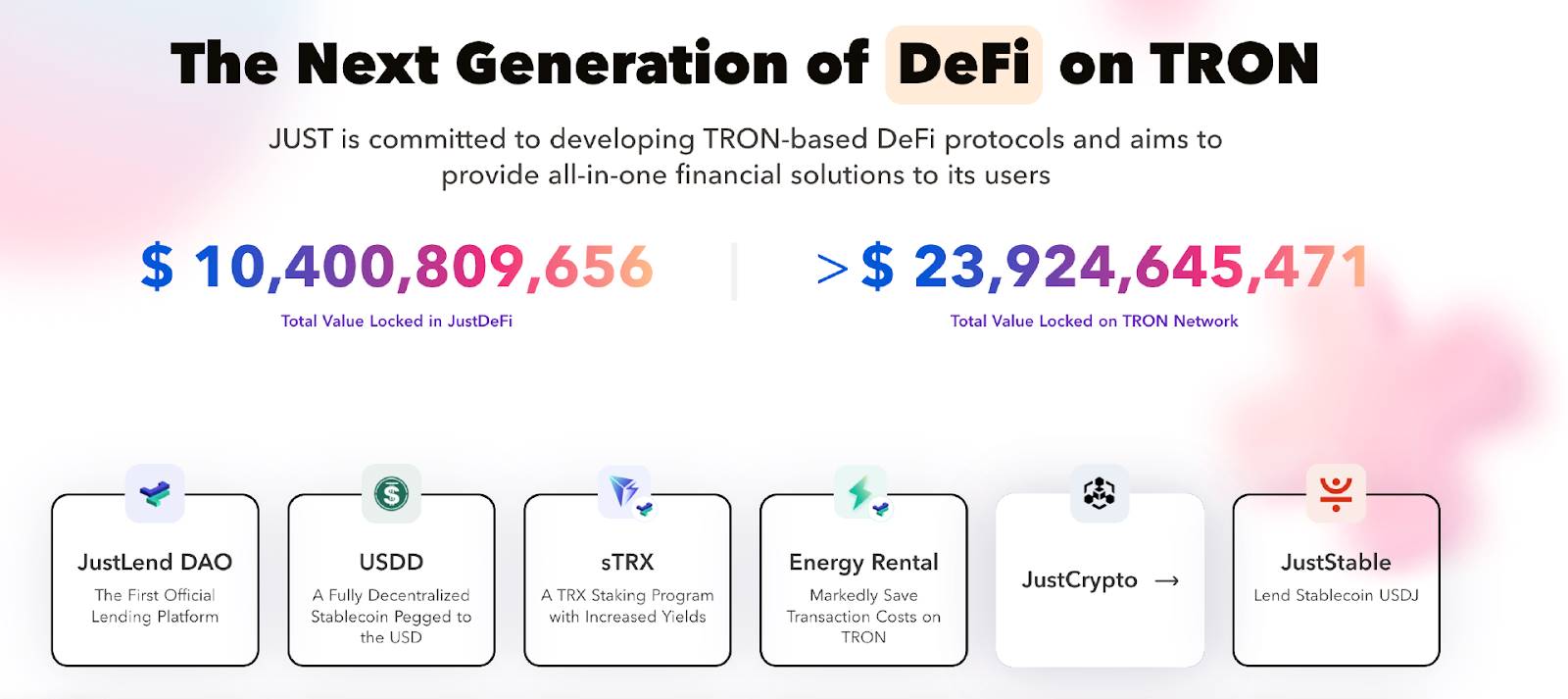
She emphasized that these figures do not come from short-term incentives or hype but are naturally driven by real demands for payments, lending, and staking worldwide, forming a resilient and self-reinforcing "value circulation system." She positioned TRON as "the infrastructure brain shouldering the重任 of global stablecoins and payments," whose complete ecological matrix and absolute depth in the stablecoin track constitute an insurmountable moat.

Anna Tangyuan reinforced this judgment from the most intuitive user experience perspective. She stated that for her and many users, TRON is no longer an "investment target" whose price needs constant attention, but a handy, reliable, low-cost transfer tool, like "a built-in tool app on a phone". This characteristic of "worry-free" and "undebatable" is precisely the mark of its maturity as infrastructure, which determines its unique stability during market fluctuations.

In summary, TRON has long ceased to be a "public chain competitor" that needs to rely on market narratives to prove its value but has evolved into a critical settlement layer in the global economy for processing high-frequency, high-value transfers. The prosperous DeFi applications within its ecosystem, low transaction costs, and极致 transfer efficiency together form a business system that does not rely on short-term subsidies and possesses a powerful endogenous circulation capability. This aligns perfectly with the core logic of "heading towards 2026": building a value structure capable of weathering cycles and sustaining itself.

The Cornerstone for Weathering Bull and Bear Markets: Real Cash Flow, Stable Demand, and Endogenous Resilience

When the topic turned to "what kind of DeFi projects can truly weather cycles," the roundtable discussion moved from observing market phenomena to deconstructing the essence of projects. The guests unanimously moved beyond the obsession with "high yield" and pointed to a more resilient underlying logic. The practices and development path of the TRON ecosystem恰好 provided a concrete and vivid example.

JaegerC systematically elaborated on the core elements for weathering cycles: real cash flow and stable endogenous demand. He believes that yield must come from the protocol's own fees and interest rate spreads, not short-term speculation. Moreover, the protocol should serve the rigid demands of economic activities like lending and payments. Tian Tian Sweety held a similar view, pointing out that projects capable of weathering cycles must be "infrastructure-level," possessing strong "self-sustaining" capabilities. High TVL and risk resistance stem from real fee-based cash flow and high usage rates, not subsidies.

This logic is clearly validated in the core protocols of the TRON ecosystem. Taking JustLend DAO as an example, its protocol revenue

does not rely solely on lending spreads but is a model of diversified real yield. Its main income comes from the liquid staking service (sTRX) provided to TRX holders, which constitutes the vast majority of its total revenue; meanwhile, interest income from traditional lending markets provides a stable supplement.

Crucially, the protocol designs a direct value feedback loop: the net income generated by the protocol is regularly used to repurchase and burn its governance token, JST, on the open market. This not only makes JST a deflationary asset but also tightly binds the success of the protocol's business (real cash flow) with the long-term interests of token holders (deflationary support for token value). Therefore, regardless of market sentiment fluctuations, as long as the real on-chain demand for staking and lending persists, the protocol can not only generate sustainable cash flow but also capture and feed this value back to ecosystem participants through the deflation mechanism. This is precisely the typical characteristic of the "high-resilience" projects emphasized by JaegerC—driven by real economic activity and possessing endogenous value regression capabilities.

Anna Tangyuan通俗化 the professional logic with a series of vivid metaphors. She pointed out sharply that many high-yield projects earn "money subsidized by the project team"; once the incentives stop, people leave and the building empties. Real cycle-weathing projects are more like the convenience store downstairs or a highway—no discounts, no hype, but they持续 generate收益 based on "being used year-round," "long-term existing demand," and "being reusable." She emphasized that real yield should come from real usage, not amplified incentives.

For millions of users worldwide, using the TRON network for USDT transfers is precisely because of its practical value of being "fast" and "cheap." This high-frequency, rigidly demanded "real usage" constitutes the most solid foundation of the ecosystem. The long-term appeal of DeFi products like SUN.io within the ecosystem is also rooted in this genuine network utility and asset沉淀, not temporary subsidy amplification. In November 2025, TRON's protocol revenue exceeded $204 million this month, achieving a断层式领先 position in the revenue rankings of major public chains. This market performance is a direct result of its massive real asset沉淀 and continuous network utility, demonstrating the underlying ecosystem's solid health and value capture ability.

Synthesizing the guests' views, a DeFi ecosystem capable of weathering bull and bear markets must evolve into an organic entity in the digital economy that provides real value, meets stable demand, and possesses endogenous resilience. The TRON ecosystem, by focusing on and彻底打通 the core rigid demand of "efficient global value flow," has taken the lead in completing the leap from a single public chain to a comprehensive financial infrastructure. It has built an organic whole centered on massive stablecoin circulation (real demand and cash flow) and a high-throughput, low-cost public chain (reusable infrastructure), naturally衍生出 lending, trading, staking, and other rich DeFi scenarios. In this system, the value capture of the protocols is closely linked to the practical value of the network, forming a life form with powerful internal circulation and anti-cycle resilience. This is not only the structural answer for the TRON ecosystem to weather cycles but also provides a clear and powerful reference for the industry to explore sustainable development paths.


İlgili Sorular

QWhat is the main shift in focus for the crypto market as it approaches 2026, according to the article?

AThe market focus is shifting from short-term speculation and narrative-driven growth to long-term, sustainable value structures built on real yields, genuine utility, and resilient ecosystems.

QWhat key role does the TRON network play in the current crypto ecosystem, as highlighted by the panelists?

ATRON has evolved into a mature 'digital financial infrastructure,' serving as a critical settlement layer for global stablecoin transactions, with nearly $80 billion USDT in circulation and handling $20-24 billion in daily stablecoin transfers.

QWhat are the core characteristics of a DeFi project or ecosystem that can truly survive market cycles, as discussed in the roundtable?

AProjects need genuine cash flow from protocol fees (not subsidies), serve stable endogenous demand (like lending or payments), have a self-sustaining business model, and demonstrate high capital efficiency and intrinsic value.

QHow does the JustLend DAO protocol on TRON generate real yield and create value for its token holders?

AIt generates revenue primarily from liquid staking services (sTRX) and traditional lending. A portion of the net income is used to buy back and burn its governance token JST, creating a deflationary mechanism that ties protocol success directly to token holder value.

QWhy did the panelists consider TRON ecosystem to be a 'resilient' infrastructure rather than just a speculative investment?

ABecause it is widely used as a practical, low-cost, and efficient tool for global payments and transfers. Its value comes from real-world utility and consistent demand, making it stable and 'boring' like essential infrastructure, rather than dependent on market hype or price speculation.

İlgili Okumalar

Gate Research Institute: The 'Wall Street-ization' Wave of Crypto Financial Products – Competition or Integration?

The article titled "Gate Research Institute: Are Crypto Financial Products Sparking a 'Wall Street' Wave—Competition or Convergence?" explores the evolving relationship between the crypto ecosystem and traditional finance (TradFi). The piece begins by reflecting on Bitcoin's original 2009 vision of decentralization, disintermediation, and moving away from banks. It then contrasts this with the 2024 landscape, where key crypto assets like Bitcoin are increasingly held through Wall Street products like ETFs issued by giants like BlackRock. The article questions whether this signifies that TradFi is systematically taking over the rights to issue, price, custody, and distribute crypto financial assets. The core argument is that this is not a zero-sum takeover but rather a bidirectional convergence where each side addresses the other's weaknesses. Crypto offers 24/7 global markets, programmable settlement, and open access but lacks compliant channels, institutional-grade custody, deep fiat liquidity, and mainstream distribution. TradFi possesses these but is constrained by legacy systems, limited operating hours, and slow settlement. Two primary convergence paths are highlighted: * **Path A (CEX to TradFi):** Exemplified by Gate, which has progressed from offering tokenized stocks and CFDs to providing direct, real stock trading (US, Hong Kong, South Korea) within its platform, using USDT. * **Path B (TradFi to Crypto):** Exemplified by Robinhood, which has integrated crypto trading, acquired exchanges like Bitstamp, and is moving traditional assets like stocks onto the blockchain via tokenization and its own Layer 2. Both paths are ultimately competing to become the next-generation, unified financial account—a "super account" where users can seamlessly trade cryptocurrencies, stocks, ETFs, RWA (Real World Assets), and tokenized treasury products in one interface. The growth of RWA and tokenized treasuries (e.g., BlackRock's BUIDL) is presented as the asset-layer fusion, providing stable, yield-bearing assets on-chain and acting as a bridge between the two worlds. In conclusion, the "Wall Street-ization" of crypto is framed as a mutual transformation. Decentralized ideals persist in the protocol layer, while at the application layer, a more efficient, global, and accessible unified capital market is emerging from this convergence. The future competition lies not between crypto exchanges and stockbrokers, but between platforms vying to offer the most comprehensive asset coverage, liquidity, and user experience within a single account.

marsbit5 dk önce

Gate Research Institute: The 'Wall Street-ization' Wave of Crypto Financial Products – Competition or Integration?

marsbit5 dk önce

Claude's Major New Feature: Screen Recording + Voice, Distilling Your Skills into AI Tasks in One Click

Claude has introduced a major new feature called "Record a Skill," available for Pro, Max, and Team users. This function, found in the Claude desktop app's CoWork menu, allows users to create reusable AI skills simply by recording their screen and providing voice narration while performing a task. Claude then automatically analyzes the recording and generates a functional Skill. A hands-on test confirmed the feature works seamlessly. Users start recording via the Skills manager, perform their workflow while verbally explaining the steps and logic, and avoid including sensitive information. After recording, Claude processes the content and creates the Skill, which can be saved and later invoked with a slash command (/). This eliminates the need for manual adjustments or writing complex instruction files. The innovation goes beyond mere efficiency. Previously, creating a Skill required writing a detailed SKILL.md file in Markdown—a significant barrier for non-technical users. "Record a Skill" bypasses this by directly capturing both actions and the implicit reasoning shared in the narration. This lowers the barrier to knowledge transfer and automation, addressing a core challenge in corporate knowledge management: the difficulty of getting experts to write and maintain documentation. However, the feature also highlights a shift in the nature of work. A case study from March 2026 showed a freelancer whose five-year client relationship was effectively replaced by a hand-coded Claude Skill automating their content workflow. With the even lower barrier of screen recording, the ability to distill personal expertise into automatable skills accelerates this trend. The "moat" for work is moving from simply knowing how to do a task to mastering tasks that are difficult or impossible to automate.

marsbit9 dk önce

Claude's Major New Feature: Screen Recording + Voice, Distilling Your Skills into AI Tasks in One Click

marsbit9 dk önce

Feeding AI "Noise" Can Also Boost Scores, This Work Enables Positive Transfer with Noise

Feeding "Noise" to AI Can Improve Performance: A Method Enables Positive Transfer from Noise This work, Semi-Supervised Noise Adaptation (SSNA), introduces a Noise Adaptation Framework (NAF) that challenges traditional transfer learning. Instead of requiring a labeled source domain of real data (e.g., images, text), NAF uses randomly generated Gaussian noise as the source. For a target task with C classes, it constructs C noise clusters by sampling from Gaussian distributions. Although this synthetic noise contains no semantic meaning, NAF trains it to form a discriminative class structure in a shared representation space—clustering same-class noise and separating different classes. The key is aligning this learned structure from the noise domain to the real, sparsely labeled target domain. A small number of target labels are still essential to establish the correspondence between noise clusters and actual classes. The training objective combines: 1) supervised loss on the few labeled target samples, 2) classification loss for the noise to build its structure, and 3) a distribution alignment loss (using Negative Domain Similarity) to minimize the gap between the noise and target domains in the shared space. Experiments show significant gains in few-label settings. With just 4 labels per class, NAF with a ResNet-18 backbone improves accuracy over a standard supervised baseline (ERM) by +12.35% on CIFAR-10, +7.61% on CIFAR-100, +4.38% on DTD-47, and +2.74% on Caltech-101. It also benefits fine-grained datasets and scales to ImageNet-1K (with 100 labels/class) and text classification (AG News). NAF can be integrated into existing semi-supervised methods like FixMatch for further gains. Ablation studies confirm the transferred benefit comes from the discriminative structure of the noise, not randomness itself. Collapsing all noise into a single point causes negative transfer, while increasing separation between noise cluster centers improves performance. The amount of noise per class is less critical once a basic structure forms. In conclusion, this work demonstrates that for positive transfer, the semantic content of source data may not be necessary. What can be effectively transferred is the *organizational structure* of categories within a representation space. This offers a promising alternative for scenarios where real source data is unavailable due to privacy, copyright, or procurement constraints.

marsbit10 dk önce

Feeding AI "Noise" Can Also Boost Scores, This Work Enables Positive Transfer with Noise

marsbit10 dk önce

İşlemler

Spot
活动图片




