South Korea's Crypto Market Shake-Up: How Should Traders View It?

marsbit2026-04-05 tarihinde yayınlandı2026-04-05 tarihinde güncellendi

Özet

South Korea's crypto market is experiencing significant turbulence following a six-month partial business suspension of its second-largest exchange, Bithumb. This event is widely underestimated globally and is not merely a compliance issue; it disrupts the competitive price discovery mechanism in a market where Upbit and Bithumb collectively hold 96% share. A critical structural information asymmetry exists due to language barriers and capital controls. Local political or regulatory shocks—like the 30% BTC crash in December 2024 after martial law was declared, while global markets fell only 2%—often trigger localized tremors first. This creates brief, highly profitable arbitrage windows for those with access to real-time Korean-language information. The "Kimchi Premium," the price gap between KRW and USD crypto pairs, is frequently misread. It is not just a retail sentiment indicator but a gauge of structural capital friction. Historically, this premium has a non-zero floor of about 1.24% due to capital controls, and its contraction often signals shifts in deeper capital pressures rather than a simple return to normality. Bithumb's suspension is accelerating liquidity concentration into Upbit, increasing systemic risk. Extreme price dislocations, like a 17% flash crash in February 2026 caused by a Bithumb operational error, become more likely and destructive in an overly centralized market. The core conclusion is that this structural information asymmetry will persist. T...

Author: Axis

Compiled by: WuBlockchain

TL;DR: Key Points on South Korea's Crypto Market Shake-Up and Information Asymmetry

· The Deep Impact of Bithumb's Suspension: The six-month partial business suspension of Bithumb, South Korea's second-largest exchange, has been severely underestimated by the global market. This is not a simple compliance crackdown; it is dismantling the competitive price discovery mechanism of the South Korean crypto market (where Upbit and Bithumb hold a 96% share).

· A Critical Structural Information Gap: Due to language barriers and capital controls, political or regulatory shocks in South Korea (like the December 2024 martial law declaration that caused a 30% local BTC crash vs. a 2% global drop) often trigger massive local tremors first. The delayed reaction in the English-speaking trading community creates a brief yet highly profitable window for arbitrageurs with first-hand information.

· Re-evaluating the "Kimchi Premium": The premium is not just a sentiment indicator for retail investors; it's a "thermometer" for cross-border capital friction. Under capital controls, Bitcoin maintains a structural non-zero floor of about 1.24%. A contraction in the premium often signals a shift in underlying capital pressures, not just a return to normalcy.

·Liquidity Oligopoly Risk: Bithumb's suspension is accelerating the concentration of funds into Upbit. Excessively concentrated liquidity is prone to extreme volatility (e.g., a 17% flash crash in BTC/KRW in February 2026 due to a Bithumb operational error), making future market dislocations more hidden and destructive.

· Core Conclusion: As the contradiction between institutional capital inflows from the new government's "pro-crypto" policies and the tightening of retail infrastructure intensifies, this structural "information asymmetry" in the South Korean market will persist, continually generating fleeting excess arbitrage (Alpha) opportunities.

A Market-Shaking Event Just Occurred, But Was Largely Underestimated by Global Traders

On March 15, South Korea's financial regulator imposed a six-month partial business suspension on Bithumb, the country's second-largest crypto exchange. English-language media largely treated it as routine compliance news, involving anti-money laundering (AML) enforcement and regulatory cleanup. However, most reports missed its deeper implications.

In reality, this is a structural market event occurring within one of the deepest on-chain fiat liquidity pools, with repercussions extending far beyond South Korea. Upbit and Bithumb together account for about 96% of the trading volume in the South Korean cryptocurrency market. Bithumb's suspension is not only reshaping the domestic market landscape but also weakening the quality of price signals this market has transmitted to global traders for years.

Simply put, South Korean crypto users are extremely active, but the system they operate in is constrained by capital controls, highly concentrated exchanges, and persistent language barriers. This unique environment means critical information affecting prices often ferments locally first before spreading globally. This creates a brief time window, causing a disconnect between local and global markets.

Global Traders Are Always a Step Behind: Due to Structural Differences, Not Chance

South Korea is by no means a peripheral market in crypto; it is one of the most valuable markets for insights into the origins of global on-chain opportunities. The Korean Won (KRW) is the second-largest fiat currency in the global crypto market by trading volume, with year-to-date trading reaching approximately $663 billion, accounting for nearly 30% of global fiat-to-crypto trading volume. Furthermore, nearly one-third of South Korean adults hold digital assets, double the proportion in the United States.

The current South Korean government, which took office in June 2025, ran on what is considered one of the most explicit "pro-crypto" political manifestos in history. Since the president's inauguration, nearly half of the top 30 performing stocks in the Korea Composite Stock Price Index (KOSPI) have been related to digital assets. Traditional stock markets quickly digested this positive signal, but the broader crypto community was largely slow to react.

This market dislocation is not an isolated case. Local political and regulatory developments in South Korea typically ferment first in Korean-language media and local Crypto Twitter (CT), causing anomalies in KRW trading pairs on Upbit and Bithumb, while English-language media often follow up hours or even days later. This information gap works in reverse too: global macro developments originating in the English-speaking context also take time to be fully priced into local Korean trading pairs. Often, by the time the information is translated and disseminated, the initial market move is over.

The most stark example occurred on December 3, 2024, when South Korean President Yoon Suk-yeol declared martial law. Driven solely by this domestic political shock, the price of BTC on South Korean exchanges plummeted by approximately 30% intraday, while the global market decline was only around 2% — a staggering price difference of 28 percentage points. The total scale of this sell-off was about $33.3 billion, briefly making the South Korean market the highest volume market globally.
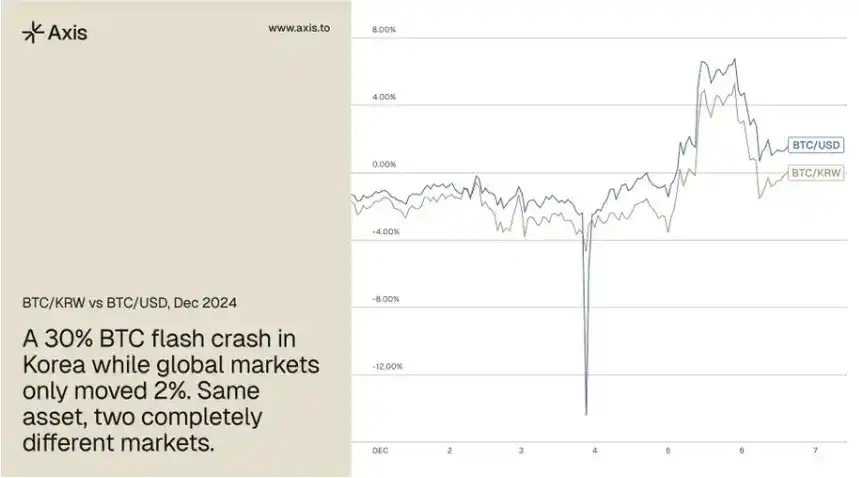
This event is a classic缩影 (snapshot) of South Korean market dislocation. Buy-side liquidity evaporated instantly, sell-side pressure surged dramatically, and the selling was almost entirely concentrated on Korean Won (KRW) trading pairs. Even stablecoins experienced severe de-pegging, with USDT dropping to $0.75 on Korean exchanges, while BTC and altcoins showed deep discounts of over 50% compared to global market prices.

Local Korean users, mistakenly believing they were scrambling for the last liquidity exit, frantically sold at market prices even though global markets were barely moving. On-chain data shows arbitrageurs sprang into action, moving millions of USDT in single transactions to arbitrage away the price difference. The huge流量 (traffic) caused front-end systems of major exchanges to crash, preventing retail users from logging in to buy the dip. During this brief window, only API traders could execute orders successfully. By any measure, this was an extremely tradeable "seismic" event, but the arbitrage window closed within just a few hours.

Bithumb's current suspension is replaying the same script. The news has been circulating in Korean-language information circles for weeks, while most traders in the English-speaking context are only hearing about it now.

The "Kimchi Premium" Is Closely Watched But Often Misinterpreted

For traders lacking access to Korean information channels, the "Kimchi Premium" has long been the most direct observable metric for gauging South Korean market dynamics. This premium measures the price difference between crypto assets priced in Korean Won (KRW) and those priced in US dollars globally. Consequently, experienced traders have long closely monitored KRW market volume. South Korea's spot altcoin market volume ranks among the highest globally and has historically been a reliable leading indicator for broader market trends.

The crux is that most traders misinterpret this signal. The market generally views the premium simply as a sentiment indicator for Korean retail investors. While retail sentiment is a factor, in a market where cross-border capital flows face regulatory friction, the premium more deeply reflects the intensity of structural capital pressures. When this regulatory friction intensifies, price dislocations tend to magnify.

Historical data makes this concrete. Looking back to 2017, when the USD/KRW exchange rate was around 1060, the "Kimchi Premium" soared to a peak of 40%, meaning the implied USDT/KRW exchange rate was effectively around 1480. By December 2024, the actual USD/KRW exchange rate did indeed break through 1480. In other words, the premium pre-priced this foreign exchange move years in advance. These signals were hidden in plain sight within publicly available data, but accurate interpretation required access to local Korean information channels.

One constant feature is that this premium does not naturally revert to zero. Research suggests that as long as capital controls exist, Bitcoin's premium will maintain a structural non-zero floor of approximately 1.24%. This means that when the premium contracts towards this level, it typically reflects a shift in underlying capital pressures, not just a simple statistical reversion to the mean.

Looking back at 2025, whenever the premium approached zero, Bitcoin recorded positive returns in the subsequent week and month: its 7-day average return was 1.7%, and its 30-day average return was 6.2%. For traders, the crucial signal is not the absolute value of the "Kimchi Premium" but its dynamic evolution over time.

Bithumb's Suspension Makes Korean Market Dislocation Harder to Predict, Intensifying Information Asymmetry

The effectiveness of the premium as a reference signal depends on how price discovery occurs *between* South Korea's major exchanges. When multiple platforms compete to price similar capital flows, the resulting spreads often contain richer information. However, as liquidity becomes increasingly concentrated among寡头 (oligopolies), the clarity of this signal begins to衰减 (decay). Thus, Bithumb's suspension is dismantling the competitive price discovery mechanism upon which this premium relies.

Following the penalty announcement, funds began rapidly migrating to Upbit, further increasing market concentration. In February 2026, a major operational error at Bithumb, where 620,000 BTC were mistakenly credited to user accounts, caused a 17% flash crash in the BTC/KRW pair before prices recovered. This episode vividly illustrates the extreme conditions that can arise when price discovery hinges heavily on a single platform operating under high pressure.
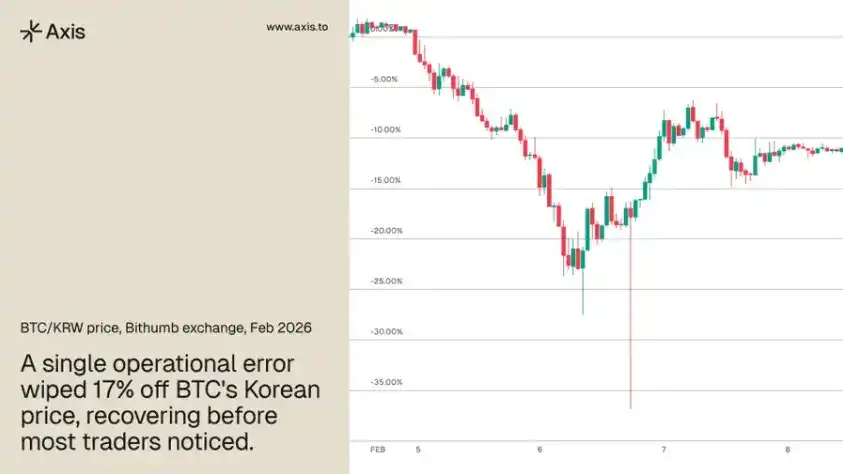
The diminishing reference value of the premium indicator does not mean market dislocations in South Korea are over. Instead, it means such dislocations become harder to predict before they erupt, further widening the information gap between participants directly tracking the Korean market and traders relying solely on English-language information.

The underlying environment fostering these dislocations is also becoming more acute. In 2025, under harsh trading rules, approximately $110 billion in crypto assets flowed out of South Korea. Under the new government, capital that was structurally squeezed out is being reintroduced through new institutional channels;但同时 (simultaneously), the exchange infrastructure relied upon by retail funds is continually tightening. Historically, such severe policy divergence has been a perfect breeding ground for the most violent and fleeting price dislocations in this market.

South Korea's Market Structure Creates Replicable Information Asymmetry for Global Traders

The "Kimchi Premium" is by no means a unique phenomenon exclusive to South Korea. This mechanism operates to varying degrees in every jurisdiction where cryptocurrency develops as a parallel financial channel alongside capital controls, with the South Korean market being merely the most widely observed example.

Both the December 2024 martial law event and the current Bithumb suspension confirm the same evolutionary logic. Market dislocations here always erupt unexpectedly, rewarding only participants with first-hand information channels, and are quickly arbitraged away before the broader market reacts. The traders who acted decisively on December 3rd weren't inherently faster or smarter. They simply watched the right signals and understood, before the market caught on, how domestic political events in South Korea translated into exchange price mechanisms.

As stablecoin infrastructure deepens globally, more markets will emit signals of capital pressure similar to those generated by South Korea over the past decade. The real challenge lies not in discovering the existence of these signals, but in building the infrastructure and trading discipline to consistently capture these opportunities.

İlgili Sorular

QWhat is the core impact of Bithumb's 6-month partial business suspension on the Korean crypto market?

AThe suspension is not just a compliance issue but is dismantling the competitive price discovery mechanism in Korea's crypto market, where Upbit and Bithumb hold a 96% combined market share. It is causing liquidity to become overly concentrated in Upbit, increasing the risk of extreme market events and making future market dislocations more hidden and destructive.

QWhy do global traders often react slowly to Korean crypto market events, and what opportunity does this create?

ADue to language barriers and capital controls, political or regulatory shocks in Korea (like the December 2024 martial law announcement) first cause local seismic events, often with a significant time lag before the information is translated and reported in English media. This creates a brief but highly profitable window for arbitrageurs with access to primary information sources.

QHow is the 'Kimchi Premium' commonly misinterpreted, and what does it actually represent?

AIt is often misinterpreted as a simple gauge of Korean retail sentiment. In reality, it is a 'thermometer' of cross-border capital friction. Due to capital controls, Bitcoin maintains a structural non-zero floor of about 1.24%. The contraction of the premium signals a shift in deeper capital pressures, not just a return to the mean.

QWhat major event exemplified the extreme market dislocation possible in Korea, and what were its effects?

AThe declaration of martial law in South Korea on December 3, 2024, caused a localized crash where the BTC price on Korean exchanges plummeted approximately 30%, while the global market fell only about 2%. This led to a 28% price gap, a $33.3 billion sell-off, USDT de-pegging to $0.75, and altcoins trading at over 50% discounts, creating a massive but brief arbitrage opportunity.

QWhat is the long-term outlook for information asymmetry and arbitrage opportunities in the Korean crypto market?

AThe structural 'information asymmetry' is expected to persist long-term. This is driven by the contradiction between the new pro-crypto government's policies, which are attracting institutional capital back, and the simultaneous tightening of infrastructure for retail investors. This environment will continue to generate fleeting, excess arbitrage (Alpha) opportunities.

İlgili Okumalar

Why Do You Always Lose Money on Polymarket? Because You're Betting on News, While the Pros Read the Rules

Why do you always lose money on Polymarket? Because you bet on news, while the pros study the rules. This article explains how top traders ("che tou") profit by meticulously analyzing market rules, not just predicting events. Polymarket, a prediction market platform, often sees disputes over event outcomes due to ambiguous rule wording. For instance, a market asking "Who will be the leader of Venezuela by the end of 2026?" was misinterpreted by many who bet on Delcy Rodríguez, assuming she held power. However, the rules specified "officially holds" as the formally appointed, sworn-in individual. Since Nicolás Maduro was still recognized as president officially, he won the market—even being in prison. To resolve such disputes, Polymarket uses a decentralized arbitration system via UMA protocol. The process involves: 1. Proposal: Anyone can propose a market outcome by staking 750 USDC, earning 5 USDC if unchallenged. 2. Dispute: A 2-hour window allows challenges with a 750 USDC stake; successful challengers earn 250 USDC. 3. Discussion: A 48-hour period on UMA Discord for evidence and debate. 4. Voting: UMA token holders vote in two 24-hour phases (blind then public). Outcomes require >65% consensus and 5M tokens voted; otherwise, four re-votes occur before Polymarket intervention. 5. Settlement: Results are final and automatic. Unlike traditional courts, Polymarket’s system lacks separation between arbitrators and stakeholders—voters often hold market positions, creating conflicts of interest. This leads to herd mentality in discussions and non-transparent outcomes without explanatory rulings, preventing precedent formation. Thus, success on Polymarket hinges on deep rule interpretation, not just event prediction, exploiting gaps between reality and contractual wording.

marsbit1 saat önce

Why Do You Always Lose Money on Polymarket? Because You're Betting on News, While the Pros Read the Rules

marsbit1 saat önce

DeepSeek Funding: Liang Wenfeng's 'Realist' Pivot

DeepSeek, a leading Chinese AI company, has initiated its first external funding round, aiming to raise at least $300 million at a valuation of no less than $10 billion. This move marks a significant shift from its founder Liang Wenfeng’s previous idealistic stance of rejecting external capital to maintain independence. Despite strong financial backing from its parent company, quantitative trading firm幻方量化 (Huanfang Quant), which provided an estimated $700 million in revenue in 2025 alone, DeepSeek faces mounting challenges. Key issues include a 15-month gap in major model updates, delays in its flagship V4 release, and the loss of several core researchers to competitors offering significantly higher compensation. The company is also undergoing a strategic pivot by migrating its infrastructure from NVIDIA’s CUDA to Huawei’s Ascend platform, a move aligned with China’s push for technological self-reliance amid U.S. export controls. However, DeepSeek lags behind rivals like智谱AI and MiniMax—both now publicly listed—in areas such as product ecosystem, multimodal capabilities, and commercialization. The funding round, though relatively small in scale, is seen as a way to establish a market-validated valuation anchor, making employee stock options more competitive and facilitating talent retention. It also signals DeepSeek’s transition from a pure research-oriented organization to a commercially-driven player in the global AI ecosystem.

marsbit2 saat önce

DeepSeek Funding: Liang Wenfeng's 'Realist' Pivot

marsbit2 saat önce

İşlemler

Spot
Futures

Popüler Makaleler

$S$ Nedir

SPERO'yu Anlamak: Kapsamlı Bir Genel Bakış SPERO'ya Giriş İnovasyonun manzarası gelişmeye devam ederken, web3 teknolojilerinin ve kripto para projelerinin ortaya çıkışı dijital geleceği şekillendirmede önemli bir rol oynamaktadır. Bu dinamik alanda dikkat çeken projelerden biri SPERO, $$s$$ olarak adlandırılmaktadır. Bu makale, SPERO hakkında ayrıntılı bilgi toplamak ve sunmak amacıyla, meraklılar ve yatırımcıların web3 ve kripto alanlarındaki temellerini, hedeflerini ve yeniliklerini anlamalarına yardımcı olmayı amaçlamaktadır. SPERO,$$s$$ Nedir? SPERO,$$s$$, kripto alanında merkeziyetsizlik ve blok zinciri teknolojisi ilkelerini kullanarak etkileşimi, faydayı ve finansal kapsayıcılığı teşvik eden bir ekosistem yaratmayı amaçlayan benzersiz bir projedir. Proje, kullanıcıların yenilikçi finansal çözümler ve hizmetler sunarak eşler arası etkileşimleri yeni yollarla kolaylaştırmayı hedeflemektedir. SPERO,$$s$$'nin temel amacı, bireyleri güçlendirmek ve kripto para alanındaki kullanıcı deneyimini artıran araçlar ve platformlar sağlamaktır. Bu, daha esnek işlem yöntemlerini mümkün kılmayı, topluluk odaklı girişimleri teşvik etmeyi ve merkeziyetsiz uygulamalar (dApp'ler) aracılığıyla finansal fırsatlar yaratmayı içermektedir. SPERO,$$s$$'nin temel vizyonu kapsayıcılık etrafında dönmekte olup, geleneksel finansal sistemlerdeki boşlukları kapatmayı ve blok zinciri teknolojisinin faydalarından yararlanmayı hedeflemektedir. SPERO,$$s$$'nin Yaratıcısı Kimdir? SPERO,$$s$$'nin yaratıcısının kimliği bir miktar belirsizdir, çünkü kurucusu(ları) hakkında ayrıntılı arka plan bilgisi sağlayan sınırlı kamuya açık kaynaklar bulunmaktadır. Bu şeffaflık eksikliği, projenin merkeziyetsizlik taahhüdünden kaynaklanabilir—birçok web3 projesinin paylaştığı bir etik anlayışı, bireysel tanınmanın yerine kolektif katkıları önceliklendirmektedir. Topluluk ve onun kolektif hedefleri etrafında tartışmaları merkezileştirerek, SPERO,$$s$$, belirli bireyleri öne çıkarmadan güçlendirme özünü taşımaktadır. Bu nedenle, SPERO'nun etik anlayışını ve misyonunu anlamak, tek bir yaratıcının kimliğini belirlemekten daha önemlidir. SPERO,$$s$$'nin Yatırımcıları Kimlerdir? SPERO,$$s$$, kripto sektöründe yeniliği teşvik etmeye adanmış girişim sermayedarlarından melek yatırımcılara kadar çeşitli yatırımcılar tarafından desteklenmektedir. Bu yatırımcıların odak noktası genellikle SPERO'nun misyonuyla uyumlu olup, toplumsal teknolojik ilerlemeyi, finansal kapsayıcılığı ve merkeziyetsiz yönetimi vaat eden projeleri önceliklendirmektedir. Bu yatırımcı temelleri, yalnızca yenilikçi ürünler sunan projelere değil, aynı zamanda blok zinciri topluluğuna ve ekosistemlerine olumlu katkılarda bulunan projelere de ilgi duymaktadır. Bu yatırımcıların desteği, SPERO,$$s$$'yi hızla gelişen kripto projeleri alanında dikkate değer bir rakip haline getirmektedir. SPERO,$$s$$ Nasıl Çalışır? SPERO,$$s$$, onu geleneksel kripto para projelerinden ayıran çok yönlü bir çerçeve kullanmaktadır. İşte benzersizliğini ve yeniliğini vurgulayan bazı temel özellikler: Merkeziyetsiz Yönetim: SPERO,$$s$$, kullanıcıların projenin geleceğiyle ilgili karar alma süreçlerine aktif olarak katılmalarını sağlayan merkeziyetsiz yönetim modellerini entegre etmektedir. Bu yaklaşım, topluluk üyeleri arasında sahiplik ve hesap verebilirlik duygusunu teşvik etmektedir. Token Kullanımı: SPERO,$$s$$, ekosistem içinde çeşitli işlevler sunmak üzere tasarlanmış kendi kripto para token'ını kullanmaktadır. Bu token'lar, işlemleri, ödülleri ve platformda sunulan hizmetlerin kolaylaştırılmasını sağlayarak genel etkileşimi ve faydayı artırmaktadır. Katmanlı Mimari: SPERO,$$s$$'nin teknik mimarisi, modülerlik ve ölçeklenebilirliği destekleyerek projenin evrimi sırasında ek özelliklerin ve uygulamaların sorunsuz bir şekilde entegrasyonuna olanak tanımaktadır. Bu uyum sağlama yeteneği, sürekli değişen kripto manzarasında geçerliliği sürdürmek için hayati öneme sahiptir. Topluluk Katılımı: Proje, işbirliği ve geri bildirim teşvik eden mekanizmalar kullanarak topluluk odaklı girişimlere vurgu yapmaktadır. Güçlü bir topluluk oluşturarak, SPERO,$$s$$, kullanıcı ihtiyaçlarını daha iyi karşılayabilir ve piyasa trendlerine uyum sağlayabilir. Kapsayıcılığa Odaklanma: Düşük işlem ücretleri ve kullanıcı dostu arayüzler sunarak, SPERO,$$s$$, daha önce kripto alanında yer almamış bireyler de dahil olmak üzere çeşitli bir kullanıcı tabanını çekmeyi hedeflemektedir. Bu kapsayıcılık taahhüdü, erişilebilirlik yoluyla güçlendirme misyonuyla uyumludur. SPERO,$$s$$ Zaman Çizelgesi Bir projenin tarihini anlamak, gelişim yolculuğu ve kilometre taşları hakkında kritik bilgiler sağlar. Aşağıda, SPERO,$$s$$'nin evriminde önemli olayları haritalayan önerilen bir zaman çizelgesi bulunmaktadır: Kavram Geliştirme ve Fikir Aşaması: SPERO,$$s$$'nin temelini oluşturan ilk fikirler, blok zinciri endüstrisindeki merkeziyetsizlik ve topluluk odaklılık ilkeleriyle yakından uyumlu olarak geliştirildi. Proje Beyaz Kağıdının Yayınlanması: Kavramsal aşamayı takiben, SPERO,$$s$$'nin vizyonunu, hedeflerini ve teknolojik altyapısını ayrıntılı bir şekilde açıklayan kapsamlı bir beyaz kağıt yayımlandı ve topluluk ilgisini ve geri bildirimini toplamak amacıyla sunuldu. Topluluk Oluşturma ve Erken Katılımlar: Projenin hedefleri etrafında tartışmalar yürüterek destek toplamak ve erken benimseyenler ile potansiyel yatırımcılar için bir topluluk oluşturmak amacıyla aktif iletişim çabaları gerçekleştirildi. Token Üretim Etkinliği: SPERO,$$s$$, yerel token'larını erken destekçilere dağıtmak ve ekosistem içinde başlangıç likiditesini sağlamak amacıyla bir token üretim etkinliği (TGE) gerçekleştirdi. İlk dApp'in Yayınlanması: SPERO,$$s$$ ile ilişkili ilk merkeziyetsiz uygulama (dApp) faaliyete geçti ve kullanıcıların platformun temel işlevleriyle etkileşimde bulunmalarını sağladı. Sürekli Gelişim ve Ortaklıklar: Projenin tekliflerine sürekli güncellemeler ve iyileştirmeler yapılmakta olup, blok zinciri alanındaki diğer oyuncularla stratejik ortaklıklar, SPERO,$$s$$'yi rekabetçi ve gelişen bir oyuncu haline getirmiştir. Sonuç SPERO,$$s$$, web3 ve kripto paranın finansal sistemleri devrim niteliğinde dönüştürme ve bireyleri güçlendirme potansiyelinin bir kanıtıdır. Merkeziyetsiz yönetime, topluluk katılımına ve yenilikçi tasarlanmış işlevselliğe olan bağlılığıyla, daha kapsayıcı bir finansal manzaraya doğru bir yol açmaktadır. Hızla gelişen kripto alanındaki herhangi bir yatırımda olduğu gibi, potansiyel yatırımcılar ve kullanıcılar, SPERO,$$s$$ içindeki devam eden gelişmelerle ilgili olarak kapsamlı bir araştırma yapmaları ve düşünceli bir şekilde katılmaları teşvik edilmektedir. Proje, kripto endüstrisinin yenilikçi ruhunu sergileyerek, sayısız olasılığını keşfetmeye davet etmektedir. SPERO,$$s$$'nin yolculuğu hala devam ederken, temel ilkeleri, teknoloji, finans ve birbirimizle etkileşim biçimimizi etkileyebilir.

89 Toplam GörüntülenmeYayınlanma 2024.12.17Güncellenme 2024.12.17

$S$ Nedir

AGENT S Nedir

Agent S: Web3'te Otonom Etkileşimin Geleceği Giriş Web3 ve kripto para dünyasında sürekli gelişen manzarada, yenilikler bireylerin dijital platformlarla etkileşim biçimlerini sürekli olarak yeniden tanımlıyor. Bu tür öncü projelerden biri olan Agent S, açık ajans çerçevesi aracılığıyla insan-bilgisayar etkileşimini devrim niteliğinde değiştirmeyi vaat ediyor. Otonom etkileşimlerin yolunu açarak, Agent S karmaşık görevleri basitleştirmeyi ve yapay zeka (AI) alanında dönüştürücü uygulamalar sunmayı hedefliyor. Bu detaylı inceleme, projenin karmaşıklıklarına, benzersiz özelliklerine ve kripto para alanındaki etkilerine dalacaktır. Agent S Nedir? Agent S, bilgisayar görevlerinin otomasyonunda üç temel zorluğu ele almak üzere özel olarak tasarlanmış çığır açıcı bir açık ajans çerçevesidir: Alan Spesifik Bilgi Edinimi: Çerçeve, çeşitli dış bilgi kaynaklarından ve iç deneyimlerden akıllıca öğrenir. Bu çift yönlü yaklaşım, alan spesifik bilgi açısından zengin bir veri havuzu oluşturmasını sağlar ve görev yürütmedeki performansını artırır. Uzun Görev Ufukları Üzerinde Planlama: Agent S, karmaşık görevlerin verimli bir şekilde parçalanmasını ve yürütülmesini kolaylaştıran deneyim artırımlı hiyerarşik planlama kullanır. Bu özellik, çoklu alt görevleri etkili ve verimli bir şekilde yönetme yeteneğini önemli ölçüde artırır. Dinamik, Homojen Olmayan Arayüzlerle Başlama: Proje, ajanlar ve kullanıcılar arasındaki etkileşimi geliştiren yenilikçi bir çözüm olan Ajan-Bilgisayar Arayüzü'ni (ACI) tanıtmaktadır. Çok Modlu Büyük Dil Modellerini (MLLM'ler) kullanarak, Agent S çeşitli grafik kullanıcı arayüzlerini sorunsuz bir şekilde gezinebilir ve manipüle edebilir. Bu öncü özellikler aracılığıyla, Agent S, makinelerle insan etkileşimini otomatikleştirmede karşılaşılan karmaşıklıkları ele alan sağlam bir çerçeve sunarak, AI ve ötesinde birçok uygulama için zemin hazırlıyor. Agent S'nin Yaratıcısı Kimdir? Agent S'nin kavramı temelde yenilikçi olsa da, yaratıcısı hakkında spesifik bilgiler belirsizliğini koruyor. Yaratıcı şu anda bilinmiyor, bu da projenin yeni aşamasını veya kurucu üyeleri gizli tutma stratejik tercihini vurguluyor. Anonimlikten bağımsız olarak, odak çerçevenin yetenekleri ve potansiyeli üzerinde kalıyor. Agent S'nin Yatırımcıları Kimlerdir? Agent S, kriptografik ekosistemde oldukça yeni olduğundan, yatırımcıları ve finansal destekçileri hakkında ayrıntılı bilgiler açıkça belgelenmemiştir. Projeyi destekleyen yatırım temelleri veya organizasyonları hakkında kamuya açık bilgilerdeki eksiklik, finansman yapısı ve gelişim yol haritası hakkında sorular doğuruyor. Destekleyicilerin anlaşılması, projenin sürdürülebilirliğini ve potansiyel pazar etkisini değerlendirmek için kritik öneme sahiptir. Agent S Nasıl Çalışır? Agent S'nin temelinde, çeşitli ortamlarda etkili bir şekilde çalışmasını sağlayan son teknoloji bir sistem yatmaktadır. İşleyiş modeli birkaç ana özellik etrafında inşa edilmiştir: İnsan Benzeri Bilgisayar Etkileşimi: Çerçeve, bilgisayarlarla etkileşimleri daha sezgisel hale getirmeyi amaçlayan gelişmiş AI planlaması sunar. Görev yürütmedeki insan davranışını taklit ederek, kullanıcı deneyimlerini yükseltmeyi vaat eder. Anlatı Belleği: Yüksek düzeyde deneyimlerden yararlanmak için kullanılan Agent S, görev geçmişlerini takip etmek amacıyla anlatı belleğini kullanarak karar verme süreçlerini geliştirir. Episodik Bellek: Bu özellik, kullanıcılara adım adım rehberlik sağlayarak, çerçevenin görevler gelişirken bağlamsal destek sunmasına olanak tanır. OpenACI Desteği: Yerel olarak çalışabilme yeteneği ile Agent S, kullanıcıların etkileşimleri ve iş akışları üzerinde kontrol sağlamasına olanak tanır ve Web3'ün merkeziyetsiz felsefesiyle uyumlu hale gelir. Dış API'lerle Kolay Entegrasyon: Çeşitli AI platformlarıyla uyumluluğu ve çok yönlülüğü, Agent S'nin mevcut teknolojik ekosistemlere sorunsuz bir şekilde entegre olmasını sağlar ve geliştiriciler ile organizasyonlar için cazip bir seçenek haline getirir. Bu işlevsellikler, Agent S'nin kripto alanındaki benzersiz konumuna katkıda bulunarak, karmaşık, çok aşamalı görevleri minimum insan müdahalesi ile otomatikleştirir. Proje geliştikçe, Web3'teki potansiyel uygulamaları dijital etkileşimlerin nasıl gelişeceğini yeniden tanımlayabilir. Agent S'nin Zaman Çizelgesi Agent S'nin gelişimi ve kilometre taşları, önemli olaylarını vurgulayan bir zaman çizelgesinde özetlenebilir: 27 Eylül 2024: Agent S'nin kavramı, “Bilgisayarları İnsan Gibi Kullanan Açık Bir Ajans Çerçevesi” başlıklı kapsamlı bir araştırma makalesi ile tanıtıldı ve projenin temelini sergiledi. 10 Ekim 2024: Araştırma makalesi arXiv'de kamuya açık olarak yayınlandı ve çerçevenin derinlemesine bir incelemesini ve OSWorld benchmark'ına dayalı performans değerlendirmesini sundu. 12 Ekim 2024: Agent S'nin yetenekleri ve özellikleri hakkında görsel bir içgörü sağlayan bir video sunumu yayımlandı ve potansiyel kullanıcılar ve yatırımcılarla daha fazla etkileşim sağlandı. Bu zaman çizelgesindeki işaretler, sadece Agent S'nin ilerlemesini değil, aynı zamanda şeffaflık ve topluluk katılımına olan bağlılığını da göstermektedir. Agent S Hakkında Ana Noktalar Agent S çerçevesi gelişmeye devam ederken, birkaç ana özellik öne çıkmakta ve yenilikçi doğasını ve potansiyelini vurgulamaktadır: Yenilikçi Çerçeve: İnsan etkileşimine benzer bir bilgisayar kullanımı sağlamak üzere tasarlanan Agent S, görev otomasyonuna yeni bir yaklaşım getiriyor. Otonom Etkileşim: GUI aracılığıyla bilgisayarlarla otonom olarak etkileşim kurabilme yeteneği, daha akıllı ve verimli hesaplama çözümlerine doğru bir sıçrama anlamına geliyor. Karmaşık Görev Otomasyonu: Sağlam metodolojisi ile karmaşık, çok aşamalı görevleri otomatikleştirerek süreçleri daha hızlı ve daha az hata payı ile gerçekleştirebilir. Sürekli İyileştirme: Öğrenme mekanizmaları, Agent S'nin geçmiş deneyimlerden öğrenmesini sağlar ve sürekli olarak performansını ve etkinliğini artırır. Çok Yönlülük: OSWorld ve WindowsAgentArena gibi farklı işletim ortamlarında uyumlu olması, geniş bir uygulama yelpazesine hizmet edebilmesini sağlar. Agent S, Web3 ve kripto alanında kendini konumlandırırken, etkileşim yeteneklerini artırma ve süreçleri otomatikleştirme potansiyeli, AI teknolojilerinde önemli bir ilerlemeyi temsil etmektedir. Yenilikçi çerçevesi aracılığıyla, Agent S dijital etkileşimlerin geleceğini örneklemekte ve çeşitli sektörlerde kullanıcılar için daha sorunsuz ve verimli bir deneyim vaat etmektedir. Sonuç Agent S, AI ve Web3'ün birleşiminde cesur bir sıçramayı temsil ediyor ve teknoloji ile etkileşim biçimimizi yeniden tanımlama kapasitesine sahip. Henüz erken aşamalarında olmasına rağmen, uygulama olanakları geniş ve çekici. Kritik zorlukları ele alan kapsamlı çerçevesi ile Agent S, otonom etkileşimleri dijital deneyimin ön plana çıkmasına taşımayı hedefliyor. Kripto para ve merkeziyetsizlik alanlarına daha derinlemesine girdikçe, Agent S gibi projelerin teknoloji ve insan-bilgisayar işbirliğinin geleceğini şekillendirmede önemli bir rol oynayacağı kesin.

379 Toplam GörüntülenmeYayınlanma 2025.01.14Güncellenme 2025.01.14

AGENT S Nedir

S Nasıl Satın Alınır

HTX.com’a hoş geldiniz! Sonic (S) satın alma işlemlerini basit ve kullanışlı bir hâle getirdik. Adım adım açıkladığımız rehberimizi takip ederek kripto yolculuğunuza başlayın. 1. Adım: HTX Hesabınızı OluşturunHTX'te ücretsiz bir hesap açmak için e-posta adresinizi veya telefon numaranızı kullanın. Sorunsuzca kaydolun ve tüm özelliklerin kilidini açın. Hesabımı Aç2. Adım: Kripto Satın Al Bölümüne Gidin ve Ödeme Yönteminizi SeçinKredi/Banka Kartı: Visa veya Mastercard'ınızı kullanarak anında Sonic (S) satın alın.Bakiye: Sorunsuz bir şekilde işlem yapmak için HTX hesap bakiyenizdeki fonları kullanın.Üçüncü Taraflar: Kullanımı kolaylaştırmak için Google Pay ve Apple Pay gibi popüler ödeme yöntemlerini ekledik.P2P: HTX'teki diğer kullanıcılarla doğrudan işlem yapın.Borsa Dışı (OTC): Yatırımcılar için kişiye özel hizmetler ve rekabetçi döviz kurları sunuyoruz.3. Adım: Sonic (S) Varlıklarınızı SaklayınSonic (S) satın aldıktan sonra HTX hesabınızda saklayın. Alternatif olarak, blok zinciri transferi yoluyla başka bir yere gönderebilir veya diğer kripto para birimlerini takas etmek için kullanabilirsiniz.4. Adım: Sonic (S) Varlıklarınızla İşlem YapınHTX'in spot piyasasında Sonic (S) ile kolayca işlemler yapın.Hesabınıza erişin, işlem çiftinizi seçin, işlemlerinizi gerçekleştirin ve gerçek zamanlı olarak izleyin. Hem yeni başlayanlar hem de deneyimli yatırımcılar için kullanıcı dostu bir deneyim sunuyoruz.

1.2k Toplam GörüntülenmeYayınlanma 2025.01.15Güncellenme 2025.03.21

S Nasıl Satın Alınır

Tartışmalar

HTX Topluluğuna hoş geldiniz. Burada, en son platform gelişmeleri hakkında bilgi sahibi olabilir ve profesyonel piyasa görüşlerine erişebilirsiniz. Kullanıcıların S (S) fiyatı hakkındaki görüşleri aşağıda sunulmaktadır.

活动图片