South Korean Stocks Plunge, Global Funds Liquidate: Has the Semiconductor Fundamentals Really Changed?

marsbit2026-06-08 tarihinde yayınlandı2026-06-08 tarihinde güncellendi

Özet

South Korean stocks experienced their sharpest decline of the year, with the KOSPI index plunging nearly 9% on Monday, triggering a market circuit breaker. Leading semiconductor firms Samsung Electronics and SK Hynix were heavily sold off, raising questions about whether the AI-driven bull market has reached an inflection point. This sell-off was largely triggered by a significant drop in the U.S. semiconductor sector late last week. Concurrently, NVIDIA CEO Jensen Huang visited Seoul over the weekend, meeting with top executives from SK Group, Samsung, LG, and NAVER. He announced a new multi-year partnership with SK Hynix to co-develop next-generation memory products for AI data centers. Huang emphasized that AI infrastructure build-out remains in its early stages, creating a stark contrast between market panic and ongoing, strengthened industry collaboration. The article argues that South Korea has become one of the most sensitive markets for global AI-related capital flows, functioning like a large AI memory ETF due to the heavy weighting of its chipmakers. The current market turmoil reflects a shift in investor focus: from simply betting on overall AI growth to scrutinizing which companies will actually capture the profits from that growth. This "profit pool reassessment" phase is causing high volatility based on supply chain news and earnings guidance. Ultimately, the direction of the Korean market will be determined by external factors—NVIDIA's orders, HBM supply-dem...

TL;DR

The South Korean stock market just experienced its sharpest drop this year.

After opening on Monday, the KOSPI fell nearly 9% intraday, triggering a circuit breaker. Both Samsung Electronics and SK Hynix plunged heavily, and the market began discussing whether the AI bull market has reached an inflection point.

But while the market panicked and sold off, another event was unfolding in Seoul.

Jensen Huang began his visit to South Korea over the weekend, not only meeting with SK Group Chairman Chey Tae-won but also announcing a new multi-year cooperation agreement between NVIDIA and SK Hynix to jointly develop next-generation memory products for AI data centers. Simultaneously, he held intensive meetings with South Korean tech giants like Samsung Electronics, LG, and NAVER, reiterating that AI infrastructure construction is still in its early stages.

Thus, a rather contrasting picture emerged in the market.

On one side, South Korea's AI leaders faced concentrated selling pressure; on the other, the most core customer in the AI supply chain was moving to strengthen its ties with Korean suppliers.

If AI demand was truly collapsing, Jensen Huang wouldn't have needed to fly to Seoul specifically to reinforce cooperation.

This is also why a new debate is emerging in the market today.

Is the Korean market preemptively signaling the peak of the AI cycle, or is it experiencing a typical high-leverage deleveraging event?

South Korea Becomes One of the Most Sensitive Markets for Global AI Trading

Although this decline occurred in South Korea, the trigger did not originate there.

Last Friday, the U.S. semiconductor sector faced a sharp sell-off. The Philadelphia Semiconductor Index recorded one of its worst single-day declines in recent years, with AI infrastructure-related companies like Broadcom and Micron also correcting. Subsequently, the market began to reassess the risk exposure of high-valuation tech stocks.

South Korea became the most directly affected market.

Over the past year, the core driver of the South Korean stock market's rise has not been its domestic economy, but rather AI data center construction, HBM demand growth, and the expansion of the NVIDIA supply chain.

Samsung Electronics and SK Hynix together account for an extremely high weighting in the Korean market. When global funds want to bet on AI infrastructure, South Korea is one of the most convenient entry points; and when funds begin to reduce their AI exposure, South Korea naturally becomes one of the easiest markets to sell.

As a result, the decline in the Korean market far exceeded that in the U.S. market itself.
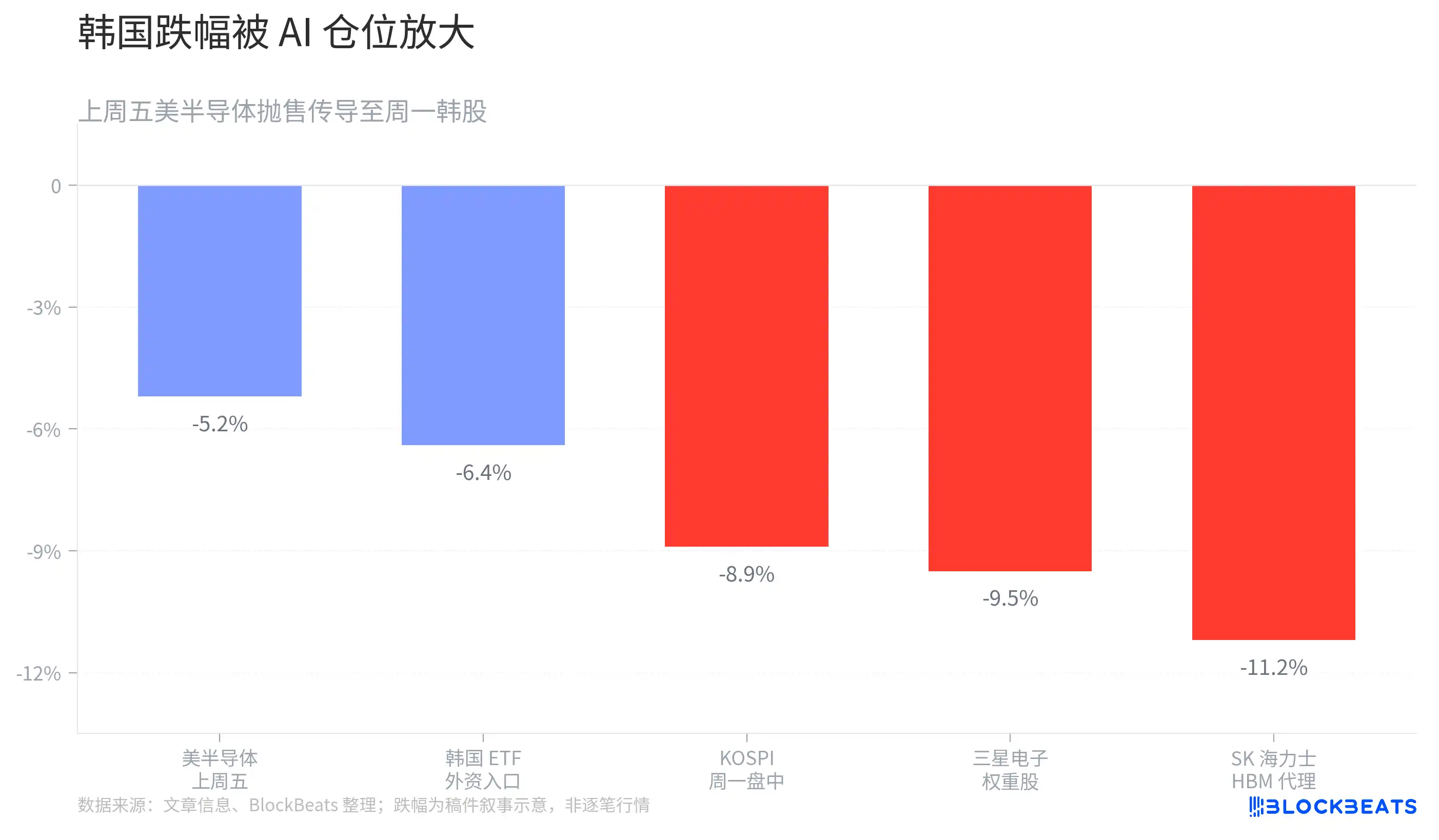
In a sense, South Korea is no longer just a national index, but more like a large AI memory ETF.

Jensen Huang's Visit to South Korea Presents a Stark Contrast to Market Panic

If market panic stems from valuations, then the biggest positive news over the weekend came from the supply chain itself.

The core objective of Jensen Huang's visit to South Korea was very clear: to further strengthen the cooperative relationship between NVIDIA and the Korean AI supply chain. The most notable development was the announcement of a new multi-year cooperation agreement between NVIDIA and SK Hynix. Over the past two years, HBM has become one of the most critical components in AI servers, and SK Hynix is one of the biggest beneficiaries of this trend.

This is also why the market highly anticipated this cooperation.

In recent months, as the scale of AI infrastructure construction continues to expand, the market began to worry about whether HBM demand growth would gradually peak. However, Jensen Huang's visit to South Korea at this time actually sends the opposite signal. If NVIDIA believed that AI data center construction was nearing its end, it wouldn't need to reinforce long-term cooperative relationships with suppliers at this point.
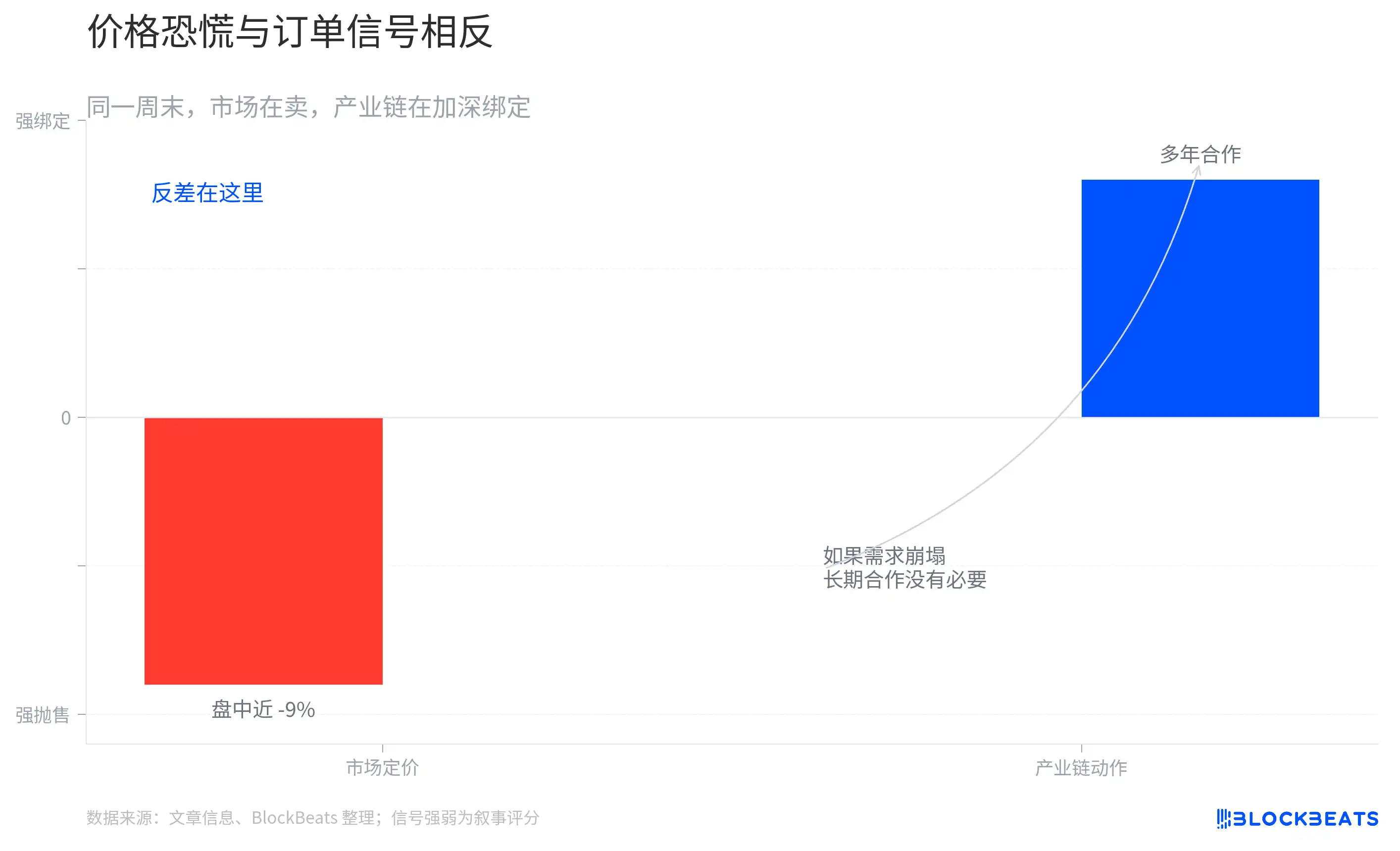
From a supply chain perspective, there is no evidence yet of a sudden disappearance of AI demand.

The most interesting part of the past two days lies right here. The capital market is using stock prices to express concerns about AI sector valuations, while the core enterprises in the supply chain are still discussing expansion and cooperation plans for the coming years. A significant temperature gap remains between the price signaled by the market and the signal released by the industry.

The AI Bull Market Begins Entering the Profit Pool Reassessment Stage

This is also the core of the current major divergence.

Over the past year, the market traded a very simple logic: AI demand growth. Therefore, NVIDIA rose, Micron rose, SK Hynix rose, Samsung Electronics rose—almost any company related to AI received a valuation boost.

But as the sector's gains continued to expand, the market has entered a second stage.

Investors are no longer satisfied with the story of 'AI will grow,' and have begun to ask another question: Who will ultimately capture the profits created by AI growth? In recent months, from the Rubin rack system memory adjustments, to the market reaction following Broadcom's earnings, to this Korean market crash, they all essentially reflect the same thing—the market is beginning to deconstruct the AI profit pool.

SK Hynix benefits from HBM, Samsung Electronics positions itself across HBM, DRAM, and advanced packaging, while Micron benefits more from the overall AI server memory upgrade. Although they all belong to the AI supply chain, their respective profit sources and pricing power are not the same.
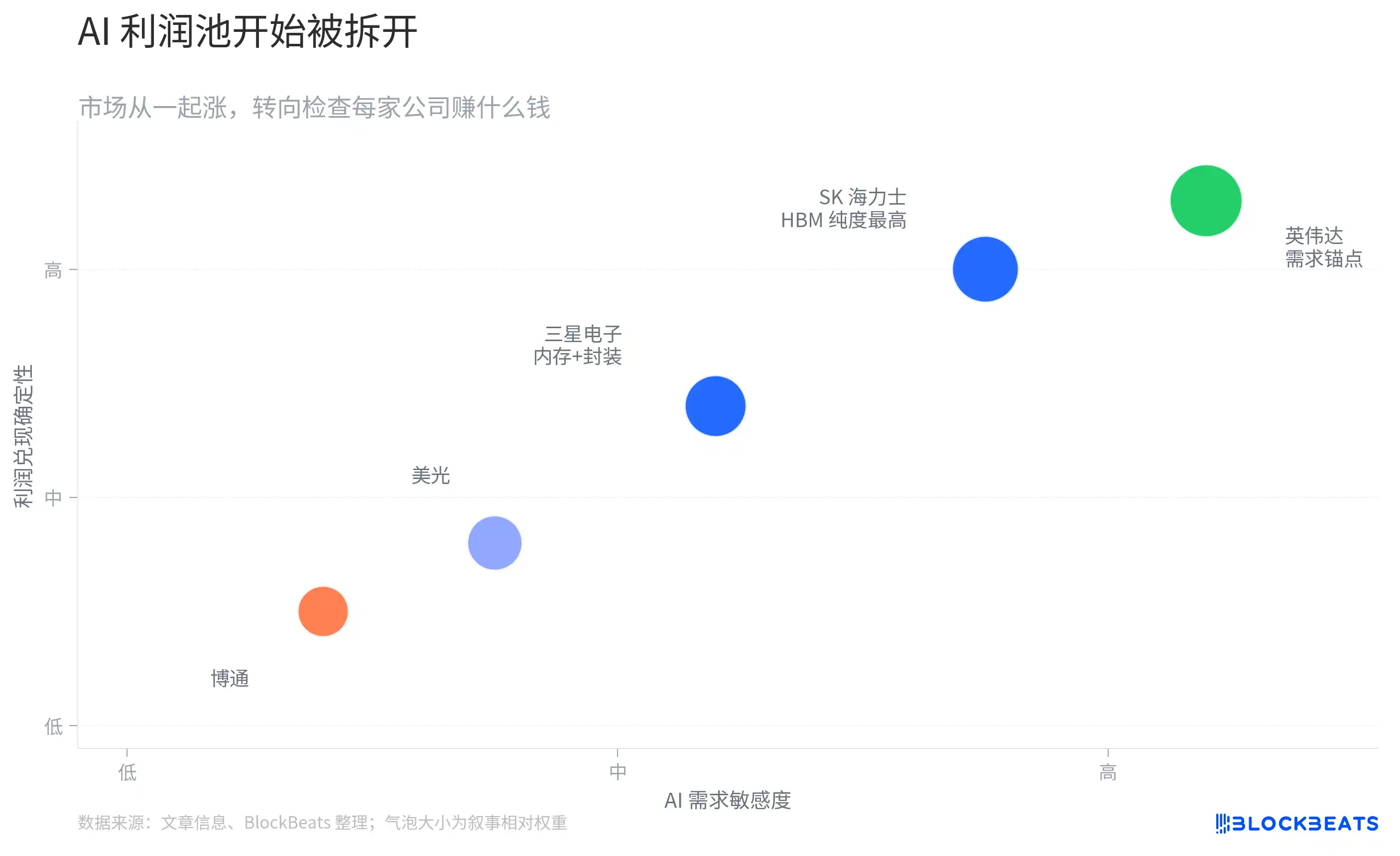
Previously, the market was willing to collectively expand valuations for the entire sector. Now, capital is beginning to examine, one by one, whether these profits can truly be realized.

This is also why a supply chain update, an earnings guidance, or even a capital expenditure adjustment can trigger significant volatility across the entire sector. The focus of market trading has shifted: rather than whether AI will continue to grow, investors are more concerned about whose financial statements the growth will ultimately land on.

What Decides South Korean Stocks is Not South Korea

In the coming weeks, what will truly determine the direction of the South Korean market remains NVIDIA's orders, HBM supply and demand, and capital expenditures from cloud service providers.
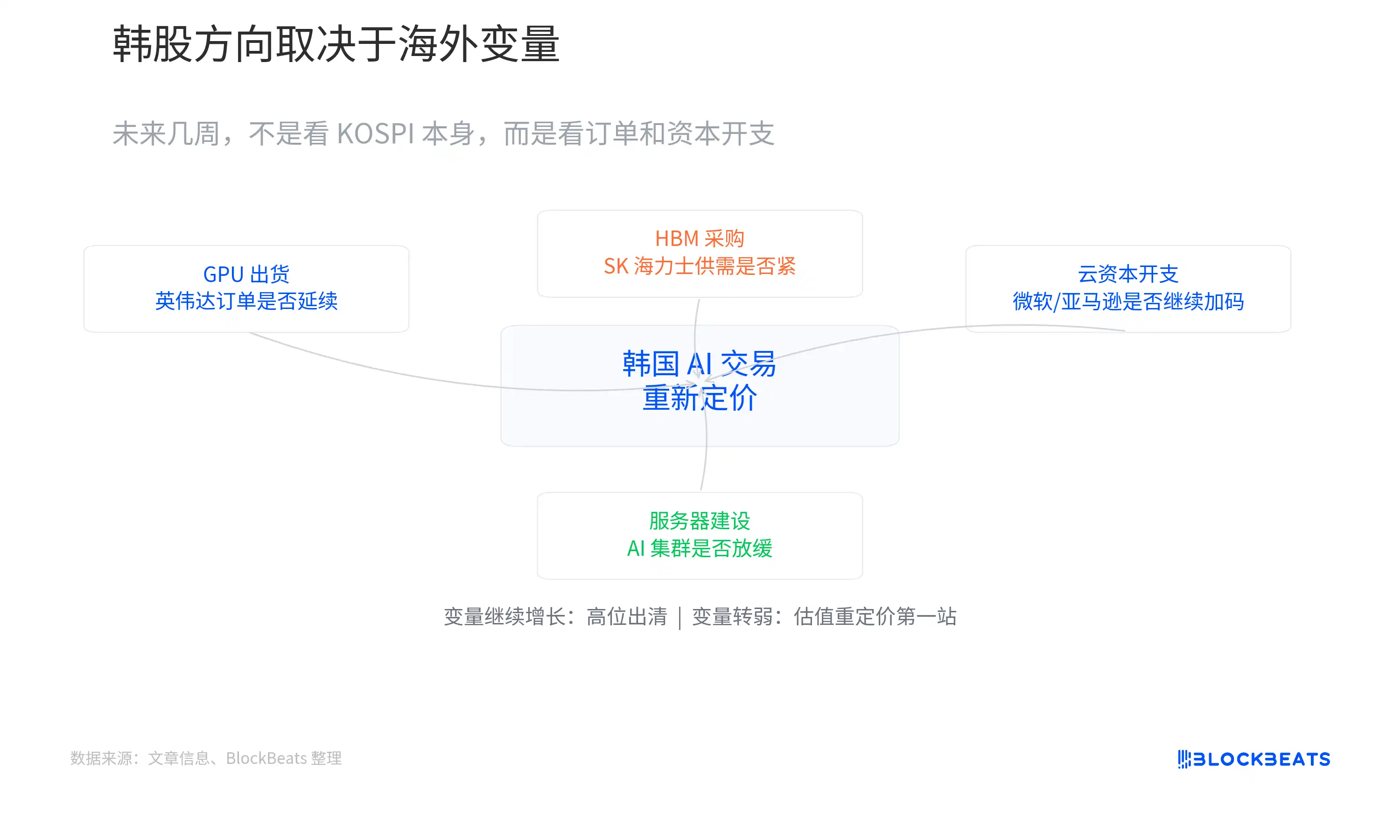
If this data begins to weaken, then this crash may be just the beginning of a larger-scale valuation adjustment.

But if data center construction, GPU shipments, and HBM procurement continue to maintain high growth, then Monday's circuit breaker looks more like a concentrated liquidation of a crowded trade.

At least from the current vantage point, the price signaled by the market and the signal released by the industry are not entirely aligned.

On one side, South Korea's AI leaders are facing the most severe selling pressure in years; on the other, Jensen Huang is in Seoul discussing the next generation of AI infrastructure with supply chain partners.

Whose judgment is closer to reality? Perhaps we will have an answer soon.

İlgili Sorular

QAccording to the article, what event triggered the sharp decline in the South Korean stock market (KOSPI), and which two companies were most affected?

AThe sharp decline in the South Korean stock market was triggered by a significant sell-off in the U.S. semiconductor sector on the previous Friday. The two most affected companies were Samsung Electronics and SK Hynix, both of which are major players in the AI supply chain and carry high weightings in the Korean market index.

QDespite the market panic, what significant business activity did Jensen Huang's recent visit to Seoul indicate about the AI industry's future?

AJensen Huang's visit to Seoul involved strengthening partnerships with key South Korean AI suppliers. The highlight was the announcement of a new multi-year cooperation agreement between NVIDIA and SK Hynix to jointly develop next-generation memory products for AI data centers. This activity indicates that core players in the AI infrastructure chain remain committed to long-term collaboration and expansion, suggesting they believe AI demand is still in its early stages and not collapsing.

QHow does the article describe the current main focus of investors in the AI sector, shifting from the initial investment phase?

AThe article states that the market has entered a second stage where the main focus of investors has shifted. Initially, investors broadly valued any company related to AI growth. Now, they are scrutinizing the 'profit pool,' asking which specific companies will actually capture and realize the profits generated by AI growth, leading to a re-evaluation based on individual profit sources and pricing power rather than sector-wide optimism.

QWhat key factors does the article identify as ultimately determining the future direction of the South Korean stock market?

AThe article identifies that the future direction of the South Korean stock market will be determined by external, global factors related to AI infrastructure demand, not domestic Korean issues. The key factors are: NVIDIA's orders, the supply and demand dynamics for HBM (High Bandwidth Memory), and the capital expenditure plans of major cloud service providers.

QWhat contrasting views does the article present regarding the nature of the South Korean market crash?

AThe article presents two contrasting interpretations of the market crash. One view is that it signals an early peak in the AI cycle, reflecting a fundamental change in demand prospects. The other view is that it represents a typical 'high-leverage unwinding' or a concentrated sell-off in a crowded trade, driven more by valuation concerns and position adjustments than by a sudden disappearance of underlying AI demand.

İlgili Okumalar

Podcast Notes | Conversation with GSR Asset Management Head: To Determine if This Crypto Rally is Real, Just Watch the Lending Rates on Aave

Podcast Summary: Dialogue with GSR's Head of Asset Management: To Determine if This Crypto Rally is Real, Just Check Lending Rates on Aave Andy Baehr, Managing Director of Asset Management at GSR, discusses the current crypto market, characterizing it as stuck in a state of "ambivalence" with short-lived, unsustainable rallies. He outlines a simple framework: the market moves between "ambivalence" and "conviction" (sustained upward momentum). Currently, every rally resembles a single-stage rocket booster that quickly fizzles out. Baehr identifies three key signals to watch: 1) DeFi lending rates, 2) the potential passage of the CLARITY Act, and 3) the market forming a consensus on the "Fed hawkish peak." He emphasizes that the most immediate indicator for the sustainability of the recent CPI-triggered rally is the USDC borrowing rate on Aave, currently around 3.75%—close to U.S. Treasury yields. The absence of a credit spread indicates low leverage demand and a lack of market energy. He explains that a healthy, sustained rally requires layered buying pressure. Last year's rally progressed from an ETH short squeeze to crypto-native trader influx and finally to ETF inflows. Currently, this structure is missing. Other potential structural buyers like Digital Asset Treasury (DAT) companies are absent, and ETF flows have proven transient. Baehr notes that while small-cap crypto tokens outperformed large caps in Q2—a potential sign of capitation in major assets—capital is also flowing to more exciting opportunities like AI stocks and tech IPOs, leaving crypto sidelined. Regarding DeFi, he highlights that platforms like Aave provide a clear, real-time signal of leverage demand through their supply/demand-driven interest rates. A significant, sustained rate increase would signal genuine market conviction. He also observes the quiet emergence of fixed-income-like products and vaults in DeFi. On regulation, the probability of the CLARITY Act passing before the August 7th deadline has dropped linearly from 75% to below 40% on Polymarket. Baehr suggests its passage would be treated as a bullish surprise, a potent driver for price movement. However, political hurdles, including ethical clause debates and disclosures about the First Family's crypto profits, remain significant obstacles. Ultimately, the market awaits clarity on the Fed's terminal rate under Chair Warsh. Until the "Fed Solstice"—the point where the market collectively understands the peak of hawkish policy—sustained conviction will be difficult to achieve.

marsbit28 dk önce

Podcast Notes | Conversation with GSR Asset Management Head: To Determine if This Crypto Rally is Real, Just Watch the Lending Rates on Aave

marsbit28 dk önce

7 Months After the Collapse of Huiwang, Southeast Asia's Escrow Platforms Undergo a Major Reshuffle

Following the collapse of Huione Pay—dubbed the "Alipay of Southeast Asia"—seven months ago, the region's underground financial guarantee platform sector is undergoing a significant reshuffle. This power vacuum has been swiftly filled by emerging platforms such as XinBi, Tiger/Navigator, JinBei (renamed JinBo), Dali/Tiancheng, and FullyLight. These platforms, operating largely via Telegram and offering services like escrow for illicit transactions, have absorbed the vast user base and markets left behind by Huione. While positioning themselves as "trust intermediaries," their primary clientele consists of networks involved in online scams, money laundering, illegal gambling, and even human trafficking. For instance, the Tiger/Navigator platform explicitly provides "escrow" services for kidnapping-for-ransom operations ("强押车交易"). Data underscores the immense scale: Huione alone processed over $103 billion in cryptocurrency payments and facilitated over $31 billion through its escrow market before its downfall, linking it to Cambodia's notorious Prince Group. Since its collapse, competitors have seen explosive growth. For example, the XinBi platform has accumulated over $1.6 billion in total USDT revenue, while platforms like NewPay, OkPay (under Dali), and FullyLight Wallet collectively processed over $4.8 billion in USDT in a single year. This ecosystem thrives in regions like Cambodia and Myanmar, where regulatory gaps allow these platforms to act as critical financial infrastructure for sprawling cybercrime industries, from scam compounds to online casinos. The article concludes that the moniker "Southeast Asian Alipay" is a misnomer, obscuring the platforms' fundamental role in enabling serious criminal enterprises rather than representing legitimate financial innovation.

Odaily星球日报1 saat önce

7 Months After the Collapse of Huiwang, Southeast Asia's Escrow Platforms Undergo a Major Reshuffle

Odaily星球日报1 saat önce

İşlemler

Spot
活动图片





