South Korea To Unveil Tokenized Securities Rules In July As Crypto Regulation Advances

bitcoinist2026-05-16 tarihinde yayınlandı2026-05-16 tarihinde güncellendi

Özet

South Korea's Financial Services Commission (FSC) plans to release a detailed framework for tokenized securities in July. This initiative follows the passage of the Token Securities Institutionalization Act, which will take effect in February 2027. The regulations aim to allow qualified issuers to launch and trade tokenized securities using distributed ledger technology through licensed intermediaries. FSC Vice Chairman Kwon Dae-young emphasized balancing innovation with trust, market order, and investor protection. The framework will include rules for issuance, infrastructure, and distribution, and permit fractional investment securities. This move is part of South Korea's broader push to regulate digital assets. Concurrently, the country is preparing to implement a 20% income tax on crypto assets starting in 2027, despite some public and political opposition. Lawmakers are also urging the government to prioritize delayed stablecoin legislation.

South Korean authorities are set to release detailed rules for the issuance, infrastructure, and distribution of tokenized securities, as the country advances its efforts to implement crypto market regulations in 2027.

FSC Eyes July Tokenized Securities Framework

On Friday, South Korea’s Financial Services Commission (FSC) revealed it is preparing to publish its framework for tokenized securities in July during the second meeting of the public-private joint “Token Securities Council,” launched in March.

Earlier this year, the National Assembly passed the Token Securities Institutionalization Act, which will take effect on February 4, 2027, to amend the Electronic Securities Act and the Capital Markets Act.

The changes are set to allow qualified issuers to launch tokenized securities using distributed ledger technology and enable the products to be traded as investment contract securities on brokerages and other licensed intermediaries.

FSC’s Vice Chairman Kwon Dae-young highlighted that the “upcoming token securities ecosystem must strike a balance between innovation and trust.” Therefore, the regulatory agency is reviewing measures to subordinate regulations and guidelines for the Tokenized Securities Act.

In addition, the regulator is expected to develop a phased roadmap for tokenizing existing standardized securities, such as stocks and bonds, as well as for on-chain settlements, drawing on international practices.

Discussing the best practices for eligibility and underlying assets, Kwon stated that the FSC will “We will uphold the fundamental principles of market order and investor protection, but we will not take a one-sided regulatory approach.” Notably, the regulator plans to allow the issuance of fractional investment securities by pooling underlying assets of the same type within a certain range.

He also explained that the government’s stance was to design a market structure that enhances trading efficiency, ensures fair competition, and protects users. The FSC’s Vice Chairman added that the regulator will add trading limits on OTC exchanges “in a way that allows the expansion of initial market liquidity while systematizing investor protection, so that the limits do not become a barrier stifling innovation.”

South Korea Prepares For Crypto Rules Implementation

The upcoming rules for tokenized securities come amid South Korea’s push to regulate digital assets and the local crypto market. Over the past few years, the country has worked to develop a framework to supervise the crypto industry and protect users.

Alongside the Token Securities Institutionalization Act, the government is expected to implement the Income Tax Act in 2027, with the tax authority fast-tracking the development of a tax base and tracking system to end years of delays.

As reported by Bitcoinist, South Korea’s National Tax Service (NTS) announced last month that it had begun “full-scale preparations” to implement the long-delayed crypto legislation in January of next year.

Under the Income Tax Act, crypto assets will be subject to a 20% income tax rate, up to 22% including local taxes, starting January 1, 2027. The financial authority plans to create a tax base by formally receiving pertinent data from crypto exchanges, establish a guidance framework for taxpayers subject to virtual asset income tax, and outline criteria for capital gains calculations.

Despite some efforts to abolish the crypto tax, including a People Power Party (PPP)-led bill and a petition with over 30,000 signatures, recent reports noted that the odds of abolishing or delaying it seem slim, as parliamentary petitions rarely lead to legislative action and authorities are committed to the 2027 rollout.

Meanwhile, South Korean lawmakers have repeatedly urged the government to prioritize stablecoin legislation, which has been delayed since late 2025 due to a disagreement between the Bank of Korea (BOK) and the FSC.
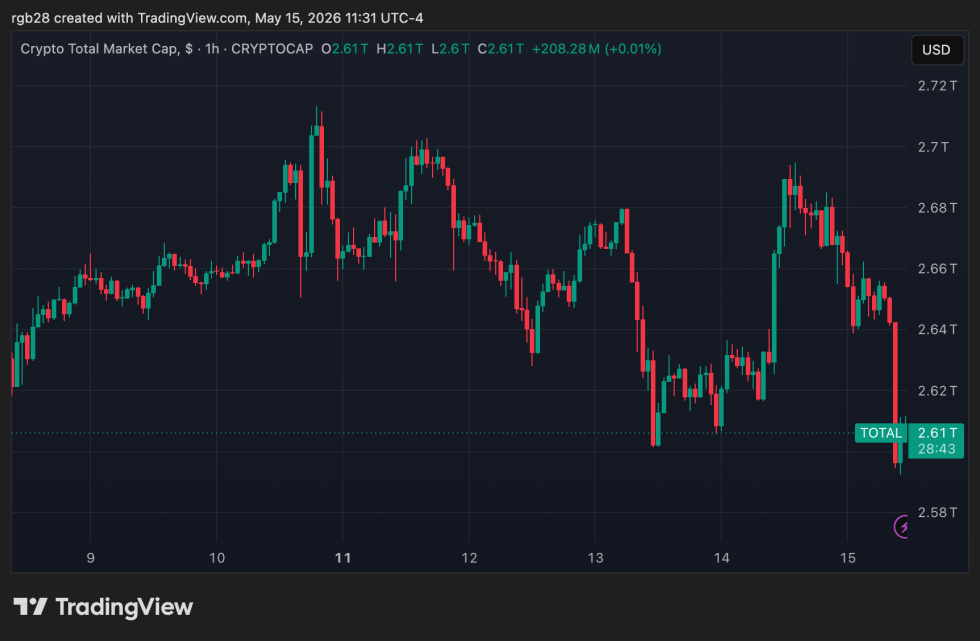
The total crypto market capitalization is at $2.61 trillion in the one-week chart. Source: TOTAL on TradingView


İlgili Sorular

QWhen will South Korea release detailed rules for tokenized securities, and under which legislative act are these rules being developed?

ASouth Korea's Financial Services Commission (FSC) plans to release its framework for tokenized securities in July 2026. These rules are being developed under the Token Securities Institutionalization Act, which was passed earlier in 2026 and amends the Electronic Securities Act and the Capital Markets Act. This legislation is set to take effect on February 4, 2027.

QAccording to FSC Vice Chairman Kwon Dae-young, what key principles will guide the upcoming token securities ecosystem?

AFSC Vice Chairman Kwon Dae-young stated that the upcoming token securities ecosystem must strike a balance between innovation and trust. He emphasized that the regulator will uphold the fundamental principles of market order and investor protection while avoiding a one-sided regulatory approach. The goal is to design a market structure that enhances trading efficiency, ensures fair competition, and protects users.

QWhat are the two main components of South Korea's crypto regulations scheduled for implementation in 2027?

ASouth Korea's crypto regulations scheduled for full implementation in 2027 consist of two main components: the Token Securities Institutionalization Act, which governs the issuance and trading of tokenized securities, and the Income Tax Act, which imposes a tax on crypto asset income. The tax will be levied at a 20% income tax rate, potentially up to 22% including local taxes, starting January 1, 2027.

QWhat preparations is South Korea's National Tax Service (NTS) making for the 2027 crypto tax implementation, and what data will be used?

ASouth Korea's National Tax Service (NTS) has begun 'full-scale preparations' to implement the crypto income tax legislation in January 2027. To create the tax base, the authority plans to formally receive pertinent transaction and user data from crypto exchanges. This data will be used to establish a guidance framework for taxpayers and outline criteria for calculating capital gains on virtual asset transactions.

QWhat is the current status of stablecoin legislation in South Korea, and what has been the primary cause of its delay?

AStablecoin legislation in South Korea has been delayed and has not been prioritized by the government despite urging from lawmakers. The primary cause of the delay is a reported disagreement between the Bank of Korea (BOK) and the Financial Services Commission (FSC) over regulatory responsibilities, which has stalled the process since late 2025.

İlgili Okumalar

Fei-Fei Li's Team Clarifies the Concept of 'World Models', Sora Merely a Renderer

"World Models" has become a widely used yet confusing term in AI. To address this, a team led by Fei-Fei Li and World Labs proposed a functional taxonomy based on the Partially Observable Markov Decision Process framework. This taxonomy categorizes systems called "world models" into three distinct projections: Renderers, Simulators, and Planners. Renderers, like OpenAI's Sora and other video generation models, focus on producing photorealistic visual outputs for human perception. They prioritize visual fidelity over physical accuracy. Simulators, such as NVIDIA Omniverse, aim to compute precise future environmental states for computational tasks like engineering analysis or digital twins. Planners, like Vision-Language-Action models, take in observations and goals to output executable actions for robots or agents. The article clarifies that most current "world models," including Sora, are primarily Renderers. They generate convincing visuals but lack the core ability to simulate state transitions based on actions, a key requirement for a true world model in classic reinforcement learning definitions. This conceptual confusion has practical implications, leading to potential misalignment in technology selection, investment, and public understanding of AI capabilities. Clear categorization is crucial. It helps enterprises avoid costly mistakes (e.g., using a renderer for robot training), allows investors to accurately assess markets, and enables researchers to build comparable benchmarks. While future systems may integrate these functions, recognizing current boundaries is essential for honest assessment and progress.

marsbit36 dk önce

Fei-Fei Li's Team Clarifies the Concept of 'World Models', Sora Merely a Renderer

marsbit36 dk önce

Bloomberg Uncovered: How Do China's Wealthy Circumvent the Annual $50,000 Limit to Transfer Assets?

**Summary: How Wealthy Chinese Circumvent $50,000 Annual Foreign Exchange Limits** Despite China's strict capital controls, including an annual $50,000 per person foreign exchange quota, an estimated $150 billion in funds still leaves the country annually via various gray and underground channels. This report outlines the evolution of China's "capital wall" and the methods used to bypass it. **The Evolving Capital Controls:** * **Foundation (1994):** The system of "current account convertibility with strict capital account controls" was established. * **Quota Set (2007):** The $50,000 individual annual forex purchase limit was formalized. * **Crackdown Begins (2015-2017):** Following market volatility, enforcement tightened. Banks were required to scrutinize transactions, and channels like using UnionPay cards for Hong Kong insurance premiums or buying overseas property were blocked. * **Digital & Legal Upgrades (2024-2026):** Enhanced algorithms now flag suspicious patterns (e.g., "smurfing"). The Common Reporting Standard (CRS) provides Chinese tax authorities with data on citizens' offshore accounts. Unlicensed cross-border brokers have been targeted. **Five Primary Methods for Moving Capital:** 1. **Underground Banking / "Hawala" (Duiqiao):** The largest-scale method. No money crosses borders. Clients pay RMB to a domestic account; an overseas associate deposits equivalent foreign currency into the client's offshore account. Risks include high fees, account freezes, and legal penalties. 2. **"Smurfing" or "Ant Moving":** Using multiple individuals' $50,000 quotas to pool funds for one offshore recipient. Increasingly detected by anti-money laundering algorithms. 3. **Trade Invoice Manipulation:** Businesses over-invoice imports or under-invoice exports via offshore shell companies, creating a pretext to transfer excess funds abroad under the guise of trade. 4. **Channel Migration:** After a crackdown on internet brokers, funds flow toward more compliant but costly channels like major banks' cross-border wealth management services or Qualified Domestic Institutional Investor (QDII) quotas. 5. **Structural Arrangements:** High-net-worth individuals use complex, high-cost legal structures involving offshore trusts, insurance, and investment migration programs to transfer asset ownership. **Regulatory Response: Focusing on People, Not Just Money** The current strategy extends oversight from enterprises to **individual residents**. Tools like CRS allow retroactive visibility into offshore assets. Cryptocurrencies, once seen as a potential loophole, are now actively monitored and prosecuted as an illegal channel. The underlying driver remains: with significant wealth concentrated among millions of affluent households seeking diversification amid domestic economic shifts, the incentive to move assets offshore persists despite regulatory barriers.

marsbit56 dk önce

Bloomberg Uncovered: How Do China's Wealthy Circumvent the Annual $50,000 Limit to Transfer Assets?

marsbit56 dk önce

İşlemler

Spot
Futures
活动图片




