Soothsayer Predicted Hantavirus 4 Years Ago, Are 'Prophets' in the Market Hidden Among the People?

Odaily星球日报2026-05-08 tarihinde yayınlandı2026-05-08 tarihinde güncellendi

Özet

A purported "soothsayer" account on X, @soothsayer, posted a cryptic tweet in June 2022 predicting the end of COVID-19 in 2023 and the later emergence of the Hantavirus. This old post resurfaced and went viral following recent Hantavirus cases linked to a cruise ship, the "Hondius," which has resulted in 3 deaths and 8 infections. While the WHO has clarified there is no large-scale outbreak and the specific Andeans virus strain has limited human-to-human transmission, the incident has fueled public anxiety and online speculation. The crypto market quickly absorbed this narrative. A Meme token named HANTA, created a year prior, saw its market cap rise to around $12 million. Prediction markets on Polymarket and Predict.fun also launched betting pools on whether the Hantavirus would be declared a pandemic by the end of 2026, with millions of dollars in wagers reflecting public sentiment. The event highlights how cryptocurrency markets rapidly convert public attention, fear, and speculation into tradable assets. The mysterious @soothsayer account, which posted only 5 times, has since gone inactive, adding an aura of urban legend to the episode and underscoring the internet's power to blend coincidence, emotion, and narrative.

Original|Odaily Planet Daily (@OdailyChina)

Author|Wenser(@wenser 2010 )
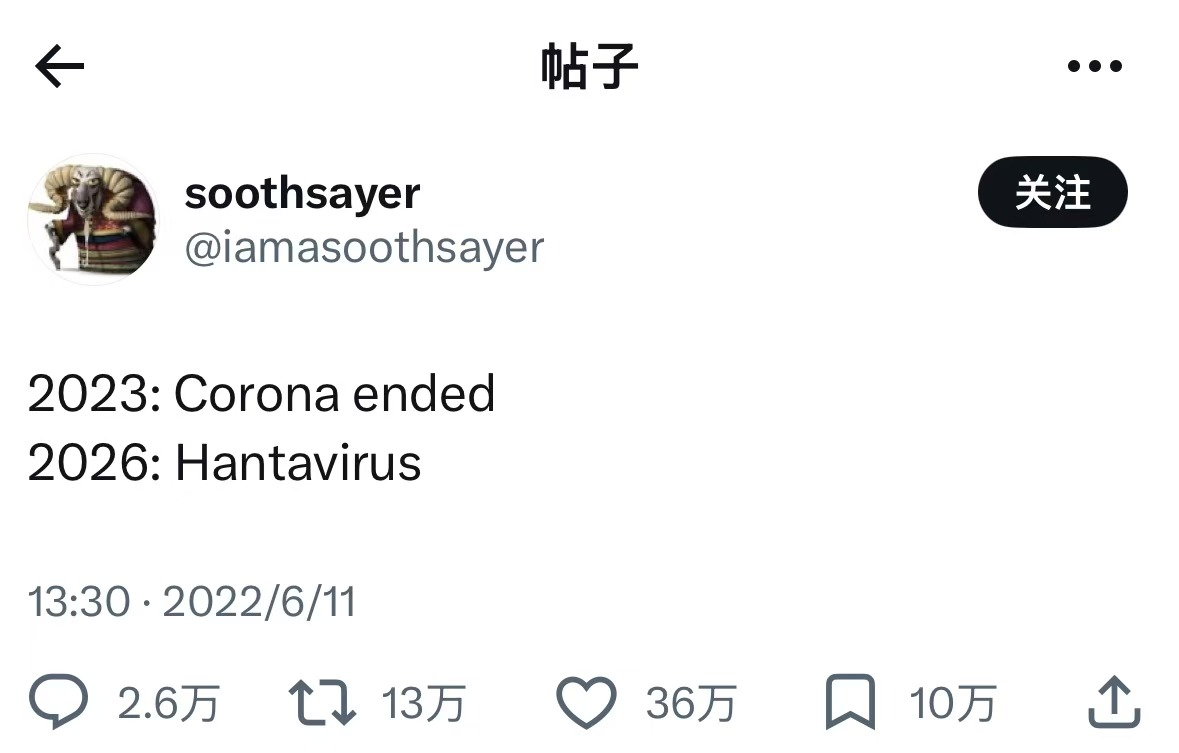
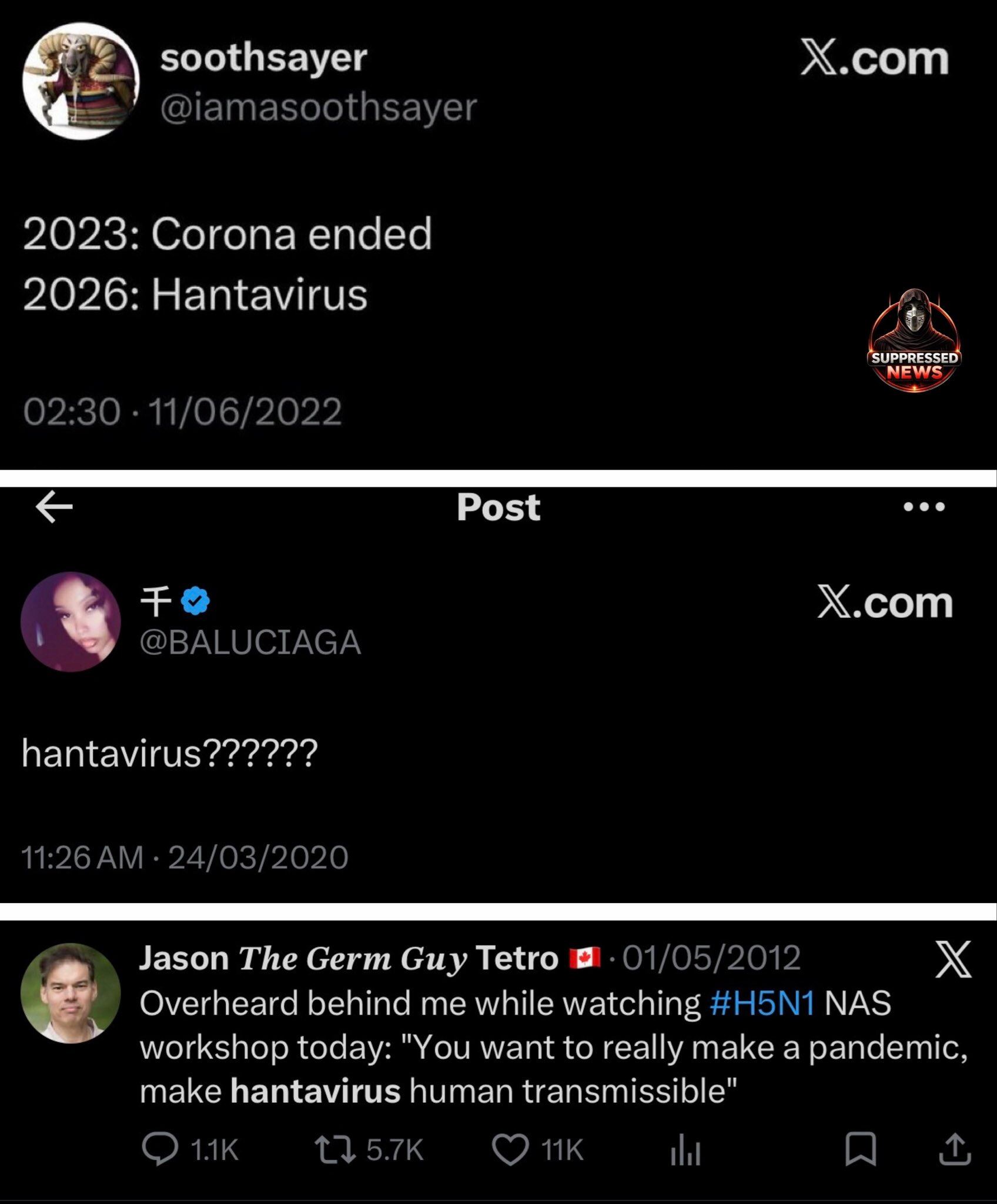
Last night, an old tweet from June 11, 2022, detonated the public opinion field on platform X like a nuclear bomb. This tweet came from a fortune-teller claiming to be able to "read the future," not only predicting the end of the COVID-19 pandemic in 2023 but also, prophetically, accurately mentioning the recent emergence of the Hantavirus.

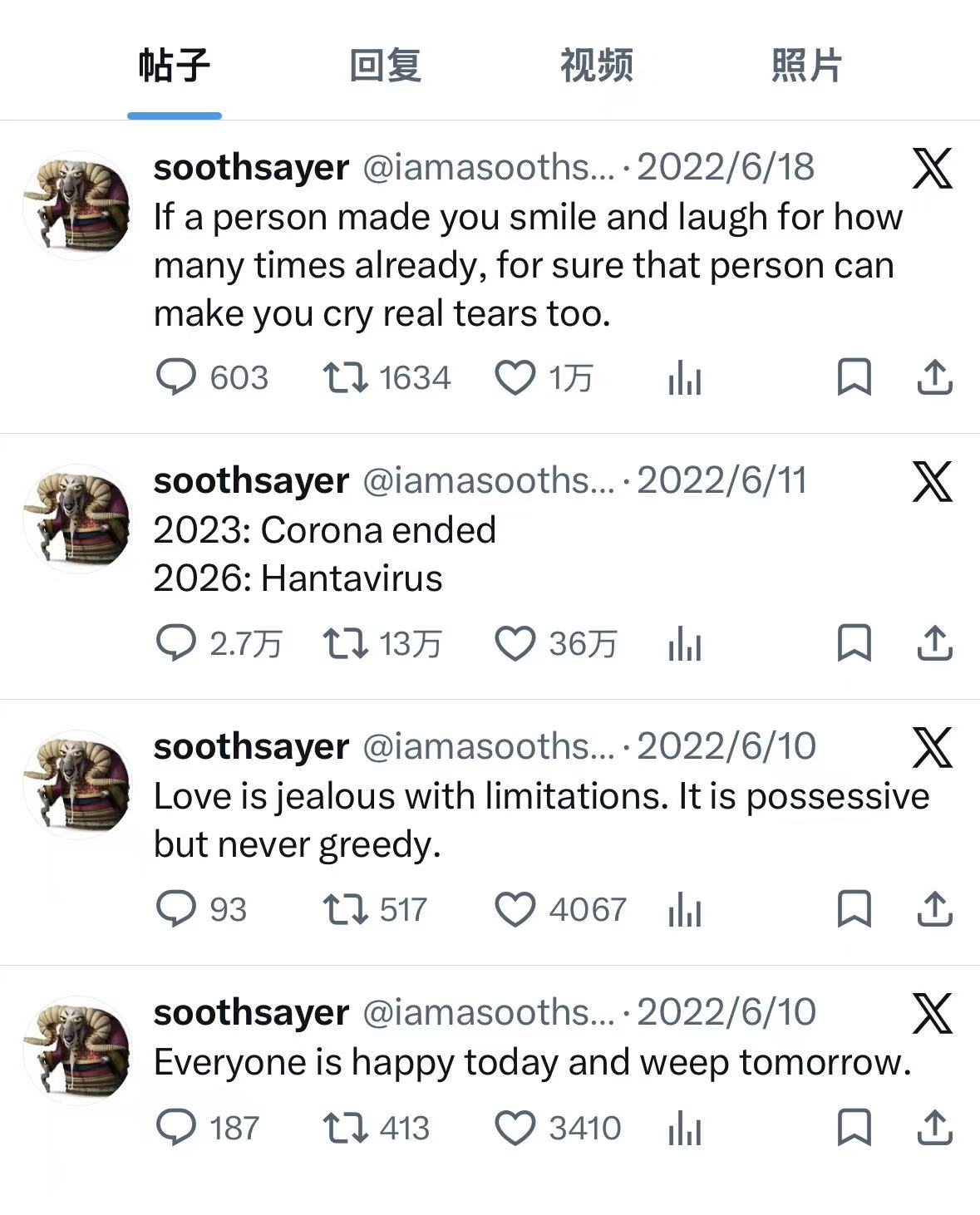
For a moment, countless people flocked to it, leaving various comments, but the account disappeared after only 5 tweets, gone without a trace, adding a mysterious touch reminiscent of an urban legend.

In the wake of the uncertainty left by the post-pandemic era, discussions related to Hantavirus quickly spilled over from public health topics, evolving into emotional amplifiers on social media. They were also rapidly absorbed by the crypto market as a new trading narrative, from Meme coins to prediction markets—speculative funds always find the points of emotional intensity first.

Amidst the indistinguishable flow of information and the resonance of group emotions, the crypto market once again showcased its instinct: rapidly converting attention, anxiety, and expectations into tradable products and prices.

A Mysterious Tweet from 4 Years Ago Linked to the Recent Cruise Ship Virus That Killed 3

The story begins with an account named @soothsayer.

This account, which only posted 5 tweets, had received little attention before. If you ignored that "Hantavirus prophecy" tweet, you might think this account was no different from the ordinary ones on X that post "inspirational quotes" and "motivational sayings" daily.

But as Hantavirus topics kept heating up these past few days, this old tweet took on a flavor of "cyber mysticism."
In April this year, a cruise ship named "Hondius" departed from Argentina in South America, originally planning to cross the entire Atlantic to the Canary Islands in Spain. However, during the voyage, a Dutch man suddenly died on board, later confirmed to be due to Hantavirus. As of May 6, the death toll had risen to 3, with infections increasing to 8, including tourists from the Netherlands, the UK, Germany, and other places. Currently, the cruise ship is temporarily denied docking due to Hantavirus, and the WHO is closely monitoring the situation. Notably, around 30 passengers disembarked from the ship two weeks prior without tracking procedures and have dispersed to 12 countries.

Therefore, although the WHO clarified that the virus had not previously shown large-scale transmission, it inevitably caused public panic, with many exclaiming, "It reminds me of the fear of being controlled by COVID."
It is worth noting that, according to test results from the South African National Institute for Communicable Diseases and the University Hospitals of Geneva, Switzerland, the virus type in this outbreak has been confirmed as the Andes Hantavirus.

The vast majority of Hantaviruses are not transmissible from human to human, but the Andes virus is the only exception; this transmission usually occurs among close contacts like family members or healthcare workers. Additionally, Hantaviruses mostly infect humans through "rodent-borne" routes, primarily via three transmission methods: respiratory infection, i.e., inhaling aerosols contaminated by rodent excreta; contact infection, i.e., broken skin or mucous membranes directly contacting excreta from infected rodents; and digestive tract infection, i.e., consuming food contaminated by rodent excreta.

As for the concern many have about whether the virus will spread to China, reliable sources indicate that in China, diseases caused by Hantavirus are known as "epidemic hemorrhagic fever." China has achieved significant success in the prevention and treatment of this virus and its associated illnesses, and there is currently no risk of a large-scale outbreak; the Chinese Embassy in Cape Verde previously issued a notice confirming that there were no Chinese citizens on the ship.

Looking back at the "fortune-teller's" tweet, it not only directly mentioned Hantavirus but was also posted four years ago, making it indeed highly topical.

Hantavirus in Crypto: Meme Coins and Prediction Markets

Following the emergence of Hantavirus, the crypto market also experienced tremors, with Meme coins and prediction markets quickly putting on their own performances.

Community members dug up a Meme coin created a year ago, officially launched on external markets on May 4th: HANTA (Hantavirus) Meme coin (2tXpgu2DLTsPUf9zFmuZmA4xrYxXKBTpVq9wAM7hzs9y). Its current market cap is temporarily reported at $12 million, making it a veritable "OG launch."

Furthermore, in terms of prediction markets, both Polymarket and Predict.fun have listed betting events related to Hantavirus.

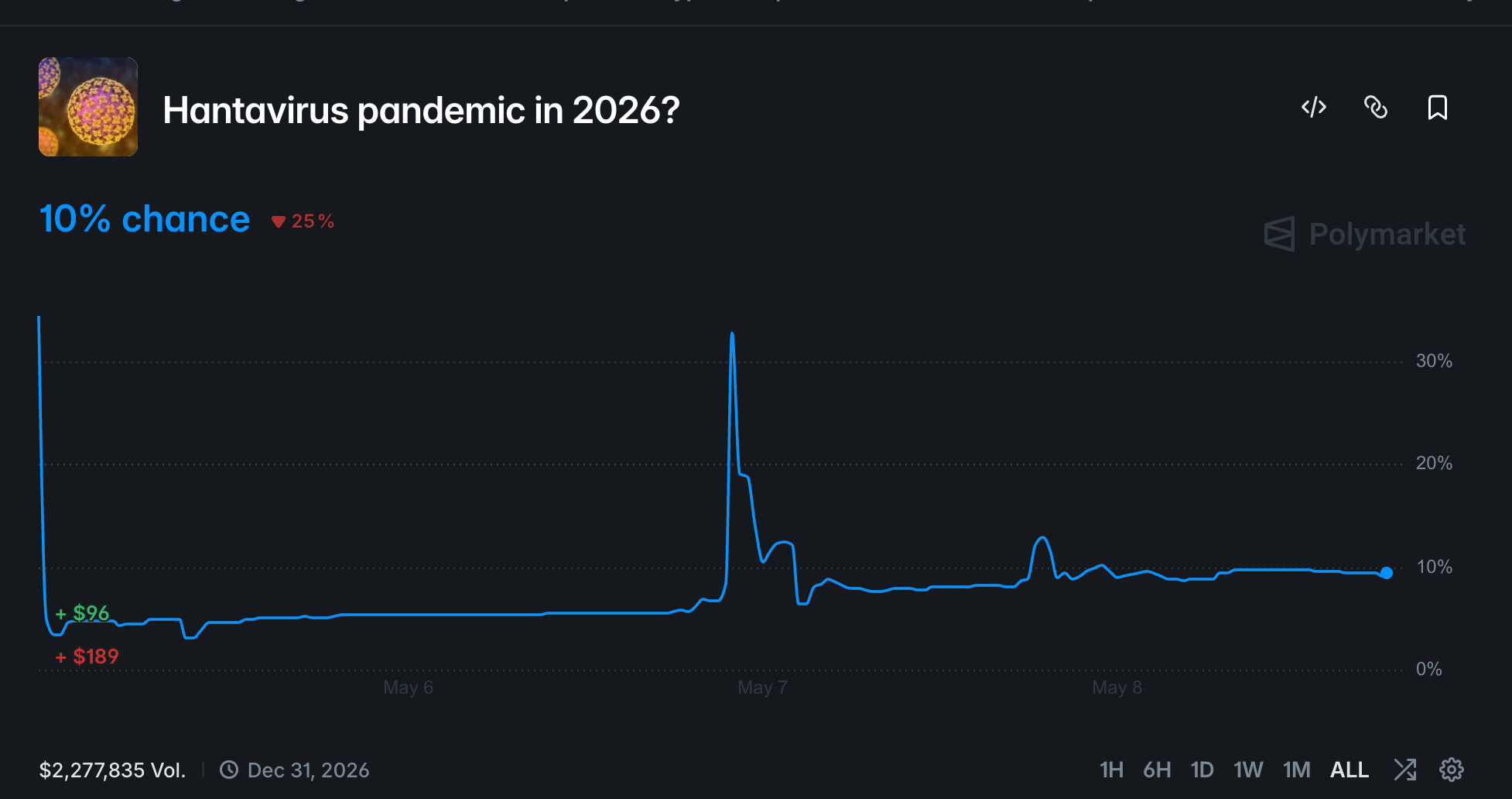
On Polymarket, the probability of the "2026 Hantavirus Pandemic" event occurring is temporarily reported at 10%, having previously surged to nearly 35%; the betting amount is currently around $2.27 million. Its settlement rule is: "If the World Health Organization, in official public communications from market creation until 11:59 PM EST on December 31, 2026, explicitly characterizes an outbreak of Hantavirus, Hantavirus Pulmonary Syndrome (HPS), Hemorrhagic Fever with Renal Syndrome (HFRS), or a Hantavirus-related outbreak as a 'pandemic,' this market will settle to 'Yes'; otherwise, this market will settle to 'No.' Explicit characterization includes official WHO statements, reports, press conferences, or publications that clearly describe the outbreak as a 'pandemic.' Declaring it a Public Health Emergency of International Concern (PHEIC) alone does not qualify unless it is also described as a pandemic. The primary settlement source for this market will be official WHO communications. Consensus from credible reporting may also serve as a source."
The probability for the similarly named betting event on the Predict.fun platform is temporarily reported at 11%, slightly higher than Polymarket's data; the betting volume is smaller, only around $4,400. Its settlement rules are similar to Polymarket's, also relying on the WHO's public statements.
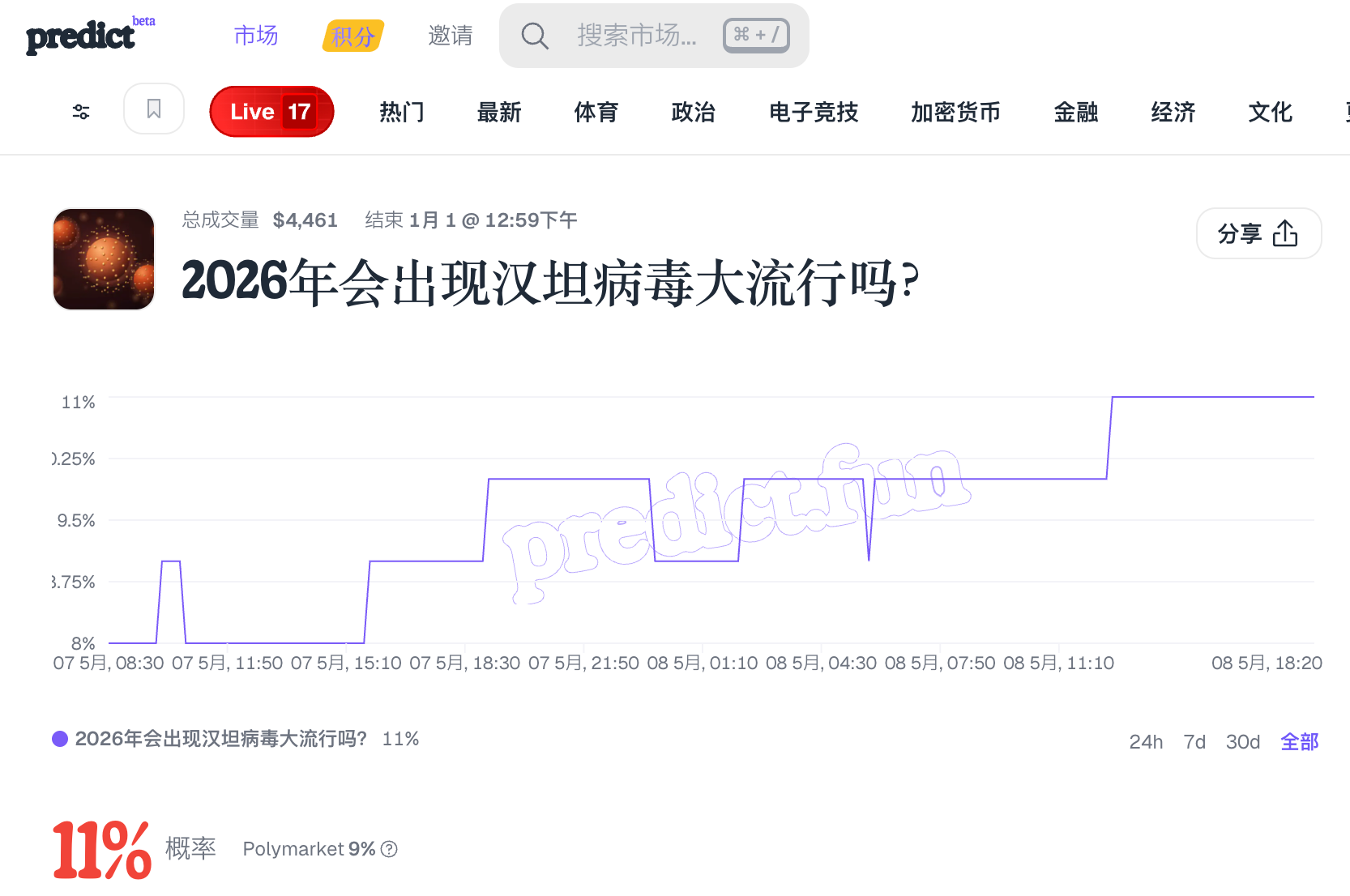
For many people, betting real money on the future is inherently addictive. The reason prediction markets are getting hotter is essentially because they turn humanity's anxiety, curiosity, and desire for the unknown directly into tradable commodities.

Finally, let's turn our attention back to platform X. There, numerous old posts about "Hantavirus" are still scattered, some posted in 2020, some even dating back to 2012. Some people fish out fragments as "divine prophecies," some piece together blurry screenshots into complete stories, and others firmly believe everything was already pre-written.

Truth or falsehood isn't important; what's truly fascinating is how the internet always manages to mix coincidence, fear, emotion, and imagination into something between reality and urban legend, making you unable to resist clicking to take a look.

Just like the words left by that fortune-teller @soothsayer: "Today's laughter, tomorrow's tears."

İlgili Sorular

QWhat event did a 2022 tweet from an account called @soothsayer supposedly predict, according to the article?

AAccording to the article, the 2022 tweet from the account @soothsayer predicted the Hantavirus. It also reportedly predicted that Covid-19 would end in 2023.

QWhat triggered the recent public discussion and market activity related to Hantavirus?

AThe recent public discussion was triggered by an outbreak of Hantavirus on the cruise ship 'Grendius,' which resulted in three deaths and eight infections among passengers from various European countries.

QAccording to the article, how has the cryptocurrency market reacted to the news about Hantavirus?

AThe cryptocurrency market has reacted by creating tradable assets and predictions related to the virus. This includes the emergence of a Hantavirus-themed meme coin (HANTA) and prediction markets on platforms like Polymarket and Predict.fun, where users can bet on whether the virus will be declared a pandemic by 2026.

QWhat is the Andean virus, and why is it specifically mentioned in relation to this Hantavirus outbreak?

AThe Andean virus is a specific type of Hantavirus. It is mentioned because it was the strain confirmed in the recent cruise ship outbreak. This strain is notable because it is the only known Hantavirus that can be transmitted from person to person, typically through close contact.

QHow do the prediction markets Polymarket and Predict.fun determine the outcome of their 'Hantavirus pandemic' bets?

AThese markets base their settlement on official statements from the World Health Organization (WHO). For a 'Yes' outcome, the WHO must explicitly characterize a Hantavirus-related outbreak as a 'pandemic' in an official public communication between the market's creation date and December 31, 2026. Merely declaring it a Public Health Emergency of International Concern (PHEIC) is not sufficient unless it is also described as a pandemic.

İlgili Okumalar

IOSG Founder: Web3 Is 'Losing Blood,' How Can Practitioners Survive Better?

IOSG Founder: Web3 Is "Bleeding Out" – How Can Practitioners Survive Better? In a candid reflection, the founder of IOSG Ventures voices deep concerns about the current state of Web3, describing an ecosystem experiencing severe "blood loss." Despite the recent MuShanghai event showcasing a successful pivot towards a more diverse, global community, a somber reality persists: many crypto-native attendees were there exploring exits or new labels in biotech, AI, and robotics. The core issue is identified as a breakdown in the ecosystem's positive feedback loop. Alarmingly, underestimated "low-probability bad events" are occurring simultaneously: a significant brain drain of Chinese developers to AI, a lack of breakout applications despite massive funding, and a widening credibility gap for practitioners globally, often stigmatized as scam artists. This has created a dire接班人 (successor) problem, with the next generation seeing little professional prestige or financial upside in crypto compared to fields like AI. A significant portion of the critique focuses on Ethereum and Vitalik Buterin. While not pessimistic about Ethereum's technology, the founder worries that critical development windows were missed by focusing on niche technical narratives like ZK and L2 instead of mass-market applications. A more urgent concern is that Vitalik may be isolated in an "information bubble," shielded from the grassroots community's hardships by layers of intermediaries, preventing crucial feedback from reaching him. The call is for Vitalik to return to a founder's mindset, re-engage directly with the community, and rally efforts for the next decade. The divergence between U.S. and Chinese OG (Original Gangster) ecosystems is stark. While many U.S. builders reinvest their wealth into the ecosystem, the Chinese scene suffers from a severe lack of "造血能力" (blood-making ability), with most market-driven funds struggling and many early success stories cashing out entirely. This threatens the entire Asian Web3 ecosystem's survival. For individual practitioners, survival advice is pragmatic: find your core "why," maintain life balance beyond token prices, continuously learn new skills (like AI), form small, trusted alliances for mutual support, and practice self-compassion. The industry's greatest need is not money or tech, but lighthouses—individuals at all levels who offer mentorship, grants, referrals, and honest reflection to guide others. The piece concludes with a direct appeal: OGs must pay forward the opportunities the industry gave them; founders must not struggle alone; and builders must continue their work, ensuring it remains a viable profession. The survival of Web3's "cathedral" depends not on any single leader but on the collective responsibility of everyone who remains.

marsbit26 dk önce

IOSG Founder: Web3 Is 'Losing Blood,' How Can Practitioners Survive Better?

marsbit26 dk önce

Deficits, Inflation, and the New Fed: The Deep Logic Behind US Bond Yields Breaking 5% and the Market Reset

In the week of May 15-19, 2026, U.S. long-term Treasury yields surged to multi-year highs, with the 30-year yield hitting 5.2%, a level unseen since 2007, and the 10-year yield climbing to 4.687%. Equity markets declined in response. Four primary factors are driving the rise in yields. First, stubborn inflation persists, with April wholesale prices rising 6% year-over-year, fueling expectations of potential future Fed rate hikes instead of cuts. Second, newly confirmed Fed Chair Kevin Warsh inherits a complex inflation battle, with markets closely awaiting his first FOMC meeting. Third, deteriorating U.S. fiscal health, marked by large deficits and rising debt servicing costs, is eroding the traditional "safe-haven" premium for Treasuries. Fourth, the "One Big Beautiful Bill" tax cuts are projected to add trillions to the national debt, contributing to Moody's recent credit rating downgrade. Rising yields pressure stocks through several channels: a higher discount rate reduces the present value of future earnings (especially for growth stocks); rising risk-free rates compress equity risk premiums, making bonds relatively more attractive; higher borrowing costs impact consumers and corporations; and a stronger dollar affects multinational earnings. For investors, the environment favors value and financial stocks over long-duration growth stocks. Bond investors find attractive yields in short to intermediate maturities, while income investors see the best fixed-income opportunities in over a decade. Key developments to watch include Chair Warsh's first FOMC meeting, upcoming inflation data, Treasury auction demand, and whether the 30-year yield approaches 6%, a level that could trigger a more sustained equity valuation reset. The bond market's message is clear: the era of cheap government borrowing is over, posing a central challenge for markets in late 2026.

marsbit28 dk önce

Deficits, Inflation, and the New Fed: The Deep Logic Behind US Bond Yields Breaking 5% and the Market Reset

marsbit28 dk önce

Is MicroStrategy Selling Bitcoin Not a Bearish Signal? Deconstructing the 5 Financial Logics Behind Corporate Bitcoin Divestment

The article "Is Strategy Selling Bitcoin Not a Bearish Signal? Decoding 5 Financial Logics Behind Corporate Bitcoin Divestment" analyzes why companies might sell their bitcoin holdings, arguing it's not necessarily negative. It begins by noting the market's surprise at Strategy's potential sale, contrasting its previous "never sell" stance. The core argument is that corporate decisions prioritize shareholder value, and selling bitcoin can be a rational strategic choice. The article outlines five key financial reasons for such sales: 1. **Increase Bitcoin Holdings Per Share:** Companies can use proceeds from bitcoin sales to repurchase shares when the stock price is undervalued relative to its bitcoin assets. This reduces the outstanding share count, potentially increasing the bitcoin amount backing each remaining share. 2. **Optimize Capital Structure & Reduce Financing Costs:** Building cash reserves through bitcoin sales can improve credit ratings (as favored by agencies like S&P), leading to lower future borrowing costs. Repaying debt with sale proceeds also reduces financial leverage. 3. **Legitimate Tax Planning:** In the absence of wash-sale rules for bitcoin in the US, companies can sell to realize capital losses, then repurchase, lowering the tax basis of their holdings and creating tax offsets. 4. **Counter Negative Market Narratives:** A controlled, non-disruptive sale could demonstrate market resilience and disprove fears that corporate selling would crash the market, thereby normalizing bitcoin as a corporate treasury asset. 5. **Repurchase Preferred Stock at a Discount:** If a company's preferred stock trades significantly below its face value, using bitcoin sale proceeds to repurchase it can retire expensive liabilities at a profit, saving on future dividend payments. The conclusion emphasizes that bitcoin's monetary properties offer flexibility. Strategic sales can protect corporate and shareholder interests, making asset utilization more important than rigid "hold" mandates.

marsbit57 dk önce

Is MicroStrategy Selling Bitcoin Not a Bearish Signal? Deconstructing the 5 Financial Logics Behind Corporate Bitcoin Divestment

marsbit57 dk önce

Why Did Zhipu Surge Nearly 30% in a Single Day?

"Global AI Model Unicorn" Zhipu's stock surged nearly 30% in a single day, reaching a new market cap high. The catalyst was the launch of its GLM-5.1-highspeed API, boasting a generation speed of **400 tokens per second**, setting a new global benchmark. This speed, roughly 3-5 times faster than industry leaders like OpenAI's GPT-4o and Anthropic's Claude, is achieved **without compromising the full-scale model's capabilities**. In the era of AI Agents requiring dozens of self-calls, such latency reduction is critical, transforming speed from a system metric into a determinant of intelligence limits. The breakthrough stems from a three-layer technical overhaul: 1. **TileRT Inference Engine**: Compiles the entire model into a continuous, always-on computation pipeline using "Warp Specialization," minimizing GPU idle time by having different processor groups handle data loading, computation, and communication in parallel. 2. **Heterogeneous Parallelism for MLA**: To efficiently run the GLM-5.1 model using the MLA attention mechanism, TileRT employs a heterogeneous strategy. One GPU handles sparse indexing/routing, while the others perform dense computation, optimizing for MLA's unique workflow. 3. **ZCube Network Architecture**: Replaces the standard Spine-Leaf (ROFT) network topology with a flat, dual-group interconnect. This design creates a single optimal path between any two GPUs, eliminating network congestion at scale and reducing latency. The business impact is significant: a 15% increase in cluster throughput (free extra capacity), a 40.6% reduction in tail latency (improved stability), and a one-third cut in networking hardware costs. Long-term, this innovation challenges the dominance of NVIDIA's integrated hardware-software stack (GPU+NVLink+InfiniBand), potentially benefiting manufacturers of high-density Leaf switches and optical modules while lowering the software barrier for domestic AI chips like Huawei's Ascend. The innovation proves that more can be achieved with the same compute, reshaping the infrastructure beyond just GPUs.

marsbit2 saat önce

Why Did Zhipu Surge Nearly 30% in a Single Day?

marsbit2 saat önce

İşlemler

Spot
Futures

Popüler Makaleler

4 Nasıl Satın Alınır

HTX.com’a hoş geldiniz! 4 (4) satın alma işlemlerini basit ve kullanışlı bir hâle getirdik. Adım adım açıkladığımız rehberimizi takip ederek kripto yolculuğunuza başlayın. 1. Adım: HTX Hesabınızı OluşturunHTX'te ücretsiz bir hesap açmak için e-posta adresinizi veya telefon numaranızı kullanın. Sorunsuzca kaydolun ve tüm özelliklerin kilidini açın. Hesabımı Aç2. Adım: Kripto Satın Al Bölümüne Gidin ve Ödeme Yönteminizi SeçinKredi/Banka Kartı: Visa veya Mastercard'ınızı kullanarak anında 4 (4) satın alın.Bakiye: Sorunsuz bir şekilde işlem yapmak için HTX hesap bakiyenizdeki fonları kullanın.Üçüncü Taraflar: Kullanımı kolaylaştırmak için Google Pay ve Apple Pay gibi popüler ödeme yöntemlerini ekledik.P2P: HTX'teki diğer kullanıcılarla doğrudan işlem yapın.Borsa Dışı (OTC): Yatırımcılar için kişiye özel hizmetler ve rekabetçi döviz kurları sunuyoruz.3. Adım: 4 (4) Varlıklarınızı Saklayın4 (4) satın aldıktan sonra HTX hesabınızda saklayın. Alternatif olarak, blok zinciri transferi yoluyla başka bir yere gönderebilir veya diğer kripto para birimlerini takas etmek için kullanabilirsiniz.4. Adım: 4 (4) Varlıklarınızla İşlem YapınHTX'in spot piyasasında 4 (4) ile kolayca işlemler yapın.Hesabınıza erişin, işlem çiftinizi seçin, işlemlerinizi gerçekleştirin ve gerçek zamanlı olarak izleyin. Hem yeni başlayanlar hem de deneyimli yatırımcılar için kullanıcı dostu bir deneyim sunuyoruz.

367 Toplam GörüntülenmeYayınlanma 2025.10.20Güncellenme 2025.10.20

4 Nasıl Satın Alınır

Tartışmalar

HTX Topluluğuna hoş geldiniz. Burada, en son platform gelişmeleri hakkında bilgi sahibi olabilir ve profesyonel piyasa görüşlerine erişebilirsiniz. Kullanıcıların 4 (4) fiyatı hakkındaki görüşleri aşağıda sunulmaktadır.

活动图片