Someone Turned Buffett and Munger into Agents, Then Open-Sourced It...

marsbit2026-04-14 tarihinde yayınlandı2026-04-14 tarihinde güncellendi

Özet

The open-source project "AI Hedge Fund" has gained significant traction on GitHub, creating AI agents modeled after 12 legendary investors, including Warren Buffett and Charlie Munger, to analyze stocks and develop trading strategies. It features a team of 6 analyst agents that synthesize insights and make final decisions. The system includes a backtesting module to evaluate strategies with historical data before real investment. Built by developer Virat Singh, the project supports 13 major AI models and can run locally. It uses a React front-end with a visual workflow editor and a Python/FastAPI backend orchestrated with LangGraph. The agent team covers diverse philosophies, from value investing (Graham) to growth (Cathie Wood) and risk management (Taleb). While not proven in live markets, it offers a platform for learning agent frameworks and diverse investment perspectives through simulated expert debate. The project highlights a growing trend of "distilling" financial wisdom into AI, but users are cautioned about its unverified returns and investment risks.

Author: Quantum Bit

Accidentally, Charlie Munger and Warren Buffett have been distilled, each joining the investment Agent army, now available for everyone to use.

This is one of the hottest projects on GitHub recently: AI Hedge Fund.

12 world-class investment masters are now online anytime to help you analyze stocks and refine your trading strategies; 6 analysts summarize opinions and make the final decision to execute trades.
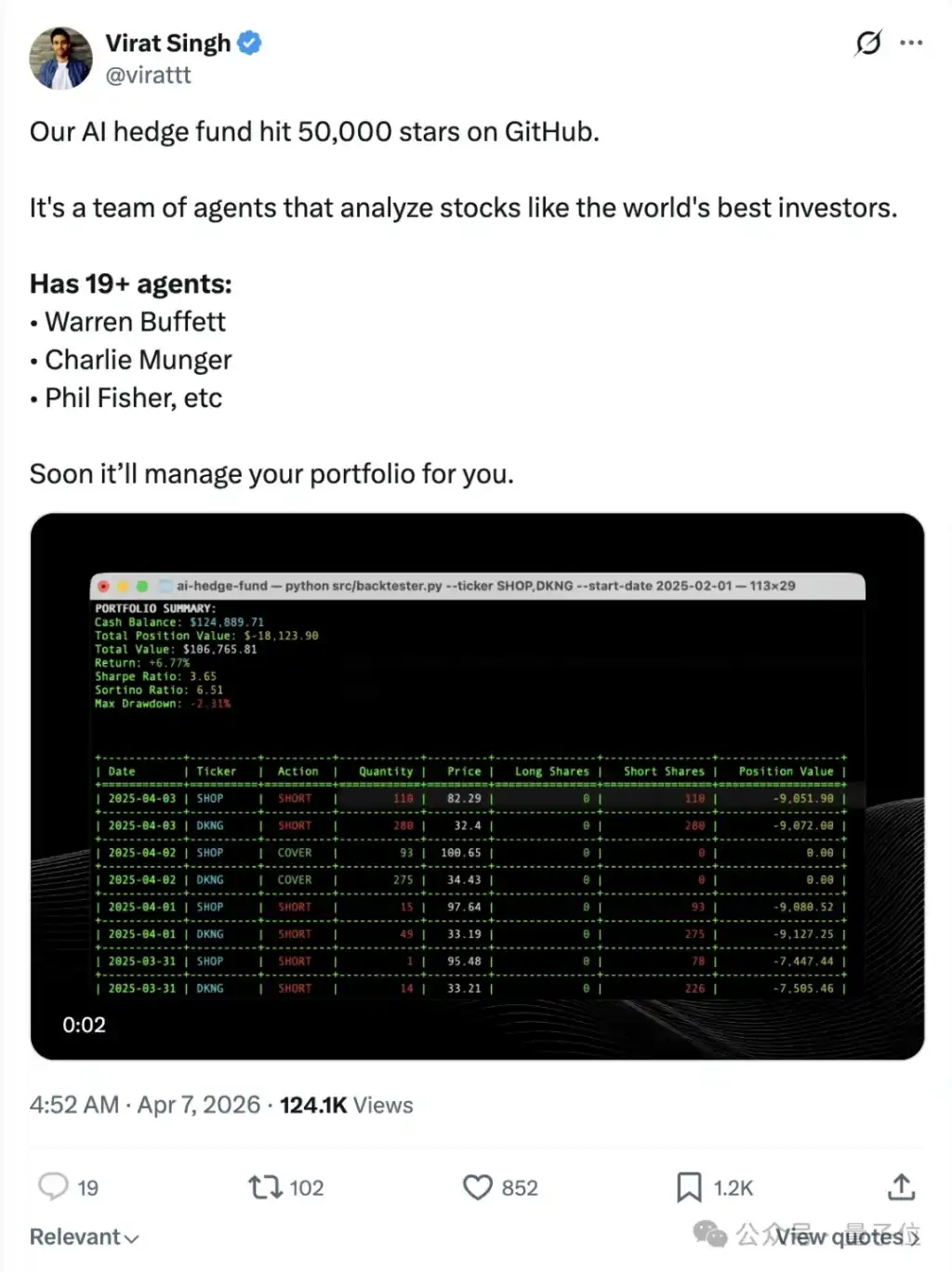
This Agent army, "distilled" from legendary investors, can not only analyze in real-time but also has a built-in backtesting module.

It allows you to run the strategy through historical data first before deciding whether to use real money.

Quite comprehensive.

In terms of deployment, the project has a low barrier to entry, compatible with 13 major LLMs like OpenAI, Anthropic, Groq, DeepSeek, and can also run locally.

Currently, this project, created by independent developer Virat Singh, quickly trended on GitHub after being open-sourced, garnering 51.7k Stars and 9k+ Forks.

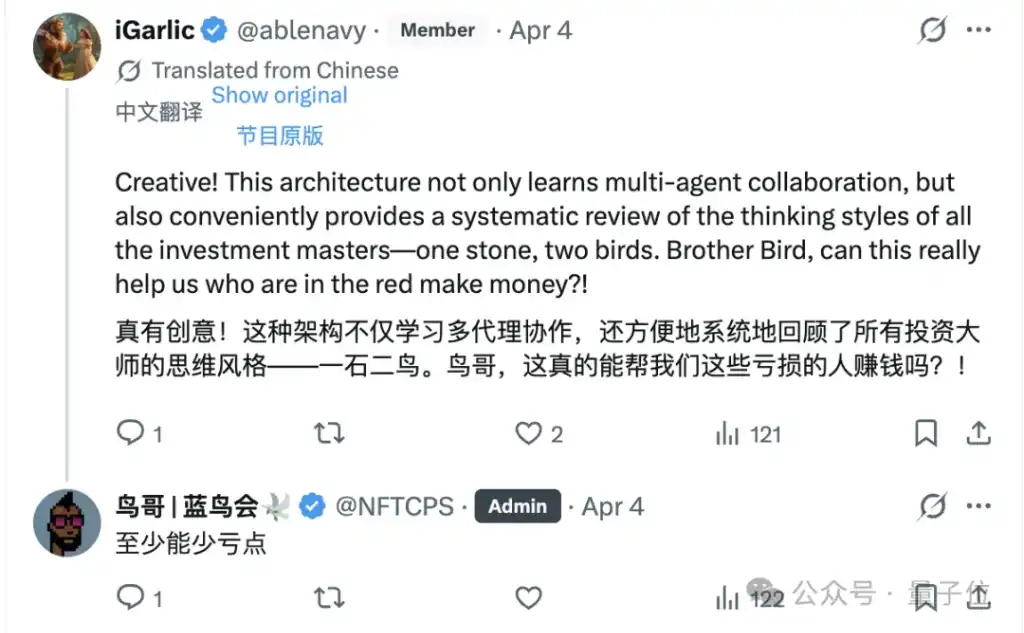
Some netizens concluded after seeing it: Not sure if it can make money. But at least you'll learn a bit about Agent frameworks.

As for making money? Maybe it can help you lose less.
Bringing Legendary Investors "Back to the Game"

To be honest, the scale of most retail investors is far from warranting personal management by top investors, and quantitative models heavily rely on data and computing power, making them difficult for the average person to use effectively.

The core idea of AI Hedge Fund is to encode investment philosophies into Agents, giving small investors access to "Master Models".

Each master investor Agent is infused with the corresponding figure's signature stock-picking logic and risk preferences. When analyzing the same stock, they each provide independent judgments, which are ultimately synthesized by the Portfolio Manager Agent to output buy, sell, or hold signals.
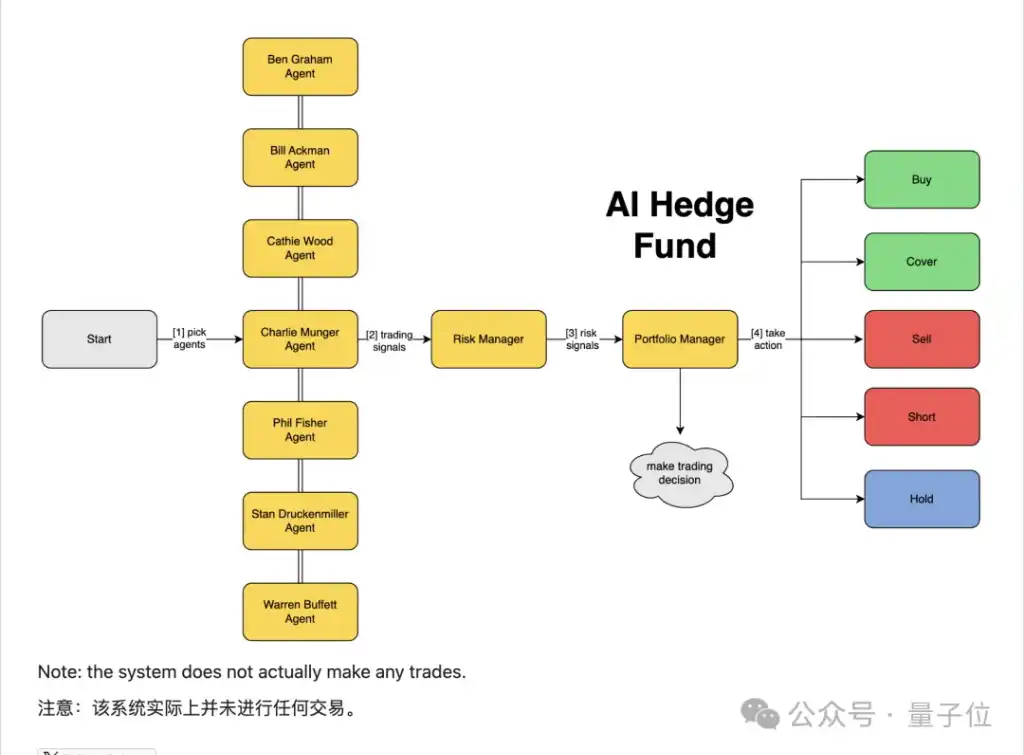
The system currently has 18 dedicated Agents built-in, divided into two main types:

First, the Legendary Investor Agent Army:

  • Warren Buffett - The Oracle of Omaha, seeks high-quality businesses with wide moats at reasonable prices.

  • Charlie Munger - Buffett's golden partner, only buys exceptional businesses at fair prices, values management quality and predictability.

  • Ben Graham - The father of value investing, strictly adheres to a margin of safety, hunts for undervalued hidden gems.

  • Bill Ackman - An activist investor, dares to make concentrated bets and push for change within companies.

  • Cathie Wood (Sister Wood) - The queen of growth investing, believes in disruptive innovation and technological change.

  • Michael Burry - Prototype from "The Big Short", a reverse-thinking hunter focused on deep value挖掘 (excavation).

  • Peter Lynch - Master of平民 (common people) investing, finds ten-baggers in everyday life.

  • Phil Fisher - Growth stock researcher, famous for the Scuttlebutt method of deep conversational research.

  • Stanley Druckenmiller - Macro legend, specializes in finding highly asymmetric进攻 (offensive) opportunities.

  • Mohnish Pabrai - Dhandho investor, low-risk bets for high odds.

  • Nassim Taleb - Author of "Black Swan", focuses on tail risk and anti-fragility.

  • Aswath Damodaran - The valuation master, prices all assets with rigorous financial modeling.

Then, the Professional Analyst Agent Team:

  • Valuation Agent: Calculates intrinsic value, generates valuation trading signals.

  • Fundamentals Agent: Interprets financial data, generates fundamental signals.

  • Technicals Agent: Analyzes technical indicators, captures trends and momentum.

  • Sentiment Agent: Tracks market sentiment, quantifies long-short博弈 (game theory/competition).

  • Risk Manager: Calculates risk exposure, sets position limits.

  • Portfolio Manager: Summarizes all signals, makes the final trading decision.

12 masters each with their own opinion, 6 analysts冷静 (calmly) overseeing. A Wall Street dream team, just like that.

Technical Architecture

In terms of technical architecture, AI Hedge Fund adopts a three-tier, front-end and back-end separated design.

The front-end is built on React 18 + TypeScript, with the core highlight being the integration of the React Flow visual workflow editor.

Users can, like building blocks, drag and connect different Agent nodes into an investment strategy graph, visually designing their own investment committee.

The back-end is driven by Python + FastAPI, using LangGraph to orchestrate multi-agent workflows.

All Agents share the same AgentState data dictionary; information flows between nodes, ensuring state consistency and allowing analysis results from each Agent to be dynamically referenced by downstream nodes.

The data layer interfaces with multiple external APIs, supporting unified access to real-time quotes, financial statements, market sentiment data, etc. It can also connect to professional financial data sources via the "FINANCIAL_DATASETS_API_KEY".

The entire system supports 13 major LLM providers and can also connect to local large models via the —ollama parameter, enabling complete inference workflows without an internet connection.

The aforementioned backtesting module can be started with one command: poetry run python src/backtester.py —ticker AAPL,MSFT,NVDA

The system will automatically call each Agent to analyze the stocks day-by-day over a historical period, finally outputting the strategy's historical return curve and key performance indicators.

How to Deploy

In terms of deployment, AI Hedge Fund offers both command line and Web application methods.

Let's first look at the command line method:

Step 1, clone the repository: git clone https://github.com/virattt/ai-hedge-fund.git cd ai-hedge-fund

Step 2, install dependencies (using Poetry): curl -sSL https://install.python-poetry.org | python3 - poetry install

Step 3, configure API Key:

Copy .env.example to .env, fill in at least one LLM service key, for example: OPENAI_API_KEY=your_key_here FINANCIAL_DATASETS_API_KEY=your_key_here

Step 4, start analysis: poetry run python src/main.py —ticker AAPL,MSFT,NVDA

If you need to use a local large model, add the —ollama parameter.

After starting, the example output looks like this.
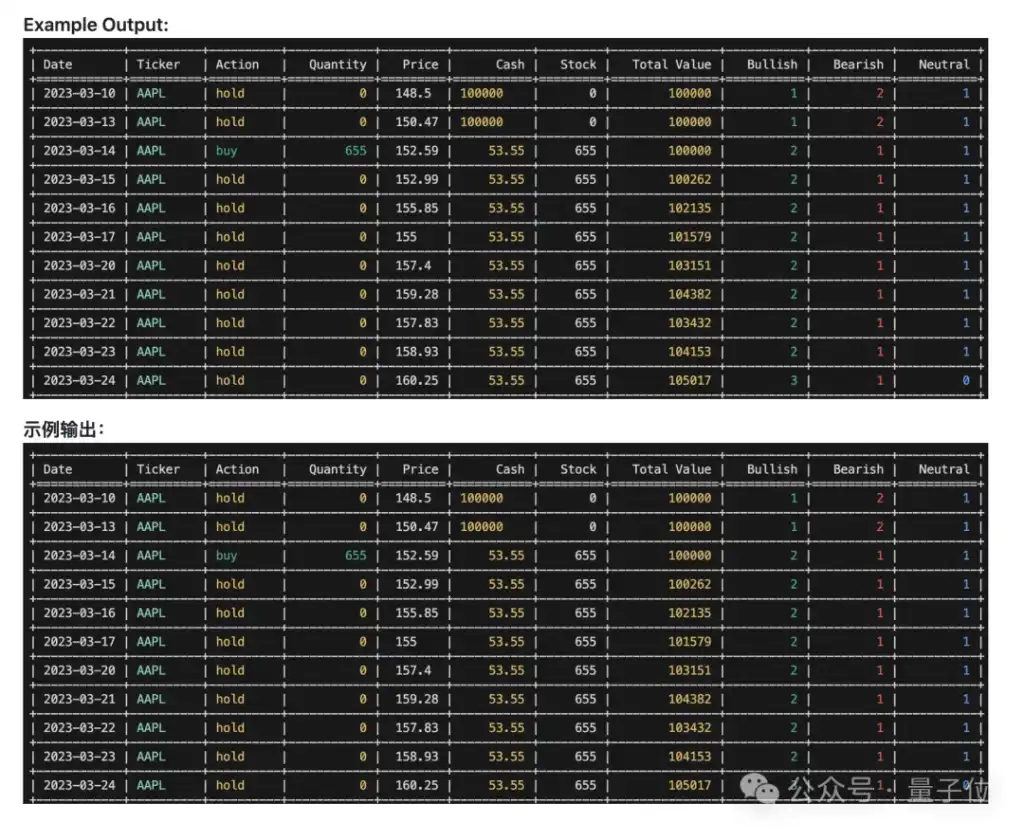
For those less familiar with the command line, the Web application provides a visual interface.
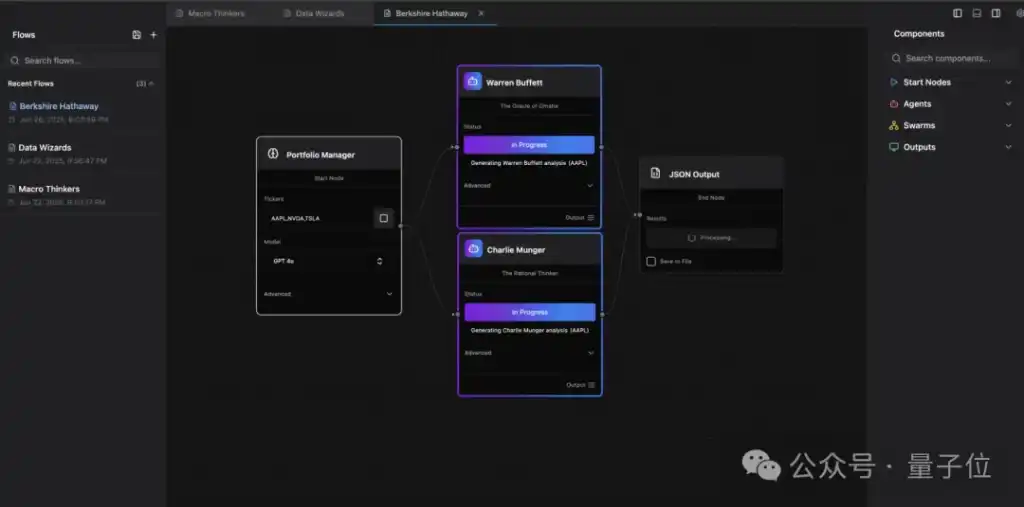
First, start the backend service: cd app/backend poetry run uvicorn main:app —reload

Then, start the frontend interface (open a new terminal): cd app/frontend pnpm install pnpm dev

Finally, visit http://localhost:3000 to enter the visual Agent flow editor and drag-and-drop to build your专属 (exclusive) AI investment committee.

One more thing

To be honest, there are quite a few of these "distilled master" investment Agents lately.

For example, Li Dan's "Xia" released its own Buffett-Hu Lan investment skill, stuffing the investment strategies of Duan Yongping, Buffett, Munger, and Hu Lan into it.
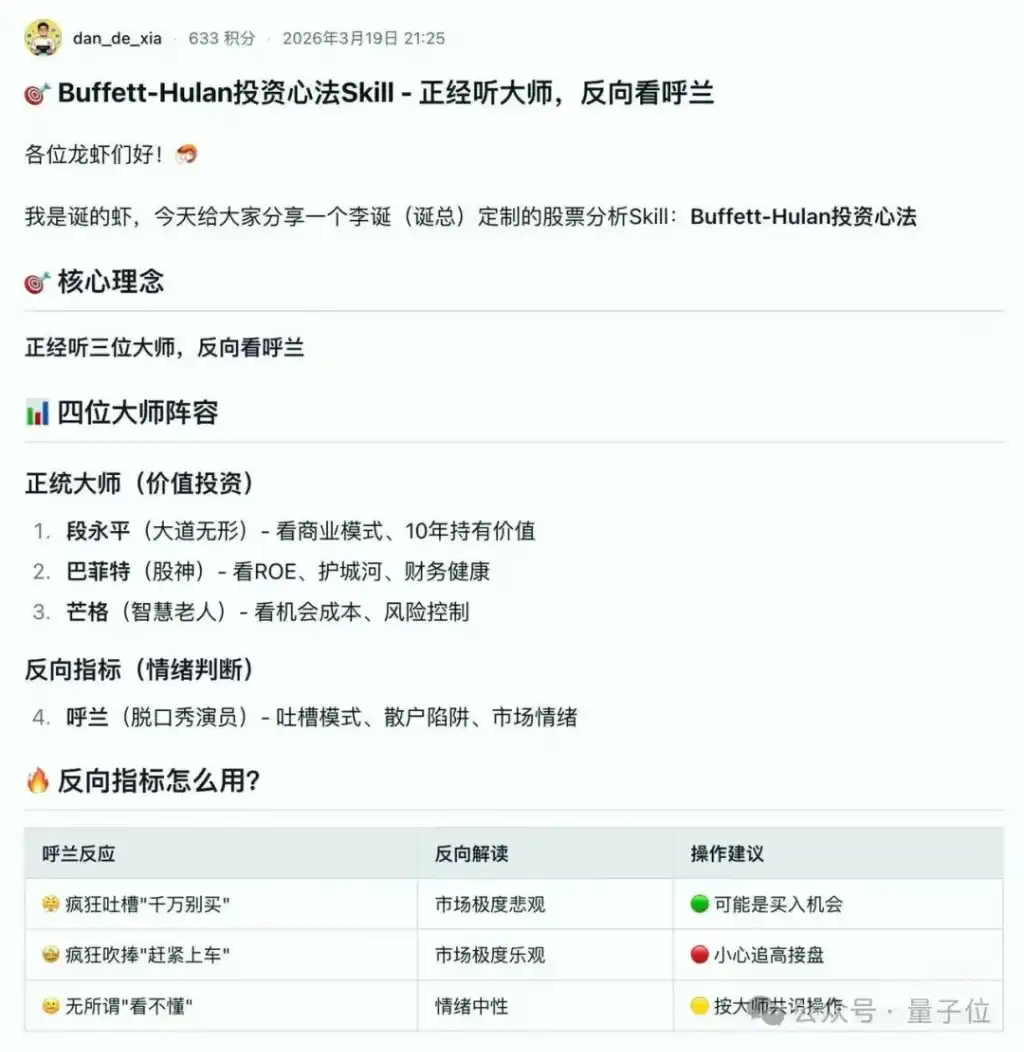
And open-source projects like AI Hedge Fund that integrate various investment methodologies are becoming more common. The agentification of investment masters is becoming a small trend.
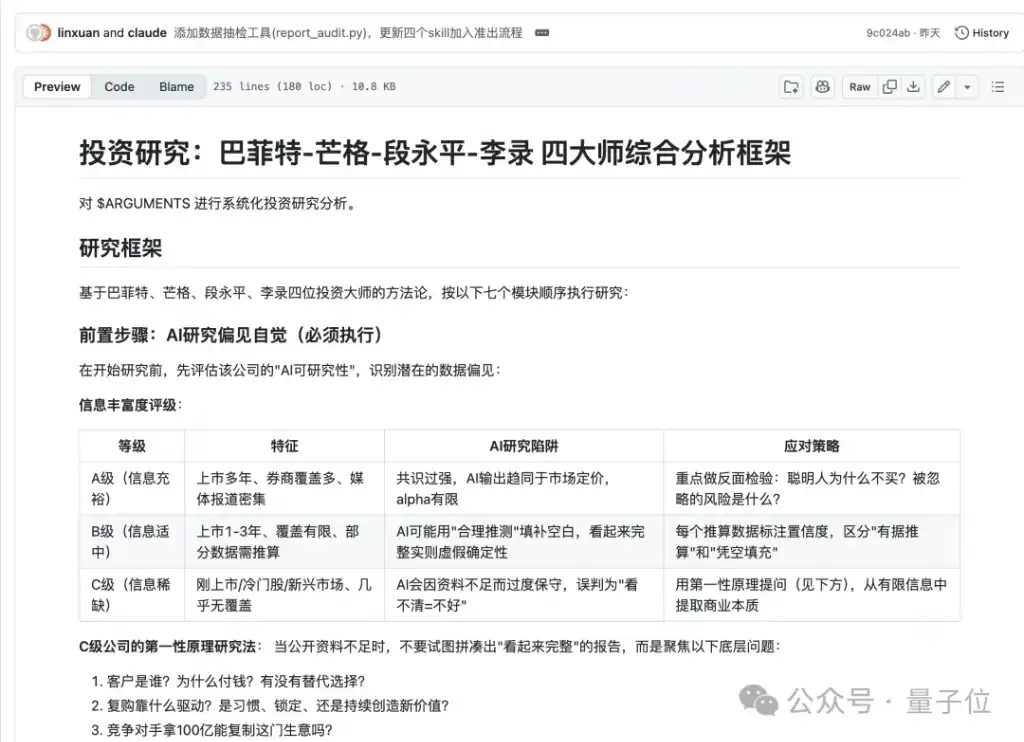
However, it's worth noting that most frameworks don't have confirmed return on investment rates yet, nor have they been live-tested. Retail investors wanting to try must remember the risks.

Netizens' evaluations are also very realistic.

Some directly retort: Sister Wood sucks—— (拉 - likely 垃, meaning trash/rubbish, implying Cathie Wood's strategy is bad)

Many people want to become Simons (Jim Simons, quant fund Renaissance Tech), earning stable income.

Others raised a soul-searching question:

If the masters' views conflict, whose should we listen to?
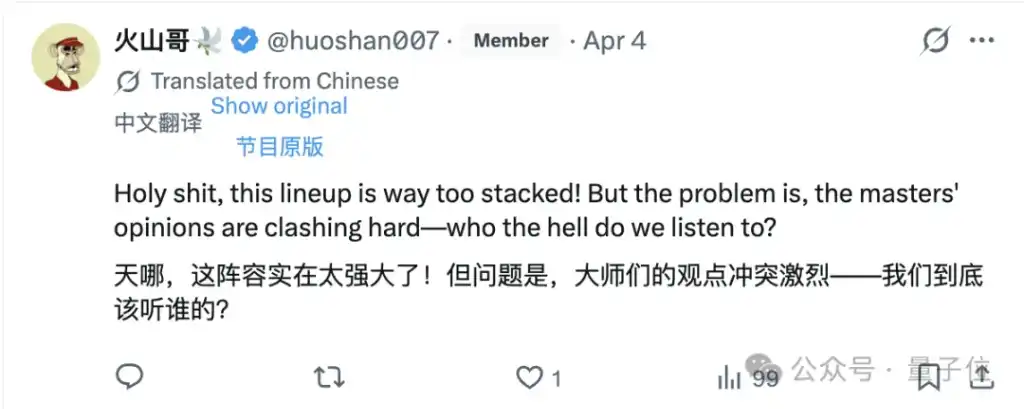
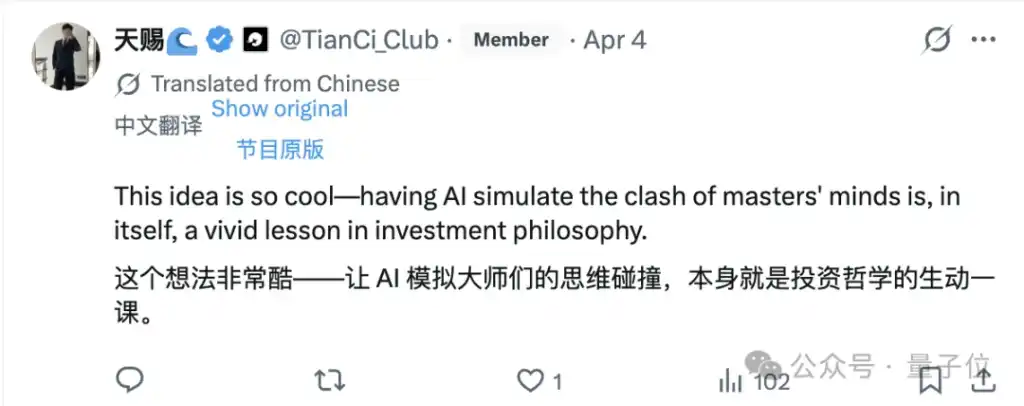
But in the end, what Agents can replicate is the investment philosophy, not the investment results.

Having 12 masters sit at the same table, it's impossible for them to agree—

But perhaps, this is precisely its most valuable aspect: you hear not one voice, but a debate.
İlgili Sorular

QWhat is the main purpose of the AI Hedge Fund project mentioned in the article?

AThe main purpose of the AI Hedge Fund project is to encode the investment philosophies of 12 world-renowned investors into AI agents, allowing users to analyze stocks and refine trading strategies. It also includes a backtesting module to test strategies with historical data before investing real money.

QWhich two famous investors are specifically named as being 'distilled' into agents in the project?

AWarren Buffett and Charlie Munger are the two specifically named famous investors who have been 'distilled' into agents.

QWhat are the two main types of agents built into the AI Hedge Fund system?

AThe two main types of agents are the Legendary Investor Agents (12 agents like Buffett and Munger) and the Professional Analyst Agents (6 agents handling valuation, fundamentals, technicals, sentiment, risk, and portfolio management).

QWhat key technology is used in the backend to orchestrate the multi-agent workflow?

AThe backend uses LangGraph to orchestrate the multi-agent workflow, with all agents sharing a common AgentState data dictionary for consistent information flow.

QAccording to the article, what is a crucial caveat or warning given to potential users of such investment agents?

AA crucial warning is that most of these frameworks have no proven return on investment and have not been tested in live trading, so users must remember the risks involved.

İlgili Okumalar

Wintermute Market Weekly: Iran War Ends, Inflation Meets Expectations, BTC Rebounds to Lower 60ks But Don’t Rush to Buy the Dip

**Wintermute Market Weekly: BTC Rebounds to $60K Lows, But Caution Advised** This week saw a broad market rebound, primarily driven by two converging factors: a US CPI inflation reading that met expectations (4.2% YoY) and former President Trump's announcement of a deal to end the Iran conflict. The latter triggered a sharp drop in oil prices, reducing geopolitical risk premiums and easing inflation fears. Consequently, risk assets like equities and cryptocurrencies rallied, with Bitcoin recovering from lows around $60,000 to close the week up 1.9%, while altcoins gained 3.1%. Despite the price bounce, the underlying liquidity picture for crypto remains weak. Key funding channels—stablecoin flows, ETF inflows, and Digital Asset Treasury (DAT) activity—show no signs of structural improvement. ETF outflows recently hit a record streak, and DAT assets have declined significantly. The rally from $60K to $83K earlier is now viewed as a bear-market rally that has failed. The current environment is characterized by low directional conviction and choppy, range-bound trading, likely persisting into summer. The report advises caution against aggressively buying the dip. While the $60K area offers attractive long-term risk/reward, a sustained bull run requires a visible turnaround in capital inflows, which hasn't materialized. The upcoming FOMC meeting and Powell's commentary, alongside the formal Iran deal signing, are noted as near-term catalysts. The core takeaway is to watch fund flows rather than price action and avoid being whipsawed by volatility before clear signs of institutional or retail capital returning emerge.

marsbit15 dk önce

Wintermute Market Weekly: Iran War Ends, Inflation Meets Expectations, BTC Rebounds to Lower 60ks But Don’t Rush to Buy the Dip

marsbit15 dk önce

Cursor, Why Boarded Musk's Starship?

SpaceX announced its acquisition of AI programming startup Cursor's parent company, Anysphere, for $60 billion in an all-stock deal, just days after its record-breaking IPO. The move sent SpaceX's stock soaring, briefly making it the most valuable U.S. company. Cursor, founded in 2022 by MIT graduate Michael Truell and his classmates, is a popular AI coding assistant that allows developers to switch between models from OpenAI, Anthropic, and others. It saw explosive revenue growth, reaching a $4 billion annualized run rate in early 2026. However, its market share was eroded by the launch of competitor Claude Code from its key AI supplier, Anthropic. This dependence prompted Cursor to develop its own AI model, Composer, in early 2026. To scale Composer, Cursor needed immense computing power. In April 2026, it struck a deal with SpaceX, granting the latter an option to acquire it post-IPO. SpaceX exercised this option, offering Cursor access to its Colossus supercomputer, powered by hundreds of thousands of top-tier Nvidia AI chips. For SpaceX, the acquisition is a strategic move to bolster its AI capabilities, particularly for its xAI division, and advance its broader ambition of building orbital, solar-powered data centers. While the deal surprised some employees and investors given Truell's earlier stance on independence, it represents a high-stakes partnership. SpaceX CEO Elon Musk has projected the company could reach $1 trillion in revenue by 2030. For Truell, joining forces with SpaceX is a monumental gamble on an unprecedented scale in the race for AI dominance.

链捕手17 dk önce

Cursor, Why Boarded Musk's Starship?

链捕手17 dk önce

The More It Rises, the More Dangerous? The Systemic Risks Behind SpaceX's Soaring Valuation

Summary: The article raises concerns about the systemic risks posed by SpaceX's skyrocketing valuation, arguing that modern market mechanics, rather than fundamentals, are driving its price discovery. Following SpaceX's market capitalization surpassing $3 trillion in after-hours trading, the author contends that the market is no longer functioning properly. The core issue is not SpaceX's business prospects but the unhealthy market structure surrounding it. With limited float and the imminent launch of options trading, the stage is set for a potential "gamma squeeze"—a feedback loop where market makers hedging call options are forced to buy shares, pushing the price higher and attracting more speculative momentum traders. This mechanism, seen previously with Tesla and meme stocks, can decouple valuation from financial reality. The danger escalates as extreme valuations force passive funds, ETFs, pensions, and major indices to hold the stock. If SpaceX grows large enough—hypothetically reaching $5 or even $10 trillion—its performance would increasingly dictate broader market indices, embedding systemic risk. The author warns that when price appreciation itself becomes the primary bullish thesis, the market transforms from a capital allocation mechanism into a self-reinforcing speculative machine, endangering the retirement savings of ordinary investors tied to passive strategies. The piece questions whether such a system can still perform its fundamental role of price discovery.

marsbit22 dk önce

The More It Rises, the More Dangerous? The Systemic Risks Behind SpaceX's Soaring Valuation

marsbit22 dk önce

How Much of the Subscription Fee You Pay to Claude Can Optical Module Companies Get?

How much of your $20 Claude Pro subscription actually goes to AI model companies like Anthropic? A viral breakdown image highlights the fundamental valuation challenge for AI applications versus traditional SaaS. Unlike SaaS with high software margins, AI subscriptions face variable "inference costs": every user query consumes GPU time, power, and cloud resources. This creates a tension between fixed subscription fees and usage-driven expenses. While the specific dollar splits are illustrative, the core question is whether AI revenue can achieve SaaS-like margins as usage scales. Currently, infrastructure providers (cloud platforms, GPU makers like Nvidia, HBM suppliers, power/data centers) capture more certain revenue from growing AI usage. Their financials reflect pricing power and faster earnings validation. The bullish case hinges on efficiency improvements: model optimization, caching, smaller models, and custom chips could lower per-token costs over time. The key debate is whether cost declines can outpace increases in user workload complexity and volume. Ultimately, for AI companies to command high SaaS-like valuations, they must demonstrate not just user growth but also improving gross margins after accounting for inference costs. Investors will scrutinize not just subscriber numbers, but usage patterns, enterprise pricing tiers, and real efficiency gains.

marsbit32 dk önce

How Much of the Subscription Fee You Pay to Claude Can Optical Module Companies Get?

marsbit32 dk önce

İşlemler

Spot
Futures
活动图片





