Solana Q1 Report: Revenue Plunges 68% Year-on-Year, Developers Decrease by 30%

marsbit2026-04-20 tarihinde yayınlandı2026-04-20 tarihinde güncellendi

Özet

Solana Q1 2026 Report: Key Metrics Show Significant Decline Amid Market Reset Solana experienced a substantial downturn in Q1 2026, with key performance indicators reflecting a broader market cooling. Total network revenue (REV) fell to $89.9 million, down 68% year-over-year (YoY) and 1.4% quarter-over-quarter (QoQ). This decline was driven by reduced speculative activity, which had previously fueled the network during the 2024/2025 bull market. Key revenue components saw mixed results: base fees dropped 8.7% QoQ, Jito tips (MEV) fell 19.7%, priority fees rose 23%, and vote fees declined 44.5%. The annualized real yield for stakers was just 0.17%, down 67% YoY. Network GDP, generated by top applications, fell 7% QoQ to $451 million. Pump Fun emerged as a standout, generating $103 million (up 3% QoQ), surpassing Solana's L1 revenue. However, daily active addresses averaged 2.4 million, down 4.8% YoY. Stablecoin supply on Solana reached $15.9 billion, down 2.7% QoQ but up 18% YoY. USDC and USDT remained dominant. DEX volumes averaged $3.2 billion daily, with private DEXs now accounting for 60% of all volume. The network's net dilution rate was 4.38%, while the cost to produce $1 of REV was $8.10, up 93% YoY. The number of new tokens created on launchpads grew 42% QoQ to 3 million, with Pump Fun dominating 85% of this market. Despite the downturn, Solana's core strengths remain: its position as a hub for retail trading apps, potential in perpetual markets, and growing use ...

Author: Michael Nadeau, The DeFi Report

Compiled by: Glendon, Techub News

Over the past year, Solana has been the preferred platform for speculation in the cryptocurrency space. This positioning has provided the network with an invaluable "stress test." As a result, user activity, fees, developer numbers, and investor attention have all exploded.

However, this has also made the network highly vulnerable to a "cooling-off" effect once risk appetite subsides. This "cooling-off" effect arrived in the first quarter. Solana has now entered a reset mode. This article provides a comprehensive data-driven update on Solana's network performance in the first quarter and the areas we are focusing on next.

Operational Performance

Real Economic Value
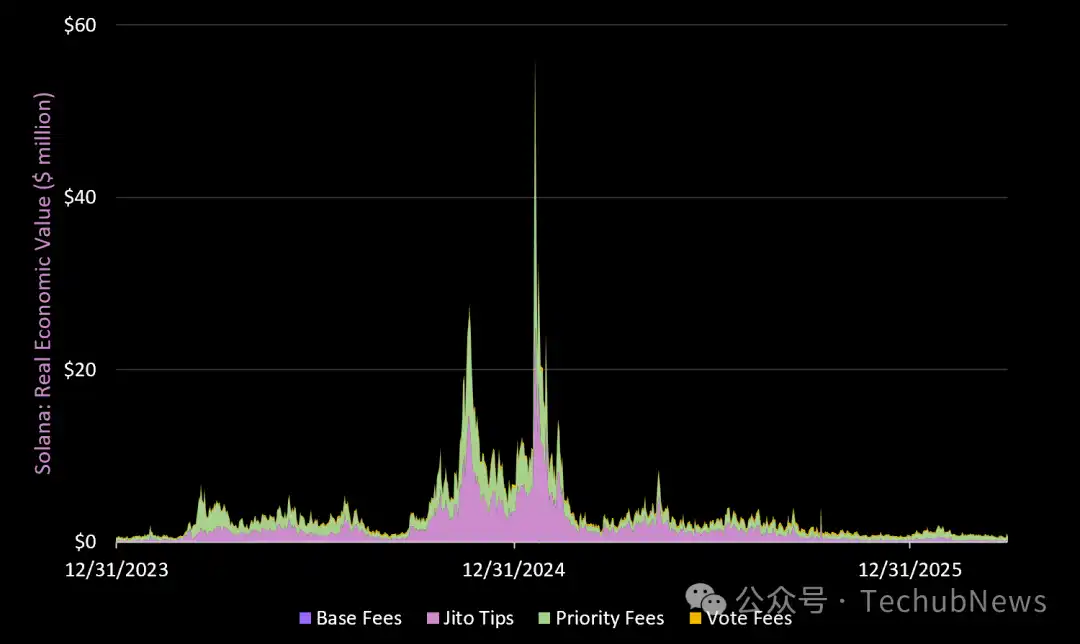
Data source: DeFi Report

REV = Base fees, priority fees, MEV (Jito tips), and voting fees for accessing L1 block space. MEV (Jito tips) is distributed to SOL holders through staking. The remaining fees go to validators, with 50% of the base fees being burned.

The total fees for the Solana network in the first quarter were $89.9 million—the lowest level since Q3 2023. This represents a 1.4% decrease from the previous quarter and a 68% decrease year-on-year.

For reference, Ethereum L1 generated $82 million in fees in the first quarter.

A breakdown is as follows:

  • Base fees: Decreased 8.7% in Q1 but increased 9.4% year-on-year;

  • Jito tips (MEV): Decreased 19.7% in Q1 and 72.3% year-on-year;

  • Priority fees: Increased 23% in Q1 but decreased 68.8% year-on-year;

  • Voting fees: Decreased 44.5% in Q1 and 16.4% year-on-year.

Key Takeaways

Solana was the "base for speculation" in the last cycle (tied with Hyperliquid). The strongest applications on the network (Pump, Axiom, Raydium, Jupiter) are all geared toward retail traders, leading to highly cyclical on-chain revenue that is heavily dependent on speculative demand.

This chart also helps visualize the period when speculation reached its most extreme levels in the last cycle: late 2024 to early 2025. Since that period, Solana's social attention and on-chain activity have been on a downward trend. It is difficult to see this trend reversing in the short term.

On the positive side, Pump Fun has performed relatively robustly during the bear market, and we are beginning to see emerging fintech companies building stablecoin applications on Solana (detailed later in the report). Ultimately, we believe Solana needs to compete with Hyperliquid for perpetual traders and lead the tokenization of on-chain equities (and other real-world assets) to mitigate the extreme cyclicality of its on-chain user base.

Real On-Chain Yield
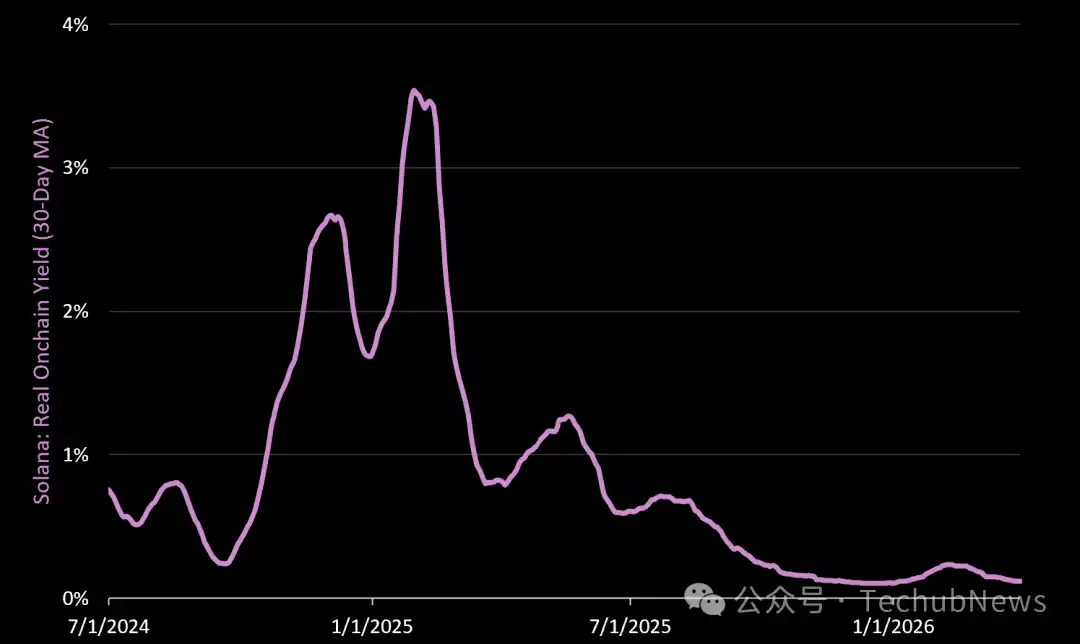
Real on-chain yield = MEV paid to validators and passed on to SOL stakers (excluding operator payments).

  • The average real on-chain yield (annualized) in Q1 was 0.17%, up 33% from the previous quarter but down 67% year-on-year. The growth in Q2 can be attributed to extreme volatility in decentralized exchanges from late January to early February.

  • The 67% year-on-year decline indicates that a significant amount of speculative froth has exited the ecosystem since the frenzy we saw in Q1 last year (when multiple G20 leaders launched meme coins on Solana).

Total On-Chain Yield

Total on-chain yield = MEV + protocol issuance paid to validators and passed on to SOL stakers (excluding operator payments).

  • The total on-chain yield (average annualized) in Q1 was 6.7%, with 89% coming from newly issued SOL.

  • Total on-chain yield increased by 0.25% this quarter but decreased by 66% year-on-year.

Network Fundamentals

Monthly GDP

GDP = Total fees generated by top on-chain applications (excluding on-chain fees). Solana's top applications generated $451 million in network GDP in Q1 (5 times the L1 REV), down 7% from Q4 2025 and down 54% year-on-year.

Top 10 applications:

  • Pump Fun (social/retail trading): $103 million (up 3% in Q1, down 13% year-on-year)

  • Circle (stablecoin): $63 million (down 28% in Q1, up 105% year-on-year)

  • Axiom (trading app): $46 million (down 24% in Q1, up 1829% year-on-year)

  • <极 dir="ltr" role="presentation">Jupiter (DEX aggregator & trading app): $45 million (down 3% in Q1, down 45% year-on-year)

  • GMX (perpetuals DEX): $32 million (significantly up from $160k in Q4)

  • Phantom (wallet): $29 million (down 12% in Q1, down 46% year-on-year)

  • Raydium (DEX & launchpad infrastructure): $24.6 million (down 26% in Q1, down 83% year-on-year)

  • Tether (stablecoin): $20.5 million (up 24% in Q1, up 85% year-on-year)

  • Jito (trade execution): $19.9 million (down 19% in Q1, down 72% year-on-year)

  • Orca (public DEX): $14.3 million (down 34% in Q1, down 55% year-on-year)

For reference, applications on Ethereum L1 generated $1.9 billion in GDP in Q1 (4.2 times that of Solana).

Key Takeaways

Pump Fun's Q1 revenue exceeded that of Solana L1. However, SOL's current valuation is 77 times that of Pump Fun (43 times on a fully diluted basis). We believe there is a misalignment here. This is why PUMP is currently on the watchlist.

Active Addresses

Unique active addresses = Unique wallet addresses initiating at least one transaction per day. The Solana network averaged 2.4 million daily active addresses in Q1, up 7.5% quarter-on-quarter but down 4.8% year-on-year.

SOL Active Staking
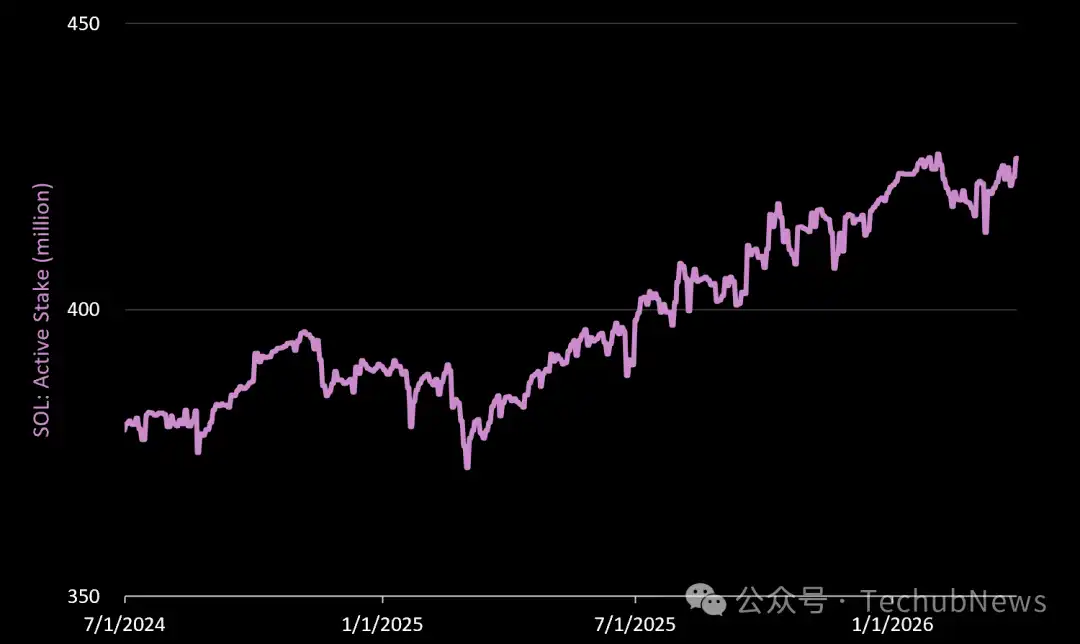
Active staking increased by 1.2% in Q1 and 10.8% year-on-year. As of March 31, 2026, 426.4 million SOL were staked on the network, accounting for 74.4% of the circulating supply and 68% of the total supply.

Key Takeaways

Unlike Ethereum, an increase in SOL staking does not increase the new issuance paid to validators. Instead, issuance follows a fixed, disinflationary schedule, decreasing by 15% annually until it reaches 1.5% per year.

Cost to Generate $1 in Revenue (REV)
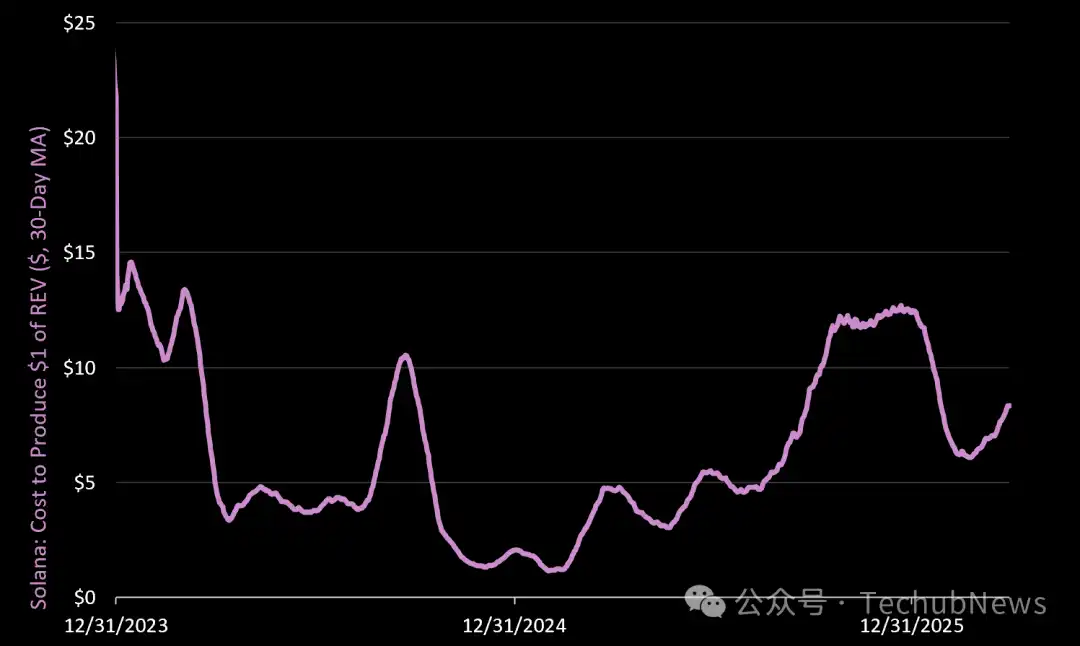
The average cost to generate $1 in real economic value in Q1 was $8.10, down 31% quarter-on-quarter but up 93% year-on-year.

Why is this important?

An increase in the cost to generate $1 of real economic value indicates that more issuance (network inflation) is required to secure the network relative to the real value generated in the quarter. This suggests that network costs/operating expenses fell faster than revenue in Q1.

For reference, Ethereum's cost to produce $1 of REV in Q1 was $13.79.

Stablecoins

Stablecoin Supply
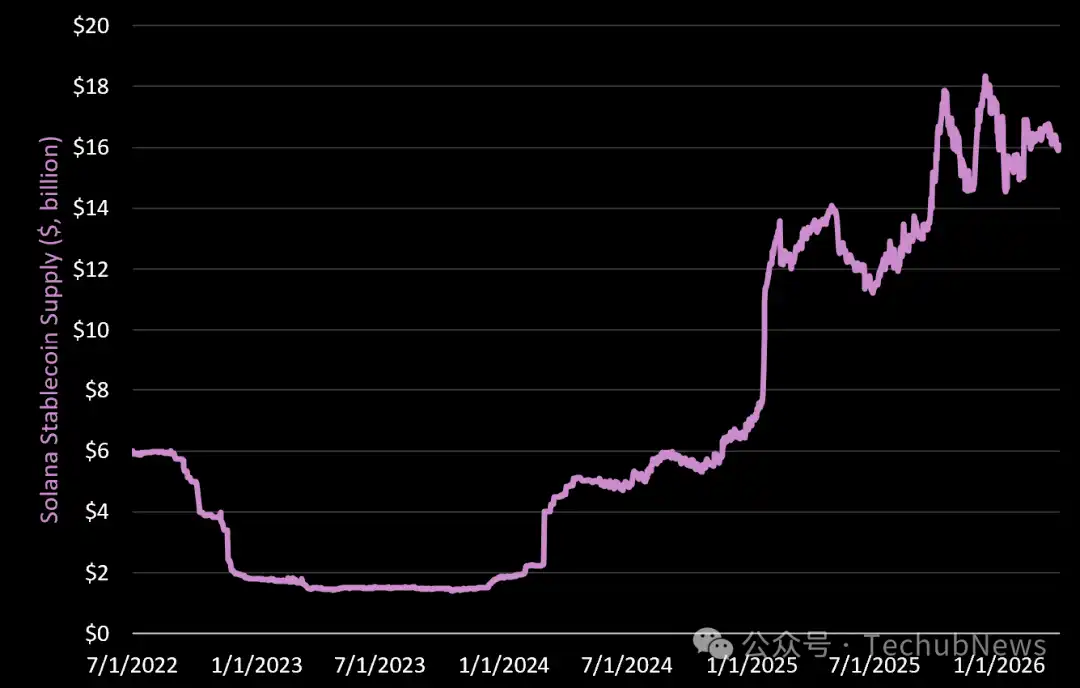
Solana now has a total of $15.9 billion in stablecoins on its network, down 2.7% in Q1 but up 18% year-on-year. This accounts for 4.5% of all stablecoin supply in cryptocurrency, placing Solana behind Ethereum, Tron, and BNB.

Major stablecoin issuers on the Solana platform:

  • Circle/USDC: $9.0 billion (down 16% in Q1, down 11% year-on-year).

  • Tether/USDT: $3.5 billion (up 27% in Q1, up 46% year-on-year).

  • Paypal/USDPY: $720 million (down 23% in Q1, but up 440% year-on-year).

  • Paxos/USDG: $940 million (up 8% in Q1, up 1021% year-on-year).

  • World Liberty Finance/USD1: $884 million (up 670% in Q1).

  • Solstice/USX: $355 million (up 16% in Q1).

We expect to see more stablecoin innovation on Solana in the following areas:

  • Latin American fintech companies serving remittances, payroll, card/exchange fees. Promising examples include Rain, Morse, and Takenos.

  • Licensed US fintech companies using stablecoins to offer new payroll solutions. We believe this could emerge after the passage of the Clarity Act, and we still believe the ultimate winning stablecoin issuer will offer a suite of services around the token.

Stablecoin Velocity
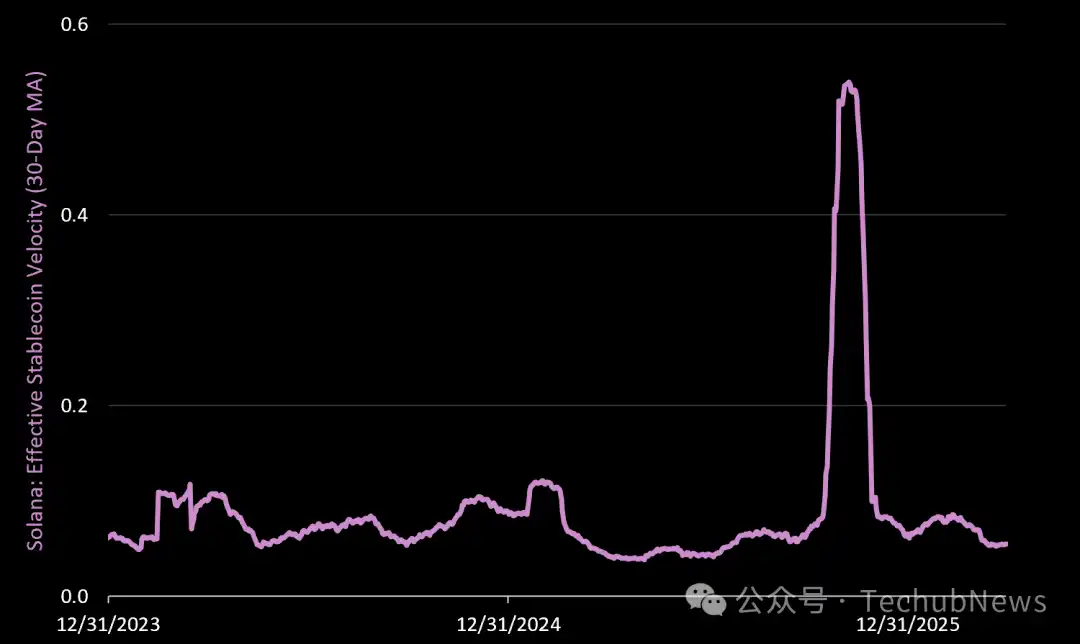
Effective stablecoin velocity measures the daily turnover rate per dollar of stablecoin supply on-chain. This metric filters out noise like wash trading and circular trades to derive true velocity, measured as daily net USD transfer volume / circulating supply. A rising value indicates increased economic activity on the Solana network.

  • Stablecoin velocity averaged 0.07 in Q1, down 69% quarter-on-quarter but up 29% year-on-year.

  • A reading of 0.07 in Q1 indicates that 7% of the stablecoin supply "turned over" daily during the quarter. For reference, Ethereum L1 turned over 2% of its stablecoin supply daily in Q1.

As emerging fintech companies building on Solana integrate with new regulations, we expect stablecoin velocity to grow steadily over the coming years, with reduced cyclicality/reliance on "risk-on" trading/speculation.

Tokenomics

Net Dilution Rate
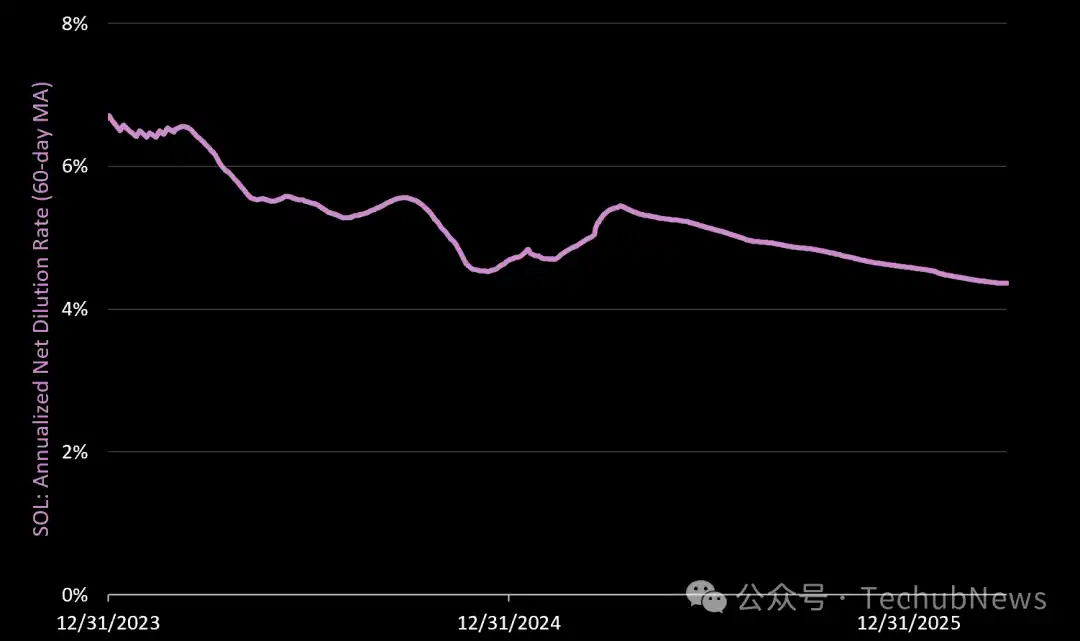
Net dilution rate = Daily protocol issuance minus burned SOL / circulating supply (annualized). A positive net dilution rate is dilutive to (unstaked) SOL holders.

SOL's net dilution rate (annualized) in Q1 was 4.38%, down 5.3% in Q1 and down 7.7% year-on-year. Drivers:

  • SOL Issuance: 6.26 million in Q1 (down from 6.45 million in Q4)

  • SOL Burned: 677,000 in Q1 (up from 637,000 in Q4)

  • Net Result: 6.19 million new SOL issued in Q1 (4.38% annualized inflation rate)

Note that, unlike Ethereum, an increase in staked assets does not increase the amount of SOL received by Solana validators. This means SOL issuance on Solana is always decreasing (the network is pre-programmed to do so, with a 15% annual disinflation rate).

What does this mean for validators/stakers?

When more SOL is staked on the network, staking yields will decrease if on-chain fees cannot make up the difference.

DeFi

DEX Volume
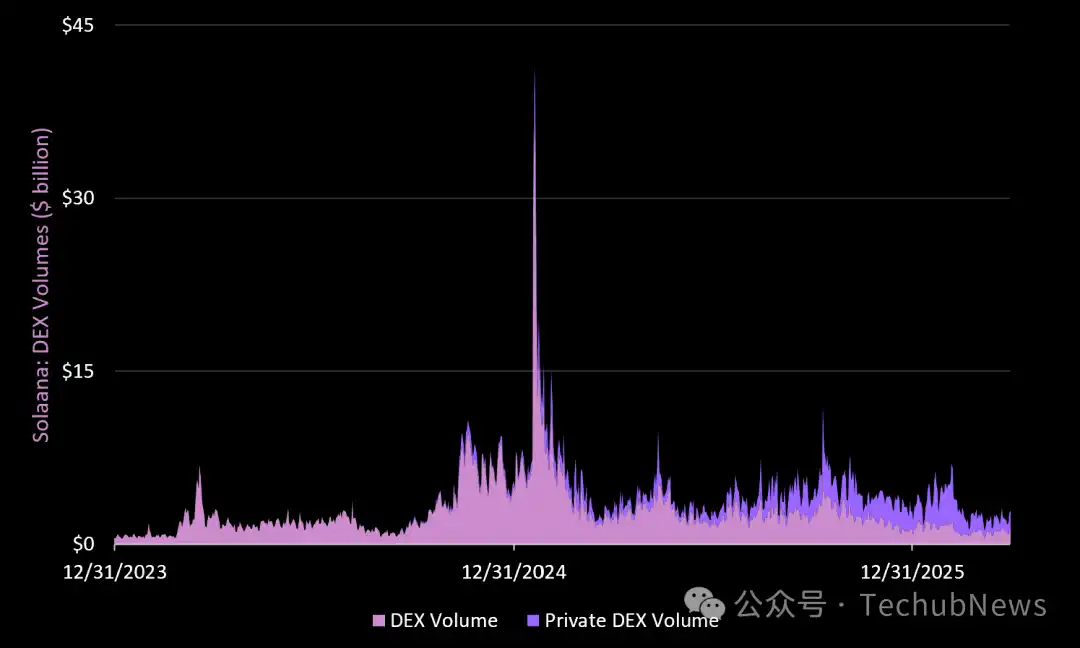
This sector includes 11 public DEXs and 9 private DEXs. The story within Solana DeFi remains the growth of private DEXs (which now dominate).

  • The average (total) daily DEX volume in Q1 was $3.2 billion, down 32% quarter-on-quarter and down 4% year-on-year. For reference, Ethereum L1 DEXs averaged $2.0 billion in daily volume in Q1, or $3.6 billion including L2 DEXs.

  • Private DEXs accounted for 60% of the volume ($1.9 billion/day) but declined 14% in Q1.

  • Public DEXs averaged $1.3 billion in daily volume in Q1, down 47% from Q4 and down 37% year-on-year.

Top DEXs on Solana by volume:

  • HumidiFi Private DEX: $613 million daily volume (down 55% in Q1).

  • BisonFi Private DEX: $574 million daily volume (up 614% in Q1).

  • Meteora Public DEX: $447 million daily volume (down 36% in Q极).

  • Raydium Public DEX: $298 million/day (down 69% in Q1, down 60% year-on-year).

  • Orca Public DEX: $278 million daily volume (down 41% in Q1, down 21% year-on-year).

DeFi Velocity
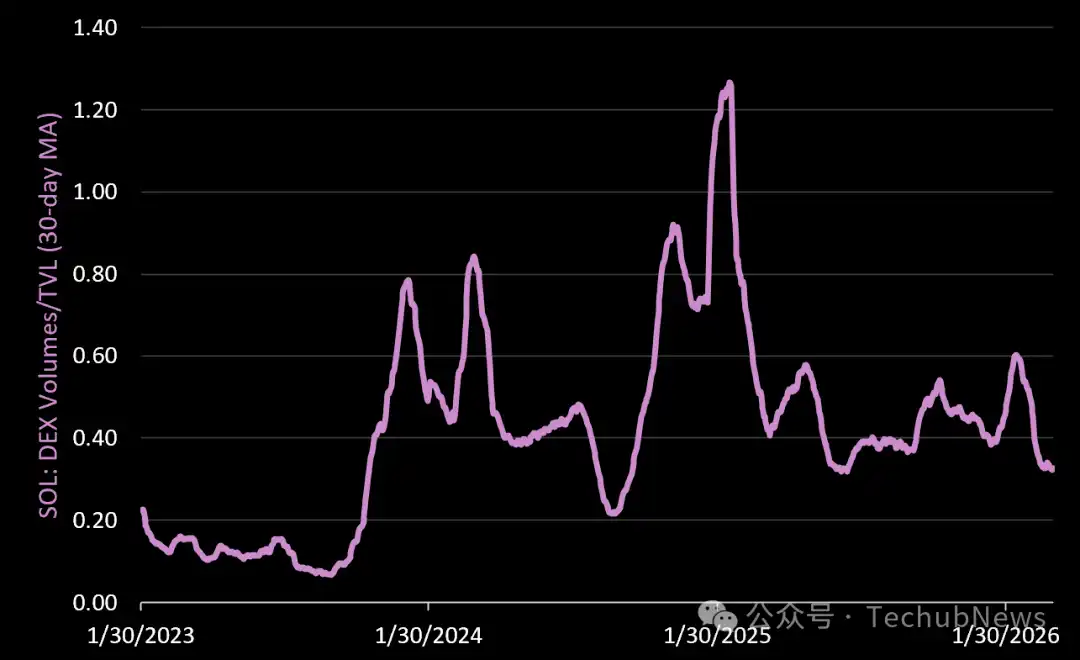
DeFi velocity measures the turnover rate of every dollar within DeFi protocols. When this value is greater than 1, it means the network's daily volume exceeds the total value locked in DeFi protocols. DeFi velocity averaged 0.43 in Q1, meaning the network turned over its TVL at an average rate of 43% per day. This was down 7% quarter-on-quarter and down 23% year-on-year.

Key Takeaways

Last week, we noted that the network dilution rate is the most important metric for Ethereum. For SOL, we believe DeFi velocity is the most important. Why?

Solana's core thesis is "fast DeFi." Speed and turnover rate are primary drivers of network fees. This is also why Solana's real yield consistently higher than Ethereum's in 2024/2025. We believe Solana's velocity will ultimately make it a magnet for capital in higher risk-on environments. This makes SOL an extremely responsive, high-beta asset.

New Trading Tokens
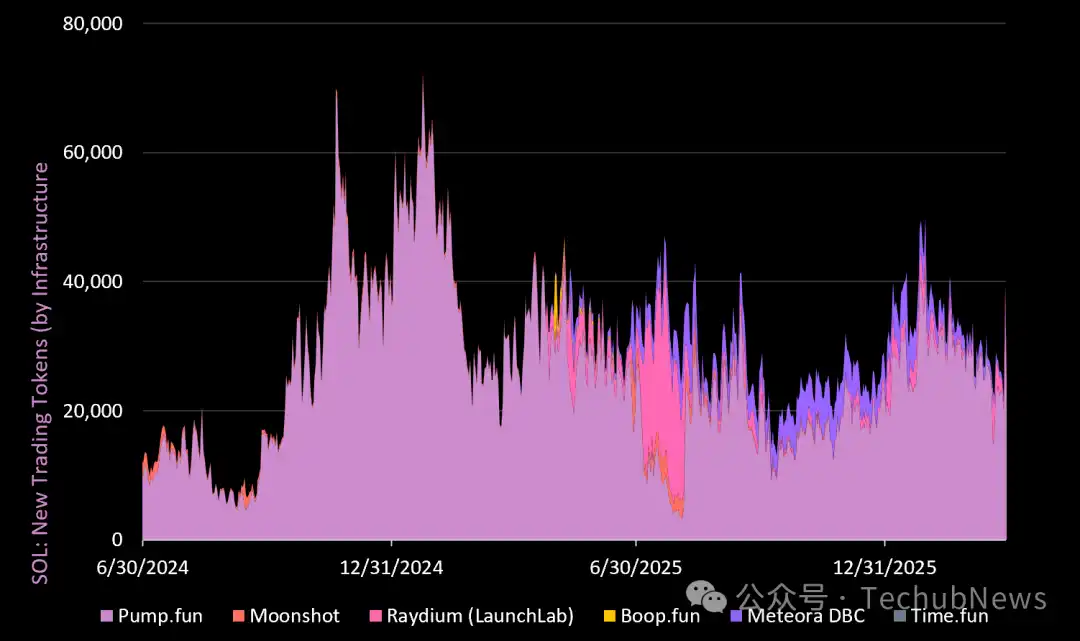
New trading tokens = Number of tokens created on Solana launchpads.

A total of 3 million tokens were created on Solana in Q1, up 42% from the previous quarter and up 21% year-on-year. Among them, Pump Fun continued to lead the market, adding 2.5 million new tokens in Q1 (capturing 85% market share). Pump Fun's performance during the bear market has been impressive and remains a major highlight within the Solana ecosystem (alongside the growth of private DEXs). Again, this application generated more revenue in Q1 than Solana L1.

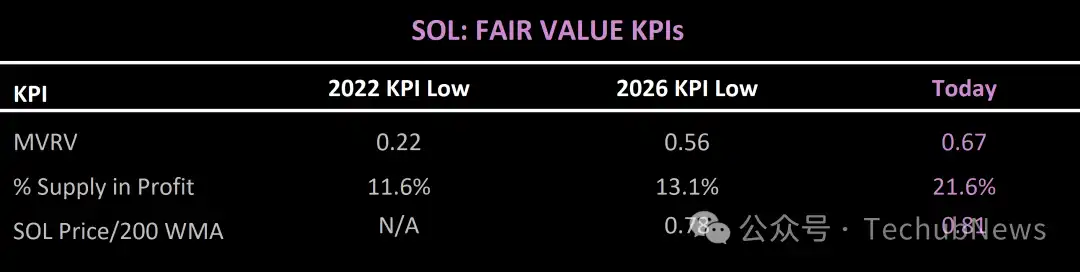
Fair Value Key Performance Indicators
Conclusion

In the last cycle, Solana was the "speculator's paradise," and it also attracted more new cryptocurrency users than any other blockchain. This allowed the network to: establish itself as the place to "build" by generating some of the fastest-growing and most profitable crypto applications (Pump, Axiom, Jupiter, etc.), and stress-test the network infrastructure (successfully).

Today, while developers may not be as "frazzled" as in 2022, the network is undoubtedly experiencing the latest round of reset. Looking ahead, we see five key pillars that could determine Solana's success in the next expansion:

  • Consumer/retail trading use case. For years, crypto-native venture capital firms have been funding on-chain "gaming" use cases. But true games barely exist in crypto. "Gaming" means retail trading. And, it is arguably the most valuable use case in crypto. As noted in the report, Pump Fun has been a major bright spot for Solana even in the current bear market. The team is now focused on improving the mobile experience to make it a mainstream social/trading app (rather than a crypto-native desktop terminal).

  • Perpetuals market. Solana needs to compete with Hyperliquid here. Notably, Solana's hottest perpetuals DEX (Drift) was exploited on April 1st, with nearly half its TVL stolen by hackers. This was a significant blow to the ecosystem, as it was already losing ground to Hyperliquid. This may now open the door for competitors or new builders to launch perpetuals projects on Solana—something to watch closely.

  • Bringing in Traditional Finance (TradFi). To become the "Nasdaq on the blockchain," Solana needs Nasdaq's assets. This means it needs to attract asset issuers who want to tokenize their assets (stocks, bonds, etc.). Beyond regulation, finding an incentive structure that works for issuers is likely the biggest hurdle. This will take some time.

  • Becoming the leading public blockchain for businesses building fintech products using stablecoins, especially in emerging markets like Latin America.

  • Continuing to win the "developer wars." Compared to its peers in crypto, the Solana Foundation operates more like a well-managed tech company. As a result, Solana tends to have a stronger developer pipeline, facilitated by a global "hacker house" program to find and onboard developers to Solana. Continued organization and investment in this area are crucial for the network's ongoing success. For reference, Solana's full-time developers are currently down 32%, while Ethereum's are down 29%.


İlgili Sorular

QWhat was the percentage decline in Solana's Q1 year-over-year revenue, and how does it compare to Ethereum L1?

ASolana's Q1 revenue declined by 68% year-over-year. For comparison, Ethereum L1 generated $82 million in fees during the same quarter.

QWhich application was the top revenue generator on Solana in Q1, and what made its performance notable?

APump Fun was the top revenue generator on Solana in Q1, with $103 million in revenue. Its performance is notable because it generated more revenue than the Solana L1 itself and grew 3% quarter-over-quarter despite the bear market.

QHow did the number of active developers on Solana change, and what is the significance of this trend?

AThe number of full-time developers on Solana decreased by 32%. This trend is significant because winning the 'developer war' and maintaining a strong developer ecosystem is crucial for the network's long-term success and innovation.

QWhat is the 'DeFi Velocity' metric, and why is it considered the most important metric for Solana according to the report?

ADeFi Velocity measures the daily turnover rate of every dollar locked in DeFi protocols. It is considered the most important metric for Solana because the network's core thesis is 'fast DeFi,' where speed and turnover are the primary drivers of network fees, making SOL a highly responsive, high-beta asset.

QWhat are the five key pillars identified for Solana's success in the next expansion cycle?

AThe five key pillars are: 1) Consumer/retail trading applications, 2) Competing in the perpetual futures market, 3) Onboarding traditional finance (TradFi) for asset tokenization, 4) Being the leading public blockchain for fintechs building with stablecoins, and 5) Continuing to win the developer war.

İlgili Okumalar

Single-Day Plunge of 30%, Arthur Hayes Suddenly Liquidates: Why Did ZEC Get Exploded by Security Issues?

On June 5th, Zcash founder Zooko Wilcox disclosed a critical soundness vulnerability in the project's latest Orchard privacy pool. This flaw, found in the elliptic curve multiplication constraints, could allow an attacker to create unlimited counterfeit ZEC within the shielded pool, with transactions appearing valid. The vulnerability was discovered in late May by security researcher Taylor Hornby, who utilized Anthropic's new Opus 4.8 AI model for a targeted audit. The Zcash ecosystem had already performed an emergency network upgrade to patch the issue. However, the detailed disclosure triggered severe market panic, causing ZEC's price to plummet over 30% in a single day. Notably, prominent investor Arthur Hayes announced he had sold his entire ZEC position following the news. The incident starkly challenges the "technological trust" narrative central to privacy coins. Despite years of top-tier cryptographic audits, the bug persisted until uncovered with advanced AI-assisted research. This highlights the growing gap between theoretical perfection and practical implementation in privacy technology. The event serves as a industry-wide warning: in an AI-driven security landscape, the assumption that "undiscovered equals safe" is obsolete. It underscores the urgent need for continuous, proactive security practices combining AI audits, formal verification, and rapid response mechanisms.

foresightnews_api53 dk önce

Single-Day Plunge of 30%, Arthur Hayes Suddenly Liquidates: Why Did ZEC Get Exploded by Security Issues?

foresightnews_api53 dk önce

Breaking the Curse of DeFi Cascading Liquidations, Vitalik Proposes a New Solution

**Vitalik Buterin Proposes New DeFi Design to Eliminate Forced Liquidations** Ethereum co-founder Vitalik Buterin has published a proposal for a new decentralized finance (DeFi) architecture aimed at removing the automatic liquidation mechanisms prevalent in current lending protocols. The core idea involves creating synthetic assets using options as building blocks, fundamentally avoiding the抵押借贷结构 that triggers forced sell-offs. The proposal responds to a recurring flaw in DeFi: during sharp market downturns, mass自动清算 of under-collateralized positions can exacerbate price declines, creating systemic selling pressure and market instability, as evidenced by recent crypto market volatility. Buterin's model would split an asset like 1 ETH into two option-like derivatives, P and N, pegged to a price index with a set strike price and expiration. At expiry, an oracle determines the settlement price to allocate the underlying ETH between P and N holders. This design eliminates the "cliff" of instant liquidation. Instead, a position's value would gradually drift from its target peg if not actively rebalanced by the user, transferring the rebalancing decision from the protocol to the user or automated tools. A key advantage is the reduced reliance on high-frequency, real-time oracle price feeds, which are vulnerable to manipulation and errors in current systems. The delayed settlement in the options model allows for more robust, fault-tolerant oracle designs. However, significant challenges remain for practical adoption. High transaction costs (slippage) from frequent rebalancing on automated market makers (AMMs) could erode user funds. The model may not be suitable for stablecoins requiring a strict 1:1 dollar peg, as it inherently allows for value drift. Success would depend on developing new liquidity provisioning models and deep markets for these synthetic assets. The proposal represents a fundamental rethinking of DeFi risk management, challenging the industry to explore alternatives to被动集中平仓 rather than merely optimizing existing liquidation processes. It remains a theoretical framework awaiting implementation and testing by development teams.

foresightnews_api56 dk önce

Breaking the Curse of DeFi Cascading Liquidations, Vitalik Proposes a New Solution

foresightnews_api56 dk önce

Bitcoin's Decline Marks the Transformation of Crypto

Title: The Decline of Bitcoin Marks the Transformation of Crypto While Bitcoin's price recently fell below $70,000, down approximately 45% from its peak, the broader crypto industry is not following it into decline. Instead, crypto is maturing and evolving beyond its dependence on Bitcoin's price movements. Two of Bitcoin's core functions are being usurped. First, AI has captured its role as the primary speculative asset. AI, with its tangible revenue, explosive demand, and massive capital inflows ($700-830 billion in 2024), is siphoning off the speculative "hot money" that once drove Bitcoin. It also contributes to a sustained high-interest-rate environment, further tightening liquidity for assets like Bitcoin. Second, dollar-pegged stablecoins like USDC and USDT have replaced Bitcoin as the crypto market's foundational currency and primary on/off-ramp. Most trading pairs and on-chain transactions are now settled in stablecoins, severing the historical link where all capital inflows had to pass through Bitcoin first. This decoupling allows projects to thrive based on their own fundamentals rather than Bitcoin's price. Examples include Hyperliquid, an on-chain derivatives exchange with annual revenues of $8-13 billion, and prediction market platform Polymarket, valued at $200 billion with $3.65 billion in annual fees. These projects are evaluated on traditional metrics like revenue and user growth. New opportunities are emerging, particularly around privacy. Privacy coins like Zcash (ZEC) are seeing surging demand, while infrastructure like NEAR enables private, cross-chain asset transfers without requiring users to hold a specific token—privacy becomes a universal service layer. In this new paradigm, stablecoins are the universal cash, various project tokens represent equity, and privacy-enabled cross-chain coordination layers (like NEAR) act as the critical infrastructure connecting a fragmented, multi-chain ecosystem. Bitcoin is now just one asset among many. The era where the entire crypto market moved in lockstep with Bitcoin is over. The industry's health should now be judged by project fundamentals—real revenue, active users, and tokenomics that capture value—and the development of the underlying infrastructure enabling a mature, dollar-denominated crypto economy.

foresightnews_api59 dk önce

Bitcoin's Decline Marks the Transformation of Crypto

foresightnews_api59 dk önce

Lightspark CEO: In Ten Years, Bitcoin Will Be as Invisible as TCP/IP, Yet Power Trillions in Daily Transactions

A decade from now, Bitcoin will function like TCP/IP — invisible yet foundational, supporting trillions in daily transactions globally, according to Lightspark CEO David Marcus. In this future, a coffee shop in Lagos receives instant payment, a manufacturer in São Paulo settles an invoice with a supplier in Ho Chi Minh City, and a freelancer in Bangalore gets paid weekly from an Austin startup — all via Bitcoin's settlement layer, with none of the parties consciously interacting with it. This vision parallels the adoption of open protocols: first driven by necessity where existing systems fail, then scaling rapidly as tools mature and economic benefits become clear. The structural shift begins with wallets. Modern non-custodial wallets, like Spark, allow users to hold dollars, local currency, and Bitcoin in a single address, seamlessly switching between them. This eliminates friction and revolutionizes global custody, moving significant deposits to user-controlled keys not by ideology, but by superior utility. As a result, Bitcoin becomes the default savings layer for billions, as its fixed supply and appreciating value make it a rational choice for savers holding it alongside stablecoins in their everyday wallets. Businesses follow a similar path, from small companies in emerging markets to multinational corporations, holding Bitcoin alongside operational stablecoins. The latest trend is direct Bitcoin transactions for commerce. When both parties hold Bitcoin, transacting in it becomes the simplest option — no conversions, no intermediary currency. This starts in niche areas like high-value B2B settlements but grows as infrastructure makes sending Bitcoin as easy as stablecoins. An accelerating force is AI agents. By 2036, AI agents conducting commerce on behalf of individuals and firms will increasingly choose Bitcoin for settlement. Optimizing for speed, finality, and minimal counterparty risk across jurisdictions, they find Bitcoin's global, neutral, and programmable network ideal for netting and settling obligations. Thus, Bitcoin is becoming the native currency for machine commerce, just as it has become a native savings asset for humans. The global monetary system is being rebuilt from the protocol layer: open infrastructure, default self-custody, Bitcoin settling everything underneath, with stablecoins as the interface. Most users won't think about Bitcoin when they transact — and they won't need to.

foresightnews_api1 saat önce

Lightspark CEO: In Ten Years, Bitcoin Will Be as Invisible as TCP/IP, Yet Power Trillions in Daily Transactions

foresightnews_api1 saat önce

İşlemler

Spot
Futures

Popüler Makaleler

T Nasıl Satın Alınır

HTX.com’a hoş geldiniz! Threshold Network Token (T) satın alma işlemlerini basit ve kullanışlı bir hâle getirdik. Adım adım açıkladığımız rehberimizi takip ederek kripto yolculuğunuza başlayın. 1. Adım: HTX Hesabınızı OluşturunHTX'te ücretsiz bir hesap açmak için e-posta adresinizi veya telefon numaranızı kullanın. Sorunsuzca kaydolun ve tüm özelliklerin kilidini açın. Hesabımı Aç2. Adım: Kripto Satın Al Bölümüne Gidin ve Ödeme Yönteminizi SeçinKredi/Banka Kartı: Visa veya Mastercard'ınızı kullanarak anında Threshold Network Token (T) satın alın.Bakiye: Sorunsuz bir şekilde işlem yapmak için HTX hesap bakiyenizdeki fonları kullanın.Üçüncü Taraflar: Kullanımı kolaylaştırmak için Google Pay ve Apple Pay gibi popüler ödeme yöntemlerini ekledik.P2P: HTX'teki diğer kullanıcılarla doğrudan işlem yapın.Borsa Dışı (OTC): Yatırımcılar için kişiye özel hizmetler ve rekabetçi döviz kurları sunuyoruz.3. Adım: Threshold Network Token (T) Varlıklarınızı SaklayınThreshold Network Token (T) satın aldıktan sonra HTX hesabınızda saklayın. Alternatif olarak, blok zinciri transferi yoluyla başka bir yere gönderebilir veya diğer kripto para birimlerini takas etmek için kullanabilirsiniz.4. Adım: Threshold Network Token (T) Varlıklarınızla İşlem YapınHTX'in spot piyasasında Threshold Network Token (T) ile kolayca işlemler yapın.Hesabınıza erişin, işlem çiftinizi seçin, işlemlerinizi gerçekleştirin ve gerçek zamanlı olarak izleyin. Hem yeni başlayanlar hem de deneyimli yatırımcılar için kullanıcı dostu bir deneyim sunuyoruz.

460 Toplam GörüntülenmeYayınlanma 2024.12.10Güncellenme 2026.06.02

T Nasıl Satın Alınır

Tartışmalar

HTX Topluluğuna hoş geldiniz. Burada, en son platform gelişmeleri hakkında bilgi sahibi olabilir ve profesyonel piyasa görüşlerine erişebilirsiniz. Kullanıcıların T (T) fiyatı hakkındaki görüşleri aşağıda sunulmaktadır.

活动图片