Solana Hit By One Of The Largest DDoS Attacks In Internet History

bitcoinist2025-12-16 tarihinde yayınlandı2025-12-16 tarihinde güncellendi

Özet

Solana has successfully withstood one of the largest DDoS attacks in internet history, estimated at 6 Tbps, without significant performance degradation. Despite the massive scale of the attack, which lasted for over a week, the network maintained median transaction confirmations around 450ms and stable slot latency. Ecosystem builders highlighted that the attack had zero noticeable impact on regular users or traders. The event underscores that blockchains have become high-value targets for industrial-scale DDoS campaigns. Solana’s resilience is attributed to its engineering and validator infrastructure, though experts note that validator count alone isn’t the sole factor in network defense. At the time of reporting, SOL traded at $126.

Solana has been battling what some ecosystem builders are calling an internet-scale DDoS campaign — and, despite the usual “Solana is fragile” jokes, the network seems to be shrugging it off.

Pipe Network said of the ongoing attack via X today: “The ongoing DDoS attack on Solana is one of the largest in internet history. 6 Tbps volumetric attack translates to billions of packets per second. Under that kind of load, you’d normally expect rising latency, missed slots, or confirmation delays.”

Pipe further says that’s not what the data is showing. “Median tx confirmation ~450ms,” the team wrote, adding that p90 remains under 700ms and slot latency is holding at 0–1 slots. In other words, if you’re a regular user or trader, you might not even know anything’s happening. Which is kind of the point.
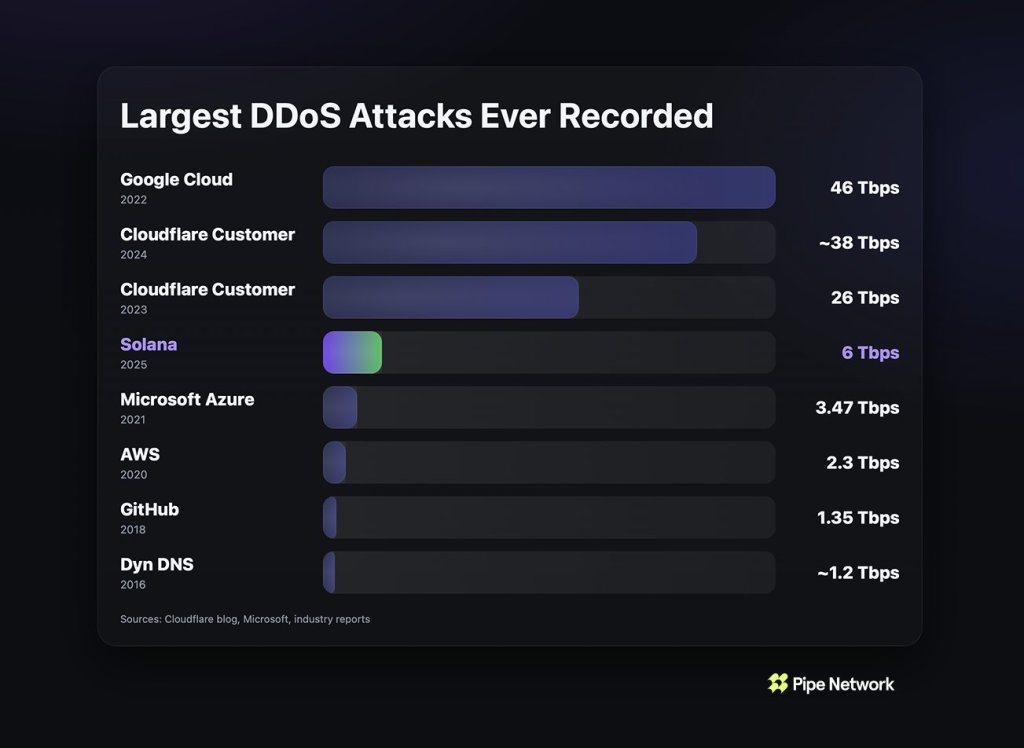
Largest DDos attacks in internet history | Source: X @pipenetwork

Reactions From The Solana Community

Raj Gokal, Solana Labs’ co-founder and COO, put it more bluntly in a reply to a broader DDoS debate: “have you heard about the ongoing DDOS against Solana that has had zero effect on performance?”

The backdrop here matters. Justin Bons had posted about Sui being DDoS’d yesterday, claiming it triggered “mass delays” and arguing that “127 validators is not enough,” with the broader warning: don’t let validator counts drift too low if you want a chain to be resilient.

Mert Mumtaz, CEO of Helius, largely agreed with the premise — but pushed back on the simplistic “more validators = solved” framing.

“I understand your point & mostly agree with you,” Mert wrote, before adding that “a chain is more resistant to DDoS with 100 professional high powered validators compared to 10k validators run by amateurs.” He also said there are scenarios where higher validator count can help, but emphasized it isn’t the core defense by itself. Then he dropped the key detail: Solana’s attack hasn’t been a one-day headline, it’s been going on for a while.

“And fyi there has been a colossal ddos attack on Solana for weeks now,” Mert wrote, later adding that Solana “has been under a colossal DDoS attack for at least over a week now btw” — and that the fact most users haven’t felt it is “a big testament to the level of engineering present here.”

Solana co-founder Anatoly Yakovenko chimed in with a more technical angle on why validator count can matter in specific leader-hand-off dynamics: “Validators count helps if the previous leader can finish their block while the current one is being hit. Then the cost of ddos approaches the cost of ddos the whole network.”

Translation: if an attacker wants to reliably disrupt block production, they may have to sustain pressure across more of the network, not just pick off a single leader at the wrong moment. That gets expensive fast.

SolanaFloor summed it up via X: “Solana has been under a sustained DDoS attack for the past week, peaking near 6 Tbps, the 4th largest attack ever recorded for any distributed system. Network data shows no impact, with sub second confirmations and stable slot latency. The Sui network was also targeted by a DDoS attack yesterday, resulting in delays in block production and periods of degraded network performance.”

And there’s a more strategic takeaway that’s starting to sound less theoretical each month: blockchains are now juicy targets. David Rhodus, founder of Permissionless Labs (and a contributor to Pipe Network), said: “This puts Solana among the most heavily DDoSed targets in internet history. It reinforces that blockchains are now Tier-1 DDoS targets. This is not “script kiddie” activity — 6 Tbps is industrial-scale.”

If you’re a validator, Mumtaz offered the practical advice you’d expect in a week like this: have backups across multiple hosting providers and regions. Because even if the chain holds, your own infrastructure might not.

The broader point, though, is the new baseline: these networks are getting stress-tested like mainstream internet services now. Solana’s claim today is that it passed — quietly, under load, and without users noticing. That’s the kind of victory that doesn’t look dramatic on a chart. It just [...] works.

At press time, Solana traded at $126.
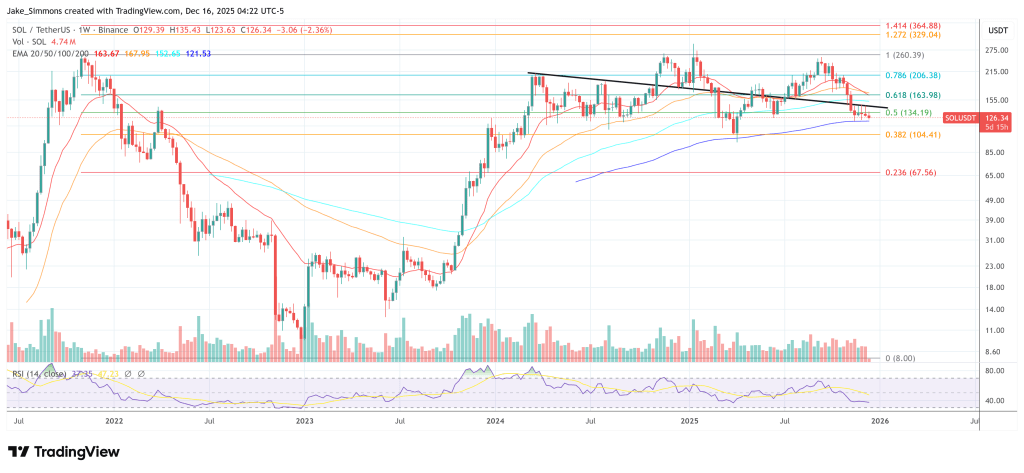
SOL remains above the 200-week EMA, 1-week chart | Source: SOLUSDT on TradingView.com

İlgili Okumalar

Second Largest Whale Cuts Losses and Liquidates, Can AAVE Still Be Bought Amid Deepening Divisions?

The second-largest AAVE whale, excluding the project team, protocol contracts, and CEXs, has sold 230,000 AAVE tokens at a significant loss of $13.45 million, causing a 12% price drop. This sell-off reflects growing tensions between Aave Labs and the community over governance and fund allocation. The conflict began when Aave switched its default swap aggregator to Cow Swap, redirecting front-end transaction fees—previously sent to the Aave DAO treasury—to Aave Labs instead. Community members estimated this change could divert over $10 million annually from the DAO to the team, raising concerns about transparency and control. Aave Labs argued that front-end products are separate from the protocol and that the team has the right to monetize them. In response, a proposal was made to transfer control of Aave’s brand assets (domains, social accounts, etc.) to token holders. Founder Stani Kulechov opposed the proposal, citing its oversimplification of complex legal and operational issues, further escalating community backlash. The situation highlights deeper structural challenges in DeFi governance, where protocol value, team control, and community rights intersect. The outcome of an ongoing snapshot vote on the proposal may determine AAVE’s short-term price direction and long-term community trust. If the conflict signals fundamental misalignment between Aave Labs and the DAO, this could mark the start of continued tension rather than an isolated incident.

marsbit16 dk önce

Second Largest Whale Cuts Losses and Liquidates, Can AAVE Still Be Bought Amid Deepening Divisions?

marsbit16 dk önce

Second Largest Whale Cuts Losses and Liquidates, Can AAVE Still Be Bought Amid Deepening Conflict?

The second-largest AAVE whale, excluding the project team, protocol contracts, and exchanges, has sold off 230,000 AAVE tokens (worth approximately $38 million) at a loss, causing a 12% price drop. The sale occurred amid growing tensions between the Aave team and its community over governance and financial control. The conflict began when the community discovered that Aave Labs, without prior communication, redirected front-end exchange fees—previously directed to the Aave DAO treasury—to its own address after switching the default trading path to Cow Swap. This change could divert an estimated $10 million annually from the community to the team. Aave Labs defended the move, arguing that front-end products are separate from the protocol and that the team has the right to monetize its own infrastructure. In response, a proposal was made to transfer control of Aave’s brand assets—including domains and social accounts—to AAVE token holders. Founder Stani Kulechov opposed the proposal, calling it oversimplified and poorly structured, further escalating community backlash. The situation highlights deeper structural tensions in DeFi between team-controlled products and community-governed protocols. The outcome of the ongoing snapshot vote on the proposal may significantly influence AAVE’s price and long-term community trust.

Odaily星球日报19 dk önce

Second Largest Whale Cuts Losses and Liquidates, Can AAVE Still Be Bought Amid Deepening Conflict?

Odaily星球日报19 dk önce

When Prediction Markets No Longer 'Predict', But 'Leak the Truth': BlockBeats Officially Launches Prediction Market Coverage

For a long time, prediction markets were seen as rational arenas where people bet on future outcomes based on public information, with prices reflecting collective consensus. However, over the past year, it has become increasingly clear that many prediction markets are not actually "predicting the future." Instead, they are exposing outcomes that have already been determined and are known to a select few, even before official announcements. When an outcome is certain but not yet public, prediction markets become a powerful and unsettling mechanism for leaking information. The movement of money itself acts as a signal—no explicit爆料, anonymous tips, or statements are needed. Key signals include unusually large bets on specific options, addresses consistently placing winning bets during critical periods, and accounts that repeatedly "predict" correctly ahead of time. This phenomenon is changing how secrets are kept and revealed. Examples include plot twists in TV shows, results of award selections, upcoming product launches or regulatory decisions, and governance votes in crypto protocols. In traditional contexts, this would be considered insider information. But in prediction markets, the mere act of betting can reveal what is known to a few. The article also highlights how prediction markets can influence reality itself, not just reveal it. A notable example is from a Coinbase earnings call where CEO Brian Armstrong used specific words that were the subject of active prediction market bets. His utterance led to immediate market settlements, rewarding those who had bet on those words being spoken. This shows that prediction markets can create a "reality distortion field," where betting activity may actually shape outcomes. As platforms like Polymarket and Kalshi grow, the issues raised by prediction markets—information leakage, insider advantage, and potential manipulation—will have increasingly significant real-world impacts.

marsbit24 dk önce

When Prediction Markets No Longer 'Predict', But 'Leak the Truth': BlockBeats Officially Launches Prediction Market Coverage

marsbit24 dk önce

İşlemler

Spot
Futures

Popüler Makaleler

Tartışmalar

HTX Topluluğuna hoş geldiniz. Burada, en son platform gelişmeleri hakkında bilgi sahibi olabilir ve profesyonel piyasa görüşlerine erişebilirsiniz. Kullanıcıların SOL (SOL) fiyatı hakkındaki görüşleri aşağıda sunulmaktadır.

活动图片