Social Capital CEO: From U.S. Stocks to SpaceX, How Equity Tokenization is Reshaping Capital Markets?

marsbit2026-03-07 tarihinde yayınlandı2026-03-07 tarihinde güncellendi

Özet

Chamath Palihapitiya discusses how equity tokenization is transforming capital markets by addressing structural limitations of traditional systems. The current stock market, valued at over $150 trillion, operates with restricted hours, relies on multiple intermediaries, and limits access to high-growth private companies. Tokenization introduces three key improvements: 24/7 trading to incorporate global information and demand, streamlined ownership reducing intermediaries and costs, and expanded access to private markets like SpaceX and OpenAI through SPV-based tokens. While these tokens offer economic exposure rather than direct ownership and lack standardization, they meet growing demand for private investments. The shift aligns with the rise of stablecoins and could save billions annually by modernizing infrastructure.

Original link:https://x.com/chamath/status/2029650649819009211

Original author:Chamath Palihapitiya

Compiled by: Ken, Chaincathcer

The modern stock market is built on infrastructure that predates the digital network by a long time.

The global stock market has a market capitalization of over $150 trillion, but trading hours are still limited, settlement still relies on multiple layers of intermediaries, and investment opportunities in many high-growth companies are still restricted to a small number of investors.

These structural limitations constrain how capital flows, who can participate, and the speed of ownership changes.

Market infrastructure providers are already exploring how to use tokenization to modernize the system. Institutions including the New York Stock Exchange, Nasdaq, and DTCC have begun developing tokenized equity and settlement infrastructure.

With the adoption of equity tokenization, these barriers are beginning to erode.

Since early 2025, the market capitalization of equity tokens has grown nearly 3.5 times, reflecting a broader shift towards the tokenization of real-world assets.
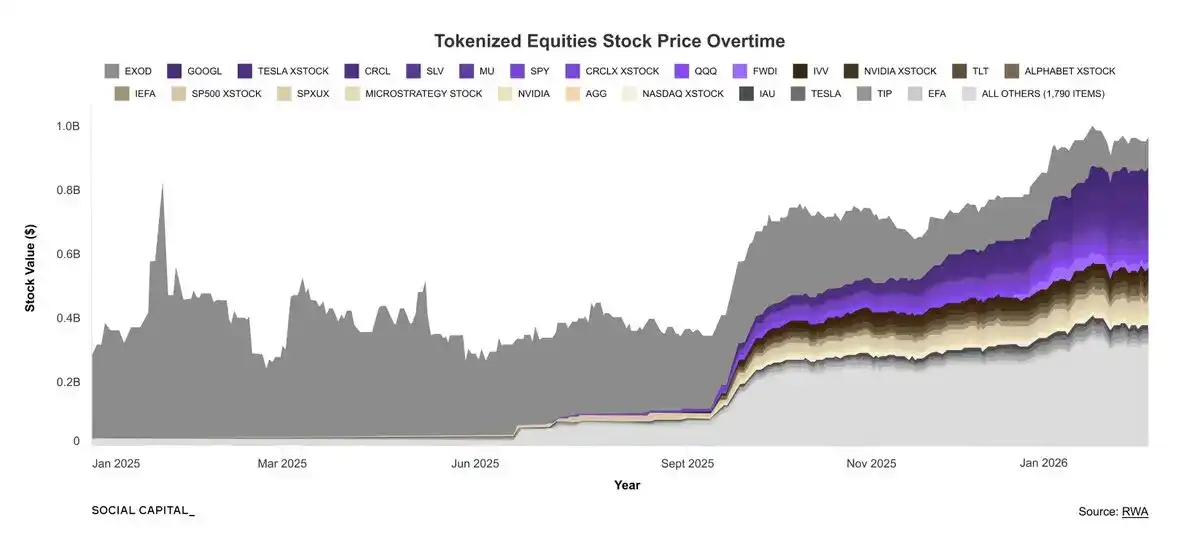
This expansion has occurred in parallel with the rise of stablecoins. These fiat-pegged tokens have grown more than tenfold in less than five years and have now become the primary settlement layer for on-chain financial activity:
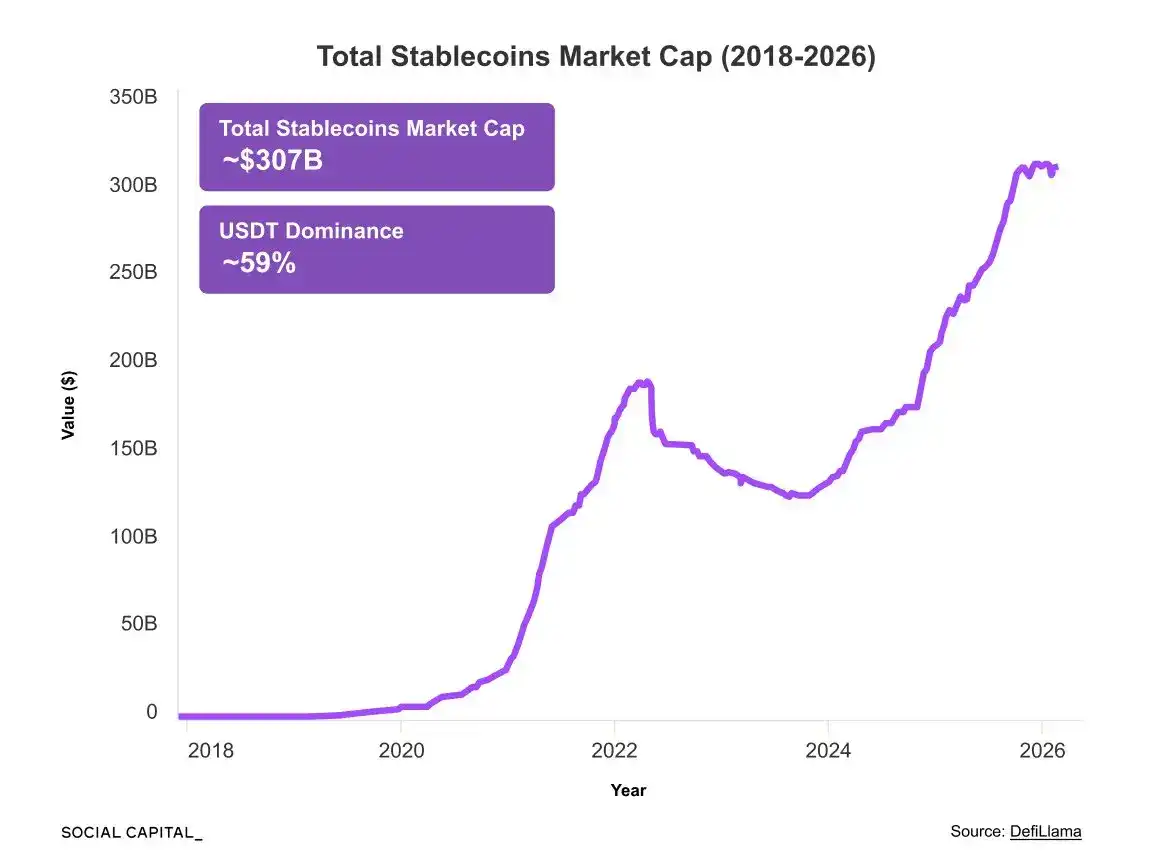
While stablecoins function differently from equity tokens, their rapid adoption shows that when tokenized financial instruments offer clear infrastructure advantages, they can achieve significant scale.

Equity tokens represent the next test: can tokenization expand from payments to the ownership of financial assets.

What are Equity Tokens?

Equity tokens are not just traditional stocks placed on a blockchain.

Traditional stocks represent ownership in a company.

An equity token is a blockchain-based asset that represents shares in a company or structured rights related to those shares, with ownership tracked and transferred via Distributed Ledger Technology (DLT).

Tokenized Equity Can Address Three Major Market Gaps 24/7

  1. 24/7 Trading: Markets are shifting from a 5-day (or shorter) weekly trading model to uninterrupted 24-hour trading.

Even today, approximately 11% of U.S. stock trading occurs outside regular trading hours.

A 24/7 market structure allows new information to be priced in more quickly during after-hours sessions and better accommodates a global shareholder base, as foreign investors currently hold about 15% of U.S. stocks.

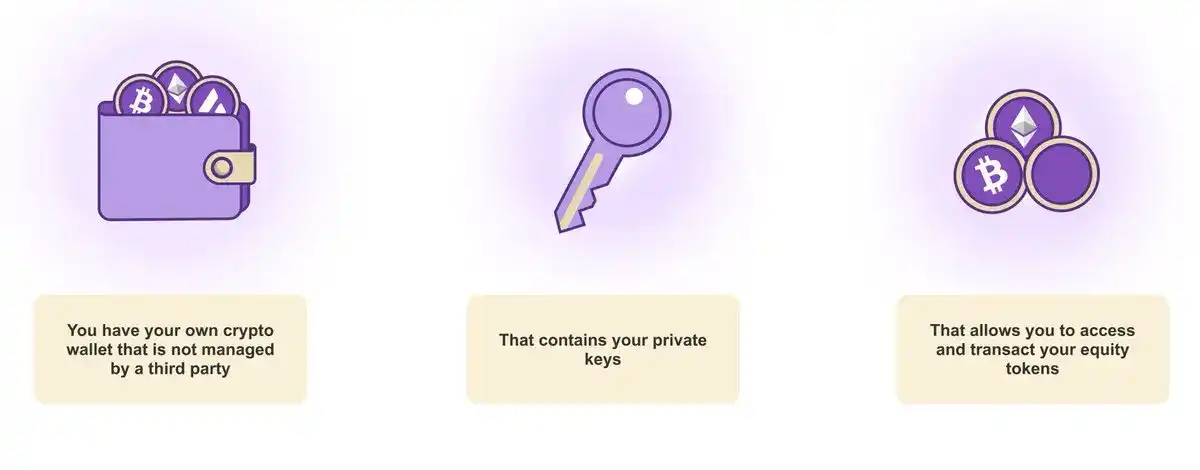
  1. Ownership: In traditional finance, equity ownership records are spread across multiple intermediaries, including brokers, clearing firms, and central securities depositories.

Tokenization reduces reliance on these layers and allows for ownership to be tracked directly on a shared ledger.

This transforms equity from a static record into a programmable financial asset.

Owners can use the asset as collateral for on-chain loans. They can use it to secure credit. They can also place it into automated liquidity pools to generate yield.

In traditional markets, similar operations typically require multiple intermediaries and additional settlement steps. Each intermediary interaction incurs brokerage fees and commissions, costs that are ultimately passed on to the equity asset holder.

Even a modest reduction in post-trade friction is estimated to save the stock industry $5 billion to $10 billion annually.
  1. Access Restrictions: While the first two advantages primarily apply to public market stocks, tokenization also addresses access restrictions in private markets.

Under current securities regulations, many private offerings are restricted to accredited investors. This typically requires an investor to have a net worth of $1 million (excluding primary residence), or an annual income of $200,000, or $300,000 jointly with a spouse.

Private companies must also control the number of shareholders to remain unlisted. U.S. regulations require companies to report to the SEC once they have more than 2,000 record shareholders or more than 500 non-accredited investors.

Furthermore, institutional venture capital funds often require limited partners to commit millions of dollars.

As a result, most investors have little access to these high-growth private companies before they enter the public markets.
极

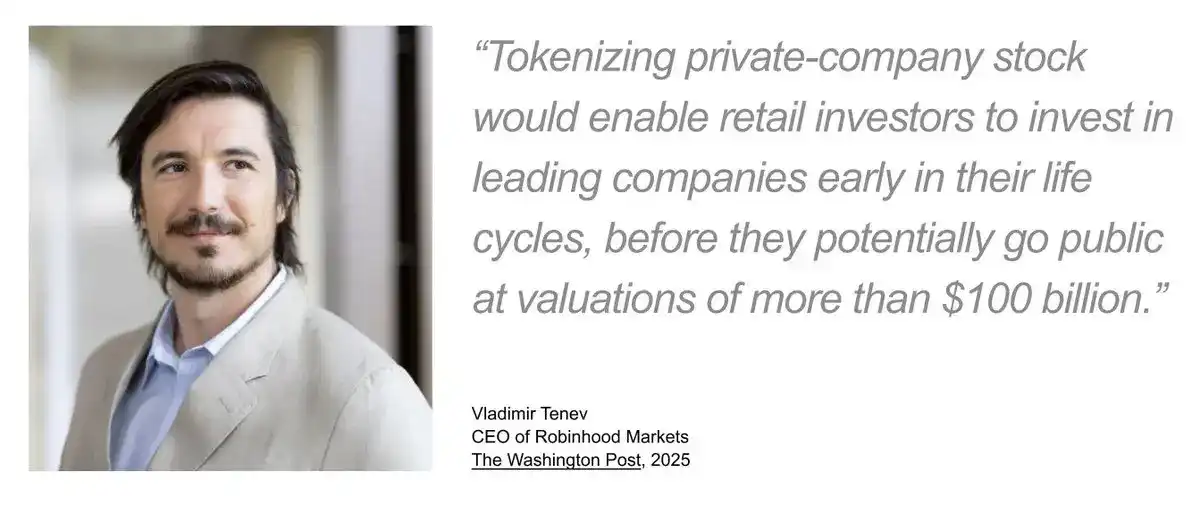
Equity tokenization promises to bridge this access gap.

Equity tokens can be issued through various structural models, but the most common method currently relies on a Special Purpose Vehicle (SPV).

In this structure, the SPV holds the underlying shares, and the tokens represent economic claims on that entity. This allows issuers to give investors exposure to investments in private companies, opportunities that were previously limited to venture capital firms and institutional investors.

For example, Robinhood recently announced the rollout of tokens for OpenAI and SpaceX to eligible users in the EU.
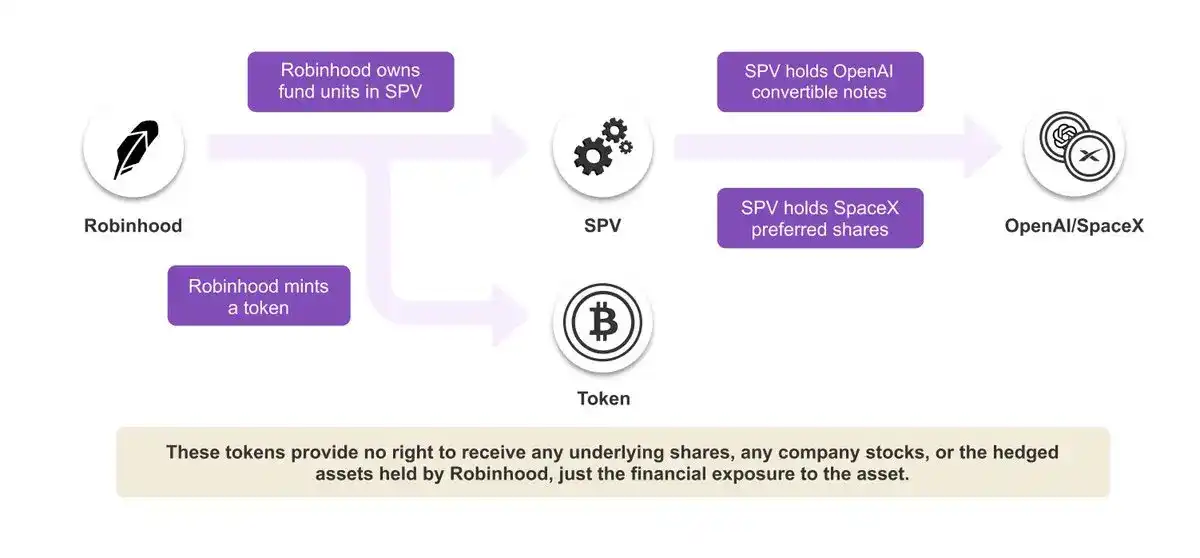
These tokens give investors exposure to two of the world's hottest private companies. However, they do not represent direct ownership of OpenAI or SpaceX shares. Instead, the tokens represent financial interests linked to an intermediary entity.

This highlights a core challenge of equity tokenization: the rights represented by the token are not always standardized.

Different issuers can design tokens with substantially different economic rights. In Robinhood's case, it is currently unclear whether the SpaceX token provides preferred stock rights, or if the token can convert to common stock should SpaceX eventually go public.

Preferred and common stock differ in liquidation priority, voting rights, and return characteristics. Without clear articulation of these terms, it is difficult for investors to price or compare tokens pegged to the same company.

Consequently, many tokenized private equity offerings provide economic exposure rather than direct ownership. Because the token sits at a different legal level than the underlying share, investors must understand the structure before assuming what they own.
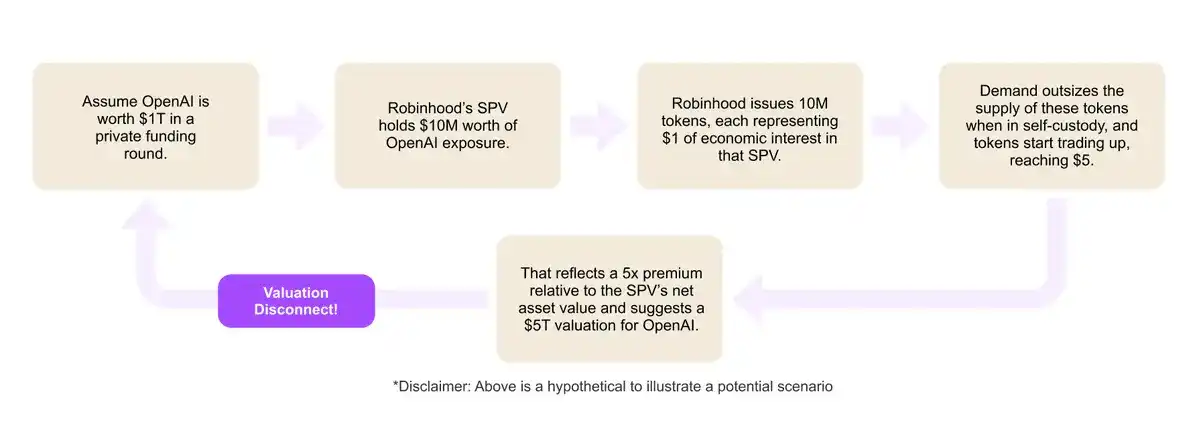
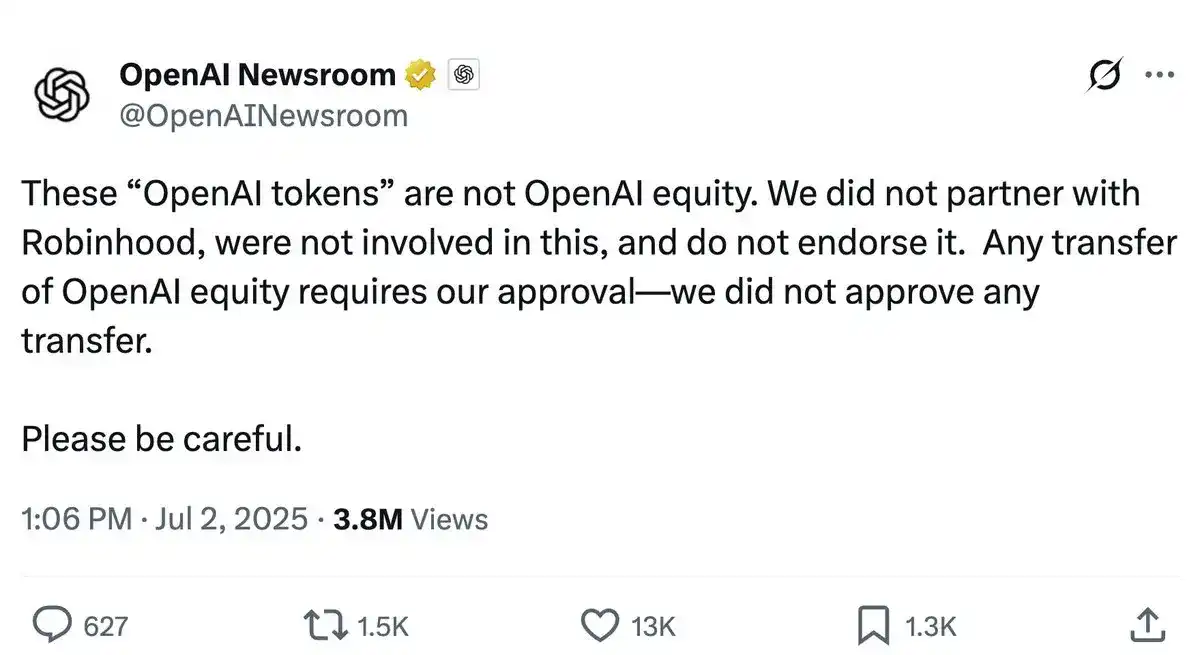
Despite these structural ambiguities, investor demand for access to private markets continues to grow. This is set against a backdrop where companies are also staying private for longer.

Surveys show that about 90% of Americans would be willing to allocate some of their retirement savings to private assets, with interest particularly strong among Gen Z and millennial investors.

Equity tokenization promises greater access to private markets, continuous liquidity, and new ways to structure financial ownership.


İlgili Sorular

QWhat are the three main market gaps that tokenized equity can address according to the article?

AThe three main market gaps are: 1) 24/7 trading, moving from limited weekly trading hours to continuous, around-the-clock markets. 2) Ownership, by reducing reliance on intermediaries and allowing for direct ownership tracking on a shared ledger, turning equity into a programmable financial asset. 3) Access restrictions, by solving the limitations in private markets that often exclude non-accredited investors from high-growth private companies.

QHow does the article define a stock token, and how is it different from a traditional stock?

AA stock token is defined as a blockchain-based asset that represents shares in a company or structured economic rights related to those shares, with ownership tracked and transferred via distributed ledger technology (DLT). It is different from a traditional stock because it is not merely a traditional stock placed on a blockchain; it represents a programmable financial asset on a shared ledger, reducing intermediary layers and enabling new financial uses like collateral for loans or placement in liquidity pools.

QWhat structural model is currently the most common for issuing equity tokens, as mentioned in the article?

AThe most common structural model for issuing equity tokens currently is through a Special Purpose Vehicle (SPV). In this structure, the SPV holds the underlying shares, and the tokens represent economic claims on that entity, providing investors exposure to private companies that were previously limited to venture capital firms and institutional investors.

QWhat core challenge does the article highlight regarding the rights represented by equity tokens?

AThe core challenge highlighted is that the rights represented by equity tokens are not always standardized. Different issuers can design tokens with substantially different economic rights, such as variations in liquidation priority, voting rights, and return characteristics. This lack of clarity makes it difficult for investors to price or compare tokens linked to the same company, as many offer economic exposure rather than direct ownership.

QWhat significant growth is cited in the article to demonstrate the shift towards real-world asset tokenization?

AThe article cites that since early 2025, the market capitalization of equity tokens has grown nearly 3.5 times. This expansion reflects a broader shift towards the tokenization of real-world assets and has occurred alongside the rise of stablecoins, which have grown more than tenfold in less than five years and become a primary settlement layer for on-chain financial activity.

İlgili Okumalar

Why Pricing Social Interactions is Doomed to Fail?

Titled "Why Putting a Price on Social Interaction Is Doomed to Fail," this article critiques attempts to monetize social networks directly through SocialFi models, arguing their inevitable failure stems from a fundamental misunderstanding of media dynamics. Using Marshall McLuhan's theory of "hot" and "cold" media, the author posits that social networks are inherently "cold" media. Their value isn't contained in individual posts but is co-created through user participation, interpretation, and fragmented, ongoing interaction (e.g., replies, shares). This ambiguity and need for user involvement are core to their function. The article asserts that SocialFi projects like Friend.tech failed because introducing real-time, tradable financial pricing (a definitive "hot" signal) into this "cold" environment doesn't add a layer—it replaces the medium's essence. The unambiguous price signal overshadows and nullifies the nuanced, participatory social signal. Users become traders, not participants, and when speculative profits vanish, the underlying social ecosystem—never genuinely cultivated—collapses entirely. This principle extends beyond crypto. The author argues platforms like Twitter have gradually "heated up" through metrics (likes, retweets counts, algorithmically defined value), shifting users from participants to performers and eroding organic engagement. The solution isn't to abandon capital but to manage its entry point. Successful models like Substack, Patreon, or Bandcamp allow capital to "condense" at specific, isolated nodes (e.g., subscriptions, one-time payments) without permeating and "heating" every social interaction. They preserve the core "cold," participatory medium while enabling monetization at designated boundaries. The NFT boom and bust serves as a stark parallel: the ancient "cold" medium of collecting (valued for story, community, gradual accumulation) was rapidly destroyed by platforms that introduced real-time floor prices, rarity scores, and trading dashboards, transforming collectors into speculators and vaporizing cultural value when prices fell. The core lesson: "Liquidity equals heat." Injecting high liquidity and definitive pricing into a "cold" participatory medium doesn't optimize it; it fundamentally alters and destroys its value-creating mechanism. The future lies not in pricing every social gesture but in finding precise, non-invasive points for capital to condense without overheating the entire ecosystem.

marsbit1 dk önce

Why Pricing Social Interactions is Doomed to Fail?

marsbit1 dk önce

Jensen Huang's CMU Speech: In the AI Era, Don't Just Watch, Build

Jensen Huang, CEO of NVIDIA and a first-generation immigrant, delivered the commencement address to Carnegie Mellon University's class of 2026. He shared his personal journey from a humble background to founding NVIDIA, emphasizing resilience, learning from failure, and the responsibility that comes with leadership. Huang framed the present moment as the dawn of the AI revolution, a shift he believes is more profound than previous computing waves. He described AI as fundamentally resetting computing—moving from human-written software to machines that understand, reason, and use tools. This will create a new industry for generating intelligence and transform every sector. While acknowledging AI's potential to automate tasks and displace some jobs, Huang distinguished between the *tasks* of a job and its core *purpose*. He argued AI will augment human capability, not replace humans. The real risk, he stated, is not AI itself, but people being left behind by those who effectively use AI. He presented AI as a generational opportunity for massive infrastructure investment—in chip factories, data centers, energy grids, and advanced manufacturing—that could re-industrialize nations like the U.S. and bridge the digital divide by making computing and intelligent tools accessible to all. Huang called for a balanced approach: advancing AI safely and responsibly, establishing prudent policies, ensuring broad access, and encouraging universal participation. He urged the graduates not to fear the future but to engage with optimism and ambition, reminding them of CMU's motto, "My heart is in the work." His core message was clear: this is their moment to actively build and shape the AI-powered future, not merely observe it.

marsbit57 dk önce

Jensen Huang's CMU Speech: In the AI Era, Don't Just Watch, Build

marsbit57 dk önce

The Era Has Arrived Where Human Writers Must Prove They Are Not Machines

The article describes an era where AI-generated content is flooding the market, forcing human authors to prove they are not machines. It begins with the example of dozens of AI-written, error-ridden biographies of Henry Kissinger appearing on Amazon within hours of his death, a pattern repeated for other deceased celebrities and even living experts who find fraudulent books under their names. This spam content has exploded, with monthly new book releases on platforms like Amazon reaching 300,000 by late 2025. The issue spans genres, from suspiciously high proportions of AI-written teen romance and self-help books to dangerous, AI-generated foraging guides containing lethal advice. The platforms' automated review systems, designed to catch plagiarism and banned words, are ill-equipped to detect AI-generated text that avoids these pitfalls while being nonsensical or fraudulent. The problem has infiltrated traditional publishing. A major publisher, Hachette, had to recall a bestselling horror novel after AI detection tools suggested 78% of its content was machine-generated. An acclaimed European philosophy book was later revealed to be entirely written by AI under a fake author persona. In response, authors are fighting back. At the 2026 London Book Fair, 10,000 writers published a blank book titled "Don't Steal This Book" containing only their signatures—using emptiness as a protest weapon in an age of AI overproduction. Initiatives like the "Human Author Certification" program have emerged, ironically placing the burden on humans to prove their work is not machine-made. The article warns of a vicious cycle: AI-generated low-quality books pollute the data used to train future AI models, leading to "model collapse" and an ever-worsening flood of digital waste, eroding trust in publishing and devaluing human creativity.

marsbit1 saat önce

The Era Has Arrived Where Human Writers Must Prove They Are Not Machines

marsbit1 saat önce

İşlemler

Spot
Futures

Popüler Makaleler

LINK Nasıl Satın Alınır

HTX.com’a hoş geldiniz! ChainLink (LINK) satın alma işlemlerini basit ve kullanışlı bir hâle getirdik. Adım adım açıkladığımız rehberimizi takip ederek kripto yolculuğunuza başlayın. 1. Adım: HTX Hesabınızı OluşturunHTX'te ücretsiz bir hesap açmak için e-posta adresinizi veya telefon numaranızı kullanın. Sorunsuzca kaydolun ve tüm özelliklerin kilidini açın. Hesabımı Aç2. Adım: Kripto Satın Al Bölümüne Gidin ve Ödeme Yönteminizi SeçinKredi/Banka Kartı: Visa veya Mastercard'ınızı kullanarak anında ChainLink (LINK) satın alın.Bakiye: Sorunsuz bir şekilde işlem yapmak için HTX hesap bakiyenizdeki fonları kullanın.Üçüncü Taraflar: Kullanımı kolaylaştırmak için Google Pay ve Apple Pay gibi popüler ödeme yöntemlerini ekledik.P2P: HTX'teki diğer kullanıcılarla doğrudan işlem yapın.Borsa Dışı (OTC): Yatırımcılar için kişiye özel hizmetler ve rekabetçi döviz kurları sunuyoruz.3. Adım: ChainLink (LINK) Varlıklarınızı SaklayınChainLink (LINK) satın aldıktan sonra HTX hesabınızda saklayın. Alternatif olarak, blok zinciri transferi yoluyla başka bir yere gönderebilir veya diğer kripto para birimlerini takas etmek için kullanabilirsiniz.4. Adım: ChainLink (LINK) Varlıklarınızla İşlem YapınHTX'in spot piyasasında ChainLink (LINK) ile kolayca işlemler yapın.Hesabınıza erişin, işlem çiftinizi seçin, işlemlerinizi gerçekleştirin ve gerçek zamanlı olarak izleyin. Hem yeni başlayanlar hem de deneyimli yatırımcılar için kullanıcı dostu bir deneyim sunuyoruz.

854 Toplam GörüntülenmeYayınlanma 2024.12.13Güncellenme 2025.03.21

LINK Nasıl Satın Alınır

Tartışmalar

HTX Topluluğuna hoş geldiniz. Burada, en son platform gelişmeleri hakkında bilgi sahibi olabilir ve profesyonel piyasa görüşlerine erişebilirsiniz. Kullanıcıların LINK (LINK) fiyatı hakkındaki görüşleri aşağıda sunulmaktadır.

活动图片












