Soaring Oil Prices No Longer Drive Up Interest Rates, What Is the Market Afraid Of?

marsbit2026-03-31 tarihinde yayınlandı2026-03-31 tarihinde güncellendi

Özet

Oil prices surged nearly 60% in March 2026—the steepest monthly rise since Brent crude's inception in 1988—after the Strait of Hormuz closed, cutting off 17.8 million barrels per day of oil flow. Historically, such spikes pushed inflation expectations and bond yields higher, but this time, the 10-year Treasury yield fell sharply from 4.44% to 3.92% in late March, signaling a decoupling. This divergence reflects a market shift: growth risks now outweigh inflation concerns. Bond markets are betting on recession rather than persistent inflation. Historical oil shocks—like those in 1973, 1979, 1990, and 2008—often preceded economic downturns. The sole exception was the 2022 spike, which triggered severe inflation instead. Market expectations pivoted rapidly. Earlier, traders anticipated rate cuts, but by late March, weak consumer confidence and manufacturing data drove bets toward Fed dovishness. Chair Powell emphasized monitoring whether the supply shock is temporary, but the bond market has already priced in recession risks. If stagflation emerges—as during 1973–1982—real assets like gold and commodities may outperform, while stocks and bonds could suffer. The 60/40 portfolio would be particularly vulnerable. Analysts project Brent could average $115–125 in April, with a peak of $150 possible if the Strait remains closed. The bond market’s verdict is clear: fear of recession dominates.

Since the closure of the Strait of Hormuz on March 2, approximately 17.8 million barrels per day of global oil flow have been cut off. In March alone, Brent crude surged nearly 60%, while WTI rose about 53%. This marks the steepest monthly gain for the Brent contract since its inception in 1988, surpassing the 46% record set during the 1990 Gulf War.

Conventionally, soaring oil prices drive up inflation expectations, and bond yields should follow suit. For most of the past two decades, oil prices and the 10-year U.S. Treasury yield have indeed been positively correlated. But this time, they moved in opposite directions.
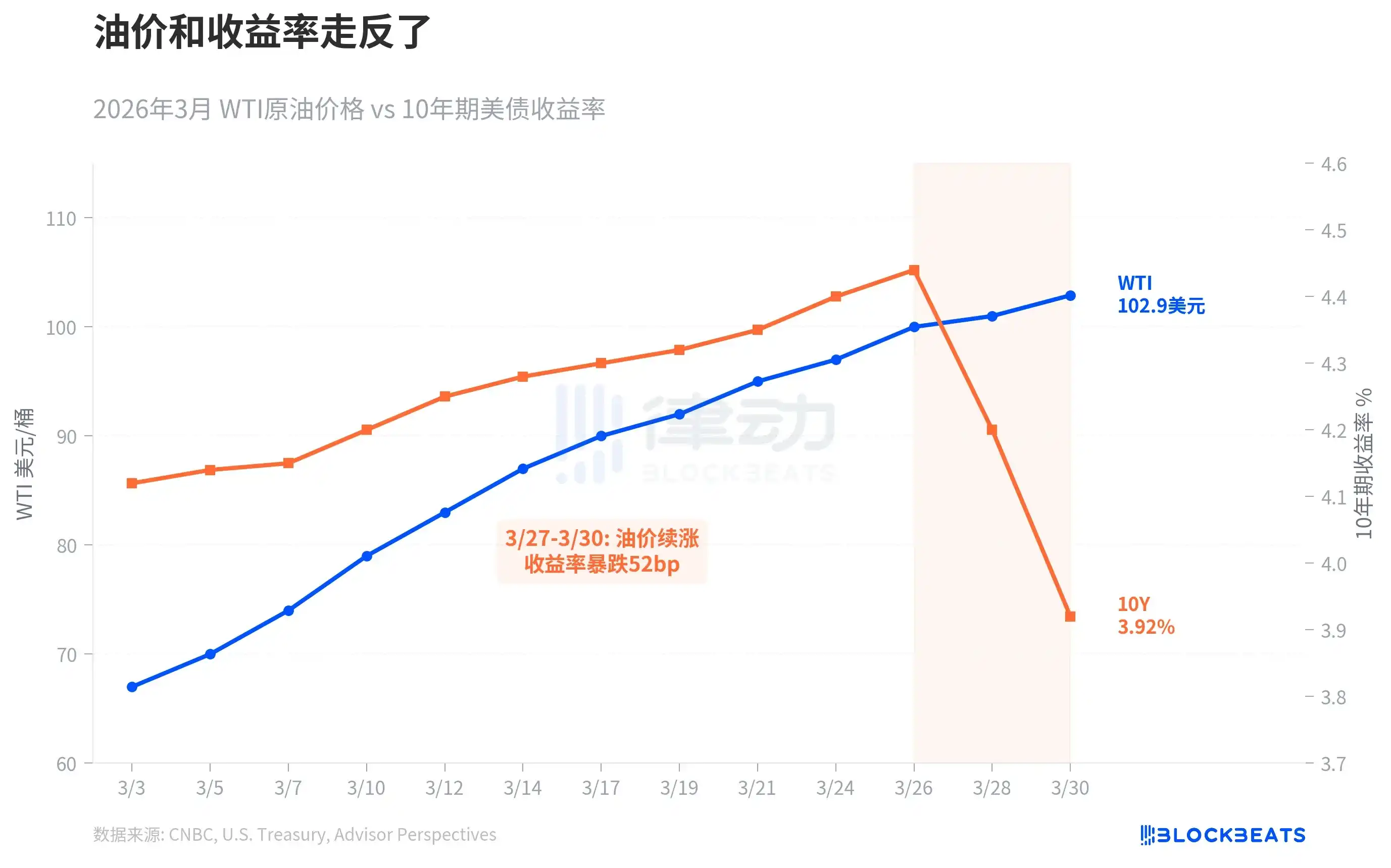
In the first three weeks of March, the two were still moving upward in sync. WTI rose from $67 to $100, while the 10-year yield climbed from 4.15% to 4.44%. The turning point occurred between March 27 and 30: oil prices continued to surge, but the yield plummeted from 4.44% to 3.92%, dropping 52 basis points in three trading sessions and breaking through the psychologically significant 4% level.

This was a classic "flight to safety," with the bond market making a judgment: growth risks have now outweighed inflation risks. As the economic firm Oxford Economics put it, "growth risks began to outweigh inflation risks." In other words, the market is not unafraid of inflation; it is more afraid of a recession.

This decoupling is not common, but whenever it occurs, the subsequent story tends to be unfavorable.
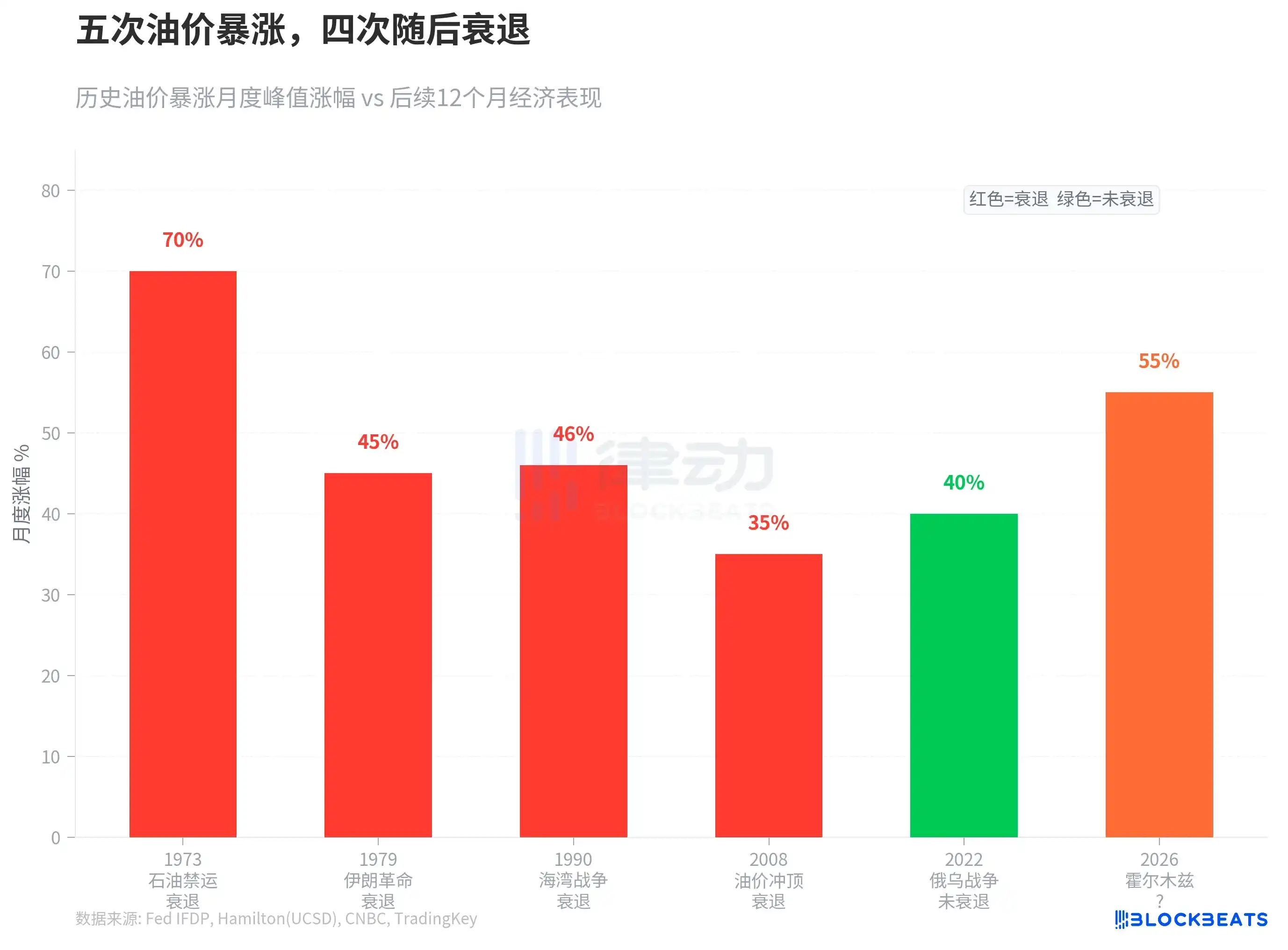
Over the past half-century, there have been five instances where oil prices surged more than 35% in a short period. During the 1973 oil embargo, U.S. GDP subsequently fell by 4.7%. The 1979 Iranian revolution caused global GDP to deviate from trend growth by 3 percentage points. The 1990 Gulf War led to a brief U.S. recession. In 2008, oil prices peaked at $147; although the primary cause of that recession was the financial crisis, the oil price shock accelerated the economic downturn. The only exception was the oil price surge driven by the 2022 Russia-Ukraine war, which did not trigger a recession but came at the cost of the most severe inflation in 40 years.

The surge in March 2026 exceeded all the above cases. According to research by Federal Reserve economist James Hamilton, there is no mechanical link between oil price shocks and recessions, but "the greater the net increase in oil prices, the more significant the suppression of consumption and investment." Goldman Sachs has raised the probability of a U.S. recession to 30%, while consulting firm EY-Parthenon puts the figure at 40%.

The market's reaction speed was also unusually fast.
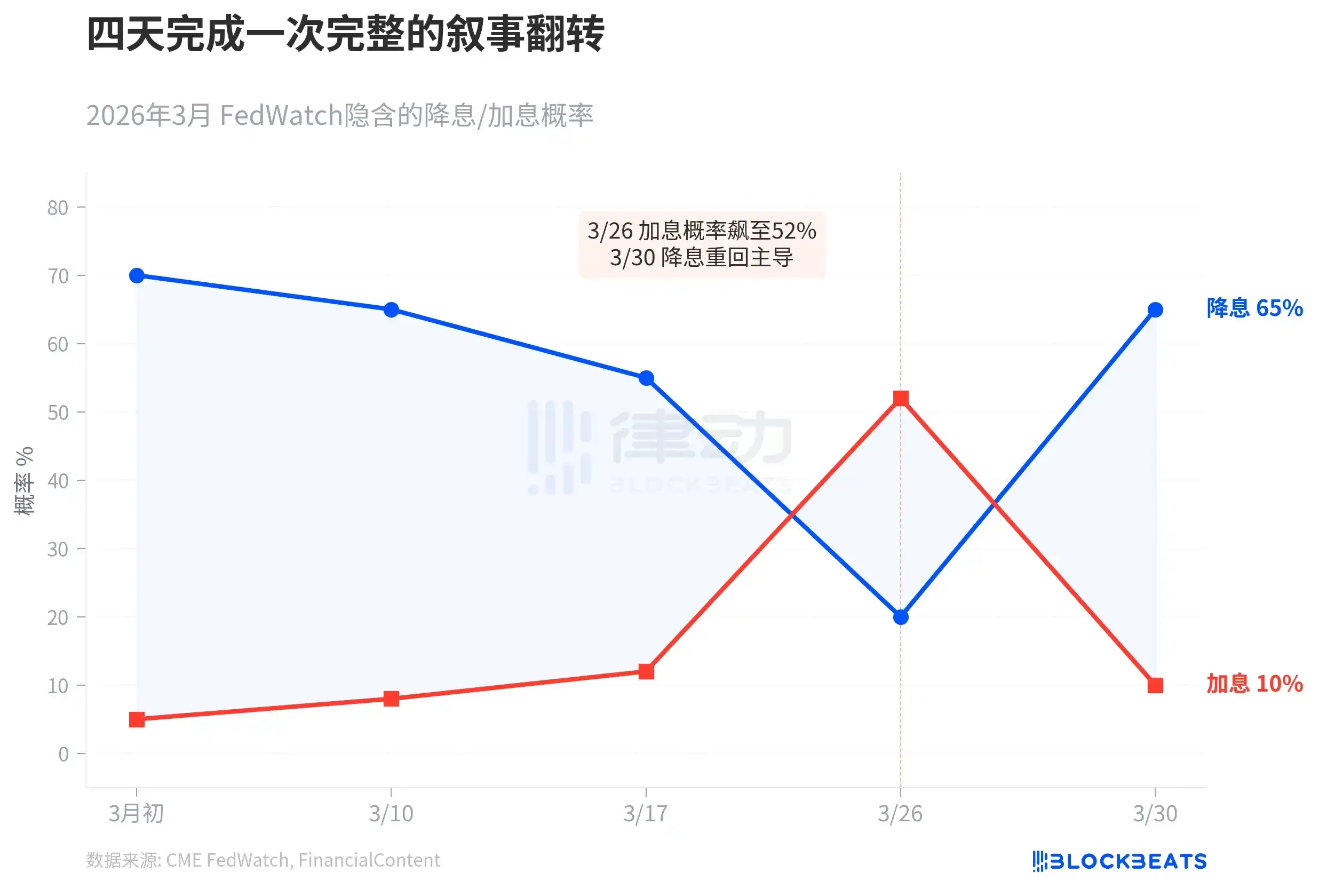
In early March, CME FedWatch showed the market expected three rate cuts for the year, with a 70% probability of a cut in June. Then, as oil prices continued to climb, the U.S. import price index jumped 1.3% on March 26, and incoming Fed Chair Kevin Warsh hinted that the neutral rate might be higher. That day, the probability of a rate hike within the year soared to 52%, and the 10-year yield touched 4.35%. FinancialContent defined this day as "The Great Hawkish Pivot."

Four days later, the narrative completely flipped. On March 30, consumer confidence data fell sharply, manufacturing unexpectedly contracted, and the 10-year yield plummeted to 3.92%. According to FinancialContent, market bets on a dovish pivot by the Fed in May rose to 65%. Goldman Sachs said the market had bet wrong on the direction of rate hikes. That same day, Powell told undergraduates at Harvard that the Fed "has not yet reached the moment where it must decide whether to look through the war shock," but emphasized that "the anchoring of inflation expectations is key."

According to Axios, Powell's remarks were interpreted by the market as: the Fed neither wants to raise rates to fight inflation nor is it in a hurry to cut rates to save the economy. Instead, it is waiting to see whether this supply shock is temporary or persistent. But the bond market can wait no longer.

If history is any guide, Citi strategist McCormick put it most bluntly: what lies ahead is stagflation, which is bad for bonds and bad for stocks.
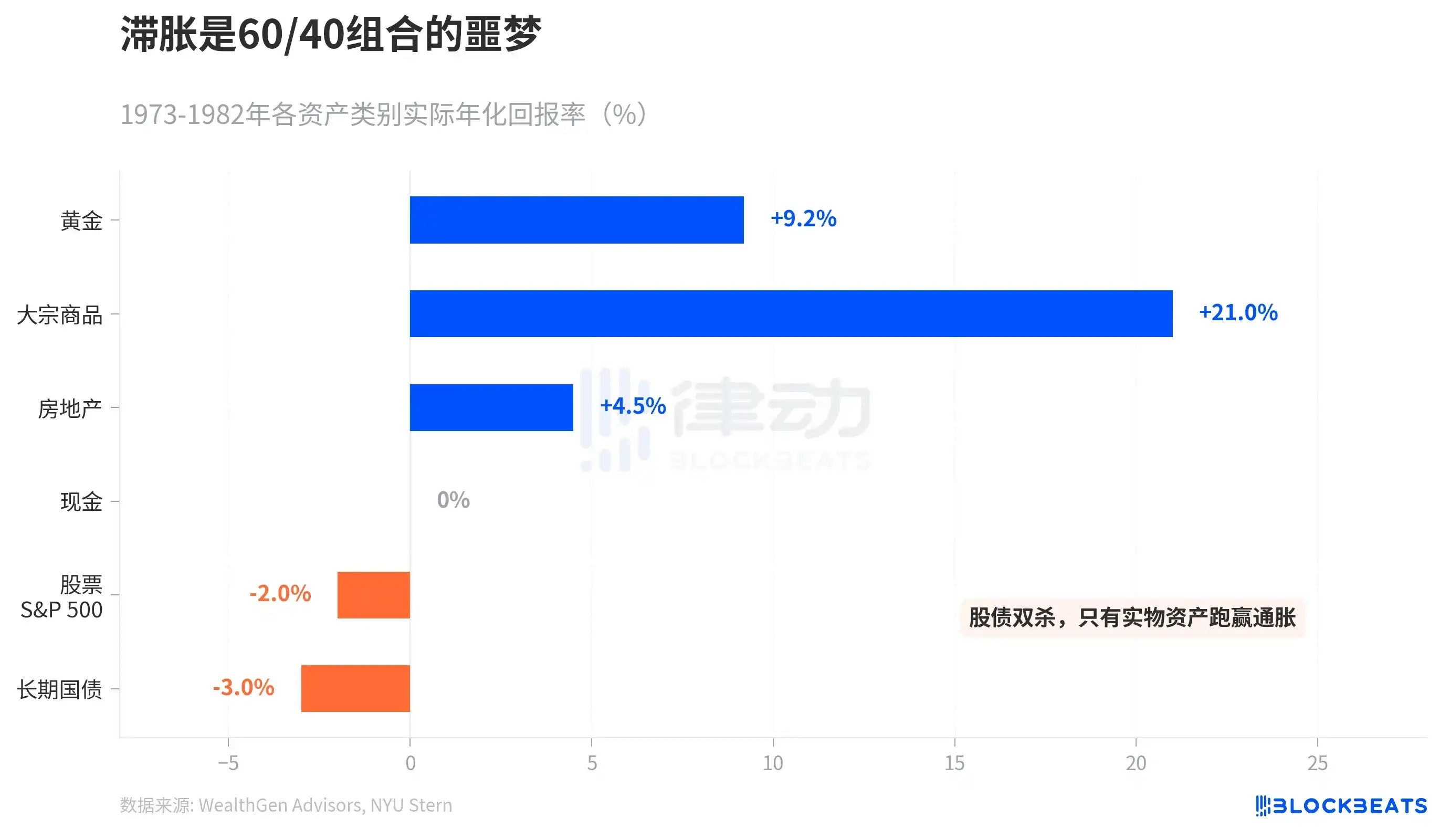
The Great Stagflation from 1973 to 1982 delivered a report card on asset returns. Gold delivered an actual annualized return of +9.2%, the commodities index (S&P GSCI) surged 586% over the decade, and real estate gained +4.5%. In contrast, the S&P 500's actual annualized return was -2%, and long-term Treasuries returned -3%. According to NYU Stern historical data, long-term Treasuries suffered a -8.6% loss in 1979 alone.

The traditional 60/40 investment portfolio (60% stocks + 40% bonds) was caught in a squeeze during stagflation. Only physical assets outperformed inflation. Société Générale predicts Brent will average $125 in April, with a "credible peak" of $150. Goldman Sachs is slightly more moderate, forecasting an April average of $115, but assuming the Strait of Hormuz reopens within six weeks, falling to $80 by year-end.

The bond market has already made a choice for everyone: between inflation and recession, it is betting on recession.


İlgili Sorular

QWhy did the 10-year Treasury yield fall sharply despite the surge in oil prices in late March 2026?

AThe bond market experienced a 'flight to safety', with growth risks (fear of recession) beginning to outweigh inflation risks, causing investors to rush into bonds and push yields down.

QWhat historical precedent suggests about the economic outcome following such a sharp oil price increase?

AHistorical cases (1973, 1979, 1990, 2008) show that sharp oil price surges of over 35% were often followed by economic recessions or significant slowdowns, with the exception of the 2022 Ukraine war spike which caused high inflation instead.

QHow did the market's expectation for Federal Reserve policy change dramatically within a few days?

AOn March 26, market pricing indicated a 52% probability of a rate hike due to inflation concerns, but by March 30, it had flipped to a 65% probability of a dovish pivot and rate cuts due to weak consumer confidence and manufacturing data.

QWhat is the potential worst-case macroeconomic scenario feared by the market, according to a Cit strategist?

ACit strategist McCormick stated that the worst-case scenario ahead is stagflation, which is bad for both bonds and stocks.

QWhich asset classes historically performed well during the 1973-1982 stagflation period, according to the article?

ADuring the 1973-1982 stagflation, gold delivered a +9.2% real annualized return, the S&P GSCI commodity index rose 586% cumulatively, and real estate returned +4.5%. In contrast, stocks and long-term bonds had negative real returns.

İlgili Okumalar

The Shutdown of Claude Mythos Revealed the True Cost of Renting AI to Me

The sudden shutdown of Claude Mythos this week starkly highlights a critical, often overlooked risk for founders: when your core capability relies entirely on someone else's platform, your fate is not in your own hands. The key question becomes: who truly owns the intelligence your product depends on? For years, the debate around open-source models focused on cost. Now, the evidence is clear: fine-tuned open-source models can achieve frontier-level quality for specific, mission-critical tasks at a fraction of the cost. However, the deeper issue is control. Relying on a third-party API is like renting; it works until the landlord changes the rules, raises the rent, or asks you to leave—as Mythos experienced. The lesson is not to stop using frontier models—they are incredible infrastructure. The goal is ownership. Ownership means starting with a powerful open-source model and shaping it around what makes your company unique: your data, workflows, domain expertise, and definition of "good." Over time, the model becomes less generic and more reflective of your business, creating durable value. The optimistic conclusion is that AI's future doesn't hinge on one superior model. There is no single frontier. The frontier includes proprietary models, models fine-tuned on company-specific knowledge, specialized models for narrow problems, and intelligent routers orchestrating model ensembles. The most interesting development is not models getting smarter, but intelligence becoming increasingly customizable. The winning companies will be those that transform intelligence into a unique, owned asset. Looking ahead, the vision is not one model dominating all, but many teams owning the part of the frontier that matters most to them.

marsbit39 dk önce

The Shutdown of Claude Mythos Revealed the True Cost of Renting AI to Me

marsbit39 dk önce

Tiger Research: U.S. Strategic Bitcoin Reserve - Should the Market Be Happy or Disappointed?

Tiger Research analyzes the evolution of U.S. legislative efforts regarding a strategic Bitcoin reserve, concluding the market impact is limited in the short term but potentially positive long-term. The core event was a March 2025 executive order by former President Trump, which designated confiscated Bitcoin as a strategic reserve and promised not to sell existing holdings (approx. 190k BTC). As it contained no mandate to purchase new Bitcoin, the market reacted negatively, with prices dropping 5.7%. Legislative history shows a significant retreat from initial ambitions. The 2024 "BITCOIN Act" proposed mandatory purchases of 1 million BTC over five years. Reintroduced in 2025, it stalled due to high fiscal costs, concerns over dollar hegemony, and opposition from the Treasury Secretary. The current frontrunner, the 2026 "American Retirement and Monetary Advancement (ARMA) Act," is a compromise. It lacks any purchase requirement, instead focusing on consolidating existing government-held Bitcoin and legally prohibiting its sale for at least 20 years. While ARMA has higher passage odds due to bipartisan support and no purchase mandate, its immediate market effect is neutral. It eliminates potential government selling pressure but creates no new demand. The long-term significance is that formally establishing Bitcoin as a national reserve asset in law could later reignite debates on mandatory purchases. Therefore, the path to a government buyer is longer than initially priced by the market, but the directional narrative remains intact.

marsbit42 dk önce

Tiger Research: U.S. Strategic Bitcoin Reserve - Should the Market Be Happy or Disappointed?

marsbit42 dk önce

US Stock Market Trend (June 16): SpaceX Rises 42% in Two Days, New Fed Chairman Takes Office Today

**U.S. Stocks Trend (June 16): SpaceX Soars 42% in Two Days, New Fed Chair Takes Office Today** Markets surged on Monday following former President Trump's social media announcement of a completed U.S.-Iran deal to reopen the Strait of Hormuz, pending a June 19 signing. The news triggered a broad risk-on rally: oil prices crashed, tech stocks soared, bond yields fell, and defensive sectors lagged. **Market Performance:** The Nasdaq jumped 3.07%, led by semiconductor stocks like Micron (+9.2%). The S&P 500 gained 1.65%, and the Dow rose 0.92% to a record high. However, the Russell 2000 small-cap index underperformed (+0.72%). SpaceX continued its hot streak, rising another 5% pre-market after disclosures of large buys by an Australian billionaire and Cathie Wood's ARK. Boeing also rallied on the transportation optimism. Conversely, energy stocks like Chevron fell over 3% on the oil price plunge, with other defensive sectors also selling off. The day's action showed a clear rotation of funds from energy/defensive plays into AI and tech narratives. **Macro & Outlook:** The VIX fear index fell 8.37%. Treasury yields declined, and WTI crude dropped over 5%. Attention now shifts to a packed schedule: the Bank of Japan is widely expected to hike rates to 1.0% on Tuesday. The Fed's June meeting concludes Wednesday, marking new Chair Wash's debut. While rates are expected to hold, his tone on stubborn inflation and the "dot plot" will be crucial for gauging the 2024 rate path. The formal Iran deal signing is set for Friday. **Trend Perspective:** While the peace deal is a genuine positive, Monday's explosive rally may have gotten ahead of itself, pricing in a swift resolution to inflation concerns. The shortened trading week faces a triple test: BoJ tightening, the Fed's policy stance, and deal implementation details. Tech and semiconductors, which led the surge, remain vulnerable to any disappointment from these key events. The real price discovery begins with the central banks' communications this week.

marsbit1 saat önce

US Stock Market Trend (June 16): SpaceX Rises 42% in Two Days, New Fed Chairman Takes Office Today

marsbit1 saat önce

İşlemler

Spot
Futures
活动图片




