Snowflake's stock price surges 33%, AI infrastructure expands from chips to the data layer

marsbit2026-05-29 tarihinde yayınlandı2026-05-29 tarihinde güncellendi

Özet

Snowflake's stock surged over 33% after the company raised its full-year revenue forecast and announced a $6 billion, five-year partnership with AWS. This agreement, which secures AWS Graviton chip supply, underscores Snowflake's evolving role in the AI infrastructure landscape. The market's reaction reflects a reassessment of data platforms as critical enablers for enterprise AI adoption. As companies move beyond conceptual AI to building operational, data-integrated AI workflows, demand for robust data storage, processing, and analysis capabilities is increasing. The deal strengthens AWS's custom chip ecosystem while positioning Snowflake not just as a data warehouse, but as a key data layer for deploying and managing AI applications. Analysts have rapidly revised their valuations upwards, signaling a shift in sentiment where proven AI-driven revenue growth is now commanding premium multiples.

Editor's note: The narrative of AI investments is further expanding from chips and models to the data infrastructure layer.

After facing stock price pressure since the beginning of the year, Snowflake saw its stock surge over 33% in a single day after raising its full-year revenue forecast and securing a $6 billion five-year cooperation agreement with AWS. The core of this market reaction isn't just about better-than-expected earnings; it's that investors have started to reassess Snowflake's position in the enterprise AI implementation chain.

Over the past year, enterprise software companies have generally faced a question: Will AI become a growth engine, or will it undermine their existing business models? Snowflake's latest performance and the AWS partnership provide a relatively clear answer—when enterprises start deploying AI applications at scale, the capabilities for data storage, processing, analysis, and model deployment become even more critical.

In this partnership, the supply of AWS Graviton chips addresses the computing power constraint issue, while the deeper integration of the Snowflake platform with AWS AI workloads points to a more profound enterprise need: companies don't simply "use AI"; they need to connect their own data into AI workflows to build operational, manageable, and scalable application systems.

This is also why Snowflake is being re-integrated into the "AI winner" narrative. AI software stocks previously experienced a sell-off, with the market being skeptical about whether "AI can truly contribute to revenue." However, Snowflake's case shows that once AI translates from conceptual demonstrations into real revenue growth, market sentiment can reverse rapidly. The fact that at least 30 analysts raised their price targets illustrates that the capital markets are re-pricing the value of data platforms within the AI infrastructure cycle.

What's even more noteworthy is that this deal also reinforces the presence of AWS's in-house chip ecosystem. From Anthropic, OpenAI, and Meta to Uber, and now Snowflake, Amazon is embedding itself deeper into the AI infrastructure through cloud, chip, and enterprise software partnerships. For Snowflake, this means it is not just an enterprise data warehouse company but is becoming a critical data layer in the process of enterprise AI application implementation.

The original text follows:
May 28—Snowflake's stock surged more than 33% on Thursday. The company previously raised its full-year revenue forecast and announced a $6 billion cooperation agreement with Amazon, bolstering investor confidence in its position as a key beneficiary of the AI boom.

This five-year agreement with Amazon Web Services (AWS) will secure a crucial supply of AWS Graviton chips for Snowflake. Currently, computing resources are becoming increasingly scarce as AI usage grows substantially.

The agreement will also further deepen the integration between Snowflake's data storage, processing, and analytics products and AI workloads on the AWS cloud. As enterprises rapidly scale their AI applications, Snowflake is poised to capture more demand. Currently, most of Snowflake's customers run on AWS.
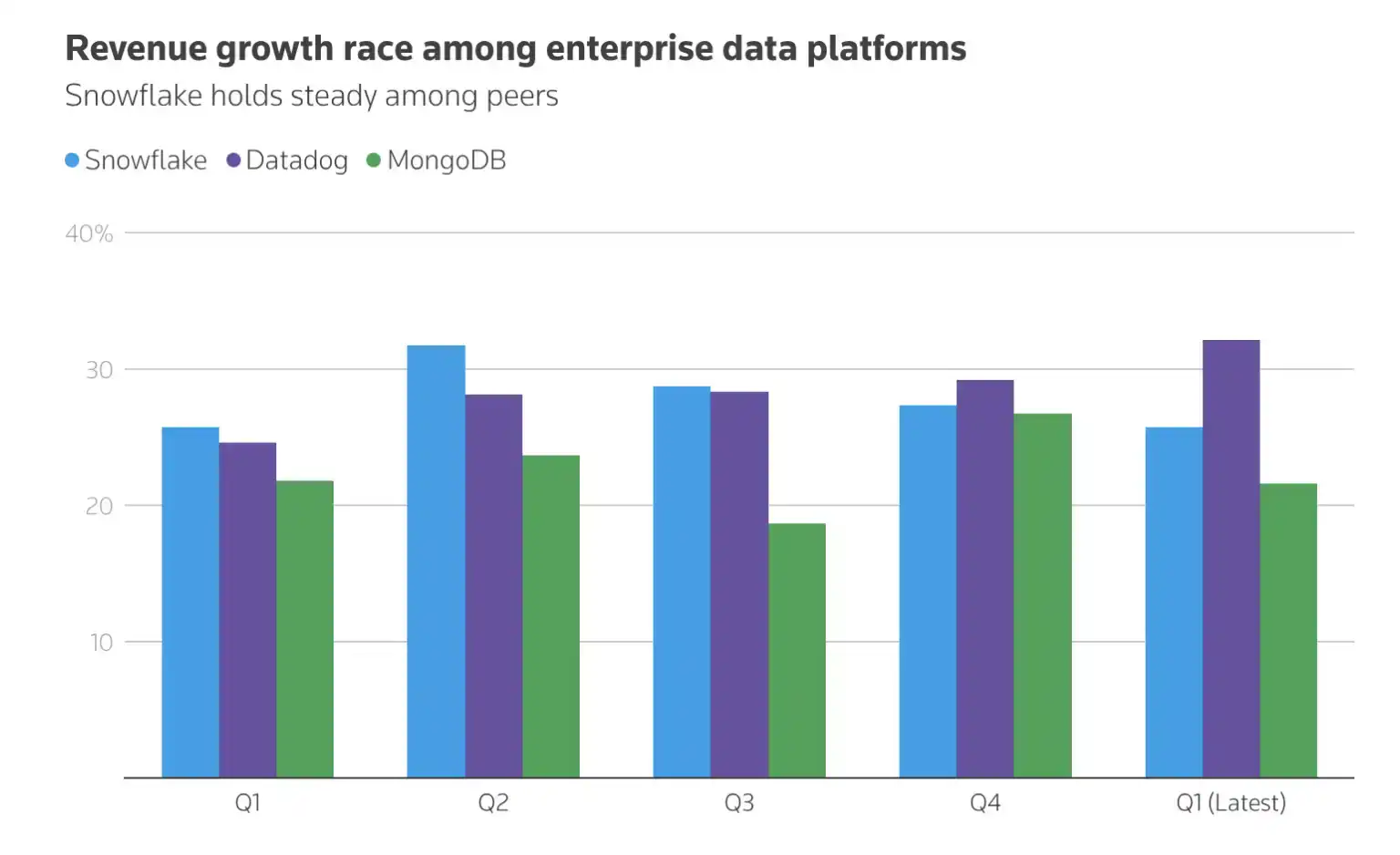
Following the announcement, at least 30 analysts raised their price targets for Snowflake, pushing the median target price from $230 before Wednesday's earnings report to $280. The stock was last trading at $233.50 in early trading.

If the current gains hold, Snowflake's market value would increase by approximately $20 billion from its previous $607.5 billion.

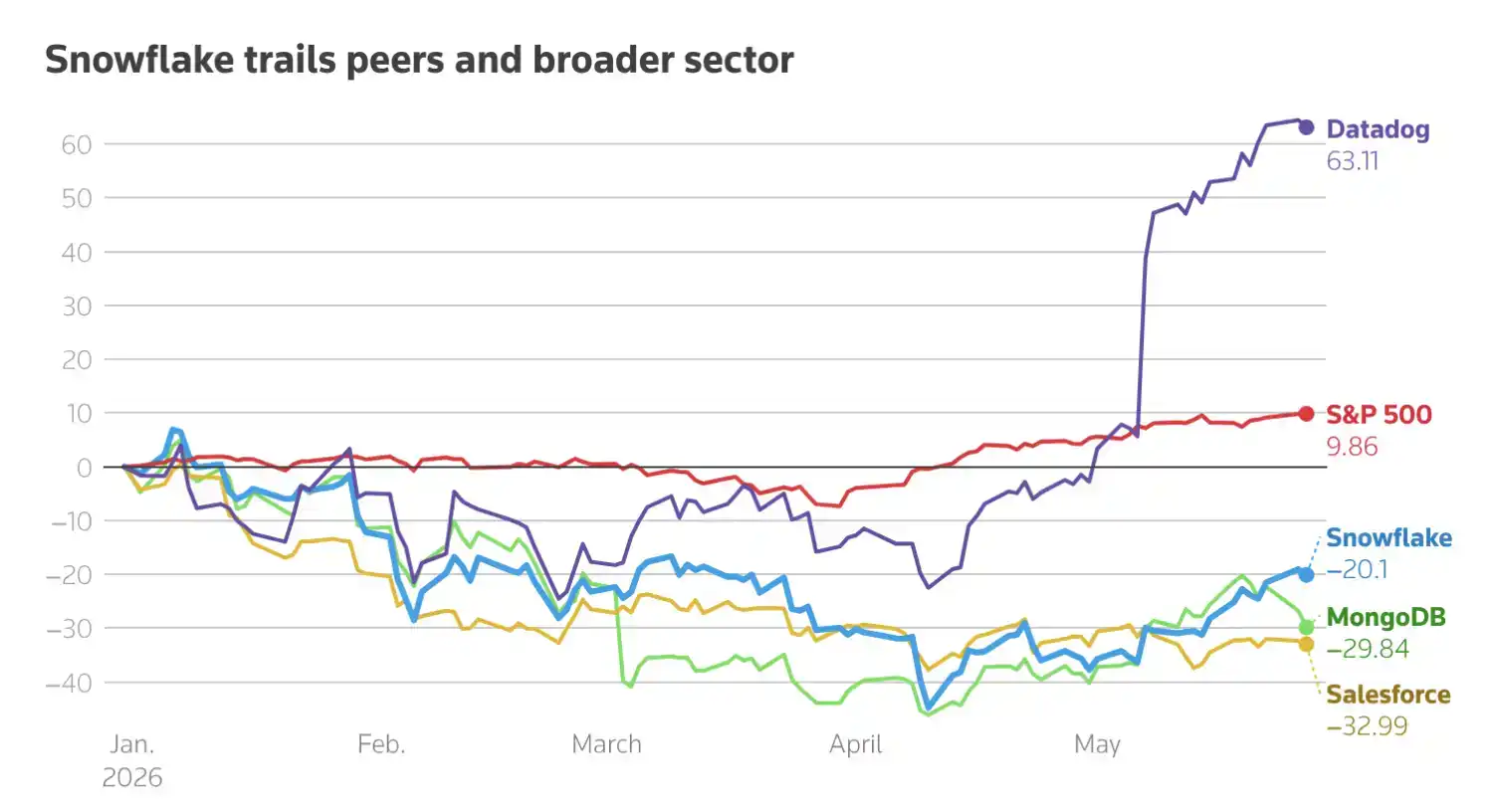
Matt Britzman, a senior equity analyst at Hargreaves Lansdown, stated that Snowflake's sharp stock rise—the stock was down 20% year-to-date before the previous trading day's close—"shows how much skepticism had built up during the wider AI software sell-off that hit data names."

"But it also shows how quickly sentiment can turn once a company proves AI is already driving revenue rather than just being PowerPoint filler."

Currently, Snowflake's forward 12-month price-to-earnings ratio is 85.21 times, compared to 85.19 times for Datadog and 47.17 times for MongoDB. A higher P/E ratio typically indicates investors are betting on stronger future growth.
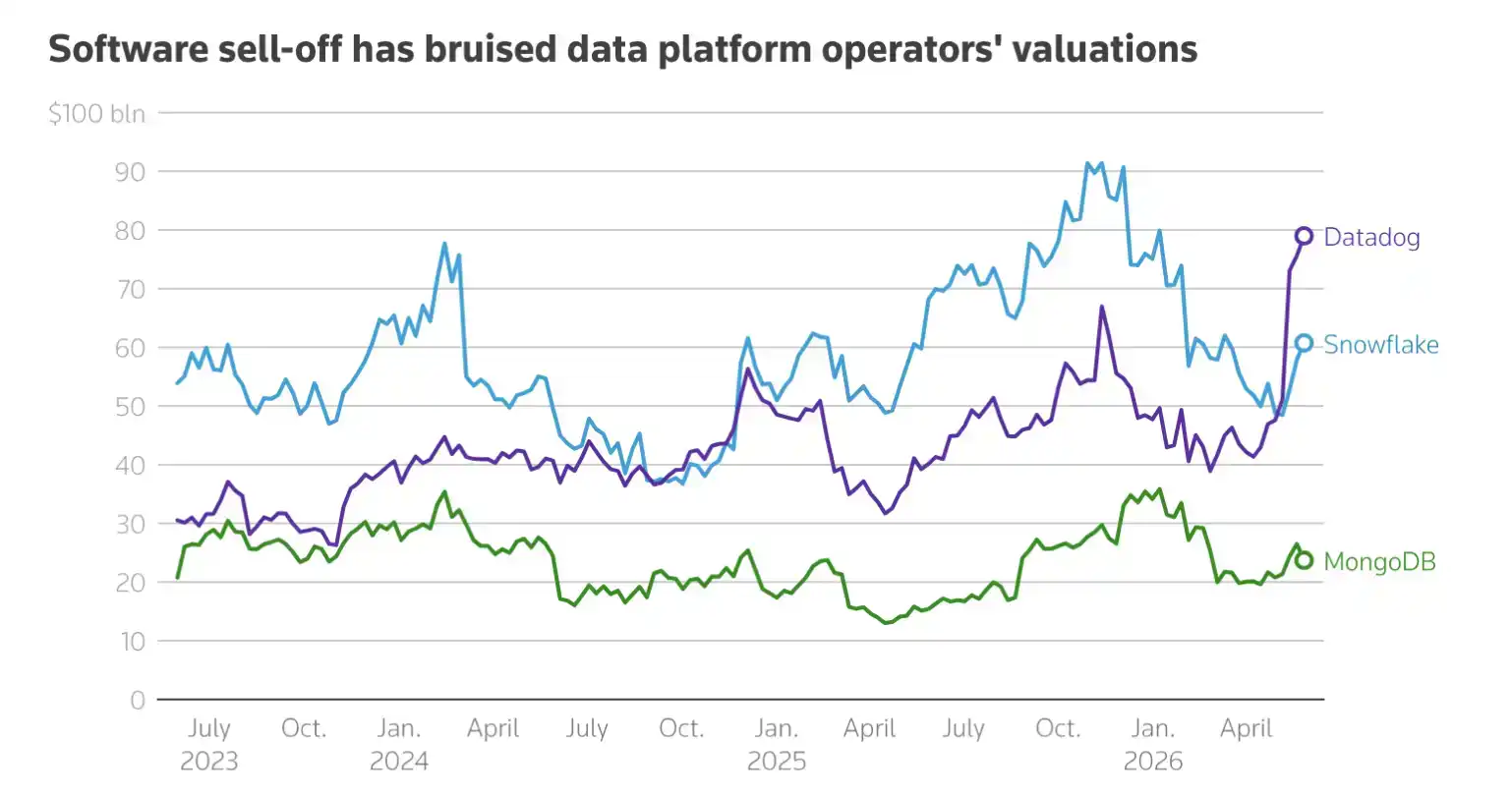
Previously, market concerns that AI would disrupt enterprise software put pressure on Snowflake. Now, the company is embedding AI into its platform, helping businesses integrate data from multiple sources, perform analysis, and build AI tools.

"We believe this set of results puts Snowflake squarely in the 'AI winner' camp and deserves a higher valuation multiple," said Patrick Colville, an equity research analyst at Scotiabank. He added that this clearly indicates Snowflake is benefiting from the growth in enterprise AI adoption.

Snowflake helps businesses store, manage, and analyze all their data on one platform. Its AI tools like Cortex Code and Snowpark are seeing strong adoption. These tools enable enterprises to build generative AI applications based on their own data and deploy machine learning models.

This agreement also serves as another vote of confidence in Amazon's in-house chip business. In recent months, Amazon has secured several significant customers, including Anthropic, OpenAI, Facebook parent Meta, and Uber.
İlgili Sorular

QWhat were the two main factors that led to Snowflake's stock price surging over 33%?

ASnowflake's stock price surged over 33% primarily due to two factors: 1) The company raised its full-year revenue guidance. 2) It announced a five-year, $6 billion partnership agreement with Amazon Web Services (AWS).

QWhat does the $6 billion AWS deal specifically provide to Snowflake, and why is it important?

AThe $6 billion deal provides Snowflake with a critical supply of AWS Graviton chips. This is important because as AI usage grows, computing power resources are becoming increasingly scarce and constrained.

QHow does the article describe the shift in the AI investment narrative, and what role does Snowflake now play in it?

AThe article states that the AI investment narrative is shifting from chips and models to the data infrastructure layer. Snowflake is now being re-evaluated as a key data layer, essential for enterprises to integrate their own data into AI workflows and build manageable, scalable AI application systems.

QAccording to the analyst from Hargreaves Lansdown, what does Snowflake's stock surge indicate about market sentiment?

AMatt Britzman from Hargreaves Lansdown stated that the surge indicates how much skepticism had built up during the broader AI software sell-off that dragged down data-related companies. It also shows how quickly market sentiment can reverse once a company proves that AI is driving actual revenue growth, not just being a presentation talking point.

QWhat are some of the specific AI tools offered by Snowflake mentioned in the article, and what is their purpose?

AThe article mentions Snowflake's Cortex Code and Snowpark AI tools. Their purpose is to enable enterprises to build generative AI applications and deploy machine learning models based on their own data.

İlgili Okumalar

Goldman Sachs Research Report Analysis: Chip Shortage to Persist Until 2028, Maintain Buy Recommendations

Goldman Sachs Research Report Summary: Memory Shortage Until 2028, Maintain Buy Recommendations Goldman Sachs' latest Asia-Pacific equities report, "The 720," forecasts a sustained memory chip upcycle extending into 2028, driven by strong AI server demand visibility, limited supply growth, and binding long-term agreements. The firm believes the market significantly underestimates the cycle's duration, as evidenced by low P/E ratios for memory stocks. Key sector calls include raising 12-month price targets for Samsung Electronics and SK Hynix, and upgrading Kioxia from Hold to Buy, citing higher and more sustainable peak profits over the next 2-3 years. The report also highlights the broader AI hardware supply chain benefiting from hyperscaler capex acceleration. Recommendations include: * MediaTek (Buy) for its data center/ASIC pivot. * Eoptolink (Buy) on 1.6T optical module ramp-up. * Biren (Buy) for its AI chip migration. * Huaqin (Buy, newly covered) for its shift from consumer electronics ODM to AI data centers. * Lenovo (Buy) on the AI PC refresh cycle. Other notable mentions include China property developers (under an optimistic scenario), BYD for its affordable city NOA strategy, and select Japanese semiconductor equipment makers. A macro theme notes the divergence between AI-boom beneficiaries (e.g., Korea, Taiwan) and energy-importing economies facing inflationary pressure. The report concludes with standard disclaimers, noting that price targets are forward-looking estimates and that sell-side research has an inherent bullish bias. The core investment thesis hinges on the longevity of the memory upcycle and the AI-driven capex wave.

marsbit20 dk önce

Goldman Sachs Research Report Analysis: Chip Shortage to Persist Until 2028, Maintain Buy Recommendations

marsbit20 dk önce

A Detailed Look at Cathie Wood's Masterful Moves on Circle

Title: A Detailed Look at Cathie Wood's Masterful Moves on Circle ARK Invest's Cathie Wood executed a textbook investment strategy on Circle (CRCL), showcasing how a long-term investor can capitalize on short-term volatility. Key to her success was securing 4.49 million shares at the $31 IPO price before the public offering, leveraging pre-IPO access unavailable to most investors. The stock debuted at $69, fueled by extreme demand against a limited float of only 15% of total shares. Wood then began systematically selling as the price soared, driven by policy optimism like the GENIUS Act, which pushed shares to nearly $299. She sold approximately 1.7 million shares across four transactions at an average price around $210, partly triggered by ARK's internal rule to rebalance when a single stock's weight exceeds 10%. Following a steep decline due to lock-up expirations, increased supply, and interest rate concerns, Circle fell over 80% from its peak. Wood started buying back shares around $82-$86 after a strong Q3 earnings report ironically caused a price drop in November 2025. She continued buying on the way down, eventually rebuilding her position to roughly 4.5 million shares by Q1 2026. The core lessons from Wood's play are: 1) A firm, independent conviction in Circle's long-term narrative as a digital dollar infrastructure player. 2) Executing in phases—selling into strength and buying into weakness—without attempting to time exact tops or bottoms. 3) Strict adherence to position-sizing and rebalancing rules, which forced profit-taking at highs and created capacity to buy at lows. For most investors, chasing the volatile post-IPO "pop" is risky; Wood's success was built on pre-IPO access, deep research, and disciplined execution.

marsbit22 dk önce

A Detailed Look at Cathie Wood's Masterful Moves on Circle

marsbit22 dk önce

Morning Post | Michael Saylor Releases Bitcoin Tracker Info; Aave Publishes Kelp rsETH Bridge Attack Post-Incident Investigation; Gravity Bridge Announces Service Suspension Following Attack

ChainCatcher Daily Summary - June 1, 2026 In regulatory news, the U.S. OCC granted preliminary conditional approval for Laser Digital to establish a federally regulated trust bank. In Vietnam, a draft law amendment proposes allowing SMEs to use digital and virtual assets as loan collateral. Hong Kong's SFC chairman reported that trading volume on the city's 12 licensed virtual asset platforms grew nearly 300% YoY in Q1 2026. Notable incidents include the Cosmos ecosystem cross-chain bridge Gravity Bridge pausing services after an attack. Aave published a post-mortem on the April 18th Kelp rsETH bridge attack, attributing it to a third-party bridge infrastructure vulnerability via an RPC poisoning attack, not the Aave protocol itself. In market developments, MicroStrategy's Michael Saylor hinted at a potential upcoming Bitcoin purchase announcement. Fed Governor Waller commented that widespread stablecoin adoption could amplify the impact of U.S. monetary policy. Meanwhile, sentiment analysis from Santiment indicates a record-high Bitcoin long/short ratio of 2.23, potentially signaling a short-term price correction, while Ethereum shows signs of FUD among commentators. In legal matters, the SEC sued the founder of Privvy Investments for an alleged $12.3 million crypto AI trading bot scam. In China, a Qingdao man was sentenced to 10 years and 9 months for stealing 107 BTC by obtaining a victim's wallet seed phrase. Top trending meme tokens on ETH, Solana, and Base networks for the past 24 hours are also listed.

链捕手1 saat önce

Morning Post | Michael Saylor Releases Bitcoin Tracker Info; Aave Publishes Kelp rsETH Bridge Attack Post-Incident Investigation; Gravity Bridge Announces Service Suspension Following Attack

链捕手1 saat önce

İşlemler

Spot
Futures

Popüler Makaleler

LAYER Nasıl Satın Alınır

HTX.com’a hoş geldiniz! Solayer (LAYER) satın alma işlemlerini basit ve kullanışlı bir hâle getirdik. Adım adım açıkladığımız rehberimizi takip ederek kripto yolculuğunuza başlayın. 1. Adım: HTX Hesabınızı OluşturunHTX'te ücretsiz bir hesap açmak için e-posta adresinizi veya telefon numaranızı kullanın. Sorunsuzca kaydolun ve tüm özelliklerin kilidini açın. Hesabımı Aç2. Adım: Kripto Satın Al Bölümüne Gidin ve Ödeme Yönteminizi SeçinKredi/Banka Kartı: Visa veya Mastercard'ınızı kullanarak anında Solayer (LAYER) satın alın.Bakiye: Sorunsuz bir şekilde işlem yapmak için HTX hesap bakiyenizdeki fonları kullanın.Üçüncü Taraflar: Kullanımı kolaylaştırmak için Google Pay ve Apple Pay gibi popüler ödeme yöntemlerini ekledik.P2P: HTX'teki diğer kullanıcılarla doğrudan işlem yapın.Borsa Dışı (OTC): Yatırımcılar için kişiye özel hizmetler ve rekabetçi döviz kurları sunuyoruz.3. Adım: Solayer (LAYER) Varlıklarınızı SaklayınSolayer (LAYER) satın aldıktan sonra HTX hesabınızda saklayın. Alternatif olarak, blok zinciri transferi yoluyla başka bir yere gönderebilir veya diğer kripto para birimlerini takas etmek için kullanabilirsiniz.4. Adım: Solayer (LAYER) Varlıklarınızla İşlem YapınHTX'in spot piyasasında Solayer (LAYER) ile kolayca işlemler yapın.Hesabınıza erişin, işlem çiftinizi seçin, işlemlerinizi gerçekleştirin ve gerçek zamanlı olarak izleyin. Hem yeni başlayanlar hem de deneyimli yatırımcılar için kullanıcı dostu bir deneyim sunuyoruz.

299 Toplam GörüntülenmeYayınlanma 2025.02.11Güncellenme 2025.03.21

LAYER Nasıl Satın Alınır

Tartışmalar

HTX Topluluğuna hoş geldiniz. Burada, en son platform gelişmeleri hakkında bilgi sahibi olabilir ve profesyonel piyasa görüşlerine erişebilirsiniz. Kullanıcıların LAYER (LAYER) fiyatı hakkındaki görüşleri aşağıda sunulmaktadır.

活动图片













