Small-Cap Tokens Hit Four-Year Low, Is the 'Altcoin Bull Run' Completely Hopeless?

marsbit2025-12-16 tarihinde yayınlandı2025-12-16 tarihinde güncellendi

Özet

Small-cap cryptocurrency tokens have plummeted to multi-year lows, with indices tracking altcoins significantly underperforming both major cryptocurrencies and traditional equities. In 2024–2025, while the S&P 500 and Nasdaq 100 delivered strong double-digit returns with limited drawdowns, altcoin indices like the CoinDesk 80 and MarketVector Small-Cap Index fell sharply—by nearly 40% and to November 2020 lows, respectively. These altcoin indices showed high correlation (0.9) with large-cap crypto assets like Bitcoin and Ethereum but delivered deeply negative returns, higher volatility, and worse risk-adjusted performance (negative Sharpe ratios). Liquidity is increasingly concentrated in high-value, institutionally supported assets such as Bitcoin, Ethereum, SOL, and XRP, indicating a structural shift away from speculative small-cap tokens. The data suggests that altcoins offered no diversification benefits and instead magnified losses during a period of broader market growth.

Author: Gino Matos

Compiled by: Luffy, Foresight News

Since January 2024, the performance comparison between cryptocurrencies and stocks indicates that the so-called new "altcoin trading" is essentially just a substitute for stock trading.

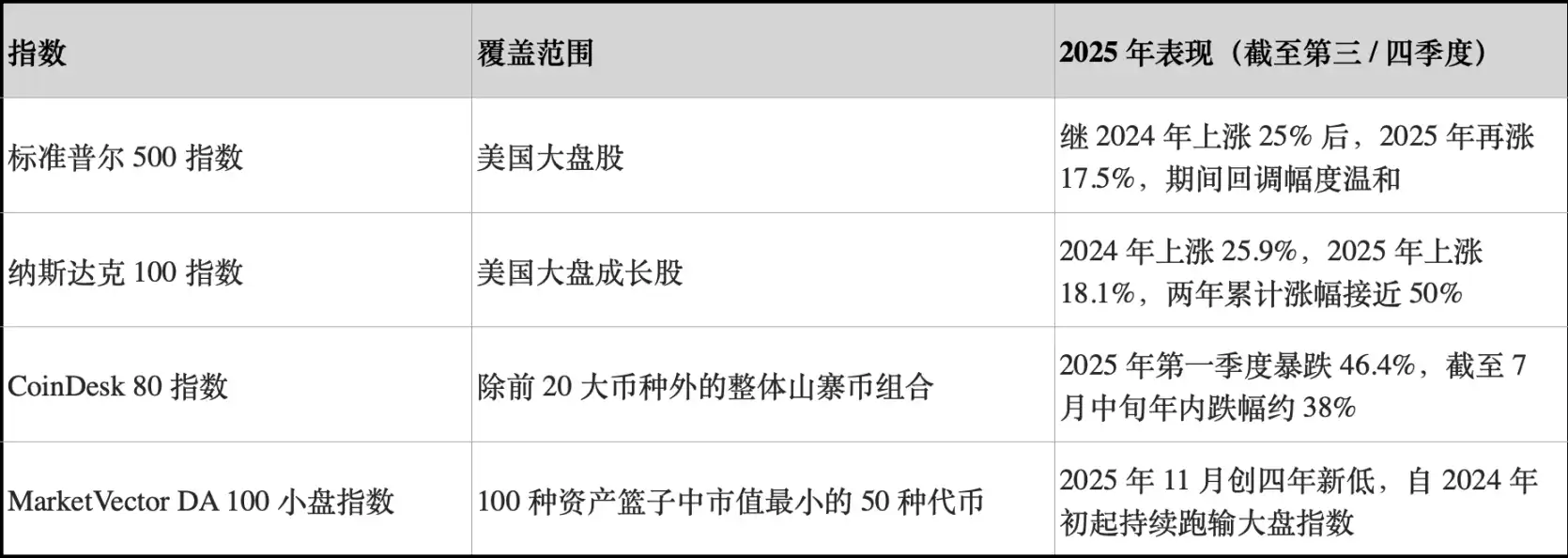
In 2024, the S&P 500 index had a return of approximately 25%, and in 2025 it reached 17.5%, with a cumulative two-year increase of about 47%. During the same period, the Nasdaq 100 index rose by 25.9% and 18.1% respectively, with a cumulative increase of nearly 49%.

The CoinDesk 80 Index, which tracks 80 assets outside the top 20 cryptocurrencies by market capitalization, plummeted 46.4% in the first quarter of 2025 alone, and by mid-July, its year-to-date decline was about 38%.

By the end of 2025, the MarketVector Digital Assets 100 Small-Cap Index fell to its lowest level since November 2020, wiping out over $1 trillion in total cryptocurrency market capitalization.

This divergence in performance is by no means a statistical error. Not only did the overall altcoin portfolio have a negative return, but its volatility was comparable to or even higher than that of stocks; in contrast, major U.S. stock indices achieved double-digit growth with controllable drawdowns.

For Bitcoin investors, the core question is: Can allocating to small-cap tokens deliver risk-adjusted returns? Or is such an allocation merely taking on exposure to a negative Sharpe ratio while maintaining similar correlations to stocks? (Note: The Sharpe ratio is a core metric for measuring the risk-adjusted return of an investment portfolio. Its calculation formula is: Annualized portfolio return - Annualized risk-free rate / Annualized volatility of the portfolio.)

Choosing a Reliable Altcoin Index

For analysis, CryptoSlate tracked three altcoin indices.

The first is the CoinDesk 80 Index, launched in January 2025. This index covers 80 assets outside the CoinDesk 20 Index, providing a portfolio of diversified assets beyond Bitcoin, Ethereum, and other major tokens.

The second is the MarketVector Digital Assets 100 Small-Cap Index. This index selects the 50 smallest tokens by market cap from a basket of 100 assets, serving as a barometer for the market's "junk assets."

The third is a small-cap index launched by Kaiko. This is a research product, not a tradable benchmark, offering a clear sell-side quantitative perspective for analyzing the small-cap asset group.

These three depict the market landscape from different dimensions: the overall altcoin portfolio, high-beta small-cap tokens, and a quantitative research perspective. Yet, the conclusions they point to are highly consistent.

In contrast, the benchmark performance of the stock market shows a completely opposite trend.

In 2024, major U.S. indices achieved gains of around 25%, and in 2025, they also saw double-digit increases, with relatively limited drawdowns during the period. During this time, the maximum intra-year drawdown of the S&P 500 index was only in the mid-to-high single digits, while the Nasdaq 100 index maintained a strong upward trend throughout.

Both major indices achieved compounded annual growth without significant givebacks of gains.

The trend of the overall altcoin indices, however, is vastly different. Reports from CoinDesk Indices show that the CoinDesk 80 Index plummeted 46.4% in the first quarter alone, while the large-cap tracking CoinDesk 20 Index fell 23.2% during the same period.

By mid-July 2025, the CoinDesk 80 Index was down 38% year-to-date, whereas the CoinDesk 5 Index, which tracks Bitcoin, Ethereum, and three other major tokens, achieved a gain of 12% to 13% during the same period.

Andrew Baehr of CoinDesk Indices, in an interview with ETF.com, described this phenomenon as "identical correlation, vastly different profit and loss performance."

The correlation between the CoinDesk 5 Index and the CoinDesk 80 Index is as high as 0.9, meaning their price movements are completely aligned in direction, but the former achieved a slight double-digit growth while the latter plunged nearly 40%.

It turns out that the diversification benefits of holding small-cap altcoins are minimal, while the performance cost is extremely heavy.

The performance of the small-cap asset sector is even worse. According to Bloomberg, by November 2025, the MarketVector Digital Assets 100 Small-Cap Index had fallen to its lowest level since November 2020.

Over the past five years, the return of this small-cap index has been approximately -8%, while the corresponding large-cap index has surged about 380%. Institutional funds clearly favor large-cap assets and avoid tail risks.

Looking at the performance of altcoins in 2024, the Kaiko small-cap index fell over 30% for the year, and mid-cap tokens also struggled to keep up with Bitcoin's gains.

Market winners were highly concentrated in a few top tokens, such as SOL and Ripple. Although the share of altcoin trading volume once rebounded to the 2021 high in 2024, 64% of the trading volume was concentrated in the top ten altcoins.

Liquidity in the cryptocurrency market has not disappeared but has shifted towards higher-value assets.

Sharpe Ratio and Drawdown Magnitude

If compared from the perspective of risk-adjusted returns, the gap widens further. The CoinDesk 80 Index and various small-cap altcoin indices not only have returns deep in negative territory but also have volatility comparable to or even higher than stocks.

The CoinDesk 80 Index plummeted 46.4% in a single quarter; the MarketVector small-cap index fell to pandemic-era lows in November after another round of declines.

The overall altcoin index experienced multiple index-level halving drawdowns: the Kaiko small-cap index fell over 30% in 2024, the CoinDesk 80 Index crashed 46% in Q1 2025, and the small-cap index fell again to 2020 lows by the end of 2025.

In contrast, the S&P 500 and Nasdaq 100 indices achieved cumulative returns of 25% and 17% over two years, with maximum drawdowns only in the mid-to-high single digits. The U.S. stock market had fluctuations, but they were overall controllable; the volatility of cryptocurrency indices, however, was highly destructive.

Even if the high volatility of altcoins is considered a structural feature, their unit risk return from 2024 to 2025 was still far lower than that of holding major U.S. stock indices.

From 2024 to 2025, the overall altcoin index had a negative Sharpe ratio; meanwhile, the S&P and Nasdaq indices had strong Sharpe ratios even without volatility adjustment. After volatility adjustment, the gap between them further widened.
Bitcoin Investors and Cryptocurrency Liquidity

The first insight from the above data is the trend of liquidity concentration and migration towards high-value assets. Reports from Bloomberg and Whalebook on the MarketVector small-cap index both pointed out that since early 2024, small-cap altcoins have consistently underperformed, and institutional funds have instead flowed into Bitcoin and Ethereum ETFs.

Combined with Kaiko's observations, although the share of altcoin trading volume rebounded to 2021 levels, funds were concentrated in the top ten altcoins. The market trend is already clear: liquidity has not completely left the cryptocurrency market but has shifted towards higher-value assets.

The previous altcoin bull market was essentially just a basis trade strategy, not a structural outperformance of assets. In December 2024, the CryptoRank Altcoin Bull Index once soared to 88 points, then plummeted to 16 points in April 2025, completely giving back all gains.

The 2024 altcoin bull market ultimately turned into a typical bubble burst; by mid-2025, the overall altcoin portfolio had almost given back all its gains, while the S&P and Nasdaq indices continued to compound growth.

For wealth advisors and asset allocators considering diversification beyond Bitcoin and Ethereum, the data from CoinDesk provides a clear case reference.

As of mid-July 2025, the large-cap tracking CoinDesk 5 Index achieved a slight double-digit growth year-to-date, while the diversified altcoin index CoinDesk 80 plummeted nearly 40%, yet their correlation was as high as 0.9.

Investors allocating to small-cap altcoins did not obtain substantial diversification benefits but instead suffered far higher return losses and drawdown risks compared to Bitcoin, Ethereum, and U.S. stocks, while still being exposed to the same macro drivers.

Current capital views most altcoins as tactical trading targets, not strategic allocation assets. From 2024 to 2025, Bitcoin and Ethereum spot ETFs had significantly better risk-adjusted returns, and U.S. stocks also performed brilliantly.

Liquidity in the altcoin market is increasingly concentrating towards a few "institutional-grade coins," such as SOL, Ripple, and other tokens with independent positive factors or clear regulatory prospects. Asset diversity at the index level is being squeezed by the market.
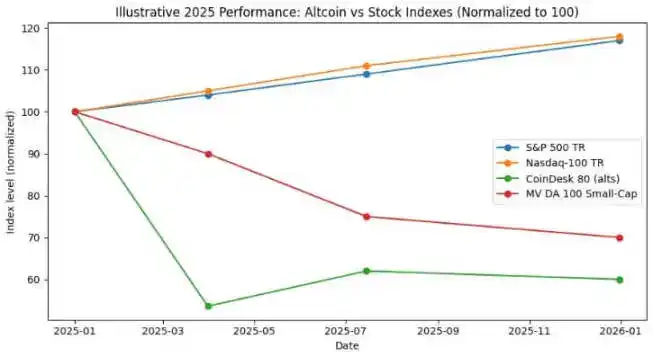
In 2025, the S&P 500 and Nasdaq 100 indices rose about 17%, while the CoinDesk 80 cryptocurrency index fell 40%, and small-cap cryptocurrencies fell 30%

What Does This Mean for Liquidity in the Next Market Cycle?

The market performance from 2024 to 2025 tested whether altcoins could achieve diversification value or outperform in an environment of rising macro risk appetite. During this period, U.S. stocks achieved double-digit growth for two consecutive years with controllable drawdowns.

Bitcoin and Ethereum gained institutional recognition through spot ETFs and benefited from a moderating regulatory environment.

In contrast, the overall altcoin index not only had negative returns and larger drawdowns but also maintained high correlations with major crypto tokens and stocks, yet failed to provide corresponding compensation for the additional risks investors undertook.

Institutional capital always chases performance. The five-year return of the MarketVector small-cap index is -8%, while the corresponding large-cap index surged 380%. This gap reflects the migration of capital towards assets with clear regulation, sufficient derivatives market liquidity, and well-developed custody infrastructure.

The CoinDesk 80 Index's 46% plunge in the first quarter and its 38% year-to-date decline by mid-July indicate that the trend of capital migration towards high-value assets is not reversing but accelerating.

For Bitcoin and Ethereum investors evaluating whether to allocate to small-cap crypto tokens, the data from 2024 to 2025 provides a clear answer: the absolute returns of the overall altcoin portfolio underperformed U.S. stocks, and the risk-adjusted returns were inferior to Bitcoin and Ethereum; despite a correlation as high as 0.9 with major crypto tokens, it provided no diversification value.


İlgili Sorular

QWhat was the performance difference between the S&P 500 and the CoinDesk 80 Index in 2025?

AIn 2025, the S&P 500 index rose by approximately 17.5%, while the CoinDesk 80 Index plummeted by 40%.

QAccording to the article, what is the main reason for the poor performance of small-cap altcoins?

AThe main reason is that institutional capital is migrating towards high-value assets like Bitcoin and Ethereum ETFs, which are seen as having clearer regulatory prospects and better infrastructure, leaving small-cap altcoins with negative returns and high volatility.

QWhat was the correlation between the CoinDesk 5 Index and the CoinDesk 80 Index, and what does this imply?

AThe correlation between the CoinDesk 5 Index and the CoinDesk 80 Index was as high as 0.9. This implies that their price directions moved almost identically, yet the performance was drastically different, with the former achieving double-digit gains while the latter fell nearly 40%, offering no meaningful diversification benefit.

QTo what level did the MarketVector Digital Assets 100 Small-Cap Index fall by the end of 2025?

ABy the end of 2025, the MarketVector Digital Assets 100 Small-Cap Index fell to its lowest level since November 2020.

QWhat does the article conclude about allocating to small-cap tokens for Bitcoin investors?

AThe article concludes that allocating to small-cap tokens did not provide a risk-adjusted return benefit. Instead, it resulted in significantly worse returns and higher drawdown risks compared to holding Bitcoin, Ethereum, or U.S. stocks, while still being exposed to the same macroeconomic factors.

İlgili Okumalar

Former CFTC Chairman, Circle President Tarbert: Preaching Long-Termism While Cashing Out $30 Million Himself

Former CFTC Chairman and Circle President Heath Tarbert has consistently advocated for a long-term vision in public, urging patience from investors as Circle’s stock price has fallen significantly from its peak. However, it has been revealed that since Circle’s IPO, Tarbert has continuously sold his CRCL shares through pre-arranged trading plans, cashing out approximately $30 million, without making any public market purchases. This contrast between his public messaging and personal actions has drawn criticism. Tarbert joined Circle in July 2023 as Chief Legal Officer, leveraging his regulatory experience to help guide the company through its IPO and expansion. Despite promoting stablecoins as long-term infrastructure, he established a 10b5-1 trading plan just before Circle went public, leading to substantial stock sales over the following year. In March 2026, he initiated another plan to sell more shares. His career trajectory highlights a pattern of moving between high-level regulatory roles and influential positions in the financial sector. After resigning as CFTC Chairman in early 2021, he joined Citadel Securities as Chief Legal Officer just 27 days later, during a period of intense regulatory scrutiny for the firm. He later joined Circle, aiding its efforts to navigate regulatory challenges for its public listing. While Tarbert's expertise in policy and compliance is valuable to companies like Circle, his actions—advocating long-term confidence while personally divesting—raise questions about the alignment between his public statements and his private financial decisions, leaving investors who followed his advice to bear the market risks.

marsbit9 dk önce

Former CFTC Chairman, Circle President Tarbert: Preaching Long-Termism While Cashing Out $30 Million Himself

marsbit9 dk önce

Gate Research Institute: The 'Wall Street-ization' Wave of Crypto Financial Products – Competition or Integration?

The article titled "Gate Research Institute: Are Crypto Financial Products Sparking a 'Wall Street' Wave—Competition or Convergence?" explores the evolving relationship between the crypto ecosystem and traditional finance (TradFi). The piece begins by reflecting on Bitcoin's original 2009 vision of decentralization, disintermediation, and moving away from banks. It then contrasts this with the 2024 landscape, where key crypto assets like Bitcoin are increasingly held through Wall Street products like ETFs issued by giants like BlackRock. The article questions whether this signifies that TradFi is systematically taking over the rights to issue, price, custody, and distribute crypto financial assets. The core argument is that this is not a zero-sum takeover but rather a bidirectional convergence where each side addresses the other's weaknesses. Crypto offers 24/7 global markets, programmable settlement, and open access but lacks compliant channels, institutional-grade custody, deep fiat liquidity, and mainstream distribution. TradFi possesses these but is constrained by legacy systems, limited operating hours, and slow settlement. Two primary convergence paths are highlighted: * **Path A (CEX to TradFi):** Exemplified by Gate, which has progressed from offering tokenized stocks and CFDs to providing direct, real stock trading (US, Hong Kong, South Korea) within its platform, using USDT. * **Path B (TradFi to Crypto):** Exemplified by Robinhood, which has integrated crypto trading, acquired exchanges like Bitstamp, and is moving traditional assets like stocks onto the blockchain via tokenization and its own Layer 2. Both paths are ultimately competing to become the next-generation, unified financial account—a "super account" where users can seamlessly trade cryptocurrencies, stocks, ETFs, RWA (Real World Assets), and tokenized treasury products in one interface. The growth of RWA and tokenized treasuries (e.g., BlackRock's BUIDL) is presented as the asset-layer fusion, providing stable, yield-bearing assets on-chain and acting as a bridge between the two worlds. In conclusion, the "Wall Street-ization" of crypto is framed as a mutual transformation. Decentralized ideals persist in the protocol layer, while at the application layer, a more efficient, global, and accessible unified capital market is emerging from this convergence. The future competition lies not between crypto exchanges and stockbrokers, but between platforms vying to offer the most comprehensive asset coverage, liquidity, and user experience within a single account.

marsbit14 dk önce

Gate Research Institute: The 'Wall Street-ization' Wave of Crypto Financial Products – Competition or Integration?

marsbit14 dk önce

Claude's Major New Feature: Screen Recording + Voice, Distilling Your Skills into AI Tasks in One Click

Claude has introduced a major new feature called "Record a Skill," available for Pro, Max, and Team users. This function, found in the Claude desktop app's CoWork menu, allows users to create reusable AI skills simply by recording their screen and providing voice narration while performing a task. Claude then automatically analyzes the recording and generates a functional Skill. A hands-on test confirmed the feature works seamlessly. Users start recording via the Skills manager, perform their workflow while verbally explaining the steps and logic, and avoid including sensitive information. After recording, Claude processes the content and creates the Skill, which can be saved and later invoked with a slash command (/). This eliminates the need for manual adjustments or writing complex instruction files. The innovation goes beyond mere efficiency. Previously, creating a Skill required writing a detailed SKILL.md file in Markdown—a significant barrier for non-technical users. "Record a Skill" bypasses this by directly capturing both actions and the implicit reasoning shared in the narration. This lowers the barrier to knowledge transfer and automation, addressing a core challenge in corporate knowledge management: the difficulty of getting experts to write and maintain documentation. However, the feature also highlights a shift in the nature of work. A case study from March 2026 showed a freelancer whose five-year client relationship was effectively replaced by a hand-coded Claude Skill automating their content workflow. With the even lower barrier of screen recording, the ability to distill personal expertise into automatable skills accelerates this trend. The "moat" for work is moving from simply knowing how to do a task to mastering tasks that are difficult or impossible to automate.

marsbit18 dk önce

Claude's Major New Feature: Screen Recording + Voice, Distilling Your Skills into AI Tasks in One Click

marsbit18 dk önce

Feeding AI "Noise" Can Also Boost Scores, This Work Enables Positive Transfer with Noise

Feeding "Noise" to AI Can Improve Performance: A Method Enables Positive Transfer from Noise This work, Semi-Supervised Noise Adaptation (SSNA), introduces a Noise Adaptation Framework (NAF) that challenges traditional transfer learning. Instead of requiring a labeled source domain of real data (e.g., images, text), NAF uses randomly generated Gaussian noise as the source. For a target task with C classes, it constructs C noise clusters by sampling from Gaussian distributions. Although this synthetic noise contains no semantic meaning, NAF trains it to form a discriminative class structure in a shared representation space—clustering same-class noise and separating different classes. The key is aligning this learned structure from the noise domain to the real, sparsely labeled target domain. A small number of target labels are still essential to establish the correspondence between noise clusters and actual classes. The training objective combines: 1) supervised loss on the few labeled target samples, 2) classification loss for the noise to build its structure, and 3) a distribution alignment loss (using Negative Domain Similarity) to minimize the gap between the noise and target domains in the shared space. Experiments show significant gains in few-label settings. With just 4 labels per class, NAF with a ResNet-18 backbone improves accuracy over a standard supervised baseline (ERM) by +12.35% on CIFAR-10, +7.61% on CIFAR-100, +4.38% on DTD-47, and +2.74% on Caltech-101. It also benefits fine-grained datasets and scales to ImageNet-1K (with 100 labels/class) and text classification (AG News). NAF can be integrated into existing semi-supervised methods like FixMatch for further gains. Ablation studies confirm the transferred benefit comes from the discriminative structure of the noise, not randomness itself. Collapsing all noise into a single point causes negative transfer, while increasing separation between noise cluster centers improves performance. The amount of noise per class is less critical once a basic structure forms. In conclusion, this work demonstrates that for positive transfer, the semantic content of source data may not be necessary. What can be effectively transferred is the *organizational structure* of categories within a representation space. This offers a promising alternative for scenarios where real source data is unavailable due to privacy, copyright, or procurement constraints.

marsbit19 dk önce

Feeding AI "Noise" Can Also Boost Scores, This Work Enables Positive Transfer with Noise

marsbit19 dk önce

İşlemler

Spot
活动图片