Six Years Since DeFi Summer, How Will the Decentralized Financial Revolution Continue?

marsbit2026-04-21 tarihinde yayınlandı2026-04-21 tarihinde güncellendi

Özet

In 2026, the DeFi sector faces a severe trust crisis following a series of high-profile security breaches, including a $292 million theft from KelpDAO’s rsETH, a $2.85 million exploit at Drift Protocol due to permission vulnerabilities, and a $14.9 million lending failure at Venus Protocol. These incidents triggered a withdrawal of approximately $10 billion from DeFi over a single weekend, highlighting systemic risks beyond smart contract flaws—such as governance, cross-chain complexity, and operational weaknesses. Despite these challenges, on-chain finance continues to grow, with capital shifting toward safer, regulated products. Stablecoins like USDT ($185B) and USDC ($78B) have reached a combined market cap of $263 billion, while tokenized U.S. Treasuries surged to $10.93 billion. Visa’s growing USDC settlement volume, now annualized at $3.5 billion, signals increasing institutional adoption of compliant blockchain-based financial infrastructure. The competition for the future of on-chain finance is intensifying. While native DeFi struggles with trust and capital outflows, regulated products—stablecoins, tokenized assets, and ETFs—are gaining dominance by offering programmable, 24/7 settlement without high DeFi risks. Over 80 crypto projects shut down in Q1 2026, reflecting dwindling patience for speculative ventures. The core challenge for open DeFi is to rebuild trust and demonstrate irreplaceable value—or risk ceding its role as the primary entry point to on-chain fin...

Written by: Liam 'Akiba' Wright

Compiled by: Saoirse, Foresight News

The theft of $292 million worth of rsETH from KelpDAO occurred at an extremely inopportune time for the DeFi industry. Prior to this, the Drift Protocol security breach on April 1st and the Venus lending protocol debacle in March had already severely damaged market confidence. Following this incident, approximately $10 billion in funds fled the entire DeFi sector over the weekend.

The叠加 of multiple crises has made the困境 facing DeFi increasingly difficult to ignore. Although the open-source decentralized financial system still exists, it is gradually losing its core status as the default on-chain financial entry point. Stablecoins, tokenized treasuries, and compliant settlement channels continue to expand rapidly, while permissionless native protocols持续承受 a market trust discount.

A list of theft incidents for 2026 circulating on social platform X直观反映了 the current industry's悲观情绪.
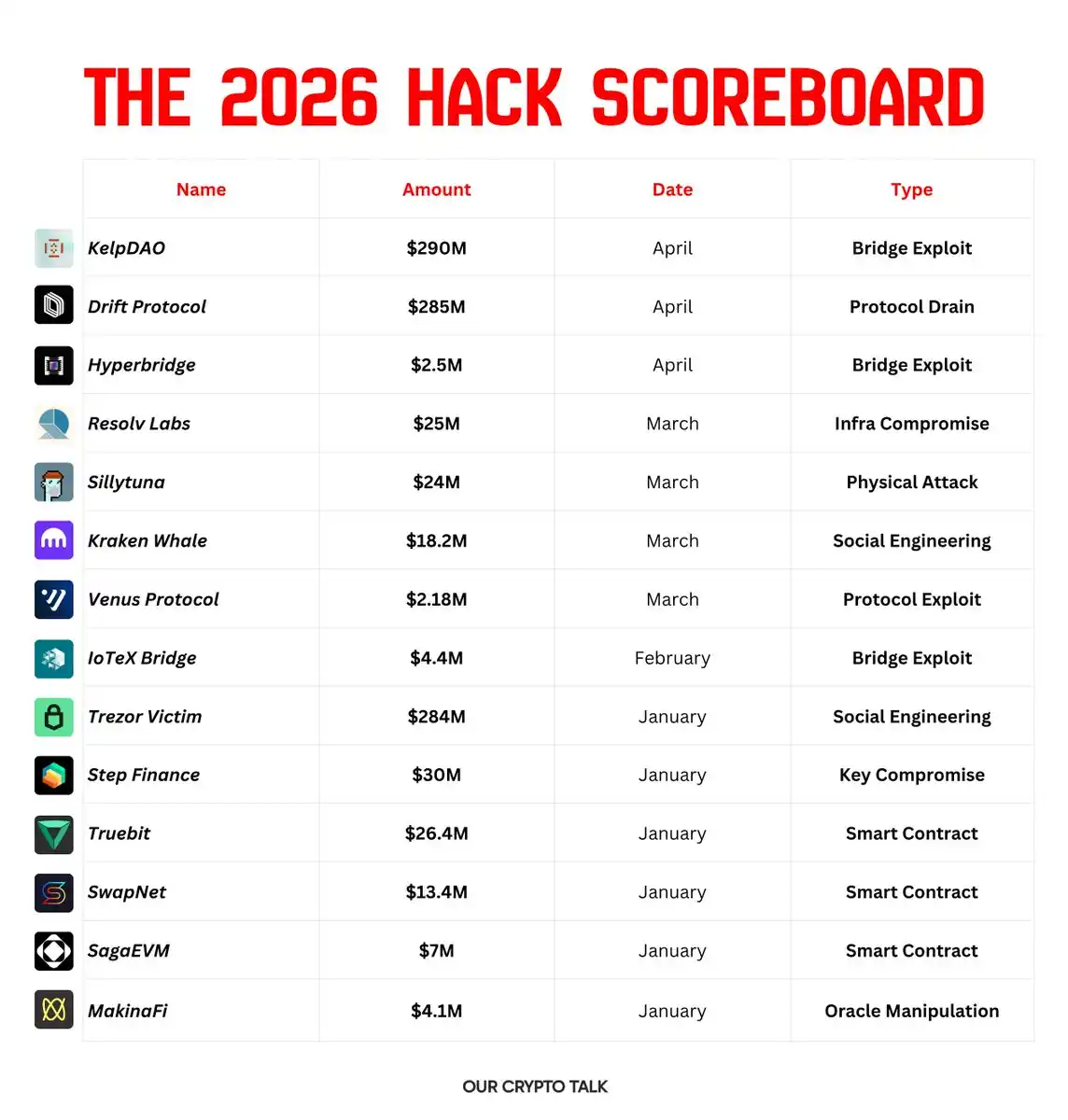
2026 Hacker Leaderboard (Source: Our Crypto Talk)

Some security incidents have been fully reviewed, some risks are still发酵, and many events blur the lines between protocol vulnerabilities, cross-chain bridge failures, and user asset theft. This article focuses on the confirmed security incidents of 2026 and the industry landscape changes暴露 by these events.

The current industry situation is vastly different from the peak of DeFi Summer in 2020 and the bull market of 2021; that glory now exists only in memory. Back then, DeFi told the market a narrative of open, efficient, and composable finance; by 2026, these traits still exist but no longer carry their own halo and market faith.

Every major coin theft event increases the trust cost for users to participate in DeFi. And currently, the fastest-growing and most secure areas of on-chain finance are becoming payment networks, tokenized treasuries, and compliant token products,不再是 the complex token ecosystems of native DeFi.

The real test for the industry now is: can open-source DeFi quickly rebuild market trust and maintain its position as the mainstream on-chain entry point? Currently, it appears the entire sector is not heading towards extinction, but rather处于空间被挤压的处境.

DeFi's Security Risks Extend Far Beyond Smart Contract Vulnerabilities

A common misconception after a major hack is to attribute all incidents to smart contract code vulnerabilities. The Drift protocol loss of approximately $285 million恰恰证明 this perception is outdated.

On-chain data analysis firm Chainalysis disclosed that the attack stemmed from permission abuse, admin pre-signature operation vulnerabilities, and fake collateral assets, not simple code statement defects. The market thus realized: a significant portion of DeFi's risks today lie in governance permissions, signature mechanisms, operational architecture, and other layers.

This fundamental change alters the underlying objects users need to trust. Code audits and market-proven contracts are still important, but they can no longer cover the complete risk chain: signature nodes, cross-chain bridges, oracles, and market parameter configurations all harbor potential risks. When protocols span multiple public chains, management committees, liquidity platforms, and collateral derivatives, the attack surface expands much faster than the update speed of the decentralization narrative.

The post-mortem of the Venus protocol also exposed similar issues, albeit in a different risk form. The attacker borrowed approximately $14.9 million in assets through overvalued asset抵押借贷, leaving the protocol with over $2 million in bad debt. Although the cause differed from Drift's, the conclusion was the same: leading DeFi lending platforms remain vulnerable to asset crises under conditions of weak liquidity and structural edge anomalies.

Then came the sudden implosion of KelpDAO. According to CryptoSlate statistics, this漏洞 directly triggered a挤兑出逃 of approximately $10 billion from the entire DeFi market, forcing all rsETH-related markets to freeze. Even though market sentiment later eased and the capital outflow data was revised, the signal remained clear: when faced with cross-chain complexity, collateral uncertainty, and systemic contagion risk, users' first choice is to withdraw funds.

This trend also aligns with the 2026 security report released by security agency TRM: the vast majority of stolen losses in the industry in 2025 came from infrastructure attacks, already surpassing单纯 smart contract vulnerabilities.

DeFi's trust crisis is becoming increasingly difficult to isolate because the industry needs to defend no longer just the code itself, but the entire complex operating system built on top of it.

On-Chain Finance is Still Growing, But Funds are Flowing to Safer Products

The overall capital landscape does not support the notion of a "complete collapse of DeFi." CryptoSlate data from April shows:

  • USDT market capitalization has reached $185 billion, USDC market cap has reached $78 billion;
  • Total stablecoin value on Tron chain is $86.958 billion, on Solana chain is $15.726 billion.

The Ethereum chain still retains the core存量资金 of native DeFi. The market is exhibiting more of a concentrated migration of funds rather than a complete exit.

The shift of funds towards low-volatility wealth management sectors is even more apparent. As of March 12, 2026, the scale of tokenized U.S. Treasury bonds reached $10.9 billion, held by over 55,000 people.

Users are still using blockchain for settlement and asset ownership confirmation, but are no longer willing to invest assets into structurally complex, high-risk native DeFi projects.

Market differentiation is very clear:

Trust Pressure and Capital Outflow Signals:

  • KelpDAO's $292 million theft triggered ~$10 billion outflow from the entire industry;
  • Drift's TVL halved due to permission vulnerabilities;
  • Venus exposed lending risks of weak liquidity and frequent bad debts.

On-Chain Growth Positive Signals:

  • Combined USDT+USDC total market cap ~$263 billion;
  • Tokenized U.S. Treasury scale reached $1.093 billion, held by over 55k;
  • Visa持续推进 USDC settlement,布局 institutional-grade stablecoin ecosystem.

Capital is clearly aggregating towards products with clear logic, sufficient collateral, and suitability for institutional entry.

Visa's 2026 stablecoin strategy report is worth special attention: its data shows that the total stablecoin supply increased by over 50% in 2025, growing from $186 billion at the beginning of the year to $274 billion at year-end; and proposes that 2026 will be the first year of正式布局 stablecoins by institutions, meaning the stablecoin track is moving towards mainstream standardization.

The same is true at the settlement level. Visa disclosed its annualized USDC monthly settlement volume has exceeded $3.5 billion.

The figure itself is not a large proportion of the entire stablecoin market, but its industry significance is profound: compliant traditional financial infrastructure is connecting to the on-chain network, no longer needing to rely on the entire ecosystem narrative of native DeFi.

Core Industry Competition: Who Will Master the Future On-Chain Infrastructure

CryptoSlate previously pointed out: compliant institutions are competing for an on-chain capital pool exceeding $330 billion, which includes approximately $317 billion in stablecoins and nearly $13 billion in tokenized treasuries.

These funds持续追求 the advantages of high speed, programmability, and 7x24 hour uninterrupted settlement. Market attention is also focused on top-tier assets and basic settlement networks, rather than various niche governance experiment projects.

The contrast with the 2021 bull cycle is particularly striking.

In past cycles, DeFi simultaneously handled both underlying infrastructure and end products: the birthplace of innovation, the source of high yields, and the blueprint for future finance were all concentrated here. By 2026, the future of on-chain finance is being stripped of the messy risks of native DeFi and repackaged.

Tokenized funds achieve 24/7 circulation and rapid清算; stablecoins undertake payment and treasury operations; institutions enjoy the advantages of blockchain while tightly controlling compliance, counterparty risk, and market structure.

CryptoSlate's project shutdown report shows: In Q1 2026, over 80 crypto projects have officially ceased operations or entered liquidation procedures. Although not limited to DeFi, it足以说明: capital's patience has run out for projects that cannot generate long-term value, stable returns, and real applications.

Crypto spot ETFs also fall within this major trend. Compliant products持续承接 market funds and attention, with users and institutions preferring infrastructure that can enjoy the advantages of blockchain without bearing the high trust risks of native DeFi.

This also leaves native DeFi with its own定位, albeit in a narrowed space: open composability and permissionless innovation still hold value, serving as a financial primitive innovation laboratory—exploring and testing new models before they are absorbed and popularized by compliant products.

The core industry矛盾 remains trust squeeze.

Native open-source DeFi is losing narrative dominance. If it cannot quickly rebuild trust, optimize operational architecture, and prove the irreplaceability of its complex design, it will gradually lose its position as the front-end entry point for on-chain finance.

The core博弈 of the industry is now clear: who will承接 the next wave of on-chain demand? And currently, it appears that safer, compliant on-chain packaged products are gaining the upper hand.


İlgili Sorular

QWhat were the major DeFi security incidents mentioned in the article that contributed to a loss of market confidence?

AThe major incidents included the $292 million theft from KelpDAO's rsETH, the $285 million security breach at Drift Protocol due to permission abuse and admin pre-signing vulnerabilities, and the Venus lending protocol exploit in March where attackers used overvalued assets as collateral to extract approximately $14.9 million, leaving over $2 million in bad debt.

QAccording to the article, what is the current trend in capital flow within the on-chain finance sector?

ACapital is flowing away from complex, high-risk native DeFi projects and is instead migrating towards safer, more structured products. This is evidenced by the growth in stablecoins (USDT and USDC with a combined market cap of ~$263 billion), tokenized U.S. Treasuries (reaching $10.93 billion), and compliant settlement channels like Visa's USDC network.

QHow has the nature of DeFi security risks evolved beyond simple smart contract vulnerabilities?

ASecurity risks have expanded beyond smart contract code flaws to include vulnerabilities in governance permissions, signature mechanisms, operational architecture, cross-chain bridges, oracles, and market parameter configurations. The TRM 2026 security report indicated that most losses now come from infrastructure attacks rather than pure contract exploits.

QWhat key signal does the Visa 2026 stablecoin strategy report provide about the future of on-chain finance?

AVisa's report signals that 2026 is the year institutions will formally enter the stablecoin space, moving towards mainstream standardization. It highlighted that stablecoin total supply grew over 50% in 2025 and that Visa's own USDC settlement volume has reached an annualized rate of $3.5 billion per month, indicating traditional finance is building compliant on-chain infrastructure independent of native DeFi.

QWhat is the core challenge or 'squeeze' that native, open-source DeFi is currently facing according to the article?

AThe core challenge is a 'trust squeeze.' Native DeFi is losing narrative dominance and its position as the default on-chain financial front-end. It cannot quickly rebuild market trust, optimize its operational architecture, and prove the indispensable value of its complex designs, it risks ceding its role to safer, more compliant on-chain wrapped products.

İlgili Okumalar

TechFlow Intelligence Bureau: Chip Stocks Lose Trillions in a Single Day, Bitcoin Falls Below $60,000, US-Iran Conflict Escalates

**Daily Tech & Markets Roundup: AI Advances, Market Turmoil, and Geopolitical Tensions** **AI / LLMs**: Anthropic's internal report on AI self-improvement sparked serious discussions about Recursive Self-Improvement (RSI). Meanwhile, debate continues on AI coding tools after Claude was accused of introducing bugs into the rsync codebase. In positive news, DeepSeek V4 Flash impressed in local deployment tests, and GitHub Copilot now supports custom endpoints for local models. A surprising research turn suggests removing chain-of-thought prompting can sometimes improve LLM performance. **Crypto / Web3**: Bitcoin plunged below $60,000, with its RSI hitting levels last seen during the COVID-19 crash, driven by strong U.S. jobs data reviving interest rate hike fears. Discussions highlight Ethereum DeFi's continued lack of a smooth consumer payment layer. **Chips / Hardware**: Chip stocks suffered a massive sell-off, with the Philadelphia Semiconductor Index posting its worst single-day drop in six years, erasing over a trillion dollars in value. Marvell, Micron, AMD, and Intel were among the biggest losers. **Tech Companies**: A leaked Microsoft document revealing goals to make Copilot "addictive" drew criticism. LinkedIn founder Reid Hoffman left Microsoft's board to focus full-time on his AI agent startup, Manus. Google was revealed to be paying SpaceX $920 million monthly for AI training compute. **Markets & Macro**: A blowout U.S. jobs report (172k vs. 80k expected) crushed hopes for near-term rate cuts, sending Treasury yields soaring and triggering a broad market sell-off. CEOs from Kraft, McDonald's, and Whirlpool simultaneously warned U.S. consumers are exhausting their savings. **Geopolitics**: U.S.-Iran tensions escalated with missile/drone interceptions and U.S. strikes on Iranian radar sites, keeping the critical Strait of Hormuz largely closed since late February and posing ongoing oil supply risks. **The Bottom Line**: The strong jobs data acted as a single trigger for correlated sell-offs across equities, crypto, and chips. Underlying the volatility is a stark contradiction between robust employment data and warnings of consumer weakness, alongside geopolitical risks that could reignite inflation, leaving markets to price in a fraught macro outlook with no clear "soft landing" path.

marsbit3 saat önce

TechFlow Intelligence Bureau: Chip Stocks Lose Trillions in a Single Day, Bitcoin Falls Below $60,000, US-Iran Conflict Escalates

marsbit3 saat önce

It Took Me a Year to See the Bitter Truth About Agent Payments

After a year building infrastructure for the Agent economy, engaging with major players like Stripe, Visa, and Coinbase, the author shares a sobering analysis of the current state of Agent payments. The core finding is a stark lack of genuine, immediate demand across most envisioned use cases. The article breaks down four key market segments: 1. **Agent-to-Merchant (Consumer Shopping):** For most product categories (e.g., clothing, electronics), conversational AI shopping is a step backwards from visual e-commerce interfaces. While agents excel at understanding needs, they can't replace side-by-side product comparison. Real merchant interest is defensive "Agent Engine Optimization," not driven by current customer demand. Potential exists for high-frequency, low-decision purchases (like food delivery) or navigating complex store UIs, but these require massive B2C distribution channels dominated by giants like Amazon. 2. **Agent-to-API (Developer Services):** Developers already have subscriptions and billing relationships for APIs (compute, data). Prepaid balances solve micro-payment issues for low transaction volumes. A deeper structural problem is that major SaaS vendors' business models rely on enterprise contracts, resisting granular pay-per-call pricing. While protocols like MPP and x402 serve the long tail of niche services, this market is small and developers are historically low-willingness-to-pay. 3. **Agent-to-Agent:** This remains largely theoretical with minimal transaction volume. While it represents a long-term bet on a fundamentally new transaction infrastructure (sub-second, micro-penny to million-dollar, multi-party settlements), it does not constitute a present market. 4. **Agent-to-Finance:** This is the only category with existing, paying demand. Integrating AI into financial workflows (trading, portfolio management) is a natural evolution and enables new capabilities like autonomous rebalancing. However, competition favors established, regulated institutions. The "real problem" is not moving money between agents, but the broader challenge of **coordination**—orchestrating work between agents and humans, verifying outcomes, and settling results. Payment is just one component of settlement, which is itself part of coordination. Companies that solve the coordination layer will subsume payment, not the other way around. While well-funded incumbents build defensively for a long-term future, startups must find where the market is today—which, for the author's team, lies outside these four categories in an area of real, growing, and underserved activity.

marsbit4 saat önce

It Took Me a Year to See the Bitter Truth About Agent Payments

marsbit4 saat önce

It Took Me a Year to See the Hard Truth About Agent Payments

**Title: It Took Me a Year to See the Hard Truth About Agent Payments** Over the past year, I've worked on infrastructure for the Agent economy, engaging with major players like Stripe, Visa, Coinbase, and numerous startups. The findings reveal a stark reality: genuine, widespread demand for Agent-based payments does not yet exist. **Key Observations:** * **Agent-to-Merchant (Shopping):** The user experience for AI shopping often falls short, especially for visual product discovery. While AI excels at understanding needs, conversational interfaces can't yet replace browsing and comparing multiple products visually. Current merchant interest is largely defensive ("Agent Engine Optimization") for a future that hasn't arrived. High-frequency, low-friction purchases (like food delivery) are potential fits, but lack open APIs and face high AI inference costs. Simpler, more affordable, or cross-language interactions for complex UIs are a niche opportunity but require massive consumer distribution to scale. * **Agent-to-API (Developer Tools):** Developer payment needs for APIs (computing, data, models) are already met through subscriptions and prepaid credits. The core challenge is not payment friction but supplier economics: most large SaaS providers prefer enterprise contracts over micropayments for API calls. Protocols like MPP and x402 suit the long-tail of smaller services but cater to a developer market historically reluctant to pay for these tools. Major infrastructure needs at the top of the stack are already being addressed. * **Agent-to-Agent (Machine Commerce):** This is a long-term vision with almost no current transaction volume. While a future with high-speed, high-frequency, multi-party machine-to-machine transactions would require novel infrastructure, it remains theoretical. The market is not here yet. * **Agent-to-Finance:** This is the only category with clear, present demand. Financial professionals and DeFi users already pay for tools, and AI augmentation is a natural evolution. Autonomous AI agents can enable entirely new financial strategies. However, competition is fierce from established, regulated incumbents who can more easily layer AI onto their existing products. **The Core Insight:** Companies, especially giants with long time horizons, are building defensively for a potential future of mass machine commerce. For them, early investment is a low-cost hedge. For startups, the current market reality is different. The primary challenge isn't just moving money between agents (payments). The larger, unsolved problem is **orchestration** – coordinating work between agents and humans, verifying outcomes, and then settling. Payment is just a part of settlement, which is just a part of orchestration. Companies that solve the orchestration problem will subsume payments, not the other way around. After a year of building, we see the real, growing, and underserved market opportunity lies in this broader domain of orchestration.

链捕手4 saat önce

It Took Me a Year to See the Hard Truth About Agent Payments

链捕手4 saat önce

İşlemler

Spot
Futures
活动图片