"Six Walnuts" Diversifies into AI Investment, Stock Price Triples in One Year

marsbit2026-06-24 tarihinde yayınlandı2026-06-24 tarihinde güncellendi

Özet

"Six Walnuts," a popular Chinese beverage brand under Yangyuan Food and Beverage, has pivoted aggressively into AI and semiconductor investments. Despite its core walnut milk drink business facing sustained decline—with revenues shrinking 41% over a decade—the parent company has channeled nearly all its annual profits for three consecutive years into a 40 billion yuan investment fund targeting AI hardware, chips, and storage. This bold move has transformed the firm into an AI-themed stock, propelling its share price up nearly 300% in one year, even as consumer stocks broadly struggled. A key bet is a 1.6 billion yuan investment in memory chipmaker Yangtze Memory, whose potential IPO could deliver substantial returns. Other investments span AI vision, edge AI chips, and GPUs, though many remain unrealized or at a paper loss. While maintaining its beverage base, Yangyuan is pursuing a dual-track strategy: steady income from its traditional business and high-risk, high-reward exposure to hard tech. Its future valuation now heavily depends on the success of these tech investments, particularly Yangtze Memory's listing. Failure could lead to significant market correction as AI expectations unwind.

Author: Think AI, Aaron

"Use your brain often, drink more Six Walnuts" is a well-known advertising slogan.

As the blockbuster beverage of Yangyuan Beverage Company, Six Walnuts once swept across the country. Few would have imagined that this beverage company would be linked to AI chips.

In fact, the parent company of Six Walnuts is almost all-in on AI, having invested nearly its entire annual net profit into AI-related industries for three consecutive years.

Although it hasn't yet made actual money from the AI industry, its stock price soared from around 17.7 yuan at the beginning of last year to a high of 52 yuan in May, a 293% increase, nearly tripling.

The market already views Yangyuan Beverage as an AI concept stock.

In contrast, similar consumer stocks have had a terrible year over the same period. Across the A-share market, 1653 individual stocks hit new lows for the year, with consumer sector stocks accounting for a very high proportion. "Six Walnuts" has become a bright spot in the market.

Why has the parent company of Six Walnuts continued to ramp up investments in hard-tech sectors like AI since 2021? If these investments fail, what will the future hold?

Main Business Shrinking, Founding Team Needs Imagination

There was a time when Yangyuan Beverage was a dominant force. In 2015, its revenue reached a historical peak of 9.1 billion yuan, making founder Yao Kuizhang the richest person in Hebei province that year.

From 2015 to 2018, Yangyuan maintained rapid development, with net profit reaching a historical maximum of 2.8 billion yuan in 2018.

At that time, Yangyuan held a 90% market share in the walnut milk industry, almost monopolizing the entire sector.

Annual net profits exceeding 2 billion yuan also made the company a cash cow.

But by the present, in 2025, Yangyuan's revenue is only around 5.3 billion yuan, a 41% decline over 10 years, and profits have halved to just 1.2 billion yuan compared to the peak.

More troubling is that the decline is not isolated. Yangyuan is under pressure in its main sales regions like East China, Central China, and North China, with declines in regions like Northeast and Northwest China even exceeding 30%. Traditional peak seasons have also failed to reverse the downturn.

Yangyuan heavily relies on core products like Six Walnuts, with walnut milk accounting for over 80% of all product sales.

New products have remained lukewarm, while walnut milk itself is losing market share to alternatives like nut milks and oat milk. The gifting attribute of Six Walnuts has also gradually weakened, placing the main business in a long-term shrinking track.

Faced with weak products, the company did not choose to increase R&D efforts, innovate with new products, or compete on the product front.

Instead, it chose a more imaginative route of AI investment. Yangyuan's overall investment philosophy is relatively simple: invest in whatever is hot.

Setting aside the question of right or wrong, let's first look at which sectors Yangyuan has heavily entered, what results it has achieved, and then we will predict Yangyuan's possible endgame.

Cross-Border Gambling Spree

Since 2021, Yangyuan Beverage has focused on laying out the upstream and downstream of AI hardware. It launched a 3-billion-yuan fund, later expanding it by another 1 billion yuan in October last year, continuously increasing bets on AI, semiconductors, and new energy.

So far, 2.95 billion yuan has been spent, with 1.05 billion yuan still idle, awaiting new projects to invest in.
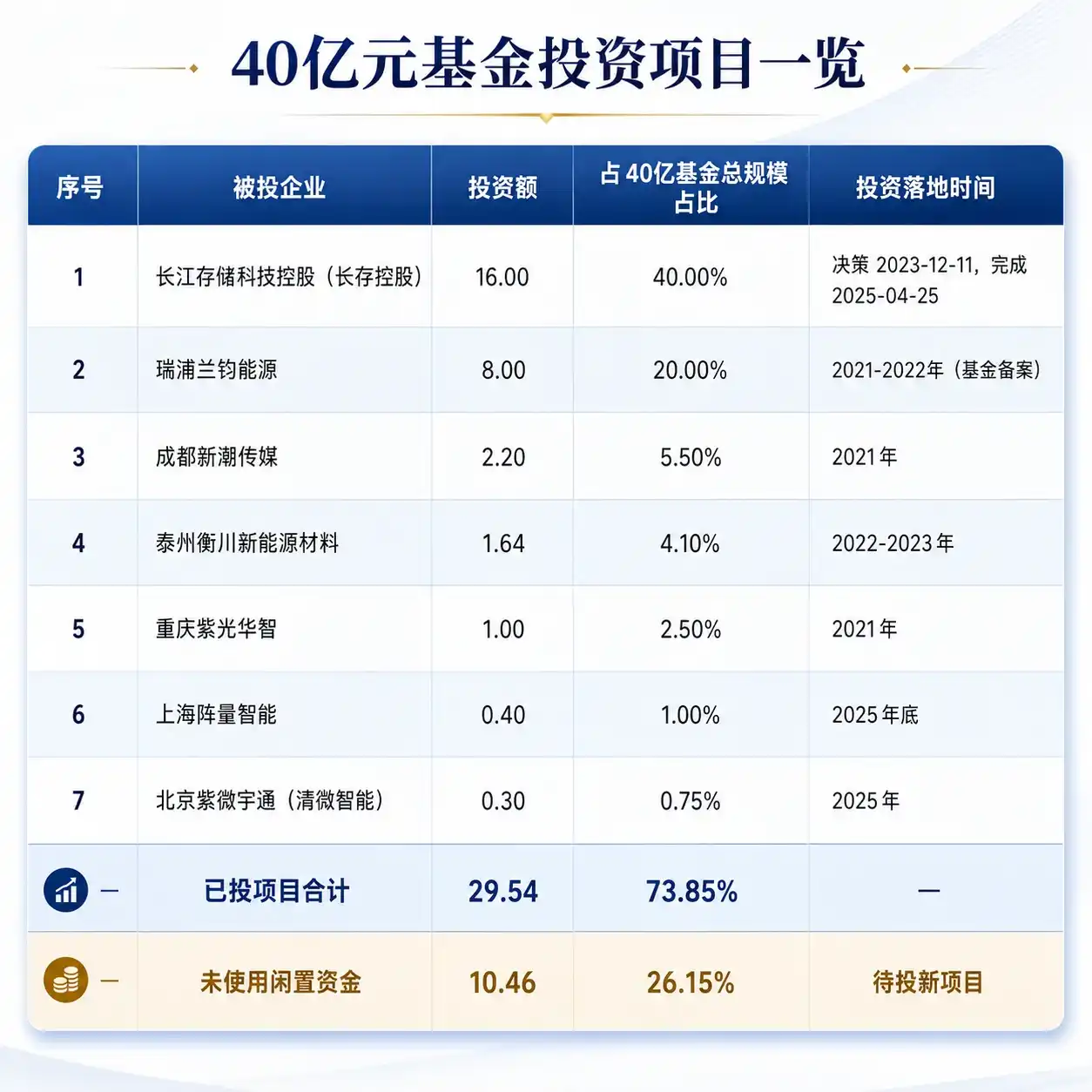
Among its 4-billion-yuan fund, one major investment drew attention: a 1.6-billion-yuan investment completed in April last year into Yangtze Memory Technologies Co., Ltd. (YMTC), acquiring a 0.99% equity stake.

1.6 billion yuan is equivalent to Yangyuan's entire annual profit. Investing the whole amount into a long-cycle industry like memory storage shows the company's boldness.

And YMTC has become hot this year, with reports of a potential domestic IPO and valuations ranging from 500 billion to 1 trillion yuan. Compared to last year's investment valuation, this represents a tripling in value.

If YMTC can successfully list, this single investment will mark the success of Yangyuan's industrial investments.

Because most of the other investments are currently at a floating loss, but Yangyuan has not exited, opting to continue holding long-term.

Among them, an 800-million-yuan investment in REPT Battero, a new energy power battery company, was fully cashed out after its 2023 Hong Kong IPO, realizing a book gain of approximately 241 million HKD.

The acquisition of Xinchao Media by Focus Media was valued at only 8.3 billion yuan, far below the 16.1 billion yuan valuation at the time of investment. Exit has not been executed yet, the fund still holds the equity, and it is currently at a floating loss.

The other AI-related companies are concentrated in areas like AI vision, edge-side AI chips, and GPUs for large model training, forming a relatively complete AI industry chain layout.

What's Next for Yangyuan?

In the coming years, Yangyuan Beverage is unlikely to completely transform into a VC company. Instead, it will likely maintain a dual-wheel model of "consumer main business as the foundation, equity investments for elasticity."

Six Walnuts will still be the company's basic business, but the walnut milk category has passed its high-growth period and will find it difficult to return to its past peak of 10 billion yuan annual revenue.

The 4-billion-yuan Quanhong Fund will remain an industrial fund worth watching.

Yangyuan's future capital will likely continue to flow into the upstream of AI computing power, including hard-tech directions like memory storage, edge-side AI chips, and industrial vision. Non-core tracks like new energy and media will gradually be marginalized.

If YMTC successfully lists, the investment gains could rewrite the income statement in one go, transforming the company's valuation from a traditional beverage stock to a dual pricing of "consumer + hard-tech shadow stock."

Conversely, if YMTC's listing is delayed or the semiconductor cycle turns cold, the stock price could also sharply retreat due to unmet tech expectations.

Trend Kriptolar

İlgili Sorular

QWhat is the main reason behind Yangyuan Beverage's (parent company of 'Six Walnuts') heavy investment in AI and related industries since 2021?

AThe primary reason is the continuous decline of its core beverage business, 'Six Walnuts.' The company faces shrinking revenues and profits in its main product line, with market share being eroded by alternatives like nut milk and oat milk. Instead of intensifying product R&D, the company has chosen to invest in high-growth, high-imagination sectors like AI to seek new growth drivers and boost its market valuation.

QWhat was the most significant AI/hard tech investment made by Yangyuan Beverage's fund, and what is its current status?

AThe most significant investment was a 1.6 billion RMB injection into Yangtze Memory Technologies Co., Ltd. (YMTC) in April of last year, acquiring a 0.99% stake. YMTC is reportedly planning a domestic IPO with a valuation estimated between 500 billion and 1 trillion RMB. If successful, this investment could triple in value and be a major success for Yangyuan's industrial investment strategy.

QHow has Yangyuan Beverage's stock price performed following its shift towards AI investments, and how does this contrast with the broader market?

AYangyuan Beverage's stock price surged from a low of around 17.7 RMB in early last year to a high of 52 RMB in May, representing a gain of approximately 293% (nearly tripling). This performance starkly contrasts with the broader A-share consumer sector, where many stocks hit yearly lows, making 'Six Walnuts' a standout performer in the market.

QAccording to the article, what is the likely future business model for Yangyuan Beverage?

AThe article suggests Yangyuan Beverage will likely maintain a dual-wheel business model: its traditional consumer beverage business (primarily 'Six Walnuts') as a stable foundation, combined with equity investments (particularly in AI and hard tech via its Quanhong Fund) to seek higher growth and valuation elasticity. It is not expected to transform completely into a venture capital firm.

QWhat are the potential risks for Yangyuan Beverage if its major AI/hard tech investments, like in YMTC, do not meet expectations?

AIf key investments like YMTC face delays in their IPO or if the semiconductor industry cycle turns downward, Yangyuan Beverage could experience a significant drop in its stock price as market expectations for tech-driven growth fail to materialize. This would lead to a sharp valuation correction. The company's financial performance would also be impacted without the anticipated large investment returns to offset the decline in its core beverage business.

İlgili Okumalar

Tiger Research: Zuckerberg Begins Betting on Prediction Markets, While Asian Nations Still View Them as Gambling

This article examines the rise of prediction markets, contrasting their growing institutional acceptance in the West with their restrictive regulation in Asia. It details how prediction markets, which originated from informal political betting and academic experiments like the Iowa Electronic Market, aggregate crowd wisdom into probabilistic prices through binary contracts. Their growth accelerated around 2020, reaching over $14 billion in monthly volume. A key driver is the "skin in the game" principle, where users risk their own capital, leading to high accuracy in predicting events like Fed rate decisions and elections, as demonstrated by platforms like Polymarket. Meta's entry, with Mark Zuckerberg reportedly leading the development of the Arena app, signals the market's maturation. In the U.S., court rulings have distinguished prediction markets from gambling, facilitating entry by traditional financial institutions. However, most Asian jurisdictions still classify them as gambling, focusing on social control rather than financial innovation. The article argues this stance creates three problems for Asia: 1) regulatory arbitrage pushes users to riskier offshore platforms, 2) loss of sovereign information infrastructure as valuable social sentiment data accumulates abroad, and 3) abandonment of user protection. It concludes that Asia needs a policy shift from prohibition to constructive regulation, integrating these markets into the formal system to harness their data as a national asset, as initiatives like Limitless Research are beginning to do.

marsbit1 saat önce

Tiger Research: Zuckerberg Begins Betting on Prediction Markets, While Asian Nations Still View Them as Gambling

marsbit1 saat önce

Ethereum's Next Decade in the Eyes of Vitalik

"Lean Ethereum" Long-Term Roadmap Unveiled by Vitalik Buterin On July 5, 2026, Vitalik Buterin published the "Lean Ethereum" roadmap, positioning it as Ethereum's third major evolution following the Merge. This multi-year, multi-phase upgrade aims to fundamentally transform Ethereum's core protocol through staged network upgrades extending to 2029. Key goals include achieving 1 gigagas per second L1 throughput (a massive increase from the current ~32 TPS), near-instant finality, and quantum-resistant cryptography. The plan involves transitioning Ethereum's security model from full transaction re-execution by all nodes to native verification via recursive STARK proofs. A major proposed change is replacing the EVM with a proof-friendly architecture like RISC-V or leanISA, though this remains a point of contention, especially with L2s like Arbitrum favoring alternatives like WASM. Other planned upgrades include a restructured state model with a large, cheap "warehouse" storage layer to drastically reduce fees for migrated applications, multi-dimensional gas pricing, and a new focus on making privacy a first-class, native protocol feature. While the roadmap significantly raises Ethereum's long-term technical ceiling, analysts note it does not directly address ETH's mid-term token economics or value capture. The plan's multi-year timeline means near-term price impact will likely depend on observable progress milestones, such as the successful deployment of the upcoming Glamsterdam gas limit increase, growth in L2 activity and blob usage, and trends in L1 fee revenue and ETH burn.

链捕手2 saat önce

Ethereum's Next Decade in the Eyes of Vitalik

链捕手2 saat önce

In Just 11 Days, Claude Rewrote Millions of Lines of Code, an Epic AI Engineering Feat Sparks Fury

In just 11 days, Bun's founder Jarred Sumner used Anthropic's Claude AI models to rewrite its million lines of code from Zig to Rust. This move sparked significant controversy, particularly from Zig's creator, Andrew Kelley, who publicly criticized Sumner's engineering practices and the decision to use AI for such a massive rewrite. Bun, a high-performance JavaScript/TypeScript runtime and rival to Node.js, was originally written in Zig. After Anthropic acquired Bun, the team encountered persistent stability and memory safety bugs in the Zig codebase. These issues, combined with Zig's strict policy against LLM-generated code, led to the decision to rewrite in Rust. The rewrite was executed using Claude AI tools at an estimated API cost of $165,000, dramatically reducing the expected time and financial cost. Andrew Kelley's response was scathing. He blamed the original bugs on poor engineering habits, calling Bun's Zig code a collection of "hacks on top of hacks." He expressed relief that Bun was no longer associated with Zig, fearing it would misrepresent the language and attract low-quality, AI-generated contributions. The tech community is divided; some view Kelley's critique as unprofessional, while others see it as a defense of engineering integrity. A major concern about the AI-driven rewrite is the resulting code quality. The translation from Zig left approximately 27,000 lines of unsafe Rust code, raising fears about long-term maintainability and technical debt. The debate centers on whether this project is a milestone in AI-assisted development or a future maintenance nightmare.

marsbit3 saat önce

In Just 11 Days, Claude Rewrote Millions of Lines of Code, an Epic AI Engineering Feat Sparks Fury

marsbit3 saat önce

From Auto Finance to Bitcoin to AI Engines: An Analysis of Cango's 'What Not to Do' Strategy

From Auto Finance to Bitcoin and Now AI: Cango's "What Not to Do" Strategy Cango, a Chinese auto finance platform that went public on the NYSE in 2018, is undergoing its third major transformation. After selling its entire auto business in 2024, it pivoted to become a large-scale Bitcoin miner, acquiring 50 exahash of mining rigs from Bitmain. However, its true goal was never Bitcoin, but owning and controlling energy infrastructure. Now, Cango is pivoting again. While most listed Bitcoin miners are leasing power to giant hyperscalers for AI training clusters, Cango is taking the opposite path. It has launched an AI inference subsidiary called EcoHash, focusing not on training but on distributed inference. The company's strategy hinges on the insight that over 70% of mining industry power is controlled by small, independent sites (10-50 MW), which are too small for hyperscalers but ideal for low-latency AI inference. Cango aims to partner with these small operators, providing the AI technology, customers, and financing through its EcoLink software layer, which can distribute workloads across sites for reliability. Cango maintains a hybrid model, running roughly 31.7 EH/s of Bitcoin mining for cash flow while aggressively cleaning its balance sheet—slashing long-term debt by 94.5% to $30.6 million and raising $75 million for its AI venture. Its first AI deployment will be at a 50 MW site in Georgia. The strategy faces skepticism, given the high costs of converting mining sites and the potential for an AI bubble. However, Cango's leadership believes discipline around "what not to do"—avoiding direct competition with hyperscalers in training—positions it to capture the long-tail demand for distributed AI inference power.

Foresight News4 saat önce

From Auto Finance to Bitcoin to AI Engines: An Analysis of Cango's 'What Not to Do' Strategy

Foresight News4 saat önce

İşlemler

Spot

Popüler Makaleler

ONE Nasıl Satın Alınır

HTX.com’a hoş geldiniz! Harmony (ONE) satın alma işlemlerini basit ve kullanışlı bir hâle getirdik. Adım adım açıkladığımız rehberimizi takip ederek kripto yolculuğunuza başlayın. 1. Adım: HTX Hesabınızı OluşturunHTX'te ücretsiz bir hesap açmak için e-posta adresinizi veya telefon numaranızı kullanın. Sorunsuzca kaydolun ve tüm özelliklerin kilidini açın. Hesabımı Aç2. Adım: Kripto Satın Al Bölümüne Gidin ve Ödeme Yönteminizi SeçinKredi/Banka Kartı: Visa veya Mastercard'ınızı kullanarak anında Harmony (ONE) satın alın.Bakiye: Sorunsuz bir şekilde işlem yapmak için HTX hesap bakiyenizdeki fonları kullanın.Üçüncü Taraflar: Kullanımı kolaylaştırmak için Google Pay ve Apple Pay gibi popüler ödeme yöntemlerini ekledik.P2P: HTX'teki diğer kullanıcılarla doğrudan işlem yapın.Borsa Dışı (OTC): Yatırımcılar için kişiye özel hizmetler ve rekabetçi döviz kurları sunuyoruz.3. Adım: Harmony (ONE) Varlıklarınızı SaklayınHarmony (ONE) satın aldıktan sonra HTX hesabınızda saklayın. Alternatif olarak, blok zinciri transferi yoluyla başka bir yere gönderebilir veya diğer kripto para birimlerini takas etmek için kullanabilirsiniz.4. Adım: Harmony (ONE) Varlıklarınızla İşlem YapınHTX'in spot piyasasında Harmony (ONE) ile kolayca işlemler yapın.Hesabınıza erişin, işlem çiftinizi seçin, işlemlerinizi gerçekleştirin ve gerçek zamanlı olarak izleyin. Hem yeni başlayanlar hem de deneyimli yatırımcılar için kullanıcı dostu bir deneyim sunuyoruz.

479 Toplam GörüntülenmeYayınlanma 2024.12.12Güncellenme 2026.06.02

ONE Nasıl Satın Alınır

Tartışmalar

HTX Topluluğuna hoş geldiniz. Burada, en son platform gelişmeleri hakkında bilgi sahibi olabilir ve profesyonel piyasa görüşlerine erişebilirsiniz. Kullanıcıların ONE (ONE) fiyatı hakkındaki görüşleri aşağıda sunulmaktadır.

活动图片