Share Price of the 'First Blockchain Stock' Plummets 96%, Is Canaan Technology Facing Delisting?

marsbit2026-07-16 tarihinde yayınlandı2026-07-16 tarihinde güncellendi

Özet

Canaan Inc., once hailed as the "world's first blockchain stock," is facing delisting from Nasdaq. The company received a 180-day extension until January 11, 2027, to regain compliance after its stock price remained below $1 for 30 consecutive days. Currently trading around $0.29, its market cap has plummeted over 90% from its peak. This crisis stems from severe financial struggles. Q1 2026 results showed a 24.3% year-over-year revenue decline to $62.7 million and a net loss of $88.7 million, which included a $25 million non-cash inventory write-down for mining rigs. The company's cash reserves have also shrunk significantly. While it holds a substantial Bitcoin reserve (1,915 BTC valued at ~$120 million), its core business is under pressure. Canaan's attempt to diversify into AI chips failed, leading to a costly shutdown of that division in 2025. Returning focus to Bitcoin mining hardware, it faces intense competition and a cyclical industry downturn. The "post-halving" era and a capital shift from crypto mining to AI infrastructure have crippled demand for its primary products. As a potential lifeline, the company is pivoting towards becoming a "computing infrastructure service provider," expanding its self-mining operations and exploring energy integration projects like waste heat utilization. It has also secured strategic investments. However, these moves have yet to restore market confidence. Canaan's story reflects the broader crypto mining winter, where the market n...

On July 15th, Canaan Technology announced that it has received a written notice from Nasdaq granting an additional 180-day grace period, extending the deadline to January 11, 2027. Prior to this, its ADS closing price had been below $1 for 30 consecutive trading days, triggering a compliance alert under Nasdaq's minimum bid price requirement.
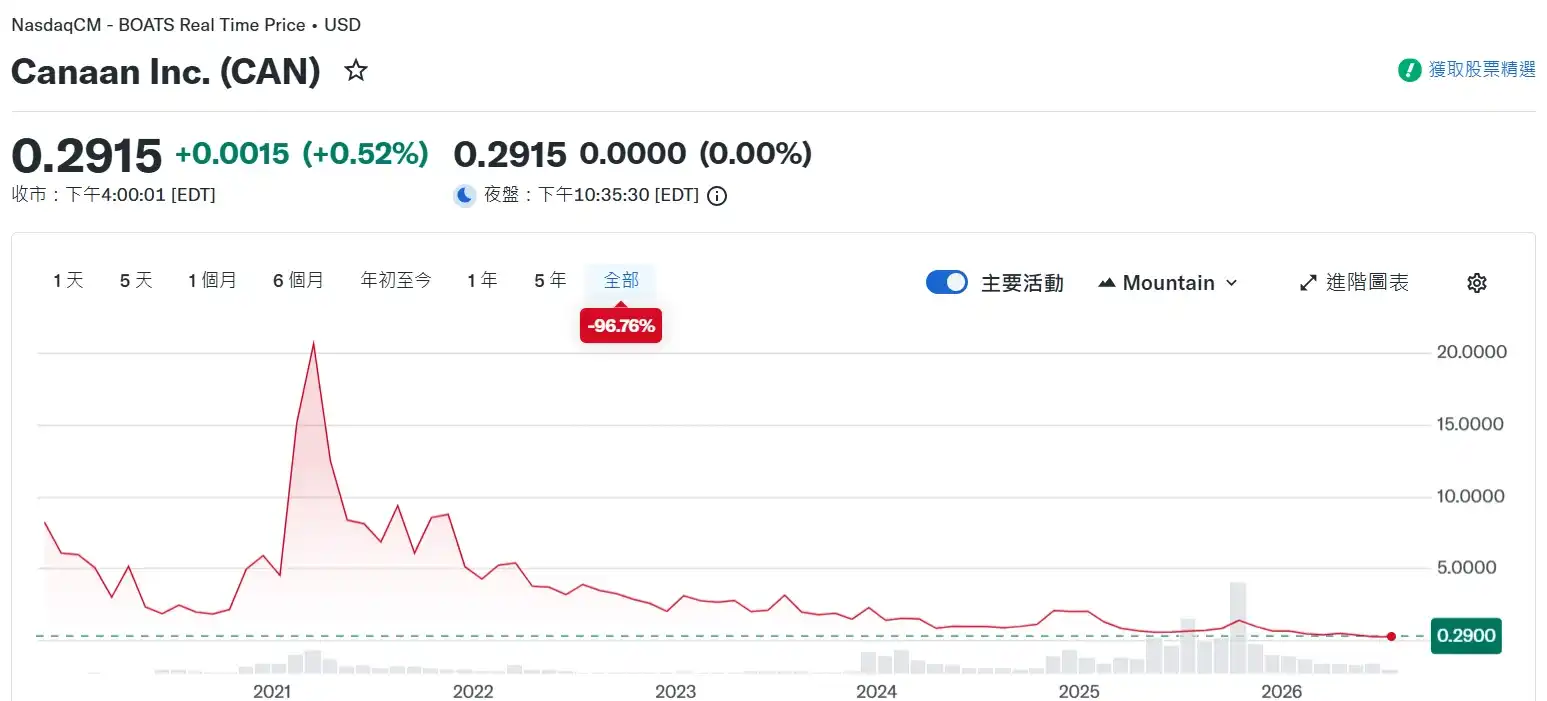
The market reaction was muted. At the close, Canaan Technology traded at $0.29, with a total market capitalization of approximately $217 million, marking a decline of over 90% from its peak market value following its IPO in November 2019. Once crowned the 'World's First Blockchain Stock', the company now stands on the brink of delisting.

The 180-Day Delisting Countdown

Canaan's tug-of-war with Nasdaq's compliance department began in May 2025. At that time, the company first received a delisting warning due to its persistently low stock price below $1, and temporarily averted the crisis thanks to a rebound in Bitcoin's price. However, the reprieve was short-lived. On January 14, 2026, Nasdaq issued another notification: Canaan's ADS closing price had been below $1 for 30 consecutive trading days. The company was required to regain compliance by July 13th, meaning its closing price needed to reach or exceed $1 for 10 consecutive trading days.

The initial grace period expired on July 13th. Canaan failed to meet the requirement. In a last-ditch effort, the company moved its listing from the more stringent Nasdaq Global Market to the lower-barrier Nasdaq Capital Market on July 1st and applied for an additional 180-day extension.

On July 15th, this application was approved, setting a new deadline of January 11, 2027.

According to Nasdaq rules, if compliance cannot be restored by that date, Canaan Technology could ultimately face delisting. The company has indicated that, if necessary, it will consider implementing a reverse stock split to boost the share price—a move typically seen by the market as a sign of weakness.

Q1 2026 Earnings: Total Revenue Down 24.3%, Net Loss of $88.7 Million

Canaan's low stock price is not without reason. Its latest financial report reveals the company is in a state of severe financial hemorrhage.

On May 19, 2026, Canaan Technology released its unaudited Q1 financial report: total revenue was $62.7 million, a year-on-year decrease of 24.3% and a sharp sequential drop of 68%; net loss was $88.7 million, further widening from a net loss of $86.4 million in the same period last year. The company recorded a gross loss of $22.9 million, which included approximately $25 million in non-cash inventory impairment—indicating Canaan had to write down the value of its mining machine inventory on a large scale, reflecting a sharp contraction in market demand.

Even more dire is the company's Q2 revenue guidance of only $35 million to $45 million, signaling continued pressure on performance in the short term. As of March 31, 2026, the company's cash balance was $43.5 million, a significant reduction from $80.8 million at the end of 2025; however, the company recovered approximately $42 million in customer receivables in April, providing some relief to liquidity.

It is noteworthy that despite losses in its core business, Canaan's cryptocurrency holdings reached a record high: at the end of Q1, the company held 1,807.60 Bitcoins (valued at $142 million). These digital assets provide a certain hedge on the balance sheet but also tie its performance closely to cryptocurrency price volatility.
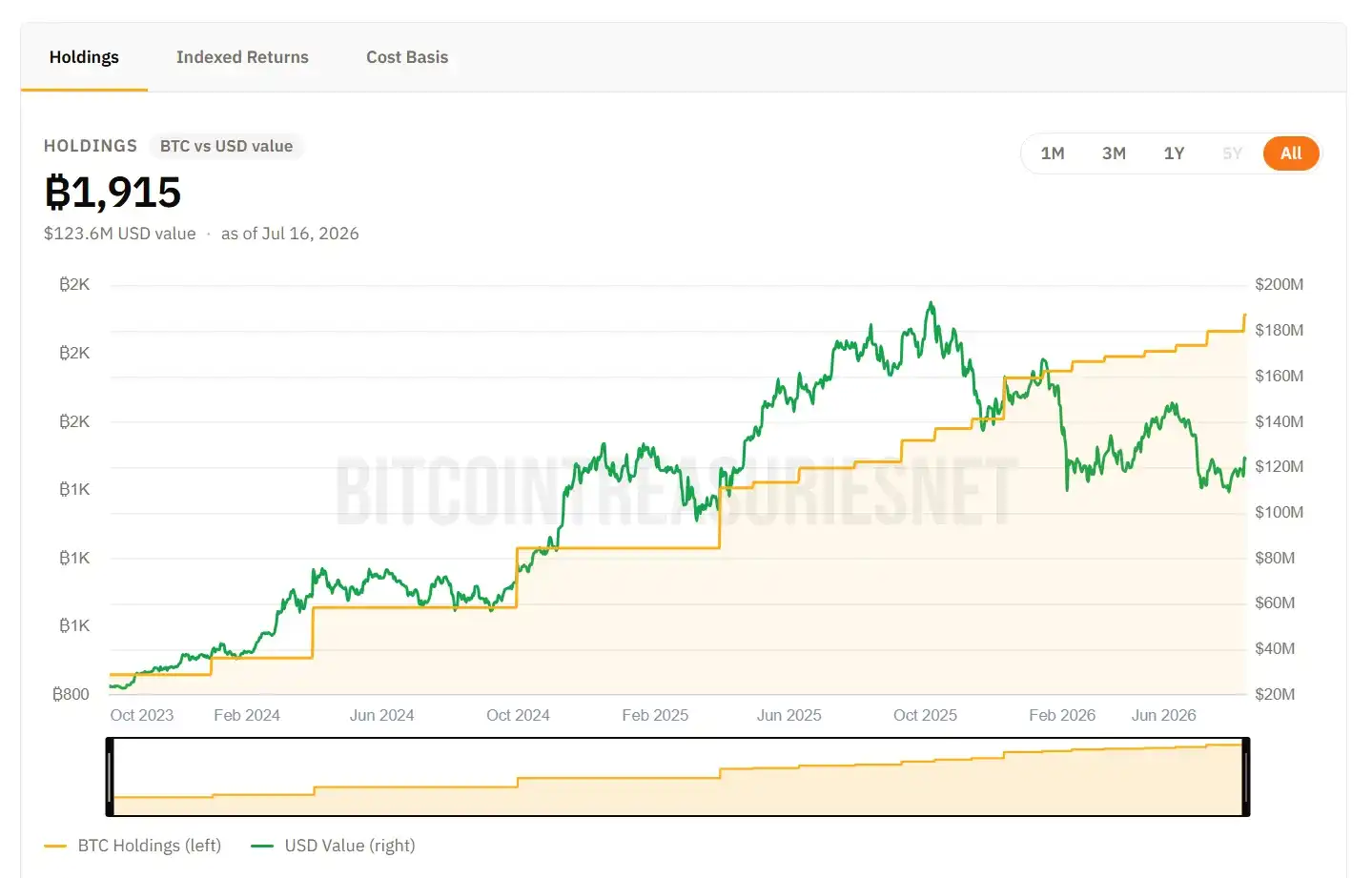
According to the latest data, Canaan's Bitcoin holdings have increased to 1,915, but their total value has fallen to $120 million.

Shattered AI Chip Dreams and the 'Pickaxe Seller' Dilemma

Canaan's predicament stems in part from a costly strategic misstep.

On June 24, 2025, the company announced the termination of its non-core AI chip business, fully refocusing on Bitcoin mining machines and proprietary mining. Its multi-year exploration of a 'second growth curve' ended in failure. According to public information, Canaan's edge computing products generated only about $900,000 in revenue in fiscal year 2024, while the operational expenses for this business segment were approximately $21.42 million, accounting for 15% of the company's total annual operating expenses. Under the pressure of a $249.8 million net loss in fiscal 2024, this 'cash-burning, non-revenue-generating' business was decisively cut.

However, returning to its core business did not make things much easier for Canaan. The mining machine industry is facing unprecedented competitive pressure. Compared to competitors like Bitmain, Canaan's market share continues to be squeezed. In Q2 2025, the company's total sold computing power was 6.4 million TH/s, a mere 3% year-on-year increase. By Q1 2026, product revenue had plummeted to $42.9 million, a cliff-like drop from $164.9 million in Q4 2024.

Zhang Nangeng, Founder of Canaan Technology

The essence of a mining machine manufacturer is being a 'pickaxe seller'—its fate is closely tied to the Bitcoin cycle. When Bitcoin prices are high and mining profits are substantial, miners are willing to increase capital expenditures; once prices slump and network-wide computing power competition intensifies, demand for mining machines rapidly cools. Since 2025, despite strong Bitcoin price performance at times, the mining industry as a whole has entered a low-margin phase in the 'post-halving' era, severely impacting Canaan's traditional business model.

Faced with the dual pressures of potential delisting and continuous losses, Canaan's management is attempting to transform from a pure hardware vendor into a 'computing power infrastructure service provider', seeking new life through vertical integration and energy sector initiatives.

Proprietary mining has become a key focus. As of the end of Q1 2026, Canaan's total computing power across 10 joint mining projects globally reached approximately 11 EH/s, a year-on-year increase of 66% and a sequential increase of 10.7%. The company acquired a 49% equity stake in Cipher Mining's ABC Projects in Texas. Additionally, the company launched a 3-megawatt pilot mining project in Canada, exploring the use of mining rig waste heat for greenhouse agriculture; and signed a 4.5-megawatt contract with a Japanese power engineering firm to participate in grid load regulation.

On the capital front, in November 2025, Canaan secured a total of $72 million in strategic investment from institutions including BH Digital and Galaxy Digital, intended to strengthen its balance sheet and fund infrastructure expansion. In December of the same year, the company's board approved a $30 million share repurchase plan, attempting to signal confidence to the market.

However, its stock price trend shows the market has not bought into this narrative.

Summary

Canaan's difficulties are a microcosm of the broader crypto mining winter.

Since 2025, the narrative surrounding the crypto industry in global capital markets has shifted significantly. With the explosion in demand for AI computing power, much of the capital previously directed towards mining machines and mining operations has pivoted to AI data centers and high-performance computing (HPC). Miners have begun migrating computing power to AI projects, directly compressing the demand space for Bitcoin mining machines.

A deeper challenge lies in the sustainability of the business model. As an ASIC chip design company, Canaan needs continuous R&D investment to maintain product competitiveness.

From a broader perspective, Canaan is undergoing a brutal process of de-bubbling. At its IPO in 2019, the company enjoyed a high valuation based on its status as the first blockchain stock. Today, the market no longer pays for the concept but demands tangible cash flow and profitability.

Until the next Bitcoin bull cycle arrives, profitability for mining companies will remain under pressure. Canaan Technology must prove within the next 6 months that it possesses the ability to navigate through this cycle.


İlgili Sorular

QWhy did Canaan receive a delisting notice from NASDAQ, and what is the new deadline for compliance?

ACanaan received the delisting notice because its ADS closing price remained below $1 for 30 consecutive trading days, violating NASDAQ's minimum bid price requirement. The company was initially given a compliance deadline of July 13, 2026, but after applying for an extension following a transfer to the NASDAQ Capital Market, it has now been granted an additional 180-day grace period. The new deadline for regaining compliance is January 11, 2027.

QWhat were the key financial figures reported by Canaan for Q1 2026?

AFor Q1 2026, Canaan reported total revenue of $62.7 million, a decrease of 24.3% year-over-year and 68% quarter-over-quarter. The company recorded a net loss of $88.7 million, which included a gross loss of $22.9 million. This gross loss contained approximately $25 million in non-cash inventory write-downs, reflecting a sharp contraction in market demand for its mining machines.

QWhat strategic pivot did Canaan attempt and why was it ultimately abandoned?

ACanaan attempted to diversify its business by developing AI chips as a 'second curve' to reduce reliance on the volatile bitcoin mining sector. However, this venture was terminated in June 2025. The AI chip business was highly unprofitable, generating only about $900,000 in revenue in FY 2024 while incurring operational expenses of approximately $21.42 million. Faced with a net loss of $249.8 million for the year, the company decided to cut this cash-burning operation and refocus entirely on its core bitcoin miner and proprietary mining businesses.

QHow is Canaan's business model being challenged by broader market trends, particularly in 2025?

ACanaan's traditional 'shovel-selling' business model is under severe pressure from two major market shifts. First, the post-halving era for Bitcoin has led to lower marginal returns for miners, cooling demand for new mining hardware. Second, and more significantly, a major capital narrative shift occurred in 2025. As AI computing demand exploded, a substantial amount of capital that previously flowed into crypto mining infrastructure was redirected towards AI data centers and high-performance computing (HPC). Some miners even began repurposing their computing power for AI projects, directly compressing the market space for new Bitcoin ASIC miners.

QDespite financial losses, what asset provides a potential hedge on Canaan's balance sheet, and what is its current status?

ACanaan holds a significant reserve of Bitcoin on its balance sheet, which acts as a potential hedge against its operational losses. As of the end of Q1 2026, the company held 1,807.60 Bitcoin, valued at $142 million. According to the latest data mentioned in the article, this reserve has since increased to 1,915 Bitcoin. However, due to market price fluctuations, the total value of this holding had decreased to approximately $120 million at the time of reporting.

İlgili Okumalar

How Will Stablecoins Reshape the Corporate Payments Landscape in 2026?

In 2026, stablecoins are no longer a niche cryptocurrency topic but are being actively explored by enterprises to modernize cross-border payments. Traditional systems, burdened by slow settlement, high costs, and limited transparency, struggle to meet the needs of global digital commerce. Stablecoins, which combine the price stability of fiat currencies with the speed and programmability of blockchain, offer compelling business advantages. These include faster settlement (minutes vs. days), lower transaction costs by reducing intermediaries, greater transparency through immutable records, 24/7 availability, and global accessibility. Key enterprise use cases are emerging: cross-border supplier payments, treasury management, payroll for distributed teams, digital commerce, and B2B transactions. A transformative aspect is programmable payments via smart contracts, enabling automation of processes like subscription billing, escrow, and supply chain payments. Adoption hinges on robust security, compliance (AML/KYC), and regulatory clarity. Future trends like asset tokenization, embedded finance, and AI-driven financial systems are expected to accelerate integration. In conclusion, stablecoins are evolving from an alternative technology into foundational infrastructure for next-generation enterprise payments, offering efficiency, cost savings, and new capabilities for a connected global economy.

marsbit34 dk önce

How Will Stablecoins Reshape the Corporate Payments Landscape in 2026?

marsbit34 dk önce

In-depth Analysis of Trade[XYZ]: How Were 92 Markets and 98% of HIP-3 Trading Volume Established?

**Deep Dive into Trade[XYZ]: How It Built 92 Markets and 98% of HIP-3 Volume** This analysis explores Trade[XYZ], a deployment on Hyperliquid's HIP-3 framework, which now accounts for 98% of its transaction volume. It argues that Trade[XYZ] is not a threat to Hyperliquid but a validation of its strategy: providing open infrastructure for specialized teams to build deep liquidity markets. The report details the significant difficulty of building institutional-grade perpetual markets for real-world assets (stocks, indices, commodities). Trade[XYZ] succeeded by rapidly launching markets (median 3.3 days), attracting deep-making market makers, and implementing sophisticated risk mechanisms (like "Discovery Bounds") to maintain liquidity even when traditional hedges are unavailable (e.g., overnight, pre-IPO). Key findings include: * **User Acquisition:** ~97% of Trade[XYZ] volume trades through Hyperliquid's own front-end, bringing over 300,000 new wallets to the protocol. * **Fee Sharing:** Protocol fees are split 50/50 between Hyperliquid (for HYPE buybacks) and the deployer. The "Growth Mode" (low fees for RWA) is a strategy to build market share before potential monetization at standard rates, as evidenced by the GOLD market. * **Market Quality:** Trade[XYZ] has achieved tight spreads and significant open interest, led by commodities and indices. Its ongoing operational management of 92 markets is a full-time business. * **Strategic Fit:** Building these markets internally would expose Hyperliquid to regulatory risk and divert focus from its core infrastructure mission. HIP-3 allows expert deployers like Trade[XYZ] to handle complex operations while Hyperliquid benefits from network effects, fees, and users. The conclusion is that Trade[XYZ]'s dominance demonstrates the success of Hyperliquid's horizontal model: attracting the best operators to build winning verticals on its neutral, high-performance base layer.

marsbit43 dk önce

In-depth Analysis of Trade[XYZ]: How Were 92 Markets and 98% of HIP-3 Trading Volume Established?

marsbit43 dk önce

Aleo's First APAC Community Event to Land in Shanghai, Collaborating with OpenBuild to Build a Privacy Computing Developer Ecosystem

Aleo, in collaboration with the open-source developer community OpenBuild, will host its first Asia-Pacific (APAC) community event, "Aleo Shanghai Community Event," on July 26, 2026, in Shanghai. This event marks a key step in Aleo's APAC ecosystem expansion and aims to bring together developers, entrepreneurs, Web3 professionals, and AI enthusiasts to explore the trends in Zero-Knowledge (ZK) proofs, programmable privacy technology, and the innovative opportunities arising from the convergence of AI and privacy computing. Differing from traditional tech talks, the event emphasizes hands-on developer participation. Attendees will have the opportunity to experience Aleo's privacy infrastructure firsthand, engage in real on-chain interactions, and provide direct feedback to the Aleo team. The agenda will feature the official launch of Aleo's APAC Hackathon program, including details on competition mechanics, prizes, mentorship, and team formation. A core focus will be the theme "AI × Programmable Privacy," examining how privacy computing can serve as critical infrastructure for the next generation of the internet, particularly with the rise of AI Agents. A panel discussion titled "Do Agents Need Privacy by Default?" will delve into data security, identity privacy, and trusted interactions for AI Agents in future commercial applications. The event will also include product demonstrations, community networking, and free discussion sessions, designed to foster connections among local developers and advance the regional developer community. **Event Details:** * **Name:** Aleo Shanghai Community Event * **Date:** July 26, 2026 (Sunday), 13:30–18:00 * **Location:** Shengbang International Plaza, Shanghai * **Organizers:** Aleo × OpenBuild **About Aleo:** Aleo is a Layer-1 blockchain enabling programmable privacy, allowing developers to build decentralized applications that combine privacy with on-chain verifiability. It is backed by investors including a16z, Haun Ventures, Samsung Next, and SoftBank. **About OpenBuild:** OpenBuild is an open-source collaborative community for developers, focused on frontier technologies like Web3 and AI, supporting builders through the entire journey from idea to product realization.

marsbit1 saat önce

Aleo's First APAC Community Event to Land in Shanghai, Collaborating with OpenBuild to Build a Privacy Computing Developer Ecosystem

marsbit1 saat önce

İşlemler

Spot
活动图片