Sevenfold Oversubscription, Can SK Hynix Save the Semiconductor Industry This Time?

Odaily星球日报2026-07-09 tarihinde yayınlandı2026-07-09 tarihinde güncellendi

Özet

SK Hynix's planned US ADR listing is drawing intense interest, with its offering reportedly oversubscribed by over seven times, potentially making it the largest foreign listing in US history. The fundraising of approximately $24.5 billion is intended for expanding its Korean production capacity, including advanced packaging and EUV equipment. This massive demand from long-term funds and prominent institutions like Baillie Gifford and Situational Awareness Partners (led by noted investor Leopold Aschenbrenner) presents a stark contrast to the recent downturn in the broader semiconductor sector. The sector has faced a significant correction, with SK Hynix's own stock falling nearly 30% from its June high. This sell-off was triggered by concerns that major tech giants might slow their AI infrastructure spending, following signals like Meta's reported plan to sell surplus computing capacity. The strong ADR appetite suggests long-term investors still believe in the AI investment cycle's fundamentals, viewing the recent decline more as a valuation reset than a demand collapse. Some market speculation even suggests the pre-IPO price drop could be strategic, setting the stage for a stronger post-listing performance. While SK Hynix's successful listing may act as a short-term positive catalyst for market sentiment, the article argues the true signal for a sustained semiconductor recovery will come from upcoming earnings reports of tech giants like Microsoft, Google, Meta, and Amazo...

Original | Odaily Planet Daily (@OdailyChina)

Author | Azuma (@azuma_eth)
Bloomberg reported this morning, citing informed sources, that the subscription multiple for the "American Depositary Receipts" (ADRs) issued in the U.S. by South Korean semiconductor giant SK Hynix has exceeded seven times, making it likely to become the largest foreign listing in U.S. history.

Previously, at the end of June, SK Hynix submitted an F-1 prospectus to the U.S. SEC, planning to list on the NASDAQ by issuing 177.9 million ADRs (each ADR representing one-tenth of an ordinary share). Based on the closing price in the South Korean market on Wednesday of 2,076,000 won (approximately $1,380), the total fundraising is expected to reach about $24.5 billion. The funds raised will be entirely used for expanding domestic production capacity in South Korea, including the Yongin wafer fab, the Cheongju advanced packaging production line, and investments in EUV and related equipment.

As SK Heads to the U.S., the Semiconductor Sector is in a Deep Squat

While SK Hynix is going public in the U.S., the entire semiconductor sector is experiencing a sharp correction.

Over the past two years, AI infrastructure investment has been the core driver of the semiconductor sector's rise. Benefiting from the sustained expansion of capital expenditures by tech giants like Microsoft, Google, Meta, and Amazon, segments of the industry chain such as GPUs, HBM memory, and advanced process equipment have seen explosive performance, driving stock prices ever higher.

Recently, however, the market has begun to re-examine the sustainability of this narrative. First, Meta was reportedly planning to sell some of its idle computing resources, interpreted by the market as a signal that tech giants have begun to signal an optimization of AI infrastructure spending. Subsequently, Blackstone's plan to build what would have been the world's largest data center project was canceled, further reinforcing market concerns about a slowdown in data center demand growth.

While these events are not entirely equivalent to the "AI investment cycle" ending, they have triggered a market repricing of a key question — after hundreds of billions of dollars in capital investment, can the AI capital expenditures of tech giants maintain their current growth rate?

As a result, the AI industry chain has been under pressure recently. From chips and memory to semiconductor equipment, the market's trading logic has shifted from "unlimited demand growth" to "whether future growth can still materialize." SK Hynix's stock price has also seen a significant correction, falling from a high of 2,917,000 won on June 25th to yesterday's closing price of 2,076,000 won, a maximum drawdown of nearly 30%.

Secondary Market Under Pressure, Primary Market Goes Wild

Interestingly, while the secondary market continues to adjust, SK Hynix's U.S. listing has received far more enthusiastic capital support than expected.

As mentioned earlier, the subscription multiple for this ADR issuance has exceeded seven times, indicating strong institutional interest. According to information disclosed in SK Hynix's roadshow materials, the demand for this subscription mainly comes from various institutions including global long-term funds, technology theme funds, sovereign wealth funds, and Asian theme investors. Among them, institutions such as Baillie Gifford, Coatue Management, and Situational Awareness Partners have expressed subscription intentions totaling approximately $7 billion.

Note the mention of Situational Awareness here; this is the fund controlled by the newly crowned "AI Stock God" Leopold Aschenbrenner, arguably the most explosively performing fund in this AI cycle. For details, see "From SBF's Protege to Turning $225M into $5.5B in a Year," and "A Look at the Latest Moves of the 24-Year-Old 'AI Stock God': 60% Position Hedging Against Semiconductor Downturn."
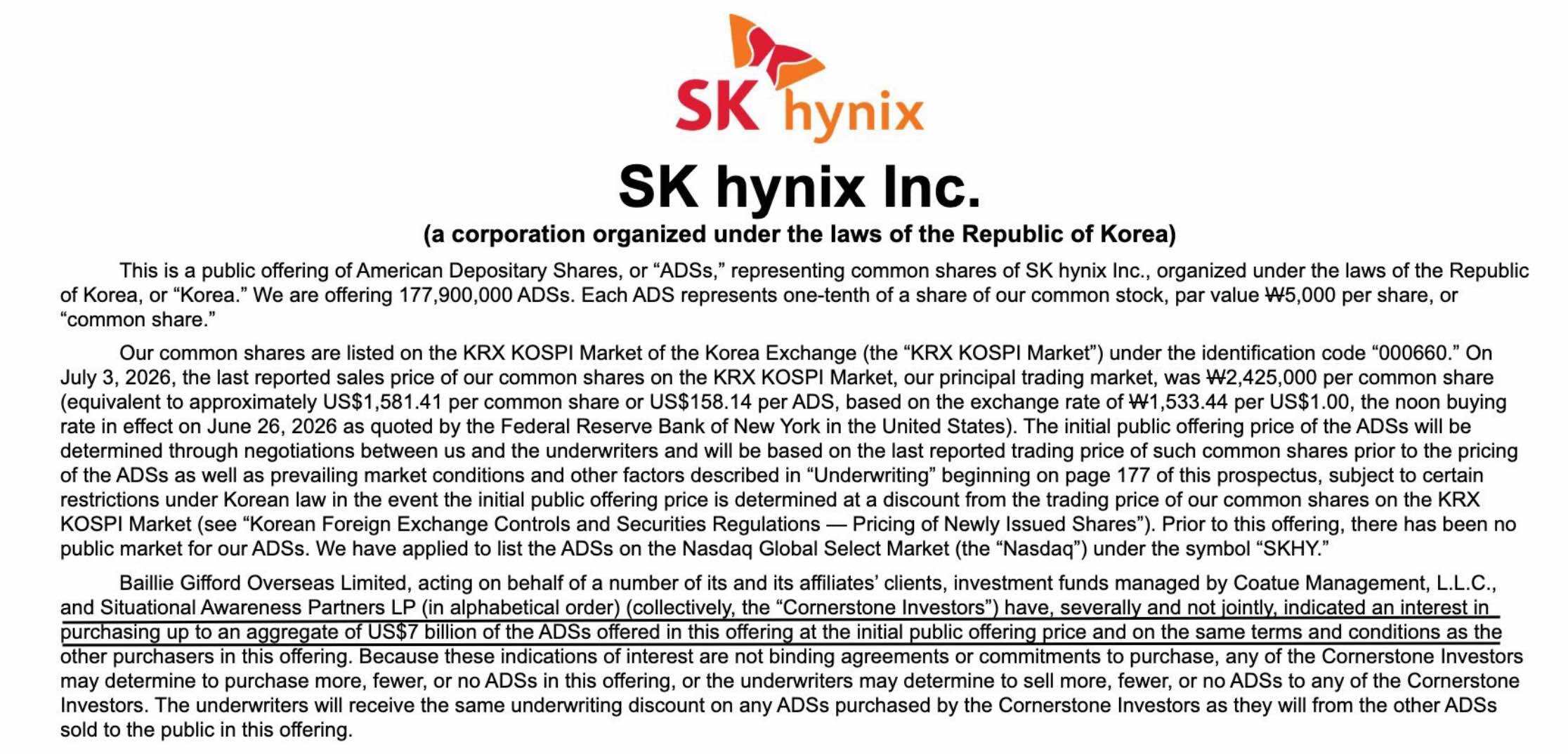
The frenzy from institutions suggests that, at least from the perspective of long-term capital, the market has not entirely dismissed the AI infrastructure investment cycle. In fact, the recent correction in the semiconductor sector is fundamentally more of an adjustment in valuations and expectations rather than a reversal in industry fundamentals. Investors are concerned about whether the future growth rate of capital expenditures will slow, not whether current core products like HBM and AI chips are losing demand.

Additionally, it's worth noting that a speculation has been circulating in the market regarding the timing of SK Hynix's listing: perhaps the significant stock price adjustment before listing on the NASDAQ is to make the post-listing performance look better, creating a win-win situation for the company, underwriters, institutions, and retail investors...

This logic may not be fully verifiable, but from a trading perspective, it could indeed reinforce market optimism about the post-IPO price trajectory — for the issuer, a lower valuation starting point is favorable for subsequent price performance; for subscribing institutions, it also implies greater potential upside.

Therefore, SK Hynix's U.S. listing this time could very well become an important inflection point for semiconductor market sentiment in the short term.

The True Reversal Signal Depends on the Tech Giants' Next Report Card

However, the mere heat of SK Hynix's U.S. IPO doesn't seem to fully answer whether the semiconductor sector's correction has ended.

Looking at the industry cycle, the core of the current market debate is not whether AI demand still exists, but whether tech giants can continue to maintain capital investments at their current scale. Over the past two years, companies like Microsoft, Google, Meta, and Amazon have continuously ramped up AI infrastructure construction, pushing global data center investment into a phase of rapid expansion. According to plans previously announced by these tech giants, AI-related capital expenditures are set to remain high in the coming years.

But simultaneously, as the scale of investment continues to expand, investors are increasingly focusing on "when these massive capital investments will translate into tangible commercial returns."

If AI application growth can keep pace with infrastructure investment, then the current adjustment in the semiconductor sector would resemble a digestion of high valuations after a rally. But if tech giants start slowing down data center construction and reduce GPU procurement, then the high-growth expectations previously priced into the AI industry chain would face significant revision. Therefore, the earnings reports from tech giants in the next few quarters will become the key to determining the direction of the semiconductor market.

In other words, while SK Hynix's listing might serve as a catalyst for short-term sentiment in the semiconductor sector, what truly determines whether the AI cycle can continue remains the clear answer from tech giants like Microsoft, Google, Meta, and Amazon regarding their future capital expenditures.


İlgili Sorular

QAccording to the article, what is the subscription multiple and projected fundraising amount for SK Hynix's ADR issuance in the US?

AThe article states that SK Hynix's ADR issuance has achieved a subscription multiple of over seven times. Based on the Korean market closing price of 2,076,000 won (approximately $1,380) per share, the projected total fundraising amount is about $24.5 billion.

QWhat is the primary concern driving the recent sell-off in the semiconductor sector, as mentioned in the article?

AThe primary concern is whether major tech giants like Microsoft, Google, Meta, and Amazon can sustain their current pace of capital expenditures on AI infrastructure, following massive investments over the past two years. Investors are reassessing the sustainability of growth expectations.

QName at least two institutions that have expressed significant subscription interest in SK Hynix's ADR offering, according to the article.

AThe article mentions that Baillie Gifford, Coatue Management, and Situational Awareness Partners have expressed combined subscription intentions of approximately $7 billion.

QHow does the article describe the relationship between SK Hynix's pre-IPO stock price correction and its potential post-listing performance?

AThe article mentions a market speculation that the significant price correction before the Nasdaq listing might be strategic, aiming for a more favorable post-IPO performance. A lower valuation starting point could benefit the stock's future price action for both the company and investing institutions.

QWhat does the article identify as the true key signal for determining the future direction of the semiconductor cycle?

AThe article identifies the upcoming financial reports from major tech giants (Microsoft, Google, Meta, Amazon) as the crucial signal. Their future capital expenditure plans will determine whether the AI investment cycle can continue, which is fundamental to the semiconductor sector's outlook.

İlgili Okumalar

Bitcoin Has Yet to Hit Bottom, While Exchange AscendEX Has Already "Run Away"

On July 6, 2026, cryptocurrency exchange AscendEX officially announced it is ceasing operations, with a complete shutdown scheduled for July 1, 2026. The platform cited the full implementation of the EU's MiCA regulation alongside market, financial, and operational challenges. Users can no longer perform most functions, with accounts limited to withdrawal purposes only. Prior to the announcement, on-chain investigator ZachXBT had issued warnings about significant withdrawal delays and a severe lack of high-liquidity assets (like ETH, USDT, SOL) in AscendEX's public hot wallets. Following the news, ZachXBT confirmed that the exchange lacks sufficient liquid assets to process multiple verified seven-figure withdrawal requests. AscendEX acknowledged that all withdrawals now require manual review, with no guarantees on processing times. Chain analysis via Arkham Intelligence shows the platform's marked wallets hold minimal readily accessible funds, with most recent activity being small withdrawals. One highlighted wallet reportedly contains only $13.46 million in altcoins. AscendEX, formerly known as BitMax, launched in 2018 and raised $50 million in a 2021 funding round. However, it suffered a major security breach in December 2021, losing approximately $77.7 million from hot wallets. The exchange compensated users but never fully recovered. The current crisis underscores the inherent risks of centralized exchanges, where poor liquidity management, regulatory pressure, and bear market conditions can trigger a collapse. The event is seen as part of a broader industry shakeout, highlighting the importance for users to prioritize non-custodial wallets or exchanges with transparent proof-of-reserves.

Foresight News35 dk önce

Bitcoin Has Yet to Hit Bottom, While Exchange AscendEX Has Already "Run Away"

Foresight News35 dk önce

Breaking News: Musk Delivers the Most Powerful Grok 4.5, Slashes Price of Top-tier Opus Intelligence Drastically

**Elon Musk Launches Grok 4.5: A Cost-Effective, High-Performance AI Rival** SpaceXAI, in collaboration with Cursor, has released Grok 4.5, its new flagship AI model designed specifically for coding and agentic tasks. Trained on tens of thousands of NVIDIA GB300 GPUs using massive, high-quality data filtered from trillions of Cursor developer interactions, the model emphasizes "per-token intelligence." In benchmark performance, Grok 4.5 is highly competitive. It scores 64.7% on SWE Bench Pro (surpassing GPT-5.5's 58.6% and Opus 4.7's 64.3%), 83.3% on Terminal Bench 2.1 (nearly matching GPT-5.5), and 62.0% on DeepSWE 1.0 (beating Opus 4.8). Overall, it ranks fourth in AAAI official tests and first in the Harvey legal agent benchmark. The model's key advantage is its combination of speed, efficiency, and low cost. It generates responses at 80 tokens per second and, crucially, uses far fewer tokens to complete tasks—4.2 times fewer than Opus 4.8 on SWE Bench Pro. It is priced at $2 per million input tokens and $6 per million output tokens, significantly undercutting competitors. Musk stated it is "roughly equivalent to Opus 4.7, but much faster." Early user tests show Grok 4.5 can generate functional code for applications like 3D solar system simulators and basic games from simple prompts, though some note it still lags behind top models in certain creative tasks. Musk has hinted at a major update next month, leveraging real-world engineering data from his companies, with an even larger 2-trillion parameter version reportedly in development. Grok 4.5 positions itself not as the absolute strongest model, but as a highly efficient and affordable alternative in the top tier.

marsbit1 saat önce

Breaking News: Musk Delivers the Most Powerful Grok 4.5, Slashes Price of Top-tier Opus Intelligence Drastically

marsbit1 saat önce

Today, The Hong Kong Exchange Was Once Again Overwhelmed

Hong Kong's stock exchange witnessed an exceptionally busy day on July 9, with a record seven companies conducting initial public offerings (IPOs) simultaneously. The list included major firms such as Luxshare Precision, which launched the largest Hong Kong IPO of the year, and other notable names like Tri-Ring Group and Qiyunshan Food. However, the market reception was sharply divided on the first trading day. While Qiyunshan Food's shares surged over 110%, several other newcomers, including Luxshare Precision, Dingtai High-Tech, and Rigol Technologies, opened below their issue prices, with some falling nearly 20%. This event highlights a broader, bustling IPO scene in Hong Kong for 2024, with 82 Chinese companies listing in the first half alone—more than double the figure from the same period last year. A significant portion of this activity comes from dual "A+H" listings, where mainland China-listed firms seek secondary listings in Hong Kong. These larger companies have accounted for nearly 60% of total fundraising. Despite the high volume, recent trends show a cooling market sentiment for many new listings. Several IPOs in early July, including that of Tongrentang Healthcare, debuted with significant losses, indicating increased investor caution and selectivity. The market narrative is shifting, with capital increasingly concentrating on high-growth sectors like artificial intelligence, robotics, and semiconductors, while traditional manufacturing and consumer goods face greater pressure and volatility. This divergence underscores a market where success is no longer guaranteed by merely listing, but depends heavily on a company's growth prospects and sector appeal.

marsbit1 saat önce

Today, The Hong Kong Exchange Was Once Again Overwhelmed

marsbit1 saat önce

Glassnode: Crypto Market Enters Later Stages of Bottoming Phase

Glassnode: Crypto Market Enters Later Stages of Bottom Formation Bitcoin has traded below the true market average and the short-term holder cost basis for five consecutive months, indicating a deep undervaluation. On-chain data reveals a significant shift in selling pressure, with long-term holders now accounting for 43% of all realized losses. Daily realized losses for this group recently peaked at $280 million, the highest level since December 2022. While this large-scale capitulation is a hallmark of bear market bottoms, a sustained decline in this metric is a prerequisite for a sustained recovery. Institutional demand remains weak. US spot Bitcoin ETFs continue to see monthly net outflows, although the pace has moderated from June's peak. Furthermore, average daily ETF trading volumes have contracted by approximately 80% from their October 2025 peak, reflecting subdued institutional participation. Derivatives markets present a mixed picture. Overall positioning has shifted to cautiously bullish, with the put/call ratio dropping to a yearly low. However, the options volatility skew remains elevated, signaling that traders are still paying a premium for downside protection. The spot price also trades below the gamma "max pain" level. In summary, multiple indicators suggest the market is in the later phases of a bottoming process, characterized by long-term holder capitulation and weak institutional inflows. However, key confirmation signals for a durable trend reversal—a sustained drop in long-term holder selling pressure, stabilization of ETF flows, and a price recovery above key cost bases—are still pending.

Foresight News1 saat önce

Glassnode: Crypto Market Enters Later Stages of Bottoming Phase

Foresight News1 saat önce

İşlemler

Spot
活动图片