Senator Lummis pushes for CLARITY Act, calls it ‘best thing to happen to DeFi community’

ambcrypto2026-04-02 tarihinde yayınlandı2026-04-02 tarihinde güncellendi

Özet

Senator Cynthia Lummis advocates for the Digital Asset Market Clarity Act of 2025, calling it the "best thing to happen to the DeFi community." She argues the legislation would provide legal certainty and a "safe harbor" for developers, validators, and node operators, ensuring American innovation remains in the U.S. However, this optimism contrasts with Polymarket's prediction market, where the act's odds of passage are only 49%, reflecting broader market uncertainty. This skepticism may stem from ongoing disagreements between the White House and crypto entities like Coinbase. Concurrently, stablecoin infrastructure is evolving. The Better Money Company, backed by A16z crypto, is developing a "stablecoin clearinghouse" to simplify the use of multiple stablecoins across different blockchains. This development follows the passage of the GENIUS Act in 2025, which streamlined stablecoin regulations. Visa's on-chain analytics report a massive $72.3 trillion in stablecoin transaction volume over the past year, with USDC recently outpacing USDT in monthly transaction volume.

The hype around the Digital Asset Market Clarity Act of 2025 is increasing day by day. Senator Cynthia Lummis is the latest to lend some fresh optimism to the ongoing discussion around yield generations, with the Senator claiming that the CLARITY Act is the “best thing that could happen to the DeFi community.”

This is evidence of how even big officials can see the ongoing uncertainty surrounding regulations that are coming up in the way of actual growth of the crypto ecosystem. Hence, by pushing demand for the passage of the CLARITY Act, Lummis believes that this would finally give the crypto community “the legal certainty they deserve”.

Lummis also stressed on the seriousness of the situation as she explained how this proposed law is a one-pot solution to “developers, validators, and node operators.”

Once approved, this Act would provide “a safe harbor” and also “ensure American innovation stays right here on U.S soil.”

Polymarket odds are painting a negative picture

However, this optimism is in contrast to Polymarket odds. At the time of writing, they sat at 49%, even below the neutral level – A sign that the broader market is still unsure about the passage of the Act.
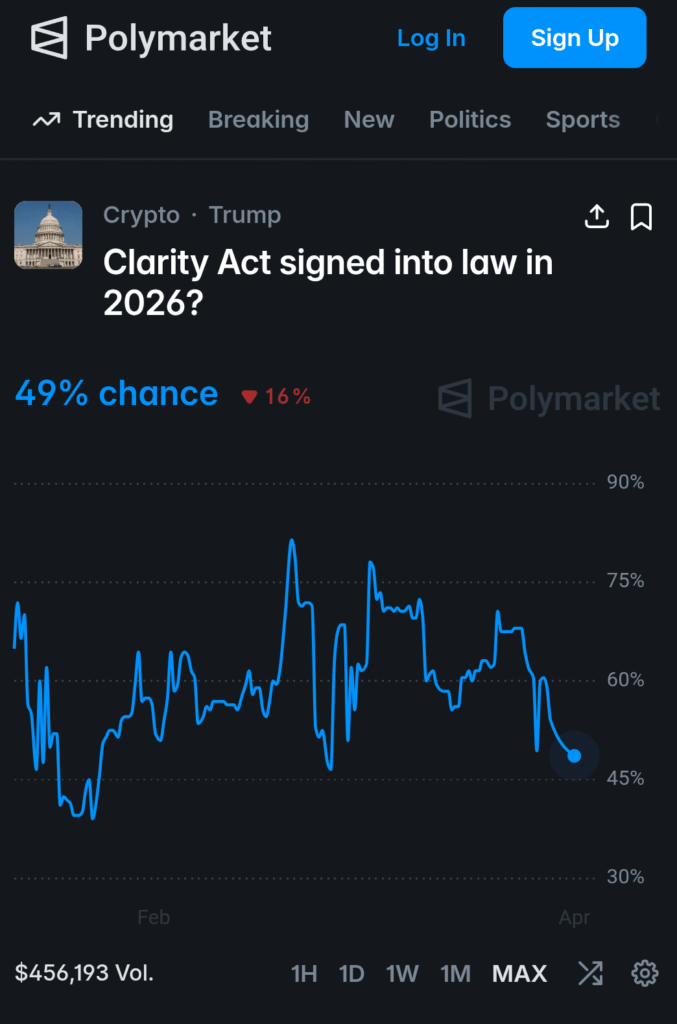
Source: Polymarket

This might be due to the series of disagreements between the White House and Coinbase.

On the contrary, others like the Better Money Company, a stablecoin infrastructure firm, are aiming to build “the next era of money”.

The current situation of the stablecoin market is such that different stablecoins exist across multiple blockchains, issuers, and platforms. And, they often require manual, costly conversions and sometimes even trading at slight value differences.

Finding the missing piece

Hence, to remove this roadblock, The Better Money Company is aiming to build “a stablecoin clearinghouse.” Under this plan, the firm will simplify how developers and businesses integrate stablecoins, enabling them to send, receive, and use multiple stablecoins as if they were one consistent form of money.

With A16z crypto investing in the startup, the plan is simply to develop the “critical missing connectivity layer” required to make the stablecoin ecosystem function effectively.

Other developments in and around stablecoins

All this is happening along the heels of the GENIUS Act that was passed in 2025, making stablecoin regulations seamless.

In the meantime, the total transaction volume of stablecoins hit a count of $72.3 trillion in the last 12 months, as per Visa’s on-chain analytics.
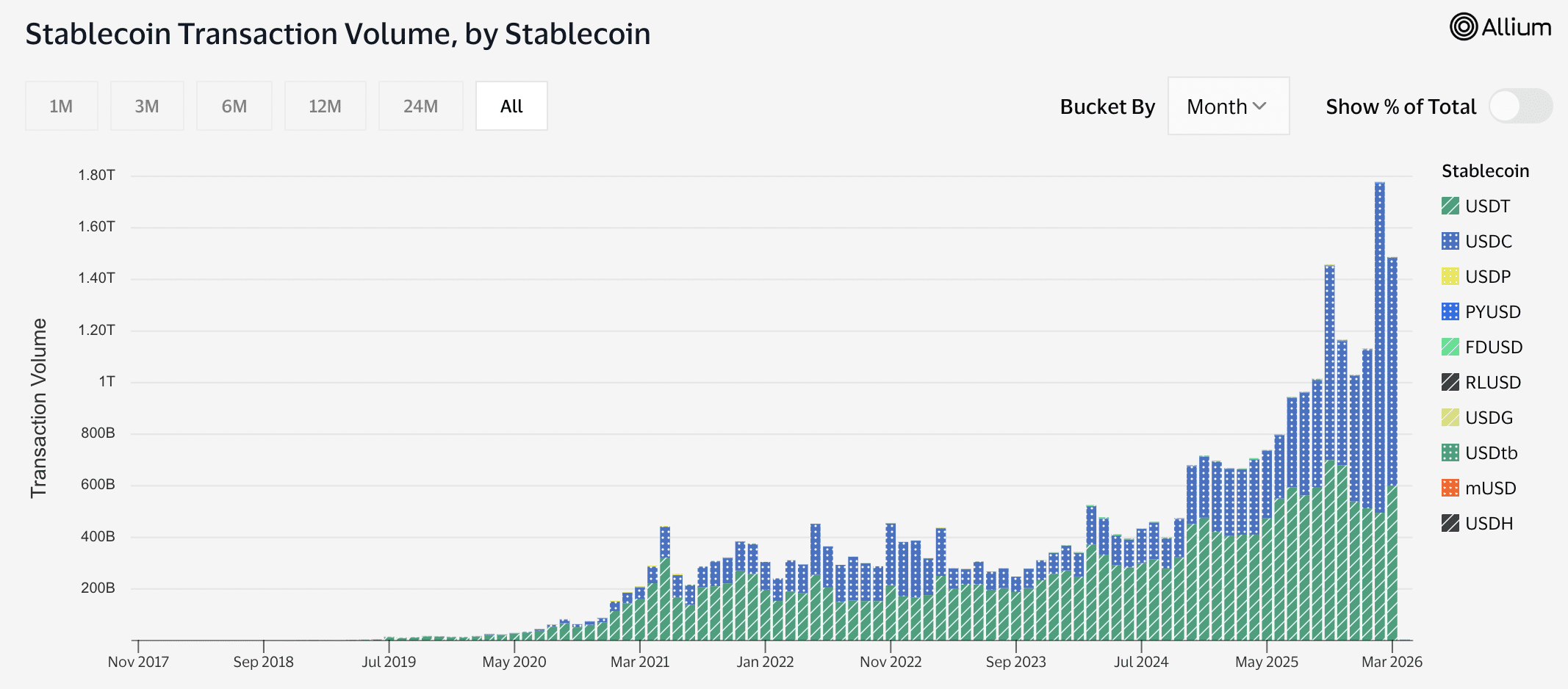
Source: Visa on-chain analytics

That’s not all either as data also revealed that USDC has been outpacing USDT lately. In fact, until last year, most months saw USDT ruling the transaction volume. However, things seem to have changed since 2026.


Final Summary

  • Despite growing optimism from the likes of Senator Cynthia Lummis, Polymarket odds remain below par.
  • Firms like Better Money Company now stepping in with new stablecoin plans.

Trend Kriptolar

İlgili Sorular

QWhat is the CLARITY Act and why does Senator Lummis support it?

AThe CLARITY Act refers to the Digital Asset Market Clarity Act of 2025. Senator Lummis supports it because she believes it will provide the DeFi community with 'the legal certainty they deserve,' act as a one-pot solution for developers, validators, and node operators, provide a 'safe harbor,' and ensure American innovation stays in the U.S.

QAccording to the article, what do the current Polymarket odds suggest about the Act's passage?

AThe current Polymarket odds, sitting at 49% (below the neutral level), suggest that the broader market is still unsure about the passage of the CLARITY Act.

QWhat problem is The Better Money Company aiming to solve with its 'stablecoin clearinghouse'?

AThe Better Money Company aims to solve the problem of different stablecoins existing across multiple blockchains, issuers, and platforms, which often require manual, costly conversions and can trade at slight value differences. Their clearinghouse would simplify integration, allowing users to send, receive, and use multiple stablecoins as one consistent form of money.

QWhat significant development in stablecoin regulation preceded the events in this article?

AThe GENIUS Act, which was passed in 2025 and made stablecoin regulations seamless, preceded the events discussed in the article.

QWhat does the data from Visa's on-chain analytics reveal about stablecoin transaction volume and the performance of USDC vs. USDT?

AVisa's on-chain analytics revealed that the total transaction volume of stablecoins was $72.3 trillion in the last 12 months. The data also showed that USDC has been outpacing USDT lately, a change from previous years where USDT typically ruled the transaction volume.

İlgili Okumalar

Annual Salary of Millions Competing for Electricians, Meta Rushes to Open Its Own Technical School

The AI boom is facing an unexpected bottleneck: a severe shortage of skilled construction workers and electricians. As tech giants like Meta, OpenAI, and Alphabet race to build massive data centers—such as OpenAI's $16 billion "Stargate" project—they are hitting a critical labor wall. The U.S. needs an estimated 130,000 more electricians, 240,000 construction workers, and 150,000 supervisors by 2030 for AI infrastructure alone, but tens of thousands of electrician jobs go unfilled each year. While AI companies offer high premiums, with electricians earning up to $280,000 annually, worker scarcity still causes massive losses—delays on a single project can cost $14.2 million per month. The complexity of building AI data centers, which require immense power (equivalent to powering hundreds of thousands of homes), sophisticated electrical systems, and advanced liquid cooling solutions, demands highly skilled technicians who are in short supply. To combat this, companies are investing heavily in training. Meta has committed $115 million to a free training school offering tuition, housing, and stipends, targeting 5,000 new workers. OpenAI is partnering with unions to secure skilled labor. These efforts are paying off, with a significant rise in Gen Z interest in trade schools over college. However, the power demands are staggering. AI data centers are driving a rapid surge in electricity consumption, projected to account for up to 12% of U.S. power use by 2028 and raising costs for consumers. Furthermore, the construction boom is project-based, leading to a potential future glut of trained workers once building peaks, which could depress wages industry-wide. The race for AI supremacy now depends as much on skilled hands as on advanced chips.

marsbit19 dk önce

Annual Salary of Millions Competing for Electricians, Meta Rushes to Open Its Own Technical School

marsbit19 dk önce

OpenAI No Longer Sells Its Most Expensive Model for Profit

OpenAI is shifting its business strategy away from promoting its most expensive, flagship models for every task. Recent price cuts—80% for GPT-5.6 Luna and 20% for Terra—signal a deeper change: the company now actively advises users that many tasks don't require the most powerful model. Instead, OpenAI recommends a tiered approach: use the high-end GPT-5.6 Sol for complex planning and analysis, then delegate execution to cheaper models like Luna. This mirrors moves by Anthropic, which recently launched Claude Opus 5 at half the price of its top model, Fable 5. Both companies are de-emphasizing flagship models as primary revenue drivers, using them instead for brand prestige and technological showcases. The industry is entering a "mass-market" phase, similar to automotive, where high-volume, cost-effective models handle daily operations and drive scale. OpenAI's price reductions are partly enabled by AI models themselves optimizing underlying code and infrastructure, creating a self-reinforcing cycle of efficiency gains and cost reduction. Competition is shifting from "who is smartest" to "who offers the best value." The goal is no longer selling individual models but fostering widespread API adoption and ecosystem lock-in. By making AI calls cheap and ubiquitous, companies like OpenAI aim to become the indispensable, utility-like infrastructure powering automated workflows—the "water and electricity" of software, quietly embedded everywhere.

marsbit19 dk önce

OpenAI No Longer Sells Its Most Expensive Model for Profit

marsbit19 dk önce

Will the Fed Definitely Raise Interest Rates in September? How Will Crypto and U.S. Stocks Withstand the Pressure?

The market's expectation for a September Fed rate hike surged dramatically in early August, jumping from under 50% to over 80% within a week. This shift followed a contentious July FOMC meeting, where a 9-3 vote to hold rates revealed growing dissent from hawkish members advocating for an immediate hike to combat persistent inflation. The primary catalyst for this repricing is rising oil prices, driven by renewed geopolitical tensions around the Strait of Hormuz, which threaten global supply. Energy costs directly influence inflation metrics, making the upcoming July CPI report (due August 12th) a critical data point. If it shows inflation reaccelerating, the probability of a September hike will solidify. For Bitcoin and crypto assets, this is typically bearish news. Bitcoin continues to behave as a high-beta, liquidity-sensitive risk asset. A rate hike raises the opportunity cost of holding non-yielding assets and could drive capital toward money markets, pressuring crypto prices in the short term. However, historical patterns suggest that if a hike is perceived as the end of a tightening cycle rather than the start, any negative price impact may be brief. U.S. stocks, particularly crypto-linked equities like Coinbase and growth-oriented tech stocks, are also vulnerable. Higher rates increase discount rates in valuation models, putting pressure on high-multiple companies. This coincides with a pivotal tech earnings season where investor focus has shifted from massive AI capital expenditure to tangible revenue and cash flow generation. Companies with negative cash flow and weak growth narratives could face heightened volatility if borrowing costs rise in September. In summary, a September Fed hike has evolved into a mainstream market scenario. Key factors to watch are oil prices, the July CPI report, and Fed communications, which will determine the final decision and its impact on volatile crypto and equity markets.

marsbit30 dk önce

Will the Fed Definitely Raise Interest Rates in September? How Will Crypto and U.S. Stocks Withstand the Pressure?

marsbit30 dk önce

İşlemler

Spot

Popüler Makaleler

HYPE Nasıl Satın Alınır

HTX.com’a hoş geldiniz! Hyperliquid (HYPE) satın alma işlemlerini basit ve kullanışlı bir hâle getirdik. Adım adım açıkladığımız rehberimizi takip ederek kripto yolculuğunuza başlayın. 1. Adım: HTX Hesabınızı OluşturunHTX'te ücretsiz bir hesap açmak için e-posta adresinizi veya telefon numaranızı kullanın. Sorunsuzca kaydolun ve tüm özelliklerin kilidini açın. Hesabımı Aç2. Adım: Kripto Satın Al Bölümüne Gidin ve Ödeme Yönteminizi SeçinKredi/Banka Kartı: Visa veya Mastercard'ınızı kullanarak anında Hyperliquid (HYPE) satın alın.Bakiye: Sorunsuz bir şekilde işlem yapmak için HTX hesap bakiyenizdeki fonları kullanın.Üçüncü Taraflar: Kullanımı kolaylaştırmak için Google Pay ve Apple Pay gibi popüler ödeme yöntemlerini ekledik.P2P: HTX'teki diğer kullanıcılarla doğrudan işlem yapın.Borsa Dışı (OTC): Yatırımcılar için kişiye özel hizmetler ve rekabetçi döviz kurları sunuyoruz.3. Adım: Hyperliquid (HYPE) Varlıklarınızı SaklayınHyperliquid (HYPE) satın aldıktan sonra HTX hesabınızda saklayın. Alternatif olarak, blok zinciri transferi yoluyla başka bir yere gönderebilir veya diğer kripto para birimlerini takas etmek için kullanabilirsiniz.4. Adım: Hyperliquid (HYPE) Varlıklarınızla İşlem YapınHTX'in spot piyasasında Hyperliquid (HYPE) ile kolayca işlemler yapın.Hesabınıza erişin, işlem çiftinizi seçin, işlemlerinizi gerçekleştirin ve gerçek zamanlı olarak izleyin. Hem yeni başlayanlar hem de deneyimli yatırımcılar için kullanıcı dostu bir deneyim sunuyoruz.

396 Toplam GörüntülenmeYayınlanma 2024.12.11Güncellenme 2026.06.02

HYPE Nasıl Satın Alınır

Tartışmalar

HTX Topluluğuna hoş geldiniz. Burada, en son platform gelişmeleri hakkında bilgi sahibi olabilir ve profesyonel piyasa görüşlerine erişebilirsiniz. Kullanıcıların HYPE (HYPE) fiyatı hakkındaki görüşleri aşağıda sunulmaktadır.

活动图片













