Securitize hires former PayPal exec as US tokenization gains traction

cointelegraph2025-12-09 tarihinde yayınlandı2025-12-09 tarihinde güncellendi

Özet

Securitize, a major tokenization platform, has hired former PayPal executive Jerome Roche as its new general counsel to strengthen its push for tokenized equity in the US. Roche previously led PayPal’s expansion into digital assets, including the PYUSD stablecoin. The company emphasized that tokenized securities are already accessible to US investors, countering the perception that such offerings are primarily available abroad. CEO Carlos Domingo stated that Securitize operates within a clear US regulatory framework using SEC-approved infrastructure, enabling fully compliant access to onchain securities. This development follows Securitize’s recent regulatory approval in the EU and signals growing acceptance of tokenization in the US, further evidenced by the SEC ending its investigation into rival platform Ondo Finance.

Major tokenization platform Securitize has doubled down on its push to bring tokenized equity to US investors, naming a former PayPal executive as its new general counsel.

Securitize on Tuesday announced the appointment of ex-PayPal executive Jerome Roche, who led the company’s expansion into digital asset projects, including the PayPal USD (PYUSD) stablecoin.

Securitize also said its tokenized securities are already available to US investors, challenging the notion that most issuers prefer to offer such products abroad due to local stock access.

“There’s been a perception that tokenized securities must be offered primarily outside the US, but our experience shows the opposite,” Securitize CEO Carlos Domingo told Cointelegraph.

“Clear regulatory path” for tokenized stocks in the US

According to Securitize, operating real-world asset (RWA) tokenization offerings inside the US regulatory perimeter is “not only possible, but scalable, at institutional quality.”

“We’ve demonstrated that there is a clear regulatory path for issuers to natively tokenize assets for US investors,” Domingo said.

“These are not synthetic representations, or derivatives, but real securities onchain,” the CEO said, adding:

“We operate using SEC-regulated infrastructure, including a registered transfer agent broker-dealer, and fund admin, which allows US investors to access and legally hold tokenized securities in a fully compliant framework.”

Securitize’s optimistic outlook on the US tokenization comes days after the platform obtained regulatory approval to operate as an investment company and a trading ánd settlement system in the European Union on Nov. 26. According to the company, the approval positioned it as one of the first operators for regulated digital securities infrastructure in both the US and EU.

Source: Securitize

“For the first time, modern ledger technology is giving us the ability to record ownership, settle transactions, and move value in ways that are fundamentally better than the fragmented systems we’ve inherited,” Securitize’s newly appointed general counsel, Roche, said in the announcement.

“Innovation only works when it fits squarely within the guardrails of applicable law,” he added, underscoring Securitize’s global push for regulated tokenized securities.

Related: US Treasurys lead tokenization wave as CoinShares predicts 2026 growth

Securitize’s news is another sign of the US warming to tokenization. On Monday, the Securities and Exchange Commission dropped its investigation into rival tokenization platform Ondo Finance.

Ondo said the decision marks a new chapter for tokenized securities in the US, where they are poised to become a “core part of the capital markets.”

Magazine: When privacy and AML laws conflict: Crypto projects’ impossible choice

İlgili Okumalar

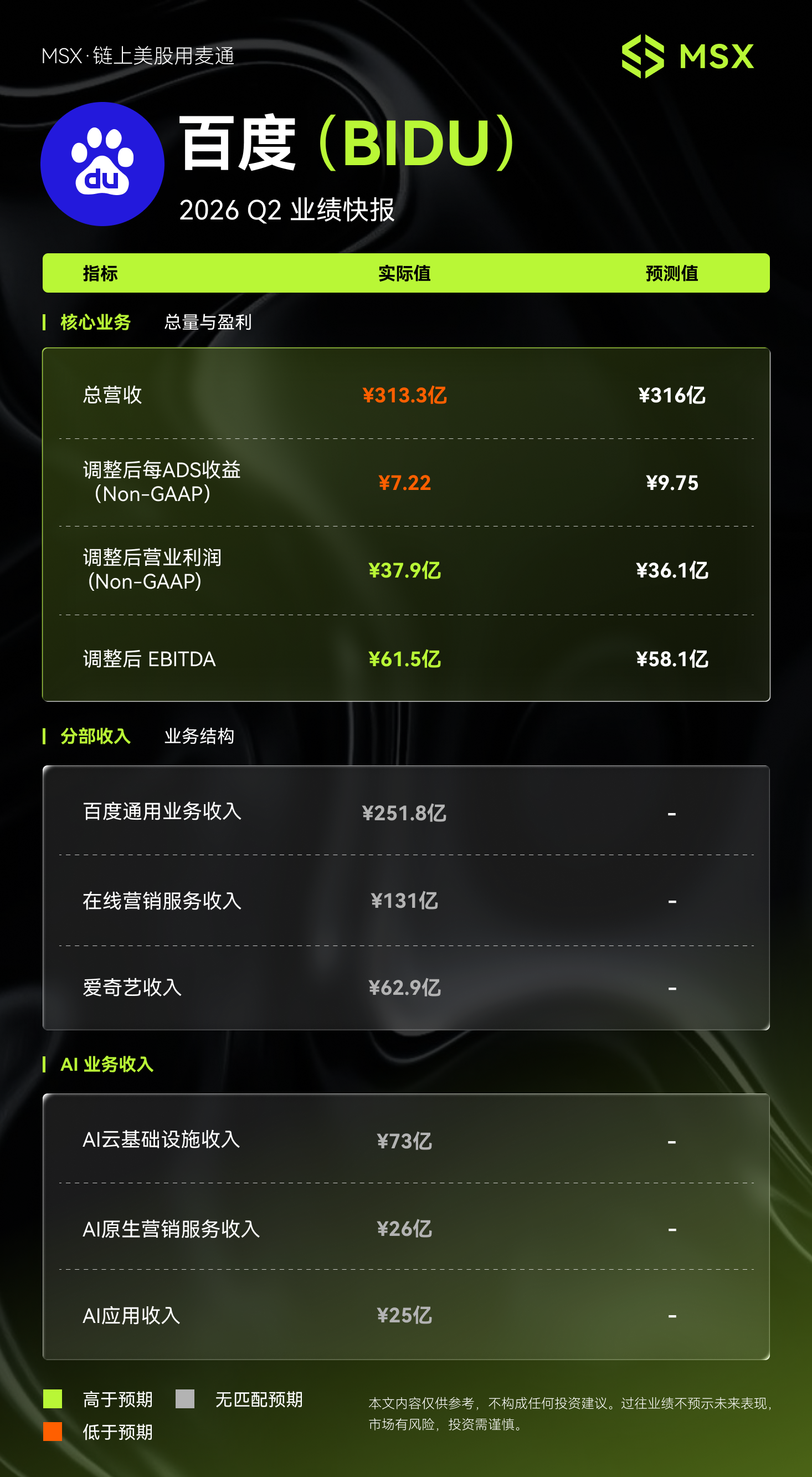
MSX US Stock Daily Observation: Baidu 2026 Q2 Earnings: AI Revenue Accounts for Half of Core Business for Two Consecutive Quarters, 283% GPU Cloud Growth Boosts Business Transformation

**MSX Daily US Stock Observation: Baidu 2026 Q2 Earnings Report** Baidu's Q2 2026 earnings present a clear picture of a company in transition. Total revenue declined slightly to RMB 313.25 billion, missing market expectations. This was driven by a continued double-digit contraction (-19%) in its core online marketing (advertising) business. The key highlight is the structural shift within the company's operations. AI-related revenue reached RMB 125 billion, accounting for approximately half of Baidu's core business income for the second consecutive quarter. Within AI, growth is heavily skewed towards infrastructure: AI cloud infrastructure revenue grew 50% year-over-year to RMB 73 billion, with GPU cloud revenue surging 283%. In contrast, AI application and AI-native marketing services revenue grew only 3% and remained flat, respectively, indicating slower commercialization on the application side. Profitability metrics were mixed. While adjusted operating profit and EBITDA exceeded expectations, demonstrating cost control, adjusted earnings per ADS of RMB 7.22 fell short by about 26%. This gap is largely attributed to depreciation and amortization costs linked to significant AI infrastructure investments, which continue to pressure bottom-line profit realization. The company holds a substantial cash position of RMB 2831 billion, providing runway for continued investment. The critical challenge ahead is translating the explosive growth in AI infrastructure (like GPU cloud) into stronger monetization from AI applications to bridge the gap between operational profit and per-share earnings.

Odaily星球日报3 dk önce

MSX US Stock Daily Observation: Baidu 2026 Q2 Earnings: AI Revenue Accounts for Half of Core Business for Two Consecutive Quarters, 283% GPU Cloud Growth Boosts Business Transformation

Odaily星球日报3 dk önce

Bitwise CIO: Three Major Cognitive Errors Common Among Crypto Investors Today

Bitwise CIO Matt Hougan highlights three key misconceptions he believes many crypto investors currently hold, presenting them as opportunities for those who see beyond them. First, investors significantly underestimate the total addressable market for crypto applications. While many view platforms like Uniswap only as tools for trading crypto assets (a ~$2 trillion market), their true potential lies in tokenizing and trading *all* asset classes—such as stocks and bonds—which represent markets hundreds of trillions of dollars in size. Second, there's a persistent overestimation of traditional financial institutions' ability to dominate crypto-native sectors. Examples like PayPal's stable币 (with ~1% market share vs. Tether/Circle's 88%) and Fidelity's custody business (trailing Coinbase) show that crypto-native firms often win due to faster iteration, focused expertise, and established user trust within the crypto ecosystem. Third, investors linearly extrapolate future on-chain transaction volumes from today's data, severely underestimating potential growth. The shift to 24/7 trading for tokenized assets could multiply trading hours by 5x. When combined with AI agents that may execute trades far more frequently than humans, transaction volumes could grow by 10x to 100x, massively boosting revenue for underlying blockchains and applications. Hougan concludes that the gap between the rapid pace of industry change and slower mainstream perception updates creates significant investment opportunities.

marsbit6 dk önce

Bitwise CIO: Three Major Cognitive Errors Common Among Crypto Investors Today

marsbit6 dk önce

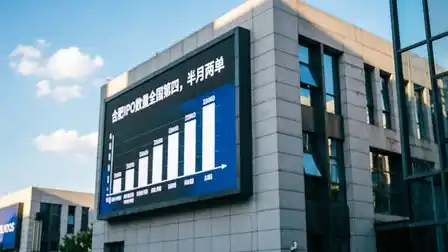
Two IPOs in Half a Month: Hefei Becomes China's Fourth City

Hefei, China's "Capital of Venture Capital," Ascends to Fourth Place in A-P-Share Market Value with Two Recent IPOs Within two weeks, two major IPOs propelled Hefei's A-share market capitalization from 1.27 trillion yuan to over 4.55 trillion yuan, ranking the city fourth nationwide, behind only Beijing, Shenzhen, and Shanghai. This surge is led by Changxin's massive listing, creating over 1 trillion yuan in paper gains for state-owned investors. Simultaneously, Hefei's GDP growth leads among Chinese cities exceeding 1 trillion yuan GDP. This success stems not from gambling on single companies, but from a decades-long, systematic "industrial investment" strategy. Hefei targets critical gaps in its industrial chain, providing patient capital. It invested in BOE in 2008 to secure display panels for its appliance hub, in Changxin in 2016 for semiconductors, and in NIO in 2020 to anchor a new energy vehicle cluster. Each investment was calculated based on long-term industrial necessity. Another IPO, Guoyi Quantum, originates from Hefei's ecosystem. Founded by a prodigy inspired by his professor's experience with overpriced foreign instruments, it symbolizes high-end scientific instrument localization. Behind the trillion-yuan paper gains is remarkable political continuity and a self-reinforcing cycle. Proceeds from earlier successful exits (e.g., BOE, NIO) were reinvested into newer projects like Changxin. The strategy withstands individual project failures and transcends typical government terms, focusing on decade-long industrial cultivation. Hefei's system integrates the University of Science and Technology of China for tech talent, state capital for long-term funding, and an unwavering focus on building complete industrial chains. While risks remain—market volatility, intense EV competition, quantum's commercialization timeline—Hefei demonstrates that when a government calculates returns over decades, the outcome differs fundamentally from short-term bets.

marsbit10 dk önce

Two IPOs in Half a Month: Hefei Becomes China's Fourth City

marsbit10 dk önce

İşlemler

Spot
活动图片