Second Largest Whale Cuts Losses and Liquidates, Can AAVE Still Be Bought Amid Deepening Conflict?

Odaily星球日报2025-12-22 tarihinde yayınlandı2025-12-22 tarihinde güncellendi

Özet

The second-largest AAVE whale, excluding the project team, protocol contracts, and exchanges, has sold off 230,000 AAVE tokens (worth approximately $38 million) at a loss, causing a 12% price drop. The sale occurred amid growing tensions between the Aave team and its community over governance and financial control. The conflict began when the community discovered that Aave Labs, without prior communication, redirected front-end exchange fees—previously directed to the Aave DAO treasury—to its own address after switching the default trading path to Cow Swap. This change could divert an estimated $10 million annually from the community to the team. Aave Labs defended the move, arguing that front-end products are separate from the protocol and that the team has the right to monetize its own infrastructure. In response, a proposal was made to transfer control of Aave’s brand assets—including domains and social accounts—to AAVE token holders. Founder Stani Kulechov opposed the proposal, calling it oversimplified and poorly structured, further escalating community backlash. The situation highlights deeper structural tensions in DeFi between team-controlled products and community-governed protocols. The outcome of the ongoing snapshot vote on the proposal may significantly influence AAVE’s price and long-term community trust.

Original | Odaily Planet Daily (@OdailyChina)

Author | Azuma (@azuma_eth)
The leading lending protocol Aave is embroiled in a public opinion storm, with the conflict between the team and the community intensifying, which has objectively shaken the confidence of token holders in the AAVE token itself.

In the early hours of today, the second-largest AAVE holding whale, excluding the project team, protocol contracts, and CEXs, cut losses and liquidated 230,000 AAVE (worth approximately $38 million), causing AAVE to drop 12% short-term. It is reported that this "number two big brother" purchased the AAVE holdings from late last year to early this year at an average price of $223.4. The average selling price today was about $165, resulting in a final loss of $13.45 million.

  • Odaily Note: The whale address is https://debank.com/profile/0xa923b13270f8622b5d5960634200dc4302b7611e.

Origin of the Incident: Fee Flow Dispute

To understand the current community crisis at Aave, we need to start with a recent change to the Aave frontend.

On December 4th, Aave announced a partnership with Cow Swap, adopting the latter as the default trading path for the swap function on the Aave frontend (Odaily Note: previously it was ParaSwap), utilizing its anti-MEV features for better quotes.
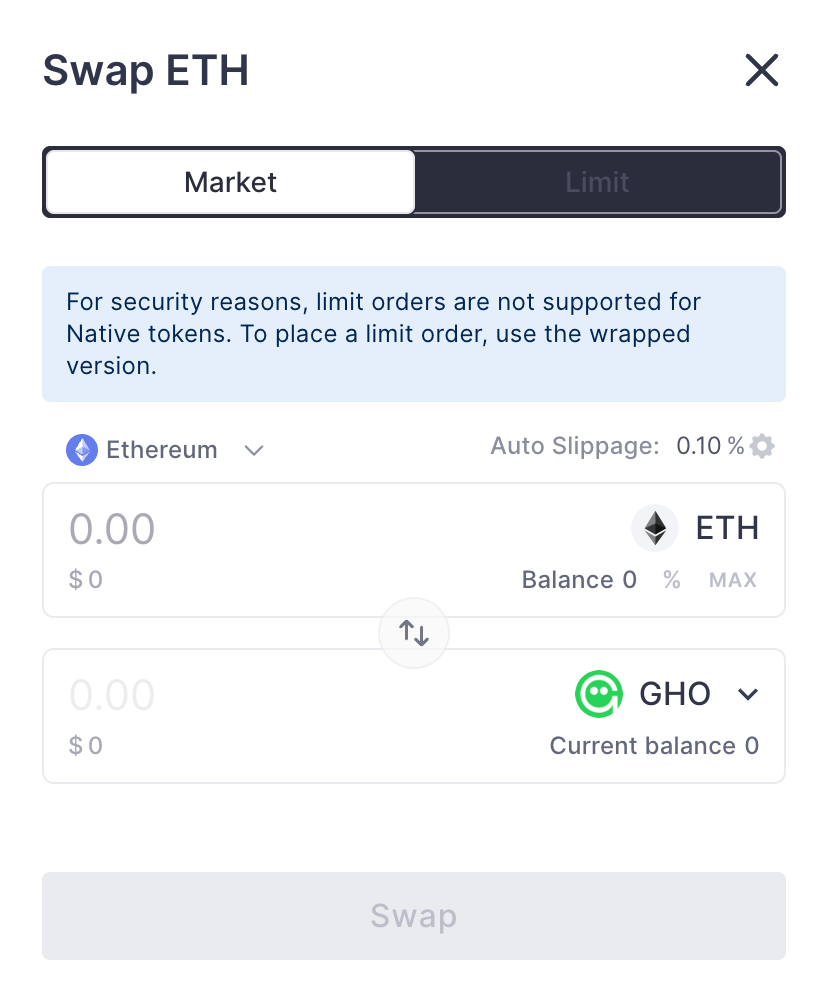
This seemed like a normal functional upgrade, but the community soon discovered that the additional fees generated by this function (including referral fees or positive slippage surplus fees), which previously flowed to the Aave DAO treasury address when using ParaSwap, were now being directed to the Aave Labs address after switching to Cow Swap.

Community representative EzR3aL was the first to notice this change, which Aave had not actively mentioned. They questioned the Aave team in the governance forum and estimated that, just tracking the income flow on Ethereum and Arbitrum, this fee change could generate around $200,000 in weekly revenue, corresponding to an annualized income of over $10 million — this meant Aave had redirected at least tens of millions of dollars in revenue from the community address to the team address, seemingly without anyone knowing.

Core Controversy: Who Really Owns the Aave Brand?

As EzR3aL's post gained traction, a large number of AAVE holders felt betrayed, especially considering that Aave made this change without communicating with the community or making any disclosure, somewhat hinting at an intention to conceal this alteration.

In response to community质疑 (queries/doubts), Aave Labs replied directly under EzR3aL's post, stating that there should be a clear distinction between the protocol layer and the product layer. The swap function interface on the Aave frontend is entirely operated by Aave Labs, which is responsible for capital investment, construction, and maintenance. This function is completely independent of the DAO-managed protocol. Therefore, Aave Labs has the right to independently decide how to operate and profit from it... The income previously flowing to the Aave DAO address was a donation from Aave Labs, but it was not an obligation.

In short, Aave Labs' stance is that the frontend interface and its ancillary functions essentially belong to the team's product, and the revenue generated should also be regarded as company property, not to be confused with the protocol and related income controlled by the DAO.

This statement quickly sparked heated discussion within the community regarding the ownership of the Aave protocol versus its products. A well-known DeFi analyst wrote an article titled "Who Really Owns 'Aave'?: Aave Labs vs Aave DAO". Odaily Planet Daily also published a Chinese translation, which can be read for further context.

On December 16th, the矛盾 (contradiction/conflict) was further intensified. Former Aave CTO Ernesto Boado initiated a proposal in the governance forum requesting the control of Aave brand assets (including domain names, social media accounts, naming rights, etc.) be transferred to AAVE token holders. The relevant assets would be managed through a DAO-controlled entity (the specific form to be determined later) with strict anti-encroachment protection mechanisms.

The proposal received nearly ten thousand views and hundreds of high-quality replies within the Aave governance forum. Various participants in the Aave ecosystem expressed their positions in the comments below the proposal. Although some voices believed the proposal's execution plan was insufficient and risked exacerbating the conflict, most replies expressed support.

Founder's Statement, But Community Unconvinced

As community sentiment heated up, Aave founder Stani responded in the forum: "...This proposal leads us in a direction unfavorable to the Aave ecosystem. It attempts to force a complex legal and operational issue into a simple 'yes/no' vote without providing a clear execution path. Handling such a complex issue should involve a specially designed structured process, achieving consensus through multiple interim checks accompanied by specific solutions. For the reasons above, I will vote against this proposal..."
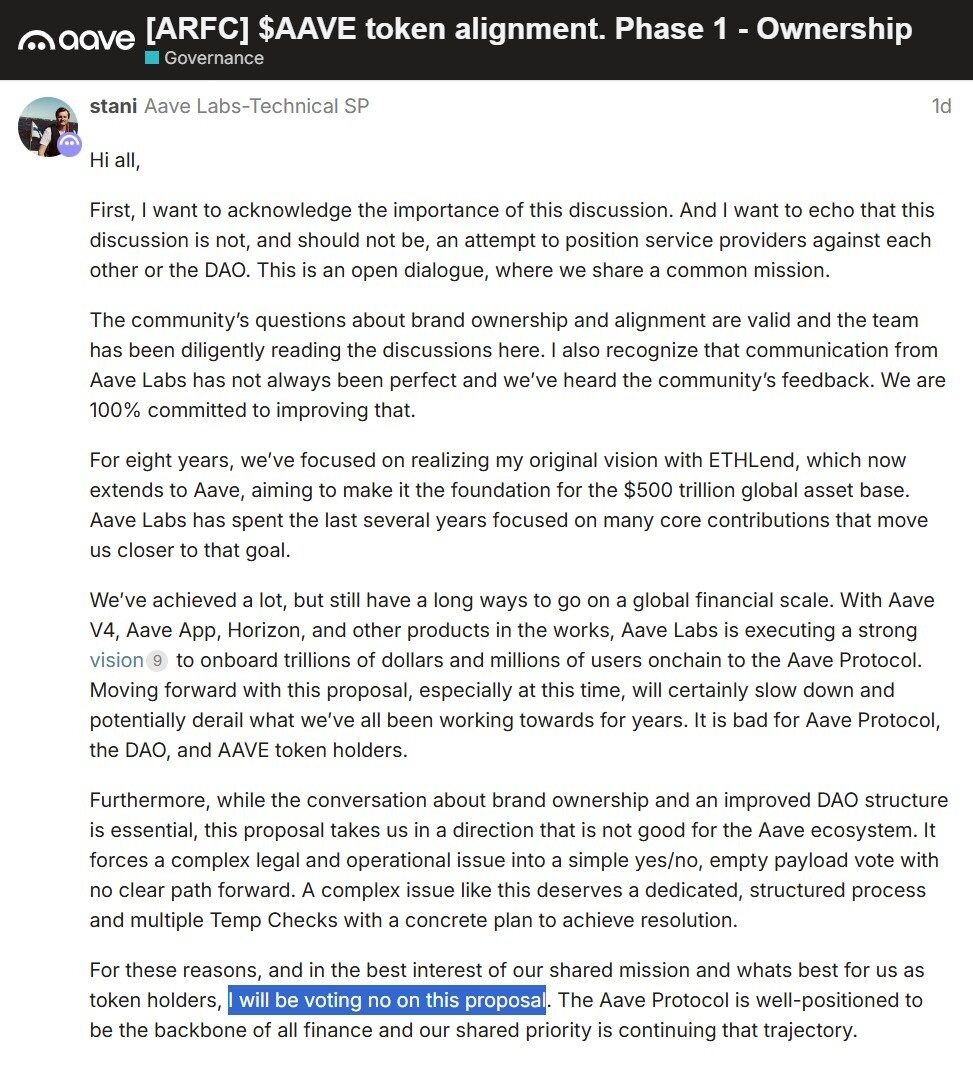
From a business operations perspective, Stani's claim that the proposal is too rash might not be wrong. However, in the current discussion atmosphere, this statement can easily be interpreted as 'the Aave founder disagrees with transferring brand assets to token holders,' which obviously further intensified the conflict between the community and the team.

After Stani's statement, even some attacking remarks against Stani appeared in the original post's comments. More users expressed their dissatisfaction via the forum or social media. An OG user mentioned it was the first time he considered liquidating his AAVE holdings. A loyal AAVE believer stated: "AAVE holders should realize this is just another DeFi shitcoin. It's neither better nor worse than the others."

The latest community development is the one mentioned at the beginning of this article: the number two big brother cutting losses and exiting with a loss exceeding ten million dollars.

Can AAVE Still Be Bought?

Just two weeks ago, Odaily Planet Daily wrote an article titled "What Did the Smart Money Aggressively Buying AAVE at Lows See?". At that time, AAVE was still a favorite of top institutions like Multicoin Capital. Its优质 (high-quality) brand reputation, substantial locked funds, clear expansion path, and strong revenue and buyback flow all proved that AAVE was a 'true value token' different from other altcoins.

But in just two weeks, a舆论危机 (public opinion crisis) spanning from fee ownership to brand control and then to team-community relations has rapidly plunged AAVE from a "representative of value tokens" into the center of controversy, even landing it on the short-term top decliners list due to emotional impact.

As of writing, Aave Labs has stated below Ernesto's proposal that they have initiated an ARFC snapshot vote on the proposal, allowing AAVE token holders to formally express their stance and clarify the future direction. The outcome of this vote and the subsequent handling attitude of the Aave Labs team will undoubtedly significantly impact Aave community faith and the short-term price performance of AAVE.

It is important to emphasize that this incident is not merely "negative news" or "performance change," but a集中拷问 (concentrated interrogation) of Aave's existing governance structure and boundaries of rights.

If you believe that Aave Labs will still maintain high alignment with Aave DAO's long-term interests, and the current friction is more of a communication and process失误 (mistake), then the price pullback led by emotions might be a good entry window; but if you think this controversy exposes not an occasional problem, but a structural contradiction of long-term unclear rights between the team and the protocol, lacking institutional constraints, then this storm might just be the beginning.

From a broader perspective, Aave's controversy is not an isolated case. As DeFi matures, protocol revenue becomes genuinely considerable, and brands and frontends begin to possess commercial value, some inherent structural contradictions between protocols and products, teams and communities will surface. Aave is pushed into the spotlight this time not because it erred more, but because it has gone further.

This debate over fees, brand, and control rights poses a question that needs answering not just by AAVE, but is an inevitable question the entire DeFi industry must eventually face.


Trend Kriptolar

İlgili Sorular

QWhat was the main reason behind the community crisis and whale selling AAVE tokens?

AThe crisis stemmed from a dispute over fee redirection from Aave's front-end swap function. After switching to Cow Swap, fees that previously flowed to the Aave DAO treasury were redirected to Aave Labs, causing community backlash over undisclosed changes and raising questions about revenue ownership.

QHow did Aave Labs justify redirecting the swap fees to their own address instead of the DAO treasury?

AAave Labs argued that the front-end interface and its swap functionality are separate from the protocol managed by the DAO. They claimed ownership of the product layer, stating that the fees generated were company property, not DAO revenue, and previous donations to the DAO were voluntary, not obligatory.

QWhat proposal did former Aave CTO Ernesto Boado make to address the community's concerns?

AErnesto Boado proposed transferring control of Aave's brand assets—including domains, social media accounts, and naming rights—to AAVE token holders through a DAO-controlled entity, aiming to ensure community governance and anti-encroachment protections.

QHow did Aave founder Stani Kulechov respond to the proposal, and what was the community's reaction?

AStani opposed the proposal, calling it overly simplistic for a complex legal and operational issue and advocating for a structured process with multiple checks. The community perceived this as resistance to decentralizing control, intensifying opposition and leading to negative sentiment, including whale sell-offs.

QWhat broader DeFi industry issue does the Aave controversy highlight?

AThe controversy underscores structural tensions in DeFi between teams and communities over revenue sharing, brand ownership, and governance control. It reflects a industry-wide challenge as protocols mature and front-end products gain commercial value, forcing debates on equitable distribution of power and profits.

İlgili Okumalar

Must-Watch Events Next Week|CLARITY Act Could Face Senate Vote; SpaceX, Circle to Report Earnings (8.3-8.9)

**Summary: Key Events and Developments to Watch (August 3-9)** The upcoming week is marked by significant financial disclosures, key legislative deadlines, and notable product updates. **Major Financial Events:** Several companies are scheduled to release their Q2 2026 earnings. American Bitcoin (ABTC) will report on August 3, followed by SpaceX and Hut 8 Mining Corp. on August 4, and Circle on August 5. Notably, a significant portion of SpaceX shares (up to 12% of total shares) will be unlocked on August 6 following their earnings release. **Key Legislative Deadline:** The U.S. Senate faces an August 7 deadline to secure 60 votes for the CLARITY Act, a bipartisan bill aiming to establish a federal regulatory framework for cryptocurrencies. The Senate may hold a full vote on the bill during the week. **Economic Data:** The U.S. July Non-Farm Payrolls report will be released on August 7, providing crucial labor market data. **Technology & Product Updates:** * **Shutdowns:** DeFi portfolio tracker Zapper and wallet app Ctrl Wallet will cease operations on August 3. * **Upgrades:** LayerZero will deprecate its v1 relayers on August 3. XRP Ledger's new version 3.3.0, featuring five new functions, is expected next week. * **AI:** Elon Musk announced that the advanced Grok 4.6 AI model is set for release around August 7. * **Bitcoin:** The BIP-110 forced signaling for a potential Bitcoin network change is scheduled to begin around August 8. **Other Notable Events:** Chinese robotics firm Unitree Tech has set its preliminary price inquiry for its IPO for August 5. South Korean exchange Upbit will delist AQT and AERGO tokens on August 3.

marsbit7 dk önce

Must-Watch Events Next Week|CLARITY Act Could Face Senate Vote; SpaceX, Circle to Report Earnings (8.3-8.9)

marsbit7 dk önce

Stocks Are Plummeting More Sharply Than Cryptocurrencies. Where Has the Money Gone?

Stock Markets Plunge Deeper Than Cryptocurrencies: Where Did the Money Go? In late July, Seoul's Kospi index triggered circuit breakers for two consecutive days, plummeting over 40% from its June high. The collapse was led by heavyweight stocks like SK Hynix, whose record profits still disappointed investors, and devastating leveraged ETFs, with one major product losing over 83% of its value. This signaled a global, forced deleveraging targeting the most crowded trades. Interestingly, while stocks exhibited extreme volatility akin to crypto markets, Bitcoin rose nearly 15% in July after a prior steep drop. Analysis shows the money fleeing equities did not flow into Bitcoin. Instead, Bitcoin had already absorbed its sell-off in May-June, when U.S. spot Bitcoin ETFs saw historic outflows. The true safe-haven beneficiary was gold, whose price rose over 20% year-on-year, highlighting a decoupling between Bitcoin and gold as "digital gold." The sell-off was a targeted unwinding of leveraged positions in tech and semiconductors, accelerated by broker-dealer risk management and shifts in the AI narrative, including new competition from Chinese memory chipmakers. The retreat path was clear: from high-valuation tech stocks to cash and U.S. Treasuries, then to gold. For Bitcoin to attract sustained institutional inflows, conditions like eased global liquidity pressure, a "soft-landing" Fed rate cut, and U.S. regulatory clarity via legislation like the stalled CLARITY Act are needed. Currently, Bitcoin is not a safe haven but an already-cleared asset. Its low correlation with tech stocks, however, makes it a potential diversification play for institutional portfolios once the storm passes. The money isn't here yet, but the positioning is underway.

marsbit7 dk önce

Stocks Are Plummeting More Sharply Than Cryptocurrencies. Where Has the Money Gone?

marsbit7 dk önce

In Conversation with Ray Dalio: We Are Currently in an AI Bubble, with 1% of My Portfolio in Bitcoin

Ray Dalio, founder of Bridgewater Associates, warns in an interview that the current AI boom shows classic bubble characteristics, which could lead to significant economic downturns as seen in past cycles like 1929 or 2000. He explains that speculative enthusiasm, fueled by debt and overvaluation, often precedes a crash when rising rates or taxation force asset sales, causing widespread losses and recession. Dalio also outlines his "Big Cycle" theory, describing an approximate 80-year pattern where widening wealth gaps, massive government deficits, and shifting geopolitical power (like China's rise) create internal conflict and global instability. He emphasizes that we are in a late-cycle, transitional phase where traditional powers like the US and UK face decline. For personal wealth protection, Dalio advises diversification beyond cash into assets like stocks, bonds, real estate, and particularly gold, which he prefers over Bitcoin. While he holds about 1% of his portfolio in Bitcoin as a non-printable hard asset, he views gold as more secure from technological or governmental threats. Regarding AI's impact, Dalio believes it will disproportionately benefit capital owners, worsening inequality by replacing both physical and cognitive labor. He suggests that human intuition and emotional intelligence, combined with AI, will be key for future workers. On taxation, Dalio argues that wealth taxes are impractical and risk triggering asset sell-offs, reducing productive investment. He points to the UK as a cautionary example of debt, low productivity, and political strife. Geopolitically, Dalio foresees a more regionalized world, with the US showing weakness in prolonged conflicts like with Iran, akin to past imperial declines. The ideal outcome, he suggests, is coexisting powerful blocs (e.g., Americas, China-Asia Pacific) without major war.

marsbit4 saat önce

In Conversation with Ray Dalio: We Are Currently in an AI Bubble, with 1% of My Portfolio in Bitcoin

marsbit4 saat önce

Daily 7.2 Trillion KRW: Foreign Capital's Record Net Buying on Friday! Wall Street Says Headwinds for Korean Stock Fund Flows Have Subsided

South Korean stock market sees a dramatic shift in fund flows. On July 31, foreign investors made a record net purchase of approximately KRW 7.2 trillion in KOSPI stocks, marking a fundamental reversal from the persistent large-scale net outflows seen in previous months. This contributed to a significant narrowing of foreign net selling in July to KRW 9.8 trillion, down sharply from KRW 48.4 trillion in June and KRW 44.5 trillion in May. Simultaneously, domestic institutional pressure eased. South Korean pension funds and asset managers turned to a net buying position in July, purchasing KRW 1.0 trillion worth of KOSPI shares, contrasting with net sales in May and June. Market volatility is expected to be dampened by new financial regulations. Effective July 31, the Financial Services Commission tightened access for retail investors to single-stock leveraged ETFs by raising the minimum cash deposit requirement. Trading volumes for these products subsequently dropped to about 50% of their monthly average. Citigroup Research maintains its year-end KOSPI target of 10,000 points. The firm cites several supportive factors: the substantial easing of headwinds from capital outflows, a robust fundamental outlook for the semiconductor sector, historically low market valuations, strong economic fundamentals, and the potential for policy support from financial authorities if needed.

marsbit4 saat önce

Daily 7.2 Trillion KRW: Foreign Capital's Record Net Buying on Friday! Wall Street Says Headwinds for Korean Stock Fund Flows Have Subsided

marsbit4 saat önce

İşlemler

Spot

Popüler Makaleler

AAVE Nasıl Satın Alınır

HTX.com’a hoş geldiniz! Aave Protocol (AAVE) satın alma işlemlerini basit ve kullanışlı bir hâle getirdik. Adım adım açıkladığımız rehberimizi takip ederek kripto yolculuğunuza başlayın. 1. Adım: HTX Hesabınızı OluşturunHTX'te ücretsiz bir hesap açmak için e-posta adresinizi veya telefon numaranızı kullanın. Sorunsuzca kaydolun ve tüm özelliklerin kilidini açın. Hesabımı Aç2. Adım: Kripto Satın Al Bölümüne Gidin ve Ödeme Yönteminizi SeçinKredi/Banka Kartı: Visa veya Mastercard'ınızı kullanarak anında Aave Protocol (AAVE) satın alın.Bakiye: Sorunsuz bir şekilde işlem yapmak için HTX hesap bakiyenizdeki fonları kullanın.Üçüncü Taraflar: Kullanımı kolaylaştırmak için Google Pay ve Apple Pay gibi popüler ödeme yöntemlerini ekledik.P2P: HTX'teki diğer kullanıcılarla doğrudan işlem yapın.Borsa Dışı (OTC): Yatırımcılar için kişiye özel hizmetler ve rekabetçi döviz kurları sunuyoruz.3. Adım: Aave Protocol (AAVE) Varlıklarınızı SaklayınAave Protocol (AAVE) satın aldıktan sonra HTX hesabınızda saklayın. Alternatif olarak, blok zinciri transferi yoluyla başka bir yere gönderebilir veya diğer kripto para birimlerini takas etmek için kullanabilirsiniz.4. Adım: Aave Protocol (AAVE) Varlıklarınızla İşlem YapınHTX'in spot piyasasında Aave Protocol (AAVE) ile kolayca işlemler yapın.Hesabınıza erişin, işlem çiftinizi seçin, işlemlerinizi gerçekleştirin ve gerçek zamanlı olarak izleyin. Hem yeni başlayanlar hem de deneyimli yatırımcılar için kullanıcı dostu bir deneyim sunuyoruz.

442 Toplam GörüntülenmeYayınlanma 2024.12.11Güncellenme 2026.06.02

AAVE Nasıl Satın Alınır

Tartışmalar

HTX Topluluğuna hoş geldiniz. Burada, en son platform gelişmeleri hakkında bilgi sahibi olabilir ve profesyonel piyasa görüşlerine erişebilirsiniz. Kullanıcıların AAVE (AAVE) fiyatı hakkındaki görüşleri aşağıda sunulmaktadır.

活动图片












