Second Largest Whale Cuts Losses and Liquidates, Can AAVE Still Be Bought Amid Deepening Conflict?

Odaily星球日报2025-12-22 tarihinde yayınlandı2025-12-22 tarihinde güncellendi

Özet

The second-largest AAVE whale, excluding the project team, protocol contracts, and exchanges, has sold off 230,000 AAVE tokens (worth approximately $38 million) at a loss, causing a 12% price drop. The sale occurred amid growing tensions between the Aave team and its community over governance and financial control. The conflict began when the community discovered that Aave Labs, without prior communication, redirected front-end exchange fees—previously directed to the Aave DAO treasury—to its own address after switching the default trading path to Cow Swap. This change could divert an estimated $10 million annually from the community to the team. Aave Labs defended the move, arguing that front-end products are separate from the protocol and that the team has the right to monetize its own infrastructure. In response, a proposal was made to transfer control of Aave’s brand assets—including domains and social accounts—to AAVE token holders. Founder Stani Kulechov opposed the proposal, calling it oversimplified and poorly structured, further escalating community backlash. The situation highlights deeper structural tensions in DeFi between team-controlled products and community-governed protocols. The outcome of the ongoing snapshot vote on the proposal may significantly influence AAVE’s price and long-term community trust.

Original | Odaily Planet Daily (@OdailyChina)

Author | Azuma (@azuma_eth)
The leading lending protocol Aave is embroiled in a public opinion storm, with the conflict between the team and the community intensifying, which has objectively shaken the confidence of token holders in the AAVE token itself.

In the early hours of today, the second-largest AAVE holding whale, excluding the project team, protocol contracts, and CEXs, cut losses and liquidated 230,000 AAVE (worth approximately $38 million), causing AAVE to drop 12% short-term. It is reported that this "number two big brother" purchased the AAVE holdings from late last year to early this year at an average price of $223.4. The average selling price today was about $165, resulting in a final loss of $13.45 million.

  • Odaily Note: The whale address is https://debank.com/profile/0xa923b13270f8622b5d5960634200dc4302b7611e.

Origin of the Incident: Fee Flow Dispute

To understand the current community crisis at Aave, we need to start with a recent change to the Aave frontend.

On December 4th, Aave announced a partnership with Cow Swap, adopting the latter as the default trading path for the swap function on the Aave frontend (Odaily Note: previously it was ParaSwap), utilizing its anti-MEV features for better quotes.
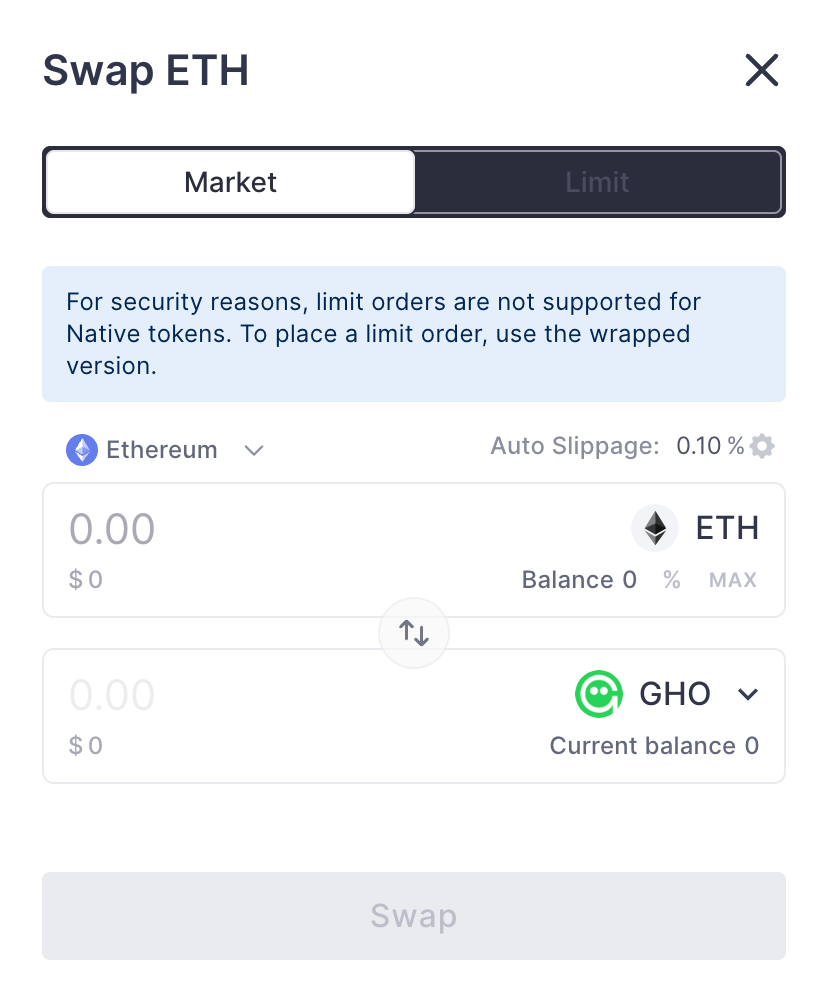
This seemed like a normal functional upgrade, but the community soon discovered that the additional fees generated by this function (including referral fees or positive slippage surplus fees), which previously flowed to the Aave DAO treasury address when using ParaSwap, were now being directed to the Aave Labs address after switching to Cow Swap.

Community representative EzR3aL was the first to notice this change, which Aave had not actively mentioned. They questioned the Aave team in the governance forum and estimated that, just tracking the income flow on Ethereum and Arbitrum, this fee change could generate around $200,000 in weekly revenue, corresponding to an annualized income of over $10 million — this meant Aave had redirected at least tens of millions of dollars in revenue from the community address to the team address, seemingly without anyone knowing.

Core Controversy: Who Really Owns the Aave Brand?

As EzR3aL's post gained traction, a large number of AAVE holders felt betrayed, especially considering that Aave made this change without communicating with the community or making any disclosure, somewhat hinting at an intention to conceal this alteration.

In response to community质疑 (queries/doubts), Aave Labs replied directly under EzR3aL's post, stating that there should be a clear distinction between the protocol layer and the product layer. The swap function interface on the Aave frontend is entirely operated by Aave Labs, which is responsible for capital investment, construction, and maintenance. This function is completely independent of the DAO-managed protocol. Therefore, Aave Labs has the right to independently decide how to operate and profit from it... The income previously flowing to the Aave DAO address was a donation from Aave Labs, but it was not an obligation.

In short, Aave Labs' stance is that the frontend interface and its ancillary functions essentially belong to the team's product, and the revenue generated should also be regarded as company property, not to be confused with the protocol and related income controlled by the DAO.

This statement quickly sparked heated discussion within the community regarding the ownership of the Aave protocol versus its products. A well-known DeFi analyst wrote an article titled "Who Really Owns 'Aave'?: Aave Labs vs Aave DAO". Odaily Planet Daily also published a Chinese translation, which can be read for further context.

On December 16th, the矛盾 (contradiction/conflict) was further intensified. Former Aave CTO Ernesto Boado initiated a proposal in the governance forum requesting the control of Aave brand assets (including domain names, social media accounts, naming rights, etc.) be transferred to AAVE token holders. The relevant assets would be managed through a DAO-controlled entity (the specific form to be determined later) with strict anti-encroachment protection mechanisms.

The proposal received nearly ten thousand views and hundreds of high-quality replies within the Aave governance forum. Various participants in the Aave ecosystem expressed their positions in the comments below the proposal. Although some voices believed the proposal's execution plan was insufficient and risked exacerbating the conflict, most replies expressed support.

Founder's Statement, But Community Unconvinced

As community sentiment heated up, Aave founder Stani responded in the forum: "...This proposal leads us in a direction unfavorable to the Aave ecosystem. It attempts to force a complex legal and operational issue into a simple 'yes/no' vote without providing a clear execution path. Handling such a complex issue should involve a specially designed structured process, achieving consensus through multiple interim checks accompanied by specific solutions. For the reasons above, I will vote against this proposal..."
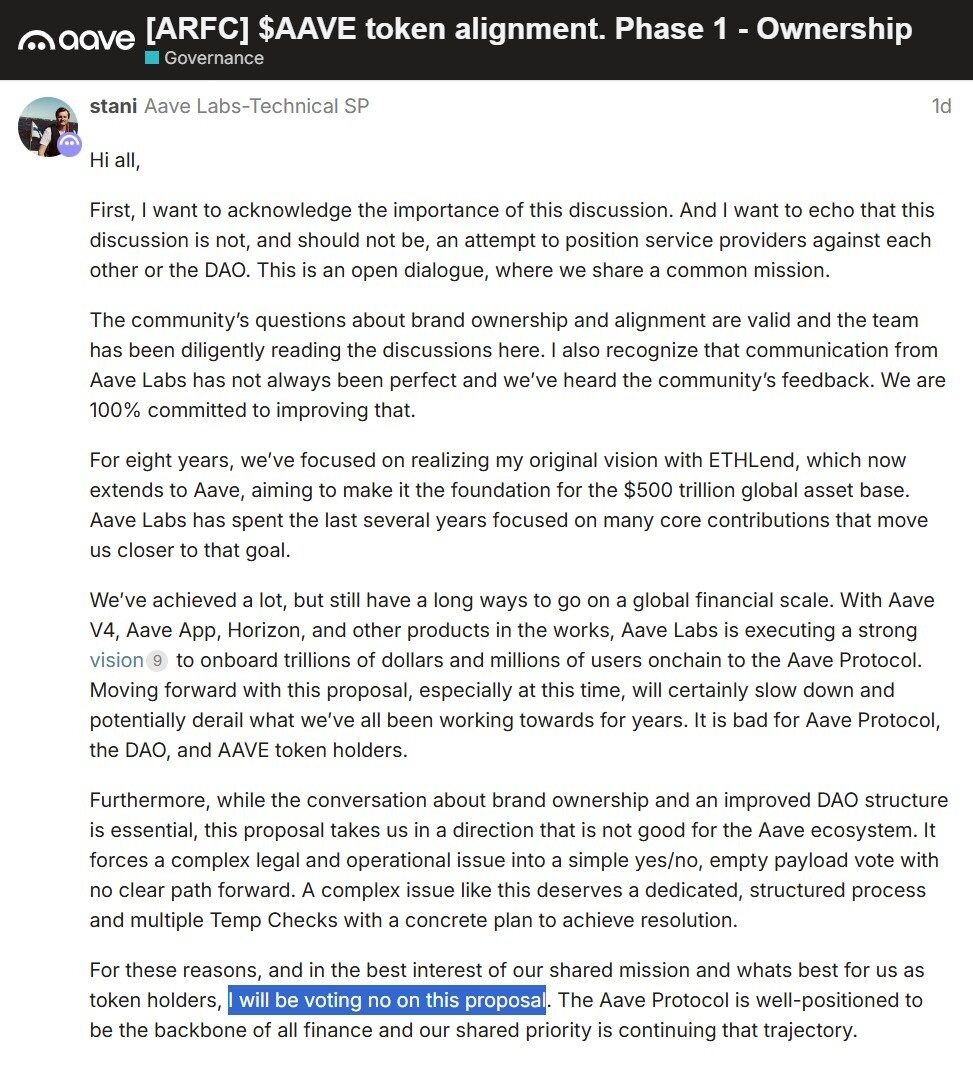
From a business operations perspective, Stani's claim that the proposal is too rash might not be wrong. However, in the current discussion atmosphere, this statement can easily be interpreted as 'the Aave founder disagrees with transferring brand assets to token holders,' which obviously further intensified the conflict between the community and the team.

After Stani's statement, even some attacking remarks against Stani appeared in the original post's comments. More users expressed their dissatisfaction via the forum or social media. An OG user mentioned it was the first time he considered liquidating his AAVE holdings. A loyal AAVE believer stated: "AAVE holders should realize this is just another DeFi shitcoin. It's neither better nor worse than the others."

The latest community development is the one mentioned at the beginning of this article: the number two big brother cutting losses and exiting with a loss exceeding ten million dollars.

Can AAVE Still Be Bought?

Just two weeks ago, Odaily Planet Daily wrote an article titled "What Did the Smart Money Aggressively Buying AAVE at Lows See?". At that time, AAVE was still a favorite of top institutions like Multicoin Capital. Its优质 (high-quality) brand reputation, substantial locked funds, clear expansion path, and strong revenue and buyback flow all proved that AAVE was a 'true value token' different from other altcoins.

But in just two weeks, a舆论危机 (public opinion crisis) spanning from fee ownership to brand control and then to team-community relations has rapidly plunged AAVE from a "representative of value tokens" into the center of controversy, even landing it on the short-term top decliners list due to emotional impact.

As of writing, Aave Labs has stated below Ernesto's proposal that they have initiated an ARFC snapshot vote on the proposal, allowing AAVE token holders to formally express their stance and clarify the future direction. The outcome of this vote and the subsequent handling attitude of the Aave Labs team will undoubtedly significantly impact Aave community faith and the short-term price performance of AAVE.

It is important to emphasize that this incident is not merely "negative news" or "performance change," but a集中拷问 (concentrated interrogation) of Aave's existing governance structure and boundaries of rights.

If you believe that Aave Labs will still maintain high alignment with Aave DAO's long-term interests, and the current friction is more of a communication and process失误 (mistake), then the price pullback led by emotions might be a good entry window; but if you think this controversy exposes not an occasional problem, but a structural contradiction of long-term unclear rights between the team and the protocol, lacking institutional constraints, then this storm might just be the beginning.

From a broader perspective, Aave's controversy is not an isolated case. As DeFi matures, protocol revenue becomes genuinely considerable, and brands and frontends begin to possess commercial value, some inherent structural contradictions between protocols and products, teams and communities will surface. Aave is pushed into the spotlight this time not because it erred more, but because it has gone further.

This debate over fees, brand, and control rights poses a question that needs answering not just by AAVE, but is an inevitable question the entire DeFi industry must eventually face.


Trend Kriptolar

İlgili Sorular

QWhat was the main reason behind the community crisis and whale selling AAVE tokens?

AThe crisis stemmed from a dispute over fee redirection from Aave's front-end swap function. After switching to Cow Swap, fees that previously flowed to the Aave DAO treasury were redirected to Aave Labs, causing community backlash over undisclosed changes and raising questions about revenue ownership.

QHow did Aave Labs justify redirecting the swap fees to their own address instead of the DAO treasury?

AAave Labs argued that the front-end interface and its swap functionality are separate from the protocol managed by the DAO. They claimed ownership of the product layer, stating that the fees generated were company property, not DAO revenue, and previous donations to the DAO were voluntary, not obligatory.

QWhat proposal did former Aave CTO Ernesto Boado make to address the community's concerns?

AErnesto Boado proposed transferring control of Aave's brand assets—including domains, social media accounts, and naming rights—to AAVE token holders through a DAO-controlled entity, aiming to ensure community governance and anti-encroachment protections.

QHow did Aave founder Stani Kulechov respond to the proposal, and what was the community's reaction?

AStani opposed the proposal, calling it overly simplistic for a complex legal and operational issue and advocating for a structured process with multiple checks. The community perceived this as resistance to decentralizing control, intensifying opposition and leading to negative sentiment, including whale sell-offs.

QWhat broader DeFi industry issue does the Aave controversy highlight?

AThe controversy underscores structural tensions in DeFi between teams and communities over revenue sharing, brand ownership, and governance control. It reflects a industry-wide challenge as protocols mature and front-end products gain commercial value, forcing debates on equitable distribution of power and profits.

İlgili Okumalar

Two Legends Lost in Three Days: Is Google's AI Talent Dam Cracking?

In three days, Google lost two AI legends. On June 18, Noam Shazeer, co-author of the seminal "Attention is All You Need" paper and Gemini co-lead, left for OpenAI. Just 48 hours later, John Jumper, 2024 Nobel laureate and AlphaFold lead, departed DeepMind for Anthropic. This follows Andrej Karpathy joining Anthropic in May. These moves highlight a structural trend: top AI talent is concentrating at mission-driven, pre-IPO firms like OpenAI and Anthropic, while Google becomes a primary source. The exodus stems from a core mission mismatch. Google's ad-centric model often subordinates AI research to product and revenue goals, creating friction for pioneers like Shazeer, who returned in 2024 only to leave again. In contrast, OpenAI and Anthropic offer singular focus on pushing AI boundaries, whether towards AGI or safety-aligned models, which deeply appeals to top researchers like Jumper. Financial incentives amplify the pull. With both OpenAI and Anthropic nearing IPO, employees stand to gain immensely from equity, an upside Google's mature stock cannot match. Furthermore, the 2023 merger of Google Brain and DeepMind, intended to consolidate strength, has instead created cultural tension and slowed the path from research to product, as evidenced by Gemini's pace. This talent redistribution is reshaping the AI landscape. While Google retains vast data and compute resources, its true crisis is the quiet, continuous loss of the people who define the field's future. The real moat in AI is not infrastructure, but the concentration of brilliant minds—a battle Google is currently losing.

marsbit16 dk önce

Two Legends Lost in Three Days: Is Google's AI Talent Dam Cracking?

marsbit16 dk önce

Behind the AI Report Card, Lies a Chinese 'Exam Setter'

Beyond the familiar performance charts like MMLU-Pro and MMMU, which major AI models strive to ace, stands a key "examiner": Chinese-Canadian researcher Wenhu Chen. An assistant professor at the University of Waterloo and founder of TIGERLab, Chen addresses the crucial need for more rigorous AI evaluation. As models like GPT-4 began scoring near-perfect results on older benchmarks like MMLU, it became difficult to distinguish their true capabilities. In response, Chen introduced MMLU-Pro in 2024, featuring harder, more reasoning-focused questions with more answer choices, successfully reintroducing meaningful performance gaps. His work extends to multi-modal evaluation with MMMU and its enhanced version, MMMU-Pro. These benchmarks test a model's ability to understand and reason with complex information from images, charts, and text across diverse academic subjects, exposing the significant challenges even top models face in genuine comprehension. Chen's background in complex QA, table reasoning, and his experience at Google DeepMind on projects like Gemini inform his approach. He understands that effective benchmarks must anticipate how models might "cheat" by memorizing data or avoiding visual analysis. His lab also actively researches video understanding and generation models (e.g., UniVideo, Vamba), ensuring his evaluation work is grounded in practical model-building challenges. Now at Meta's Super Intelligence Lab, Chen continues his focus on multi-modal data and evaluation, representing the deep yet often unseen contributions of Chinese talent in shaping the fundamental tools of the AI industry.

marsbit28 dk önce

Behind the AI Report Card, Lies a Chinese 'Exam Setter'

marsbit28 dk önce

Alliance Co-founder's Letter to Entrepreneurs: Written at the Moment Cursor Sold for $600 Billion

Alliance Co-founder's Letter to Entrepreneurs: On Cursor's $60 Billion Sale Many aspiring founders see massive exits like Cursor's $60B sale and wonder why they can't achieve the same, often concluding opportunities are exhausted. But great companies aren't built in obvious, crowded spaces. Cursor, like Stripe, Figma, and Shopify before it, started with a non-consensus belief about the future. Before ChatGPT, they believed AI would transform knowledge work. They focused on a genuinely exciting domain, became their own customer, and obsessed over power users. Their journey involved years of "glass-chewing" effort before the market was ready. The pattern is consistent: identify a long-term technological shift, find a missed entry point, and execute for years before the trend becomes obvious. First-generation products (PayPal, Adobe, Amazon) prove a market exists. Second-generation winners (Stripe, Figma, Shopify) rebuild that market around new insights, technology, or changing customer behaviors. Founders must identify their phase in the cycle. Early entrants like Coinbase or Cursor focus on making new technology usable for power users. Later entrants find the "yin" to the established "yang"—the blind spots incumbents miss as they grow distant from individual users. The key is deep market immersion. Use every product in your space. Talk to users. Build an audience. Stop looking for ideas and start *seeing* them everywhere. Then, choose one. The idea must offer a 10x improvement or solve a "hair-on-fire" pain point—something severe enough that users are already crafting workarounds. When building, avoid feature bloat. Ask: why would someone switch? Great startups rarely force new behaviors; they improve familiar workflows with drastically lower friction (e.g., Cursor forked VS Code instead of creating a new editor). Distribution is the underestimated moat. Before product-market fit, achieve distribution-market fit. How do customers discover new tools? Founders like those at Airbnb, Stripe, and Cursor did unscalable, manual work to recruit early users. The final, unteachable ingredient is resilience. Cursor built for years pre-market, faced rejection, and persisted. So did Airbnb, Nvidia, and Rain (which launched post-FTX collapse). The lesson isn't that these founders were smarter, but that they stayed in the game long enough for their insights to compound. Framework: Spot technological cycles. Cultivate unique insight. Obsess over your market. Talk to customers. Find a hair-on-fire problem. Build the simplest wedge. Win your distribution channel. Above all, don't quit when it gets hard. Most people won't do these things consistently. The few who do build the next generation of great companies. Go build.

marsbit31 dk önce

Alliance Co-founder's Letter to Entrepreneurs: Written at the Moment Cursor Sold for $600 Billion

marsbit31 dk önce

Weekly Editor's Picks (0613-0619)

Weekly Editor's Picks (0613-0619): Market Insights & Analysis This weekly digest curates in-depth analysis often lost in the information flow, focusing on key insights across macro trends, investment, and technology. **Macro & Geopolitics:** With the Strait of Hormuz reopening and military conflict shifting to negotiation, markets are pivoting from "war shock" to "supply restoration." Trades include shorting crude risk premiums, longing airlines/tourism, Asian energy importers, and bond duration, while shorting inflation expectations. LNG, fertilizer, and chemical chains are also being repriced. **Investment & VC:** Ray Dalio advises against betting on concentrated AI giants dominating indices, advocating for diversified portfolios of high-quality, low-correlation assets instead. Analysis covers the 4-year crypto cycle, predicting the core surviving product by 2029 will be asset trading markets. Current BTC metrics suggest a potential bottoming zone, presenting a patient accumulation window. SpaceX's high-profile IPO at a $2.1T valuation faces scrutiny over fundamentals, with key watchpoints being its likely inclusion in the Nasdaq index and Q2 earnings. Concerns are raised about potential "gamma squeeze" and systemic risks if its narrative-driven valuation gets amplified by passive index funds. Robinhood (HOOD) is noted for breaking its high correlation with crypto, bolstered by its stock trading and new underwriting business. **Web3 & AI:** A warning highlights ~$1.8T in off-balance-sheet AI infrastructure commitments (purchase commitments, leases) as a potential systemic risk if AI monetization lags. AI models are being used for World Cup predictions, adding a new layer for betting markets. A cost breakdown of a $20 AI subscription reveals the supply chain from model companies to cloud, GPUs, and power. **Prediction Markets:** The emergence of prediction market "concept stocks" is noted, with Robinhood developing its own platform, Rothera, signaling a shift from market competition to a "channel war" for user access. **CeFi & DeFi:** The SpaceX IPO tested perpetual contract mechanisms for pre-IPO assets, highlighting challenges in handling corporate actions like stock splits on-chain. The de-pegging of STRC (Strategy's preferred share) to ~$89 reflects market concerns over MicroStrategy's capital structure and BTC-backed leverage model. BlackRock's covered-call Bitcoin ETF (BITA) offers yield but caps upside, appealing to yield-seeking institutions. **Ethereum:** An opinion piece argues Ethereum's core strength is its vast developer community and composability, solidifying its role as the default operating system for the financial internet. **Weekly Hot Topics:** Include the US-Iran deal reopening the Strait of Hormuz, Fed's hawkish hold, Anthropic restricting model access, SpaceX acquiring Cursor, and a humorous stock surge for "Liuliumei" due to its "LLM" ticker.

marsbit36 dk önce

Weekly Editor's Picks (0613-0619)

marsbit36 dk önce

Alliance's Co-Founder's Letter to Entrepreneurs: Written on the Occasion of Cursor's $60 Billion Sale

In this letter to entrepreneurs, Alliance reflects on the success of Cursor's $60 billion sale to Elon Musk, using it as a case study to counter the misconception that opportunities in crowded fields like AI or crypto are exhausted. The piece argues that great companies like Cursor, Stripe, Figma, and Shopify are not built by geniuses with perfect ideas, but by founders who start with a non-consensus belief about the future and build for years before that future becomes obvious to everyone. They identify long-term shifts, find overlooked entry points, and execute relentlessly. The framework for success involves: 1. **Identifying your place in the technology cycle**: Early-stage opportunities focus on making new tech usable for power users (e.g., Coinbase, Cursor). Later-stage opportunities involve finding the "yin" to an existing "yang"—the blind spots of first-generation players (e.g., Stripe vs. PayPal, Figma vs. Adobe). 2. **Cultivating unique insights**: Immerse yourself deeply in the market. Use every product, talk to users, and build an audience. Insights will emerge naturally from deep engagement. 3. **Finding a "hair-on-fire" problem**: Look for a 10x improvement or a severe, urgent pain point. The strongest signal is people already building clumsy workarounds. 4. **Building a focused MVP**: Don't just add features because you can. Ask why users would abandon their current tool for yours. The best startups rarely force new behaviors; they improve familiar workflows with drastically lower friction. 5. **Winning a distribution channel**: Distribution is often the moat. Before product-market fit, achieve channel-market fit. Find where your customers are and build an engine to reach them, even through unscalable, manual efforts initially. 6. **Persistence**: The final, unteachable ingredient is resilience. Success stories like Cursor, Airbnb, and Nvidia involved years of grinding, rejection, and perseverance when the path forward seemed unclear. The conclusion is that there is no secret. Most people fail to consistently execute these steps over the long term. The few who do build the companies that define the next era. The world is yours to create.

链捕手42 dk önce

Alliance's Co-Founder's Letter to Entrepreneurs: Written on the Occasion of Cursor's $60 Billion Sale

链捕手42 dk önce

İşlemler

Spot
Futures

Popüler Makaleler

AAVE Nasıl Satın Alınır

HTX.com’a hoş geldiniz! Aave Protocol (AAVE) satın alma işlemlerini basit ve kullanışlı bir hâle getirdik. Adım adım açıkladığımız rehberimizi takip ederek kripto yolculuğunuza başlayın. 1. Adım: HTX Hesabınızı OluşturunHTX'te ücretsiz bir hesap açmak için e-posta adresinizi veya telefon numaranızı kullanın. Sorunsuzca kaydolun ve tüm özelliklerin kilidini açın. Hesabımı Aç2. Adım: Kripto Satın Al Bölümüne Gidin ve Ödeme Yönteminizi SeçinKredi/Banka Kartı: Visa veya Mastercard'ınızı kullanarak anında Aave Protocol (AAVE) satın alın.Bakiye: Sorunsuz bir şekilde işlem yapmak için HTX hesap bakiyenizdeki fonları kullanın.Üçüncü Taraflar: Kullanımı kolaylaştırmak için Google Pay ve Apple Pay gibi popüler ödeme yöntemlerini ekledik.P2P: HTX'teki diğer kullanıcılarla doğrudan işlem yapın.Borsa Dışı (OTC): Yatırımcılar için kişiye özel hizmetler ve rekabetçi döviz kurları sunuyoruz.3. Adım: Aave Protocol (AAVE) Varlıklarınızı SaklayınAave Protocol (AAVE) satın aldıktan sonra HTX hesabınızda saklayın. Alternatif olarak, blok zinciri transferi yoluyla başka bir yere gönderebilir veya diğer kripto para birimlerini takas etmek için kullanabilirsiniz.4. Adım: Aave Protocol (AAVE) Varlıklarınızla İşlem YapınHTX'in spot piyasasında Aave Protocol (AAVE) ile kolayca işlemler yapın.Hesabınıza erişin, işlem çiftinizi seçin, işlemlerinizi gerçekleştirin ve gerçek zamanlı olarak izleyin. Hem yeni başlayanlar hem de deneyimli yatırımcılar için kullanıcı dostu bir deneyim sunuyoruz.

398 Toplam GörüntülenmeYayınlanma 2024.12.11Güncellenme 2026.06.02

AAVE Nasıl Satın Alınır

Tartışmalar

HTX Topluluğuna hoş geldiniz. Burada, en son platform gelişmeleri hakkında bilgi sahibi olabilir ve profesyonel piyasa görüşlerine erişebilirsiniz. Kullanıcıların AAVE (AAVE) fiyatı hakkındaki görüşleri aşağıda sunulmaktadır.

活动图片