Saylor Says ‘Don’t Sell Your Bitcoin’, as LiquidChain Unites Liquidity for Utility

bitcoinist2026-02-03 tarihinde yayınlandı2026-02-03 tarihinde güncellendi

Özet

Michael Saylor advocates holding Bitcoin as long-term "economic energy," but this creates capital inefficiency. DeFi needs high-quality collateral, yet moving Bitcoin across chains is complex and risky. LiquidChain ($LIQUID) addresses this with a Layer 3 solution that unifies liquidity from Bitcoin, Ethereum, and Solana into a single execution layer. Its Cross-Chain VM allows developers to build applications that use assets from all three chains simultaneously, reducing friction and counterparty risk. The protocol also enables liquidity staking, letting users earn yield without selling their assets. $LIQUID tokens power the network and offer staking rewards, positioning LiquidChain as infrastructure for connected, multi-chain DeFi.

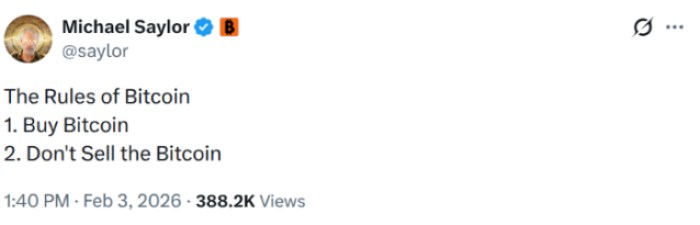
Michael Saylor says that Bitcoin isn’t currency for spending, it’s ‘economic energy’ meant to be preserved for 100 years.

The Strategy chairman’s thesis is simple: you don’t sell the winner to buy the losers. While this ‘Diamond Hand’ philosophy has shifted Bitcoin from speculative toy to treasury reserve asset, it creates a massive friction point: capital inefficiency.

While Saylor advocates for indefinite holding, the broader DeFi ecosystem is starving for high-quality collateral. Right now, traders face a binary choice: leave Bitcoin gathering dust in cold storage, or risk it in a maze of bridges, wrapped tokens, and centralized custodians just to chase yield on Ethereum. (Sound familiar?)
This fragmentation is the bottleneck of the current cycle. Liquidity is trapped in silos, making cross-chain moves slow, expensive, and technically risky.
We’re seeing a shift from ‘store of value’ to ‘productive assets.’ As institutional flows stabilize, the next frontier isn’t just owning crypto; it’s using it across ecosystems without selling the bag.

This demand is fueling Layer 3 (L3) infrastructure designed to smash these barriers. Enter LiquidChain ($LIQUID), a protocol engineering a fusion of Bitcoin, Ethereum, and Solana liquidity into a single execution environment.

Breaking Down The Silos With A Unified Liquidity Layer

The real risk in the DeFi landscape today isn’t price drops, it’s execution complexity. Moving value from Bitcoin to Solana usually involves multiple hops, slippage, and ‘wrapped’ assets that introduce sketchy counterparty risk. This fragmentation means billions in liquidity remain trapped on their native chains.

LiquidChain fixes this by deploying a Cross-Chain VM (Virtual Machine) that serves as a unified execution layer.
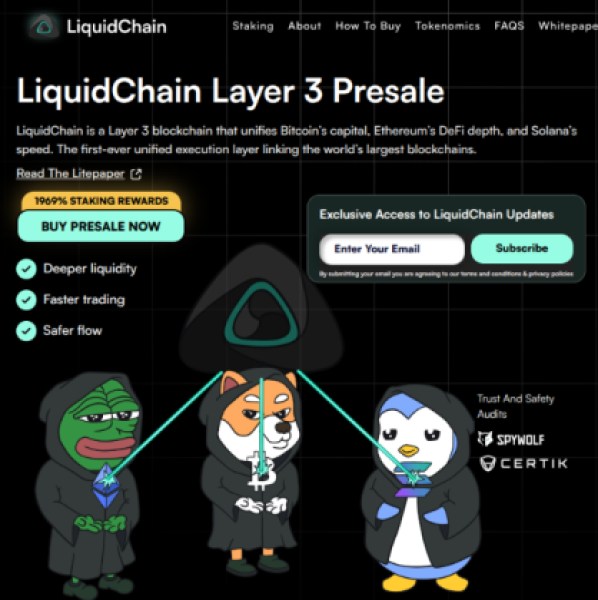
Instead of forcing users to bridge assets manually, LiquidChain’s ‘Deploy-Once Architecture’ allows developers to build applications that tap into $BTC, $ETH, and $SOL simultaneously. That’s critical for removing the friction that kills adoption.

In the LiquidChain model, you could theoretically pledge Bitcoin collateral to access Solana-speed execution or Ethereum-based DeFi protocols in a single step.
The protocol’s architecture focuses on verifiable settlement. By operating as Layer 3 infrastructure, it aggregates security from the underlying chains while offering a single interface.

If you’re a developer, this ends the headache of maintaining different codebases for different ecosystems. Instead of having to choose between Ethereum’s TVL (Total Value Locked) or Solana’s speed, LiquidChain offers a venue where they coexist.

EXPLORE UNIFIED LIQUIDITY WITH $LIQUID.

Unlocking Capital Efficiency Through Liquidity Staking

Saylor’s advice to ‘never sell’ is a solid strategy, but it doesn’t solve the cash flow problem. Investors holding large caps are often asset-rich but liquidity-poor. LiquidChain tackles this through its native utility model, which centers on Liquidity Staking.

The protocol is designed to use the $LIQUID token not just for governance, but as transaction fuel powering the network. By staking liquidity, you can earn rewards derived from the economic activity passing through the Layer 3 infrastructure. It matches the ‘productive crypto’ narrative perfectly, assets generate yield without you having to sell a dime.

You can buy your $LIQUID now for $0.0135 and don’t miss the staking opportunities currently sitting at 1966%.

Plus, the platform aims to include a grant system for developers, incentivizing dApps that use this cross-chain fluidity. This ecosystem approach suggests the future of DeFi isn’t about which chain ‘wins,’ but which infrastructure connects them.

By enabling single-step execution across the industry’s three largest liquidity pools, LiquidChain positions itself as the connective tissue for the next phase of market maturity. To paraphrase an adage, it appears in crypto, it’s no longer what you have but how its connected.’

JOIN THE LIQUIDCHAIN ECOSYSTEM.

Disclaimer: This article is for informational purposes only and does not constitute financial advice. Cryptocurrency investments, including presales and new protocols, carry high risks, including the potential for total loss. Always verify smart contract audits and conduct your own due diligence.


İlgili Sorular

QWhat is Michael Saylor's main thesis regarding Bitcoin, as mentioned in the article?

AMichael Saylor's main thesis is that Bitcoin isn't currency for spending, but 'economic energy' meant to be preserved for 100 years. He advocates for not selling the winner (Bitcoin) to buy the losers, promoting a 'Diamond Hand' philosophy of indefinite holding.

QWhat problem does the article identify with the current DeFi ecosystem in relation to Bitcoin?

AThe article identifies that the current DeFi ecosystem suffers from capital inefficiency and fragmentation. Liquidity is trapped in silos, making cross-chain moves slow, expensive, and technically risky. Traders face a binary choice: either leave Bitcoin idle in cold storage or risk it through complex bridges, wrapped tokens, and centralized custodians to chase yield.

QHow does LiquidChain aim to solve the problem of fragmented liquidity across different blockchains?

ALiquidChain aims to solve fragmentation by deploying a Cross-Chain VM (Virtual Machine) that serves as a unified execution layer. Its 'Deploy-Once Architecture' allows developers to build applications that can tap into Bitcoin ($BTC), Ethereum ($ETH), and Solana ($SOL) liquidity simultaneously, enabling single-step execution across these ecosystems.

QWhat is the role of the $LIQUID token within the LiquidChain ecosystem?

AThe $LIQUID token is used not just for governance but also as transaction fuel powering the network. Users can stake their liquidity to earn rewards derived from the economic activity on the Layer 3 infrastructure, allowing them to generate yield without having to sell their underlying assets.

QWhat specific benefit does LiquidChain's Liquidity Staking offer to investors who follow a 'never sell' strategy like Saylor's?

ALiquidity Staking offers a solution to the 'cash flow problem' for investors who are asset-rich but liquidity-poor due to holding large caps like Bitcoin. It allows them to earn yield on their assets by staking liquidity, generating rewards from network activity without having to sell any of their principal holdings.

İlgili Okumalar

Can a Hair Dryer Earn $34,000? Deciphering the Reflexivity Paradox in Prediction Markets

An individual manipulated a weather sensor at Paris Charles de Gaulle Airport with a portable heat source, causing a Polymarket weather market to settle at 22°C and earning $34,000. This incident highlights a fundamental issue in prediction markets: when a market aims to reflect reality, it also incentivizes participants to influence that reality. Prediction markets operate on two layers: platform rules (what outcome counts as a win) and data sources (what actually happened). While most focus on rules, the real vulnerability lies in the data source. If reality is recorded through a specific source, influencing that source directly affects market settlement. The article categorizes markets by their vulnerability: 1. **Single-point physical data sources** (e.g., weather stations): Easily manipulated through physical interference. 2. **Insider information markets** (e.g., MrBeast video details): Insiders like team members use non-public information to trade. Kalshi fined a剪辑师 $20,000 for insider trading. 3. **Actor-manipulated markets** (e.g., Andrew Tate’s tweet counts): The subject of the market can control the outcome. Evidence suggests Tate’sociated accounts coordinated to profit. 4. **Individual-action markets** (e.g., WNBA disruptions): A single person can execute an event to profit from their pre-placed bets. Kalshi and Polymarket handle these issues differently. Kalshi enforces strict KYC, publicly penalizes insider trading, and reports to regulators. Polymarket, with its anonymous wallet-based system, has historically been more permissive, arguing that insider information improves market accuracy. However, it cooperated with authorities in the "Van Dyke case," where a user traded on classified government information. The core paradox is reflexivity: prediction markets are designed to discover truth, but their financial incentives can distort reality. The more valuable a prediction becomes, the more likely participants are to influence the event itself. The market ceases to be a mirror of reality and instead shapes it.

marsbit35 dk önce

Can a Hair Dryer Earn $34,000? Deciphering the Reflexivity Paradox in Prediction Markets

marsbit35 dk önce

First Day Review of "Musk's WeChat" XChat: Even Worse Than Expected

Elon Musk's much-anticipated "WeChat-like" app, XChat, has officially launched after multiple delays. The initial review reveals a product that falls short of expectations, offering an experience largely similar to X Platform's (formerly Twitter) direct messages, despite being marketed as an encrypted communication tool. Key observations from the first-day test include: 1. The app's promoted "end-to-end encryption" and its claimed relation to Bitcoin's architecture were criticized by experts as a superficial attempt to capitalize on crypto buzz, with no real technical connection. 2. Musk's vision of an ad-free "secure communication system" is technically met, but only because the app is currently extremely basic, featuring only a single chat interface. 3. A promised anti-screenshot feature appears inconsistent; it works in X Platform group chats but fails within the XChat app itself, where screenshots still capture avatars. 4. The app supports 45 languages and has a 16+ age rating, indicating a broader tolerance for content compared to WeChat's 13+ rating. 5. A puzzling login process requires users to verify the email associated with their X account. 6. The touted encryption" feels minimal in practice, with its presence only indicated by a simple "Encrypted - Yes" label on messages. 7. Disappearing message timers for groups can be set from 5 minutes to 4 weeks, with the timer starting upon being read by a user. 8. Group invite links are shared with X Platform groups. 9. Group size limits are planned to be increased, aiming for 1000 members, a move that has drawn user criticism. 10. The app offers 8 different colored icons, and its chat bubbles are notably similar to WeChat's. Message deletion options mimic Telegram's. Crucially, many pre-announced features like importing X contacts, integrating Grok AI, X Money payments, and Cashtags are not yet available. The initial release is seen as a bare-bones and underwhelming first step.

Odaily星球日报1 saat önce

First Day Review of "Musk's WeChat" XChat: Even Worse Than Expected

Odaily星球日报1 saat önce

İşlemler

Spot
Futures

Popüler Makaleler

T Nasıl Satın Alınır

HTX.com’a hoş geldiniz! Threshold Network Token (T) satın alma işlemlerini basit ve kullanışlı bir hâle getirdik. Adım adım açıkladığımız rehberimizi takip ederek kripto yolculuğunuza başlayın. 1. Adım: HTX Hesabınızı OluşturunHTX'te ücretsiz bir hesap açmak için e-posta adresinizi veya telefon numaranızı kullanın. Sorunsuzca kaydolun ve tüm özelliklerin kilidini açın. Hesabımı Aç2. Adım: Kripto Satın Al Bölümüne Gidin ve Ödeme Yönteminizi SeçinKredi/Banka Kartı: Visa veya Mastercard'ınızı kullanarak anında Threshold Network Token (T) satın alın.Bakiye: Sorunsuz bir şekilde işlem yapmak için HTX hesap bakiyenizdeki fonları kullanın.Üçüncü Taraflar: Kullanımı kolaylaştırmak için Google Pay ve Apple Pay gibi popüler ödeme yöntemlerini ekledik.P2P: HTX'teki diğer kullanıcılarla doğrudan işlem yapın.Borsa Dışı (OTC): Yatırımcılar için kişiye özel hizmetler ve rekabetçi döviz kurları sunuyoruz.3. Adım: Threshold Network Token (T) Varlıklarınızı SaklayınThreshold Network Token (T) satın aldıktan sonra HTX hesabınızda saklayın. Alternatif olarak, blok zinciri transferi yoluyla başka bir yere gönderebilir veya diğer kripto para birimlerini takas etmek için kullanabilirsiniz.4. Adım: Threshold Network Token (T) Varlıklarınızla İşlem YapınHTX'in spot piyasasında Threshold Network Token (T) ile kolayca işlemler yapın.Hesabınıza erişin, işlem çiftinizi seçin, işlemlerinizi gerçekleştirin ve gerçek zamanlı olarak izleyin. Hem yeni başlayanlar hem de deneyimli yatırımcılar için kullanıcı dostu bir deneyim sunuyoruz.

365 Toplam GörüntülenmeYayınlanma 2024.12.10Güncellenme 2025.03.21

T Nasıl Satın Alınır

Tartışmalar

HTX Topluluğuna hoş geldiniz. Burada, en son platform gelişmeleri hakkında bilgi sahibi olabilir ve profesyonel piyasa görüşlerine erişebilirsiniz. Kullanıcıların T (T) fiyatı hakkındaki görüşleri aşağıda sunulmaktadır.

活动图片