Sam Bankman-Fried Appeals Conviction While Crypto Security Braces for the Quantum Era with $BMIC

bitcoinist2026-02-11 tarihinde yayınlandı2026-02-11 tarihinde güncellendi

Özet

Sam Bankman-Fried, founder of FTX, has appealed his fraud conviction and 25-year sentence, reopening a major case that highlighted a catastrophic breakdown of trust in crypto. As the industry grapples with this legacy, attention is shifting toward next-generation security solutions. A key emerging threat is quantum computing, which risks breaking current encryption standards. The article highlights $BMIC as a project built to address this with a post-quantum cryptographic security stack, including quantum-resistant wallets, staking, and payments. Having raised over $446K in its presale, BMIC represents a growing investor focus on preemptive security rather than reactive fixes, positioning itself as a potential new standard in crypto infrastructure.

Sam Bankman-Fried, the disgraced founder of FTX, is officially appealing his conviction and 25-year prison sentence. The legal filing reopens one of the biggest fraud cases in crypto history, and for an industry still grappling with the fallout, it’s like pouring salt in a very old wound.
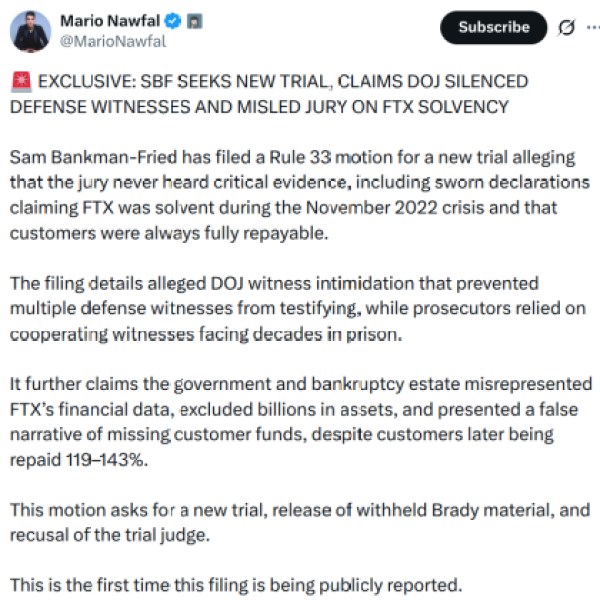
SBF’s appeal challenges various trial decisions, from witness testimony to alleged conflicts of interest. But let’s be clear: the FTX saga was never about tech failing. It was a catastrophic breakdown of trust.

Billions in user funds vanished not because of a sophisticated hack, but due to internal fraud and shockingly poor custody. That collapse forced a painful but necessary conversation across the market: How do we actually secure digital assets?

While the courts wrestle with crypto’s ghosts, innovators are already building for the future. We’re now seeing a clear shift in investor focus toward projects that prioritize provable, next-gen security over pure hype. That’s where the real story is.

The Quantum Threat and BMIC’s Future-Proof Solution

But what most market coverage misses is that while the industry defends against today’s threats, a far bigger one looms: quantum computing. State-sponsored and corporate labs are racing to build machines capable of shattering the encryption that protects everything from bank accounts to crypto wallets.

It’s a threat (one many still dismiss) known as the ‘harvest now, decrypt later’ attack, stealing encrypted data today with the plan to unlock it once quantum computers are powerful enough. For crypto, this isn’t just a problem; it’s an existential risk.

This is the exact problem BMIC ($BMIC) was engineered to solve. It isn’t just another DeFi protocol or meme coin; it’s a foundational security layer built for the quantum age. The project delivers a full stack of financial tools, wallet, staking, and payments, all shielded by post-quantum cryptography (PQC).
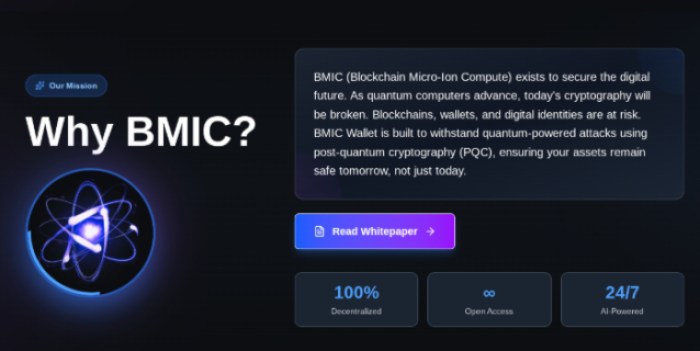
While traditional wallets expose public keys during transactions, BMIC uses ERC-4337 smart accounts and a Zero Public-Key Exposure model to protect users from both current and future threats. It even integrates an AI-enhanced threat detection system to proactively neutralize suspicious activity.

The key difference here is a shift from reactive security to preemptive protection. So, is your portfolio truly safe if its core cryptography has a known expiration date?

LEARN MORE ABOUT BMIC AND ITS QUANTUM STACK

A New Security Standard Attracting Early Investment

If history has taught us anything, it’s that after a major market failure like FTX, capital flows toward infrastructure that promises to prevent the next crisis. We’re seeing that play out right now. The early traction for the BMIC presale seems to prove the point, having already raised over $446K, with tokens currently priced at just $0.049474.

Frankly, this doesn’t look like speculative froth; it looks like a calculated investment in a long-term solution. It’s why we picked $BMIC as a best new cryptocurrency.

The project’s utility is centered on its native token, $BMIC, which powers the whole ecosystem. It’s used for staking on the quantum-secure network, participating in governance, and fueling its ‘Burn-to-Compute’ model for access to advanced security features.

The ripple effect of a successful quantum-proof platform could be immense, potentially setting a new security standard for the entire industry. The risk? As always, it comes down to execution and adoption. But in a market still scarred by FTX, a project building decentralized, future-proof security is a compelling story.

buy your $BMIC here

This article is for informational purposes only and does not constitute financial advice. All investments carry risks, and readers should conduct their own due diligence.


Trend Kriptolar

İlgili Sorular

QWhat is Sam Bankman-Fried appealing and why is this significant for the crypto industry?

ASam Bankman-Fried is appealing his conviction and 25-year prison sentence for his role in the FTX fraud case. This is significant because it reopens one of the largest fraud cases in crypto history, forcing the industry to confront the catastrophic breakdown of trust and the need for better security measures.

QAccording to the article, what is the 'existential risk' facing cryptocurrency that many still dismiss?

AThe existential risk is the threat posed by quantum computing, specifically through 'harvest now, decrypt later' attacks, where encrypted data is stolen today with the intention of decrypting it once quantum computers become powerful enough to break current encryption standards.

QWhat specific problem does the BMIC ($BMIC) project claim to solve?

ABMIC ($BMIC) is engineered to provide a foundational security layer for the quantum age. It uses post-quantum cryptography (PQC) to protect a full stack of financial tools, including its wallet, staking, and payments system, from both current threats and future quantum attacks.

QHow does BMIC's security model differ from traditional crypto wallets?

AUnlike traditional wallets that expose public keys during transactions, BMIC uses ERC-4337 smart accounts and a Zero Public-Key Exposure model to protect users. It also integrates an AI-enhanced threat detection system for proactive security, shifting from a reactive to a preemptive protection model.

QWhat evidence does the article provide to suggest that BMIC is attracting serious investment rather than speculative interest?

AThe article points to the BMIC presale having raised over $446K as evidence of calculated, long-term investment. It states this early traction indicates capital is flowing toward infrastructure that promises to prevent future crises, like the FTX collapse, rather than mere speculative froth.

İlgili Okumalar

Can Japan Buy Growth with AI? Will the Bond Market Believe It?

Japan's cabinet has introduced the 2026 Basic Policy on Economic and Fiscal Management and Reform, shifting its primary fiscal target. The new framework moves away from the traditional annual primary balance goal and instead prioritizes a stable reduction of the debt-to-GDP ratio. This change is tied to a strategy of increased "responsible proactive fiscal" spending, aiming to boost long-term growth through investments in strategic sectors like AI, semiconductors, energy, and robotics. The government estimates total public and private investment in 62 key technologies could exceed 370 trillion yen by 2040. The market reaction has been mixed and cautious. While equity markets may respond to policy signals, bond markets are focused on fiscal credibility. Concerns center on whether the weakening of the clear primary balance anchor could lead to looser fiscal discipline. If investors doubt that these strategic investments will generate sufficient productivity gains, tax revenue, and nominal growth to outpace rising interest costs, they may demand higher yields on Japanese Government Bonds (JGBs). Recent volatility in the yen and JGB yields, with the 10-year yield briefly reaching 2.9%, reflects this skepticism. The success of this new framework hinges on two factors: whether Japan can achieve a nominal growth rate consistently higher than its long-term interest rates, and whether future budgets demonstrate disciplined control over bond issuance. The government's narrative is that strategic investment is essential to break Japan's cycle of low growth, aging, and labor shortages. However, the bond market will continuously assess the credibility of this plan, pricing the risk that it may represent fiscal expansion rather than a viable growth strategy.

marsbit25 dk önce

Can Japan Buy Growth with AI? Will the Bond Market Believe It?

marsbit25 dk önce

Misjudged A-Shares: Resilience, Expectations, and Confidence

China's A-share market recently faced selling pressure, especially in tech sectors, initially triggered by a global tech sell-off that began in South Korea. However, the article argues this is a case of "mistaken injury" and highlights the market's underlying resilience. This resilience stems from three main pillars: **1) Tech Sector Fundamentals:** Unlike Korea's market dominated by a few memory chip stocks, China's tech sector is diversified across computing, communications, electronics, and semiconductors, supported by dual narratives of global AI supply chains and domestic substitution. Core areas like optical modules and fiber optics continue to show strong earnings growth. **2) "National Team" Support:** State-backed institutions and large corporations have made significant market purchases and announced buybacks, providing liquidity and signaling confidence. This is seen as a stabilizing policy signal, often associated with market bottoms. **3) Broader Market Pillars:** Other major sectors are showing endogenous recovery momentum. Consumer stocks benefit from stabilizing CPI and signs of sector recovery (e.g., liquor price hikes). Cyclical sectors like aluminum have high earnings, potential price increases due to tight supply, and low valuations. The financial sector offers stable dividends and low valuations. The conclusion is that the sell-off was driven by external contagion, not a collapse in fundamentals. With strong policy support and recovering momentum across key sectors, the A-share market possesses the toughness to regain stability.

marsbit56 dk önce

Misjudged A-Shares: Resilience, Expectations, and Confidence

marsbit56 dk önce

İşlemler

Spot

Popüler Makaleler

ERA Nasıl Satın Alınır

HTX.com’a hoş geldiniz! Caldera (ERA) satın alma işlemlerini basit ve kullanışlı bir hâle getirdik. Adım adım açıkladığımız rehberimizi takip ederek kripto yolculuğunuza başlayın. 1. Adım: HTX Hesabınızı OluşturunHTX'te ücretsiz bir hesap açmak için e-posta adresinizi veya telefon numaranızı kullanın. Sorunsuzca kaydolun ve tüm özelliklerin kilidini açın. Hesabımı Aç2. Adım: Kripto Satın Al Bölümüne Gidin ve Ödeme Yönteminizi SeçinKredi/Banka Kartı: Visa veya Mastercard'ınızı kullanarak anında Caldera (ERA) satın alın.Bakiye: Sorunsuz bir şekilde işlem yapmak için HTX hesap bakiyenizdeki fonları kullanın.Üçüncü Taraflar: Kullanımı kolaylaştırmak için Google Pay ve Apple Pay gibi popüler ödeme yöntemlerini ekledik.P2P: HTX'teki diğer kullanıcılarla doğrudan işlem yapın.Borsa Dışı (OTC): Yatırımcılar için kişiye özel hizmetler ve rekabetçi döviz kurları sunuyoruz.3. Adım: Caldera (ERA) Varlıklarınızı SaklayınCaldera (ERA) satın aldıktan sonra HTX hesabınızda saklayın. Alternatif olarak, blok zinciri transferi yoluyla başka bir yere gönderebilir veya diğer kripto para birimlerini takas etmek için kullanabilirsiniz.4. Adım: Caldera (ERA) Varlıklarınızla İşlem YapınHTX'in spot piyasasında Caldera (ERA) ile kolayca işlemler yapın.Hesabınıza erişin, işlem çiftinizi seçin, işlemlerinizi gerçekleştirin ve gerçek zamanlı olarak izleyin. Hem yeni başlayanlar hem de deneyimli yatırımcılar için kullanıcı dostu bir deneyim sunuyoruz.

581 Toplam GörüntülenmeYayınlanma 2025.07.17Güncellenme 2026.06.02

ERA Nasıl Satın Alınır

Tartışmalar

HTX Topluluğuna hoş geldiniz. Burada, en son platform gelişmeleri hakkında bilgi sahibi olabilir ve profesyonel piyasa görüşlerine erişebilirsiniz. Kullanıcıların ERA (ERA) fiyatı hakkındaki görüşleri aşağıda sunulmaktadır.

活动图片












