Sam Bankman-Fried Appeals Conviction While Crypto Security Braces for the Quantum Era with $BMIC

bitcoinist2026-02-11 tarihinde yayınlandı2026-02-11 tarihinde güncellendi

Özet

Sam Bankman-Fried, founder of FTX, has appealed his fraud conviction and 25-year sentence, reopening a major case that highlighted a catastrophic breakdown of trust in crypto. As the industry grapples with this legacy, attention is shifting toward next-generation security solutions. A key emerging threat is quantum computing, which risks breaking current encryption standards. The article highlights $BMIC as a project built to address this with a post-quantum cryptographic security stack, including quantum-resistant wallets, staking, and payments. Having raised over $446K in its presale, BMIC represents a growing investor focus on preemptive security rather than reactive fixes, positioning itself as a potential new standard in crypto infrastructure.

Sam Bankman-Fried, the disgraced founder of FTX, is officially appealing his conviction and 25-year prison sentence. The legal filing reopens one of the biggest fraud cases in crypto history, and for an industry still grappling with the fallout, it’s like pouring salt in a very old wound.
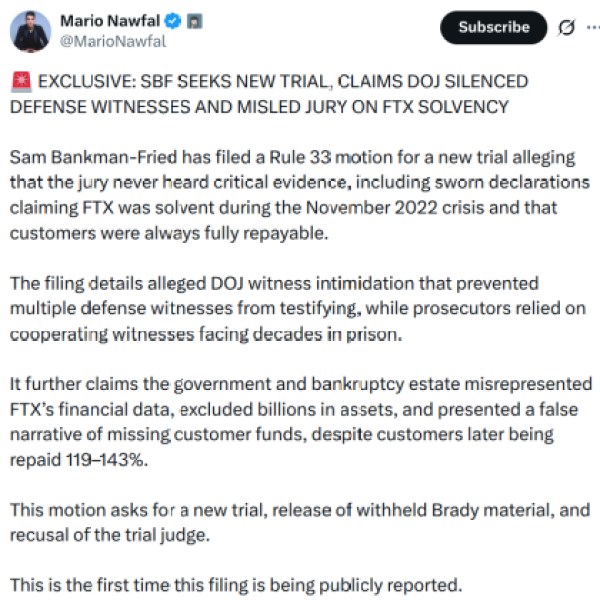
SBF’s appeal challenges various trial decisions, from witness testimony to alleged conflicts of interest. But let’s be clear: the FTX saga was never about tech failing. It was a catastrophic breakdown of trust.

Billions in user funds vanished not because of a sophisticated hack, but due to internal fraud and shockingly poor custody. That collapse forced a painful but necessary conversation across the market: How do we actually secure digital assets?

While the courts wrestle with crypto’s ghosts, innovators are already building for the future. We’re now seeing a clear shift in investor focus toward projects that prioritize provable, next-gen security over pure hype. That’s where the real story is.

The Quantum Threat and BMIC’s Future-Proof Solution

But what most market coverage misses is that while the industry defends against today’s threats, a far bigger one looms: quantum computing. State-sponsored and corporate labs are racing to build machines capable of shattering the encryption that protects everything from bank accounts to crypto wallets.

It’s a threat (one many still dismiss) known as the ‘harvest now, decrypt later’ attack, stealing encrypted data today with the plan to unlock it once quantum computers are powerful enough. For crypto, this isn’t just a problem; it’s an existential risk.

This is the exact problem BMIC ($BMIC) was engineered to solve. It isn’t just another DeFi protocol or meme coin; it’s a foundational security layer built for the quantum age. The project delivers a full stack of financial tools, wallet, staking, and payments, all shielded by post-quantum cryptography (PQC).
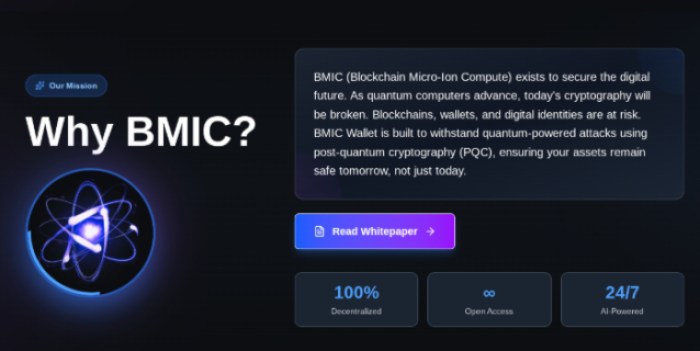
While traditional wallets expose public keys during transactions, BMIC uses ERC-4337 smart accounts and a Zero Public-Key Exposure model to protect users from both current and future threats. It even integrates an AI-enhanced threat detection system to proactively neutralize suspicious activity.

The key difference here is a shift from reactive security to preemptive protection. So, is your portfolio truly safe if its core cryptography has a known expiration date?

LEARN MORE ABOUT BMIC AND ITS QUANTUM STACK

A New Security Standard Attracting Early Investment

If history has taught us anything, it’s that after a major market failure like FTX, capital flows toward infrastructure that promises to prevent the next crisis. We’re seeing that play out right now. The early traction for the BMIC presale seems to prove the point, having already raised over $446K, with tokens currently priced at just $0.049474.

Frankly, this doesn’t look like speculative froth; it looks like a calculated investment in a long-term solution. It’s why we picked $BMIC as a best new cryptocurrency.

The project’s utility is centered on its native token, $BMIC, which powers the whole ecosystem. It’s used for staking on the quantum-secure network, participating in governance, and fueling its ‘Burn-to-Compute’ model for access to advanced security features.

The ripple effect of a successful quantum-proof platform could be immense, potentially setting a new security standard for the entire industry. The risk? As always, it comes down to execution and adoption. But in a market still scarred by FTX, a project building decentralized, future-proof security is a compelling story.

buy your $BMIC here

This article is for informational purposes only and does not constitute financial advice. All investments carry risks, and readers should conduct their own due diligence.


İlgili Sorular

QWhat is Sam Bankman-Fried appealing and why is this significant for the crypto industry?

ASam Bankman-Fried is appealing his conviction and 25-year prison sentence for his role in the FTX fraud case. This is significant because it reopens one of the largest fraud cases in crypto history, forcing the industry to confront the catastrophic breakdown of trust and the need for better security measures.

QAccording to the article, what is the 'existential risk' facing cryptocurrency that many still dismiss?

AThe existential risk is the threat posed by quantum computing, specifically through 'harvest now, decrypt later' attacks, where encrypted data is stolen today with the intention of decrypting it once quantum computers become powerful enough to break current encryption standards.

QWhat specific problem does the BMIC ($BMIC) project claim to solve?

ABMIC ($BMIC) is engineered to provide a foundational security layer for the quantum age. It uses post-quantum cryptography (PQC) to protect a full stack of financial tools, including its wallet, staking, and payments system, from both current threats and future quantum attacks.

QHow does BMIC's security model differ from traditional crypto wallets?

AUnlike traditional wallets that expose public keys during transactions, BMIC uses ERC-4337 smart accounts and a Zero Public-Key Exposure model to protect users. It also integrates an AI-enhanced threat detection system for proactive security, shifting from a reactive to a preemptive protection model.

QWhat evidence does the article provide to suggest that BMIC is attracting serious investment rather than speculative interest?

AThe article points to the BMIC presale having raised over $446K as evidence of calculated, long-term investment. It states this early traction indicates capital is flowing toward infrastructure that promises to prevent future crises, like the FTX collapse, rather than mere speculative froth.

İlgili Okumalar

Bitcoin's 'Rally Ends,' Officially Entering the Later Stage of a Bear Market?

Bitcoin prices declined 13% this week, reversing the recent rebound and signaling a likely transition into the later stages of a bear market. Key on-chain metrics deteriorated, with the short-term holder cost basis falling below the Realized Price—a pattern last seen in early 2022, characteristic of bear market maturity. The rally to ~$82k proved to be a bear market bounce, as evidenced by the 90-day realized profit/loss ratio failing to sustain above the bullish threshold of 2. Daily realized losses surged to $1.35B, including significant selling from long-term holders who accumulated near cycle tops, indicating ongoing supply redistribution. Price was rejected almost precisely at the aggregate US spot ETF cost basis of ~$83k, turning that level into resistance and leaving the average ETF investor underwater again. Spot market selling pressure intensified, with the 7-day volume delta turning significantly negative to its weakest level since February. While a major long liquidation event cleared over $400M in leverage, spot demand has not yet stepped in to absorb the resulting supply. Options markets continue pricing in higher future volatility (elevated volatility risk premium) and maintain a skew toward put options, reflecting persistent demand for downside protection, though not yet panic. Overall, market structure remains fragile. Sustained recovery likely requires a reclaim of the ETF cost basis, a shift back to positive spot demand, and a slowdown in realized loss-taking. Until then, the market risks further downside or extended consolidation within the broader bear trend.

Foresight News1 saat önce

Bitcoin's 'Rally Ends,' Officially Entering the Later Stage of a Bear Market?

Foresight News1 saat önce

How Risky is the "Death Spiral" of MSTR and STRC?

Summary: This article explores the perceived "death spiral" risk between MicroStrategy (MSTR), its Bitcoin holdings, and its perpetual preferred stock (STRC), drawing comparisons to the LUNA-UST collapse. While both systems feature price anchors, high yields for holders, and potential feedback loops, their core mechanisms differ fundamentally. The MSTR-STRC structure relies on continuous financing to sustain its high dividend payouts, primarily through stock ATM offerings. A negative feedback cycle could occur: falling MSTR stock price makes raising equity capital harder, increasing pressure to sell Bitcoin, which undermines STRC confidence and further depresses MSTR. However, unlike LUNA-UST's automated, direct linkage, the MSTR-STRC loop is weaker and has brakes: STRC dividends can be deferred or rates lowered, and STRC holders have a $100/share liquidation preference in bankruptcy, providing a price floor. The company's sustainability hinges on its ability to continue financing. Its current ~$900 million USD reserves cover only about 6.3 months of its ~$1.71 billion annual interest/dividend burden. The next six months are critical, aligning with both the potential bottom in Bitcoin's four-year cycle and the depletion timeline of its reserves. While a LUNA-style catastrophic collapse is deemed highly unlikely due to structural differences, the key question is whether MicroStrategy can navigate this period through healthy deleveraging to restart its capital engine.

Foresight News1 saat önce

How Risky is the "Death Spiral" of MSTR and STRC?

Foresight News1 saat önce

İşlemler

Spot
Futures

Popüler Makaleler

ERA Nasıl Satın Alınır

HTX.com’a hoş geldiniz! Caldera (ERA) satın alma işlemlerini basit ve kullanışlı bir hâle getirdik. Adım adım açıkladığımız rehberimizi takip ederek kripto yolculuğunuza başlayın. 1. Adım: HTX Hesabınızı OluşturunHTX'te ücretsiz bir hesap açmak için e-posta adresinizi veya telefon numaranızı kullanın. Sorunsuzca kaydolun ve tüm özelliklerin kilidini açın. Hesabımı Aç2. Adım: Kripto Satın Al Bölümüne Gidin ve Ödeme Yönteminizi SeçinKredi/Banka Kartı: Visa veya Mastercard'ınızı kullanarak anında Caldera (ERA) satın alın.Bakiye: Sorunsuz bir şekilde işlem yapmak için HTX hesap bakiyenizdeki fonları kullanın.Üçüncü Taraflar: Kullanımı kolaylaştırmak için Google Pay ve Apple Pay gibi popüler ödeme yöntemlerini ekledik.P2P: HTX'teki diğer kullanıcılarla doğrudan işlem yapın.Borsa Dışı (OTC): Yatırımcılar için kişiye özel hizmetler ve rekabetçi döviz kurları sunuyoruz.3. Adım: Caldera (ERA) Varlıklarınızı SaklayınCaldera (ERA) satın aldıktan sonra HTX hesabınızda saklayın. Alternatif olarak, blok zinciri transferi yoluyla başka bir yere gönderebilir veya diğer kripto para birimlerini takas etmek için kullanabilirsiniz.4. Adım: Caldera (ERA) Varlıklarınızla İşlem YapınHTX'in spot piyasasında Caldera (ERA) ile kolayca işlemler yapın.Hesabınıza erişin, işlem çiftinizi seçin, işlemlerinizi gerçekleştirin ve gerçek zamanlı olarak izleyin. Hem yeni başlayanlar hem de deneyimli yatırımcılar için kullanıcı dostu bir deneyim sunuyoruz.

475 Toplam GörüntülenmeYayınlanma 2025.07.17Güncellenme 2026.06.02

ERA Nasıl Satın Alınır

Tartışmalar

HTX Topluluğuna hoş geldiniz. Burada, en son platform gelişmeleri hakkında bilgi sahibi olabilir ve profesyonel piyasa görüşlerine erişebilirsiniz. Kullanıcıların ERA (ERA) fiyatı hakkındaki görüşleri aşağıda sunulmaktadır.

活动图片












