This weekly report covers the period from February 27, 2026, to March 6, 2026.
This week, the total on-chain market capitalization of RWA grew steadily to $26.52 billion, while the total market cap of stablecoins continued to rise for two consecutive months to $299.09 billion. The number of monthly active addresses continued to recover, indicating that the market is entering a phase of steady expansion and improving user activity.
Regulatory frameworks received important guidance: The Federal Reserve clarified that the capital rules for tokenized securities are "technology-neutral," removing obstacles for banks to participate in on-chain assets. The U.S. Senate housing bill unexpectedly included a temporary ban on CBDCs. The debate over stablecoin yields continues, and the OCC issued detailed rules restricting indirect interest payments. The Bank of Japan launched a blockchain-based central bank currency settlement experiment. Global regulations are becoming more detailed amid divergence.
At the project level, two main trends emerged: "Traditional finance fully on-chain" and "The rise of non-USD stablecoins." An alliance of 12 EU banks, Qivalis, plans to launch a euro stablecoin in the second half of the year. Germany's AllUnity issued a Swiss franc stablecoin, CHFAU. The Canadian government and TD Bank successfully piloted a C$100 million blockchain bond. Delin Holdings is advancing the tokenization of properties and funds.
Payments are increasingly penetrating: Visa and Stripe plan to expand stablecoin card issuance to over 100 countries. Western Union partnered with Crossmint to launch USDPT on Solana.
In terms of financing, ARQ completed a $70 million funding round to expand stablecoin financial applications. QFEX completed a $9.5 million seed round to launch a high-leverage RWA trading platform. Tether made a strategic investment in Axiym to integrate USDT into compliant payment networks.
Driven by increasingly clear regulatory frameworks and deep involvement from mainstream institutions, RWA and stablecoins are moving from "technically feasible" to a new stage of "regulatory certainty" and "ecosystem formation." Compliance efficiency, user expansion, and scenario deepening together form the foundation for the next phase of growth.
Data Overview
RWA Sector Overview
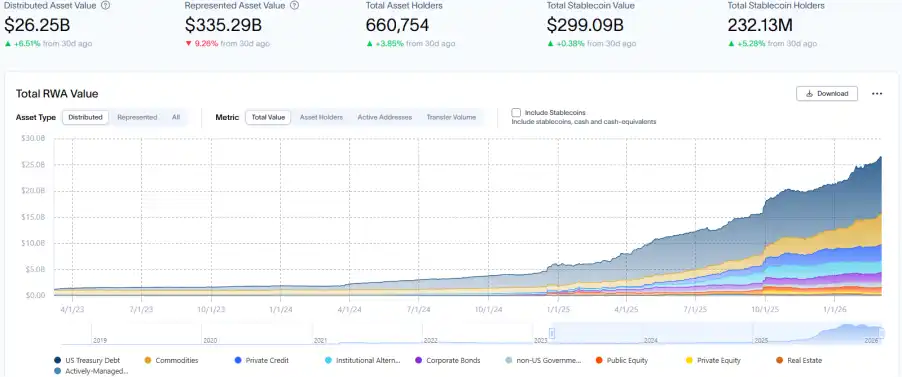
According to the latest data from RWA.xyz, as of March 6, 2026, the total on-chain market capitalization of RWA reached $26.52 billion, an increase of 6.51% compared to the previous month. The total number of asset holders reached approximately 660,800, an increase of 4.35% compared to the previous month, slightly lower than the growth rate of asset size, indicating that the incremental funds are mainly allocated by institutions or large investors.
Stablecoin Market
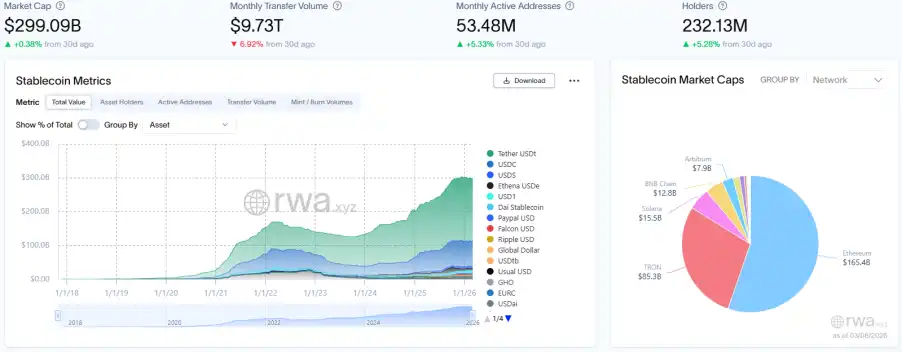
The total market capitalization of stablecoins温和ly rebounded to $299.09 billion, a微增 of 0.03% compared to the previous month, maintaining positive growth for two consecutive months, further consolidating the liquidity stabilization trend. Monthly transfer volume slightly decreased to $9.73 trillion, a decrease of 6.92% compared to the previous month, ending the previous growth trend, reflecting a阶段性降温 in market settlement demand. The存量资金周转率 (transfer volume/market cap) remained at 32.5 times, still at a historical high but marginally slowing down.
The total number of monthly active addresses increased to 53.48 million, an increase of 5.33% compared to the previous month. The total number of holders grew steadily to 232 million, an increase of 5.28% compared to the previous month. The two indicators matched, indicating that retail participation continued to recover, and user activity indicators improved.
The data shows that the market has entered a repair phase characterized by steady total expansion and improving user activity, but the decline in transfer volume requires attention to the sustainability of capital activity.
The leading stablecoins are USDT, USDC, and USDS. Among them, USDT's market cap increased by 0.09% compared to the previous month; USDC's market cap increased微增 by 0.002%; USDS's market cap increased微升 by 0.04%.
Regulatory News
Federal Reserve Clarifies Capital Rules for Tokenized Securities, Calls Framework "Technology-Neutral"
According to The Block, the Federal Reserve released a Q&A document clarifying that banks should treat tokenized securities according to existing capital rules, emphasizing that the existing framework is "technology-neutral." The Fed stated that the technology used to issue or transfer securities (including blockchain technology) does not affect its regulatory capital treatment. Eligible tokenized securities should be treated under the same rules as non-tokenized securities. Tokenized securities that meet the same legal and risk management requirements as traditional securities can be used as financial collateral. The Fed added that capital rules do not provide differential treatment regardless of whether permissioned or permissionless chains are used. This move is another guidance from regulators on the on-chain application of traditional assets, following the SEC's clarification in January that tokenized securities still need to comply with federal securities laws.
U.S. Senate Housing Bill Includes Central Bank Digital Currency Ban Clause
According to CoinDesk, the U.S. Senate Banking Committee included a clause in the latest bipartisan housing bill that temporarily prohibits the Federal Reserve from issuing a central bank digital currency (CBDC). The "Housing Act of the 21st Century," proposed by Committee Chairman Tim Scott and senior member Elizabeth Warren, aims to promote U.S. housing construction by reducing regulatory barriers.
In this 303-page bill, the CBDC ban clause, which occupies only two pages, stipulates that the Federal Reserve Board or Federal Reserve Banks shall not directly or through intermediaries such as financial institutions issue or create a CBDC or any digital asset substantially similar to it. The ban is effective until December 31, 2030, and establishes an exception for permissionless, private "dollar-denominated" currencies that fully preserve the privacy protection of physical currency. A statement of support for the bill issued by the White House explicitly mentioned support for this CBDC clause, saying it "prevents the development of a CBDC that could pose a significant threat to personal privacy and freedom." Congress has previously attempted to pass similar bans multiple times. The House passed a separate bill last year, but it has not yet been fully approved by Congress.
Stablecoin Yield Debate Continues, French Hill Urges Senate to Adopt House Crypto Bill
According to The Block, amid the ongoing controversy over stablecoin yields, senior House Republican French Hill suggested that the Senate directly adopt the CLARITY Act, a crypto market structure bill passed by the House, to advance the legislative process. The bill passed the House with bipartisan support last year but did not address the current controversial焦点 in the Senate—the stablecoin yield issue. Hill said that if the Senate cannot reach a clear conclusion, he建议 using the House version, which received support from 78 Democrats, as a solution. He also pointed out that the Treasury Department could intervene. Last week, the OCC issued a proposal for the implementation of the GENIUS Act and sought public comment.
Bank of Japan to Conduct Blockchain-Based Central Bank Currency Settlement Experiment
According to Jinshi, Bank of Japan Governor Kazuo Ueda stated that looking ahead, blockchain technology has the potential to develop into infrastructure for transactions and settlements involving various assets and services (including delivery versus payment). For a new era of financial ecosystem (characterized by the integration of AI and blockchain to generate new financial services) to develop, it is necessary to establish a mechanism to ensure the transparency and authenticity of transactions, especially the safety and soundness of payments. The Bank of Japan will conduct technical experiments on settlement using central bank money in the form of demand deposits on a blockchain-based system.
Australia Approves License for Compliant Australian Dollar Stablecoin Based on XRP Ledger
According to Solid Intel, Australian regulators have granted a regulated digital currency license to a digital Australian dollar stablecoin issued on the XRP Ledger, allowing banks to use the compliant AUD stablecoin for business settlement and payments on-chain.
Russian Ministry of Finance Considering New Stablecoin Bill
According to Cryptopolitan, the Russian Ministry of Finance is considering introducing a new stablecoin bill to utilize its "huge potential." The ministry said it wants to introduce a stablecoin bill separately, rather than bundling stablecoin rules with the new rules of the upcoming cryptocurrency exchange law. Alexey Yakovlev, head of the Financial Policy Department of the Ministry of Finance, said that stablecoins have "huge potential" and plans to address the regulatory issues of stablecoins as soon as possible after the State Duma passes a law prohibiting citizens from trading cryptocurrencies on unlicensed platforms.
Stablecoins currently have no legal status under Russian law. The Russian central bank has previously created a category of "foreign digital rights" that can approve certain stablecoins for cross-border payments. In October last year, the ruble-pegged stablecoin A7A5 was approved as the first such asset available for overseas trade.
Local News
Delin Holdings Advances RWA Tokenization of Central Property and Animoca Fund
According to AASTOCKS, Delin Holdings stated that the Hong Kong Securities and Futures Commission had "no further comments" on its RWA tokenization business plan on February 24, allowing it to proceed with the tokenization and distribution of equity in the Delin Building LPF and Animoca Brands LPF fund. Delin Securities intends to distribute to professional investors. The tokens will be issued by the solution provider on HashKey Chain and XRPL.
Project Progress
Kraken Launches Unified Execution Layer xChange for xStocks Tokenized Stock Trading
According to The Block, Kraken launched an on-chain trading engine and unified execution layer, xChange, for its xStocks tokenized assets, enabling 24/7 trading, five days a week, on Ethereum and Solana. The platform supports direct trading of over 70 tokenized U.S. stocks and ETFs, including popular ones like Apple, Tesla, and the S&P 500. xChange ensures full execution through atomic settlement, with pricing derived from real-time public markets. xStocks announced integration with 1inch on the same day to enhance xChange's on-chain liquidity.
Bitfinex Securities Resumes USDT-Denominated Tokenized Bond Issuance
According to Cointelegraph, Bitfinex Securities, a subsidiary of Bitfinex, announced that it will resume issuing tokenized bonds denominated in USDT, targeting the securitization fund ALTERNATIVE in Luxembourg. The future issuance scale is expected to exceed $10 million. These bonds will be issued and settled on the Bitcoin sidechain Liquid Network, with fundraising, coupon payments, and principal repayments fully executed on-chain. Since 2023, Bitfinex Securities has completed four tokenized bond issuances, totaling $6.2 million, three of which have matured and been fully repaid, returning approximately $1 million in principal to investors.
Progmat to Migrate Japan's Largest Security Token Platform to Avalanche L1
According to Ledger Insights, Progmat, a Japanese security token platform incubated by MUFG, announced a partnership with Ava Labs, planning to migrate its current system based on the Corda Enterprise ledger to the Avalanche L1 blockchain by the end of June 2026. Progmat's adjustment aims to transfer existing and future security tokens to a public chain ecosystem compatible with Ethereum to improve interoperability with various permissionless chains. Meanwhile, its existing interoperability partner, Datachain, will continue to support the issuance of security tokens on non-Avalanche chains and provide delivery versus payment (DvP) and payment versus payment (PvP) settlement based on various stablecoins.
Canadian Government and TD Bank Successfully Pilot C$100 Million Bond Issuance Using Hyperledger Fabric Technology
According to The Block, the Bank of Canada announced the completion of the "Project Samara" tokenization pilot project, successfully issuing a C$100 million government bond using Hyperledger Fabric technology. The project was issued by Export Development Canada, with participation from TD Bank and Royal Bank of Canada, and issued a three-month Canadian dollar-denominated bond to a "closed investor group," covering the entire process of issuance, bidding, coupon payment, redemption, and secondary trading.
The project evaluation found that blockchain technology can improve operational efficiency, improve data integrity, and reduce counterparty and settlement risks, but these advantages are partially offset by increased system complexity, liquidity costs, and deficiencies in the existing regulatory framework. The Bank of Canada stated that although the technology is feasible, widespread adoption may progress slowly due to integration challenges and limited willingness to改造 core infrastructure. The project builds on the Jasper project launched by the Bank of Canada in 2016.
Qivalis, an Alliance Formed by 12 EU Banks, Plans to Launch Euro Stablecoin in Second Half of This Year
According to CoinDesk, Qivalis, formed by 12 EU banks including ING, UniCredit, BNP Paribas, CaixaBank, and BBVA, is in deep discussions with multiple crypto exchanges, market makers, and liquidity providers. It plans to launch a euro-pegged stablecoin compliant with MiCA regulations in the second half of this year, with sufficient liquidity available at launch on regulated platforms. Qivalis stated that the stablecoin will be backed 1:1 by at least 40% bank deposits and the rest by high-quality, short-duration eurozone sovereign bonds as reserves, custodied by multiple highly rated institutions, and support 24/7 redemption. The project is currently applying for authorization under the MiCA framework from the Dutch central bank, aiming to provide a regulated alternative to dollar stablecoins and a real-time cross-border corporate payment tool for the eurozone.
Germany's AllUnity Issues Compliant Swiss Franc-Pegged Stablecoin CHFAU
According to CoinDesk on February 27, German electronic money institution AllUnity announced the launch of the Swiss franc-pegged stablecoin CHFAU on the Ethereum blockchain. The token is backed 1:1 by Swiss franc reserves and is intended for institutional payments, settlement, and treasury operations. This is another expansion of AllUnity's product line after launching a euro stablecoin last year. CHFAU is regulated by the German Federal Financial Supervisory Authority (BaFin) and plans to expand to other networks later this year. AllUnity is a joint venture of DWS, Galaxy, and Flow Traders.
Sony Bank Partners with Yen Stablecoin JPYC, Users Can Buy JPYC Directly from Bank Accounts
According to NADA News, yen stablecoin issuer JPYC announced that it has signed a strategic business cooperation agreement with Sony Bank to utilize the yen stablecoin JPYC. Sony Bank's Web3 business subsidiary, BlockBloom, will also participate in the cooperation, aiming to build a seamless new mechanism connecting banking infrastructure, stablecoins, and the entertainment field.
In terms of specific measures, the two parties are exploring providing real-time account transfer functionality on the "JPYC EX" platform provided by JPYC. Once this function is implemented, users can purchase JPYC directly from their Sony Bank accounts without additional transfer operations. Additionally, the two parties will explore cooperation with entertainment IPs such as music and games, aiming to create new experiences that integrate payment and fan interaction.
Visa and Stripe Plan to Expand Their Stablecoin Card Issuance to Over 100 Countries
According to Solid Intel, Visa and Stripe plan to expand their stablecoin card issuance product to over 100 countries worldwide.
Western Union Partners with Crossmint to Advance Launch of Its Stablecoin USDPT on Solana
According to Cointelegraph, cross-border payment company Western Union has partnered with infrastructure provider Crossmint to support the issuance of its USDPT stablecoin on the Solana blockchain and connect it to the global payment network. The cooperation will integrate Crossmint's wallet and payment API with Western Union's infrastructure, allowing fintech platforms to use stablecoins to transfer funds and convert digital dollars into local currency through over 360,000 cash withdrawal points worldwide of Western Union.
PayPal, MoonPay, and M0 Jointly Launch PYUSDx, Supporting Apps to Create Their Own Stablecoins
According to Cointelegraph, payment giant PayPal, together with MoonPay and stablecoin platform M0, jointly launched PYUSDx, aiming to help developers create dollar-pegged stablecoins supported by PayPal USD (PYUSD) for use within specific applications, platforms, or ecosystems. The product is scheduled to be officially launched next month.
PYUSDx is a tokenization and issuance framework provided by MoonPay Digital Assets, independent of the native PYUSD. Developers can use this framework to quickly launch brand-customized, cross-chain supported stablecoins with reserve transparency without having to build monetary infrastructure from scratch. Currently, the DeFi protocol USD.ai has become the first developer to build an AI infrastructure-specific stablecoin on this platform. It is important to note that PYUSDx tokens are independent of PayPal USD and cannot be used, sent, or stored directly in PayPal or Venmo accounts.
Ripple Expands Payment Platform into Comprehensive Fiat and Stablecoin Infrastructure
According to Tech in Asia, Ripple has expanded its payment platform into comprehensive fiat and stablecoin infrastructure, allowing businesses to collect, hold, exchange, and pay funds within 60 markets. This upgrade is based on the recent acquisitions of Palisade and Rail, adding custody management, treasury automation, virtual accounts, and fiat and stablecoin settlement functions, all integrated into a single interface. Ripple stated that the platform has累计 processed over $100 billion in transaction volume. Last year, global annual transaction volume reached $33 trillion, with stablecoins accounting for about 30% of on-chain activity.
USDsui, a Sui Ecosystem Stablecoin Issued by Bridge, Launches on Mainnet
According to The Block, USDsui, a Sui ecosystem stablecoin issued by Stripe's Bridge, has officially launched on the mainnet. The stablecoin aims to provide a unified digital dollar for scalable finance and global payments, supporting wallets, DeFi protocols, and applications within the Sui ecosystem, and can interoperate with other stablecoins issued by Bridge. USDsui was first announced last November and is designed to comply with the U.S. stablecoin legislation GENIUS Act passed in 2025.
Angle Protocol Announces Gradual Shutdown of EURA and USDA Stablecoin Business
The Angle Protocol community passed proposal AIP-112, agreeing to an orderly shutdown of the EURA and USDA stablecoins within a one-year transition period. Users can bridge EURA and USDA from various chains back to Ethereum through the Angle App before March 1, 2027, and exchange them for EURC and USDC at a 1:1 ratio. VaultManager positions can be closed to retrieve collateral. After the transition period, the protocol will cease operations, and EURA and USDA may depeg. The remaining reserves will be recovered by multi-signature and airdropped proportionally to unredeemed token holders already on Ethereum via Merkl. Users will have another one-year window to claim after the airdrop goes live.
Maiton MSX Launches Pre-IPO Section, First Batch Opens Subscription for 4 Unicorns Including SpaceX and ByteDance
The decentralized RWA trading platform Maiton MSX officially launched the Pre-IPO section and initiated the first issuance. The first batch of open targets includes equity quotas of 4 unlisted companies: SpaceX ($3 million), ByteDance ($2 million), Lambda Labs ($1 million), and Cerebras Systems ($500,000). Eligible users can participate in the subscription through the MSX platform, with a minimum subscription amount of $10 per transaction.
This Pre-IPO section is built based on the cooperation structure between MSX and Republic. Related assets are connected through compliant channels and held by regulated third-party custodians. MSX stated that it will expand the scope of Pre-IPO targets in stages in the future and explore technical paths to enhance asset liquidity.
Financing Dynamics
Yen Stablecoin Issuer JPYC Completes Approximately $12 Million Series B Funding, Led by Asteria
According to Ledger Insights, Japanese yen stablecoin issuer JPYC completed the first phase of its Series B funding, raising approximately 1.78 billion yen (about $12 million), led by Japanese IT solutions provider Asteria. Most of the funds came from Japanese companies and fund institutions, with BitFlyer Holdings also participating. JPYC launched in October 2025 under Japan's fund transfer business regulatory framework and is currently the only onshore yen stablecoin. It has partnered with Densan Systems, a payment infrastructure provider covering approximately 65,000 convenience stores in Japan, to explore domestic payments, cross-border remittances, and tourism payments in convenience store scenarios. It also participates in Circle's stablecoin foreign exchange quotation system, StableFX, for cross-border settlement.
Stablecoin-Focused Financial App ARQ Completes $70 Million Funding, with Sequoia Capital and Founders Fund Participating
According to Bloomberg, the stablecoin-focused Latin American financial app ARQ completed a $70 million funding round with participation from Sequoia Capital and Founders Fund. This round of funding will be used for rebranding, hiring new employees, and expanding services beyond dollar-denominated transfers, including wealth management, local currency high-yield accounts, and credit business.
ARQ, formerly known as DolarApp, provides multi-currency accounts, digital wallets, foreign exchange, and debit card services to help users store and transfer funds across borders. It has over 2 million customers in Latin America, with annualized transaction volume exceeding $10 billion. ARQ stated that it has built infrastructure connecting traditional banking networks and stablecoin-based payment systems, enabling users to hold and trade foreign currencies.
Cyclops Raises $8 Million to Advance Stablecoin Payment Infrastructure
According to Fortune, U.S. stablecoin infrastructure startup Cyclops completed an $8 million funding round. Investors included Castle Island Ventures, F-Prime, and payment company Shift4 Payments. The valuation was not disclosed. Cyclops provides underlying stablecoin settlement technology for merchants and payment companies in industries such as aviation and hotels. It currently cooperates with helicopter travel company Blade and merchants using Shift4, such as Blue Origin, providing a "technical pipeline" when they complete 24/7 settlement through stablecoins. The company was founded by Alex Wilson and two others and currently has about 20 employees. It profits from transaction fees and plans to further expand cooperation with payment and card organizations such as Fiserv, Adyen, Global Payments, and Visa, Mastercard, American Express.
QFEX Completes $9.5 Million Seed Funding and Launches 24/7 High-Leverage RWA Trading Platform
QFEX announced the completion of a $9.5 million seed funding round. This round was led by General Catalyst partner Yuri Sagalov, with participation from Paul Graham, Y Combinator, and several institutions and angels. Investors included NexusVP, Moonfire VC, Goodwater Capital, Liquid2V, 468 Capital, RitualVC, etc. QFEX claims to be the first traditional finance team-led, 24/7 tradable traditional asset (RWA) high-leverage exchange, providing investors with up to 50x leverage for trading U.S. stocks, commodities, and foreign exchange. Team members come from Citadel, Jump Trading, Optiver, Jane Street, Tower Research Capital, and Flow Traders.
Tether Makes Strategic Investment in Axiym to Integrate USDT into Compliant Payment Networks
According to an announcement on Tether's official website, Tether announced a strategic investment in fintech company Axiym, which provides distributed funding and clearing infrastructure within the regulated payment ecosystem, supporting the native embedding of USDT into cross-border payment and settlement processes. Axiym stated that its network already covers 140 countries, 70 currencies, and processes real settlement activities daily.
Insights Collection
ECB Report Warns: Stablecoins May Pose Significant Risks to Monetary Policy
According to Bloomberg, a working paper from the European Central Bank warned that the widespread adoption of stablecoins could pose significant risks to eurozone banks and the monetary policy sovereignty of the European Central Bank, especially stablecoins pegged to foreign currencies such as the U.S. dollar. The paper pointed out that the rapid expansion of stablecoins could trigger a reallocation of retail bank deposits to digital assets, restricting banks' credit intermediation capabilities and increasing the uncertainty of policy rate transmission to loan规模. If the mature stablecoin market is dominated by non-euro denominated instruments, the risks will be further amplified. The governor of the Dutch central bank said that stablecoins may pose risks to the core of the financial system due to their reserve management methods. The governor of the German central bank had previously praised euro-denominated stablecoins for payments.
TD Cowen: Banks May Lose in Stablecoin Yield Debate, But Stalemate Could Endanger Crypto Bill
According to The Block, TD Cowen analysis pointed out that banks may ultimately lose in the stablecoin yield debate because opposing consumers from receiving yields is politically unsustainable. However, if this dispute drags on for too long, it could endanger the passage of the U.S. crypto market structure bill, the CLARITY Act.
Last week, the OCC issued a proposal for the implementation of the GENIUS Act, incorporating a statutory prohibition that issuers cannot directly pay stablecoin yields, and establishing a "rebuttable presumption": if the issuer coordinates with affiliated parties and the latter pays yields to holders, such third-party yield arrangements may be illegal. TD Cowen believes that unless platforms are explicitly prohibited from paying yields, the OCC's approach is难以令 banks满意. The OCC may change its stance after receiving public comments, or issuers and platforms may adjust contract structures to circumvent regulation, or even platforms may successfully challenge the rule in court. After the Chevron doctrine was abolished, the OCC's interpretation of the GENIUS Act no longer enjoys judicial deference, and Congress did not explicitly prohibit platforms from paying interest or issuers from paying marketing fees to platforms.
Data Illustrates the Real Usage Map of Stablecoins: Over 170 Million Global Holders, Over 90% Flowing to DEXs and CEXs
PANews Overview: The global stablecoin supply has exceeded $3.04 trillion. Although USDT and USDC occupy nearly 90% of the market share, "challengers" like USDS and PYUSD are rising rapidly. Data shows that the number of global holding addresses has exceeded 170 million, with CEXs being the largest holding entities, and the ownership concentration of emerging stablecoins is generally extremely high.
In terms of用途, stablecoins have gone beyond mere savings功能, with over 90% of on-chain transfers flowing to active scenarios such as DEX liquidity, lending, and CEX trading. It is worth noting that the circulation speed of USDC on Layer 2 networks like Base and Solana far exceeds that of USDT, reflecting extremely high transaction媒介 activity.
Additionally, non-USD stablecoins (such as the euro, real, etc.) are also quietly布局 globally, indicating that on-chain financial infrastructure is expanding towards global localized currencies.
Delin Holdings "Breaks Through": Detailed Explanation of Hong Kong's First Replicable RWA Business Model
PANews Overview: Delin Holdings' RWA tokenization business received "no further comments" from the Hong Kong Securities and Futures Commission, marking the official establishment of Hong Kong's first replicable RWA business model.
The core of this model lies in incorporating assets into the existing regulatory system and legal framework, using a Limited Partnership Fund (LPF) as a legal interface to achieve asset securitization, while the blockchain only承担 the function of fund share ledger registration, not directly putting physical assets on-chain.
Currently, this business is only for professional investors and does not involve virtual asset exchanges. All issuance and redemption are completed within licensed financial institutions.
This progress proves that the essence of RWA is "ledger rewriting," making the blockchain a part of the licensed financial system. This path of "fund shares on-chain" has paved the way for future RWA standardization, secondary market trading, and retail普及,具有重要的 industry milestone significance.
Yen Stablecoin: Can Japan Leverage Global $4 Trillion On-Chain Carry Trade?
PANews Overview: The Japanese government is positioning the yen stablecoin as the core of its Web3 strategy, aiming to replicate the traditional foreign exchange market's yen carry trade on-chain to regain global financial discourse power.
Financial giants represented by the SBI Group are accelerating their布局, developing the Strium blockchain and launching compliant stablecoins like JPYSC to provide infrastructure for institutional-grade RWA settlement, dividend payments, and 24/7 on-chain carry trades.
The strategic significance of the yen stablecoin lies in leveraging its advantage as an ultra-low-interest funding currency to attract global institutions to conduct efficient interest rate differential trades through DeFi protocols.
Despite challenges such as insufficient liquidity, regulatory details to be完善, and high crypto taxes抑制 retail participation, Japan is still trying to establish a non-dollar cornerstone asset in the dollar-dominated on-chain world through this initiative, reshaping the global credit and carry trade market格局.