Author | Ethan(@ethanzhang_web3)
RWA Sector Market Performance
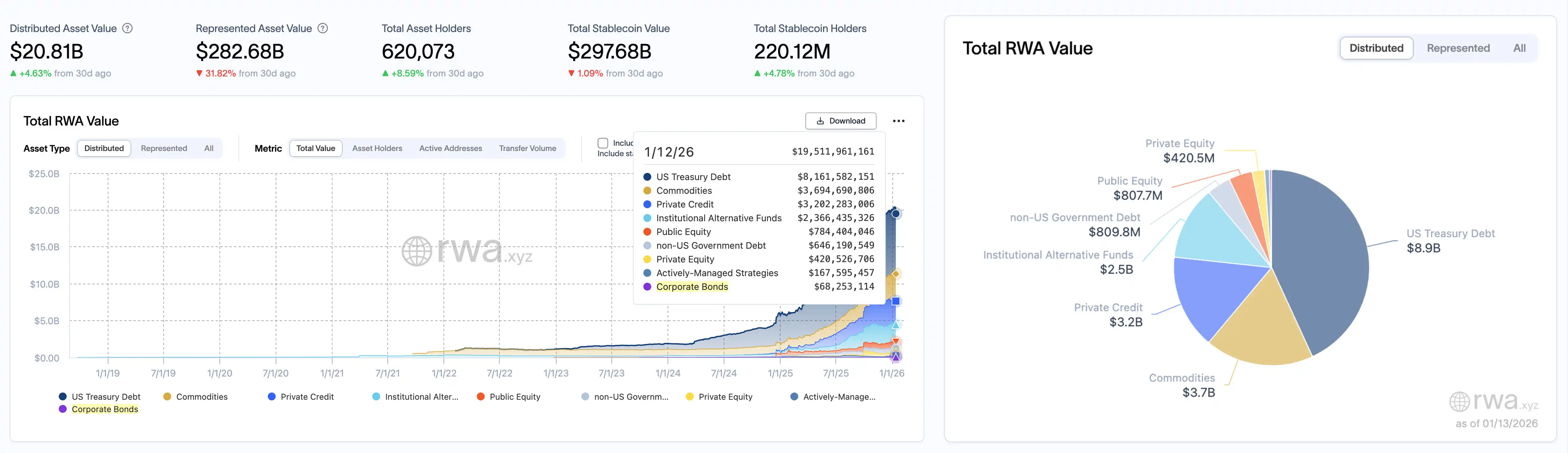
According to the rwa.xyz data dashboard, as of January 13, 2026, the total on-chain value of RWA (Distributed Asset Value) continued to rise, growing from $19.59 billion the previous week (January 6) to $20.81 billion, a net increase of $1.22 billion for the week, with a sequential growth rate of 6.23%, showing a stronger momentum compared to the previous week's 2.83% increase. Possibly due to another adjustment in statistical methodology, the broader RWA market size saw a significant correction, dropping from $401.53 billion to $282.68 billion, a reduction of approximately $118.85 billion, a steep decline of 29.6%. The number of on-chain asset users continued to grow, with the number of total holders increasing from 604,909 to 620,073, adding over 15,100 new users in a single week, a 2.5% increase. The expansion momentum of stablecoin users continued to strengthen, with holding addresses growing from 217.94 million to 220.12 million, an increase of 2.18 million users, a sequential 1% rise; the total market capitalization of stablecoins saw a slight correction, decreasing from $298.58 billion to $297.68 billion, a reduction of $900 million, a decline of about 0.3%.
In terms of asset structure, U.S. Treasury bonds remained firmly in the top position, with a total scale of $8.9 billion, a slight increase of $200 million from the previous period's $8.7 billion, a 2.3% gain. Commodity assets saw little change, recorded at $3.7 billion, up $100 million from the previous week's $3.6 billion, a 2.78% increase. Private credit rebounded significantly, growing from $2.3 billion to $3.2 billion, a weekly surge of $900 million, a substantial increase of 39%. Institutional alternative funds saw a slight correction, decreasing slightly from $2.6 billion to $2.5 billion, a drop of about $100 million, with minimal volatility. Non-U.S. government debt increased from $772.1 million to $809.8 million, a sequential growth of $37.7 million, a 4.88% increase. Public equity steadily rose, from $775.4 million to $807.7 million, an increase of approximately $32.3 million, a 4.2% gain. Private equity increased from $407.7 million to $420.5 million, recording modest growth of about 3.14%.
Trend Analysis (Compared to Last Week)
Overall, this period's on-chain RWA assets, excluding the impact of the sharp contraction in the broader RWA market due to statistical adjustments, still showed significantly accelerated growth momentum, with user numbers continuing to climb. Structurally, private credit performed exceptionally well this period, while U.S. Treasuries and commodity assets remained core holdings, with small fluctuations but continuous capital inflow. Non-U.S. debt and public equity continued their warming trend, indicating a stable preference for moderately risky debt and equity assets. Alternative assets (such as private equity, institutional strategies) remained stable, but their overall proportion did not increase further.
Market Keywords: On-chain acceleration, structural expansion, private credit explosion.
Key Event Review
Crypto Market Structure Draft Bans Interest Payments on Stablecoin Balances
SolanaFloor posted on platform X, stating that the latest crypto market structure draft adopts the stablecoin yield treatment method long pushed by banks, prohibiting interest payments solely for holding. Rewards linked to activities such as trading, staking, liquidity provision, or governance participation are still permitted.
RWA Market Cap Excluding Stablecoins Breaks $20 Billion, Hitting a New All-Time High
The tokenized digital securities platform Securitize quoted rwa.xyz data on platform X, showing that the market capitalization of RWA (Real World Assets) excluding stablecoins has broken through $20 billion, setting a new all-time high, demonstrating investors' continued interest in the blockchainization of traditional assets. The tokenized U.S. Treasury market performed particularly well, with a market cap exceeding $8.87 billion. Additionally, BlackRock's BUILD fund currently has a market cap of $1.73 billion.
Bipartisan Senate Inclined to Adjust GENIUS Stablecoin Yield Rules, CLARITY Act Nears Advancement
Sources revealed that bipartisan senators are gradually accepting the demands of banking lobbying groups regarding adjustments to the stablecoin yield rules in the GENIUS Act. Adjustment paths include: adopting the方案 proposed by Senator Alsobrooks, limiting yields to trading activities (more supported by Democrats); or requiring that only institutions holding a U.S. Office of the Comptroller of the Currency (OCC) bank charter can provide stablecoin yields. The latter is considered more friendly to parts of the crypto industry but is highly controversial in the DeFi space.
Additionally, it was reported that Scott is expected to submit the House version of the CLARITY Act as placeholder text tonight to initiate next week's review process. The formal text must be submitted by midnight Monday at the latest.
Other industry insiders involved in communications with Senate staff indicated that the previous statement that "prayer is needed for the bill to pass" was more of a light-hearted joke than a pessimistic judgment of the legislative prospects. The final direction may become clearer in the coming days.
Beijing Academy of Social Sciences Vice President: Suggests Adding Clauses to the "People's Bank of China Law" to Clarify Digital Yuan's Cross-Border Payment Functions
Fan Wenzhong, Vice President of the Beijing Academy of Social Sciences and Executive Director of the China Finance Society, wrote in the Hong Kong Wen Wei Po article "Steadily Promoting the Synergistic Innovation of Digital Yuan and Hong Kong Stablecoins," pointing out: The current cross-border use of the digital yuan mainly relies on internal regulations and pilot policies of the People's Bank of China, lacking clear legal authorization. It is suggested to add clauses during the revision of the "People's Bank of China Law" to clarify the digital yuan's cross-border payment functions and the legality of interconnecting with compliant foreign digital currency systems. Simultaneously, efforts should be made to specify special regulatory requirements and preferential policies for "stablecoin issuing institutions exchanging with the mainland's central bank digital currency" in the implementation rules of Hong Kong's "Stablecoin Ordinance," forming institutional synergy.
2025 Stablecoin Transaction Volume Reaches $33 Trillion, Hitting a Historic High
Bloomberg, citing Artemis Analytics data, reported that global stablecoin transaction volume surged 72% year-on-year in 2025, reaching a record $33 trillion. Driven by a pro-crypto policy environment, stablecoin usage expanded significantly.
Among them, the transaction volume of USDC, issued by Circle, reached $18.3 trillion, ranking first; the transaction volume of USDT, issued by Tether, was $13.3 trillion, also remaining high. Together, they account for the vast majority of stablecoin trading activity.
The report stated that after the Trump administration released more crypto-friendly policy signals, the use of stablecoins in payments, trade settlements, and cross-border capital flows increased significantly, making them one of the core infrastructures of the crypto market. Analysis believes that the explosive growth in stablecoin transaction volume highlights their rising importance in the global financial system and also brings higher attention to future regulatory and policy directions.
Paul Chan: Virtual Currency is Part of Financial Innovation, Hong Kong Should Embrace It But Must Handle It Cautiously
Hong Kong Financial Secretary Paul Chan, attending a program today, stated that Hong Kong's economic growth last year was 3.2%. Regarding the development of virtual currency and artificial intelligence, Chan pointed out that virtual currency is part of financial innovation, and Hong Kong should embrace it. However, the confidentiality of blockchain technology may bring risks such as insufficient investor protection, impact on anti-money laundering, and threats to financial stability. He emphasized that the Hong Kong government must handle it carefully and incorporate it into an appropriate regulatory framework. Chan also expressed skepticism about promoting virtual currency investment to the general public, believing that education and awareness should be strengthened.
An audience member suggested that Hong Kong could consider launching a gold-pegged stablecoin, as gold has long been regarded as a true store of value throughout history, especially meaningful in the current economic environment. Chan stated that stablecoins would be developed step by step, and after the first step is done well, suggestions of pegging to gold or other assets would be considered, emphasizing the need for cautious handling.
South Korea Lifts Nine-Year Corporate Crypto Ban, Allows Listed Companies Etc. to Invest 5% of Net Assets in Crypto Assets
The South Korean Financial Services Commission has finalized guidelines allowing listed companies and professional investors to trade cryptocurrencies. This new regulation ends a nine-year ban, allowing eligible corporate entities to invest up to 5% of their net assets annually in the top 20 cryptocurrencies by market cap on South Korea's top five exchanges.
This policy adjustment is expected to grant market access to about 3,500 entities, including listed companies and registered professional investment institutions. Regulators will also require exchanges to implement staggered execution and order size limits. Currently, whether USD stablecoins like USDT qualify for investment is still under discussion.
70 Economists Issue Open Letter: Calls for Digital Euro Project to Prioritize Public Interest
70 economists and policy experts issued an open letter calling on Members of the European Parliament to support a digital euro that clearly serves the public interest. The letter argues that this is crucial for Europe's monetary sovereignty and ensuring access to central bank money in an economy where cash use is declining. It warns that without a strong public option, private stablecoins and foreign payment giants could exert greater influence over digital payments in Europe. Signatories include José Leandro, former EU Executive Board Director of the European Bank for Reconstruction and Development (EBRD), French economist Thomas Piketty, among others. They describe the proposed central bank digital currency (CBDC) as a public good, advocating for a public digital payment method issued by the Eurosystem, with basic services free of charge, covering the entire euro area, to complement rather than replace cash.
World Liberty Markets Lending Platform to Support ETH and Stablecoins USD1, USDC, and USDT
The Trump family's crypto project, World Liberty Financial, launched a platform allowing users to lend digital assets among themselves, named "World Liberty Markets". The service will officially go live on Monday. In addition to Ethereum, stablecoins USDC and USDT, it will also support the company's own token WLFI and stablecoin USD1.
Stablecoin Company Rain Raises $250 Million at $1.95 Billion Valuation, Led by ICONIQ
Stablecoin company Rain announced it has raised $250 million at a valuation of $1.95 billion, led by ICONIQ, with participation from Sapphire Ventures, Dragonfly, Bessemer, Lightspeed, and Galaxy Ventures, among others. To date, the company's total funding exceeds $338 million. Rain helps clients launch stablecoin cards on the Visa network. The company plans to use this capital to expand its presence in North America, South America, Europe, Asia, and Africa markets. It will also use the funds to help adapt to the rapidly changing global regulatory environment.
Stablecoin Financial Infrastructure Provider VelaFi Completes $20 Million Series B Funding, Led by XVC and Ikuyo
Stablecoin financial infrastructure provider VelaFi announced the completion of a $20 million Series B funding round, led by XVC and Ikuyo, with participation from Planetree, BAI Capital, Alibaba's investment arm Alibaba Investment, among others. To date, the company's total funding has reached $40 million. VelaFi was founded in 2020, initially building payment infrastructure in Latin America, and has since expanded its business to the US and Asia. Its platform connects local banking systems, cross-border payment networks, and major stablecoin protocols, enabling businesses to transfer funds across markets faster and at lower cost than traditional systems.
Cathie Wood: US Government May "Directly Buy" Bitcoin to Reserve National Assets
ARK Invest founder Cathie Wood stated that the US government may begin directly purchasing Bitcoin in the future to build up the national Bitcoin strategic reserve, rather than relying solely on assets seized by law enforcement.
Wood pointed out in a recent episode of the "Bitcoin Brainstorm" podcast that although the Trump administration has established a national Bitcoin reserve through executive order, the source of the reserve so far has been limited to confiscated BTC, with no market purchases made yet. "The initial goal is to hold 1 million Bitcoin, so I think they will eventually start buying," Wood said.
She believes that Trump will still attach great importance to cryptocurrency issues under midterm election pressure, which is beneficial for the Bitcoin strategic reserve. On the one hand, Trump and his family's interests in the crypto industry are deepening; on the other hand, the crypto community played an important role in his winning the presidential election.
"He doesn't want to be a 'lame duck president.' He wants one or two more productive years in office, and he sees crypto as a path to the future," Wood said.
The report stated that the Trump administration has signed multiple executive orders establishing a Bitcoin reserve and crypto asset inventory, and formed a crypto and AI working group led by David Sacks to promote industry legislation including the GENIUS Act (stablecoin legislation).
Wall Street and Crypto Industry Hold Closed-Door Talks on Legislative Differences, Progress Made on DeFi and Yield-Bearing Stablecoins
Wall Street's main trade group, SIFMA, held private meetings with DeFi and crypto industry representatives to discuss differences in the Senate's crypto market structure bill, with "progress" made particularly around DeFi regulatory provisions.
Sources said SIFMA recently opposed regulatory exemptions for some DeFi protocols and developers in the bill, while joining banking lobbying groups in pushing to restrict yield-bearing dollar stablecoins. The crypto industry, on the other hand, is trying to persuade them to lower their demands to avoid undermining bipartisan negotiation results.
The time window is closing rapidly. Senate Banking Committee Chairman Tim Scott plans to advance the bill for review next week. The industry widely believes that if bipartisan support cannot be obtained at the committee stage, the bill will struggle to proceed to a full Senate vote. This bill is seen as key legislation reshaping the US crypto regulatory framework, and its final outcome remains highly uncertain.
Coinbase May Withdraw Support for CLARITY Act Due to Stablecoin Reward Ban
US cryptocurrency exchange Coinbase is increasing pressure on US lawmakers to resist proposals in the major cryptocurrency bill called the CLARITY Act that would ban certain decentralized finance provisions. Bloomberg, citing informed sources, reported that if the bill restricts stablecoin issuers from offering rewards on platforms like crypto exchanges, Coinbase may reconsider its support for the bill.
Banking groups are concerned that stablecoin rewards and yield products could siphon trillions of dollars away from the traditional banking system. The GENIUS Act passed in July 2025 prohibits stablecoin issuers from providing interest or yields to holders but did not explicitly prohibit third parties like crypto exchanges from offering rewards. The banking industry is now trying to close this loophole through the CLARITY Act. Stablecoins have become a major source of revenue for Coinbase, contributing nearly $247 million in revenue in the fourth quarter of 2024. The US Senate Banking Committee is expected to discuss this issue at its meeting this Thursday.
Hot Project Updates
Ondo Finance (ONDO)

One-Sentence Introduction:
Ondo Finance is a decentralized finance protocol focused on structured financial products and the tokenization of real-world assets. Its goal is to provide users with fixed-income products, such as tokenized U.S. Treasuries or other financial instruments, through blockchain technology. Ondo Finance allows users to invest in low-risk, high-liquidity assets while maintaining decentralized transparency and security. Its token, ONDO, is used for protocol governance and incentive mechanisms. The platform also supports cross-chain operations to expand its application within the DeFi ecosystem.
Previous Updates:
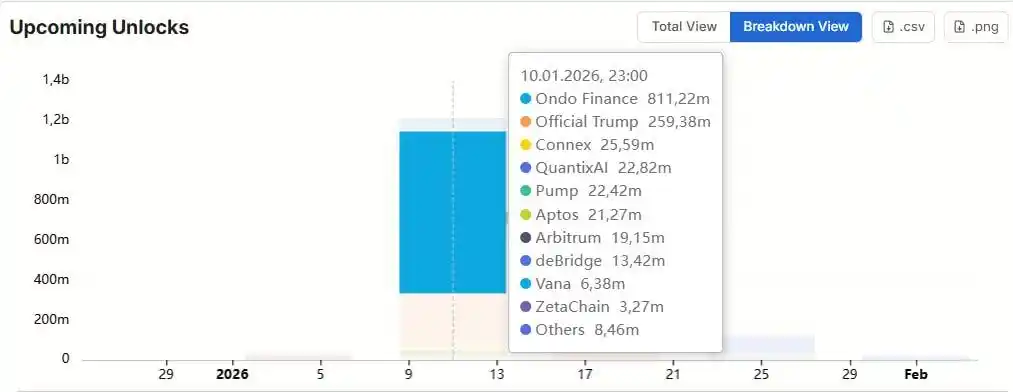
On January 4, according to onchainschool.pro monitoring, token unlocks worth over $1 billion are expected next week, including several well-known projects such as ONDO, TRUMP, PUMP, and APTOS.
Previously, Ondo Finance announced on platform X that its tokenized stocks and ETF platform will launch on the Solana blockchain in early 2026, aiming to bring Wall Street liquidity to the internet capital market.
MSX(STONKS)
One-Sentence Introduction:
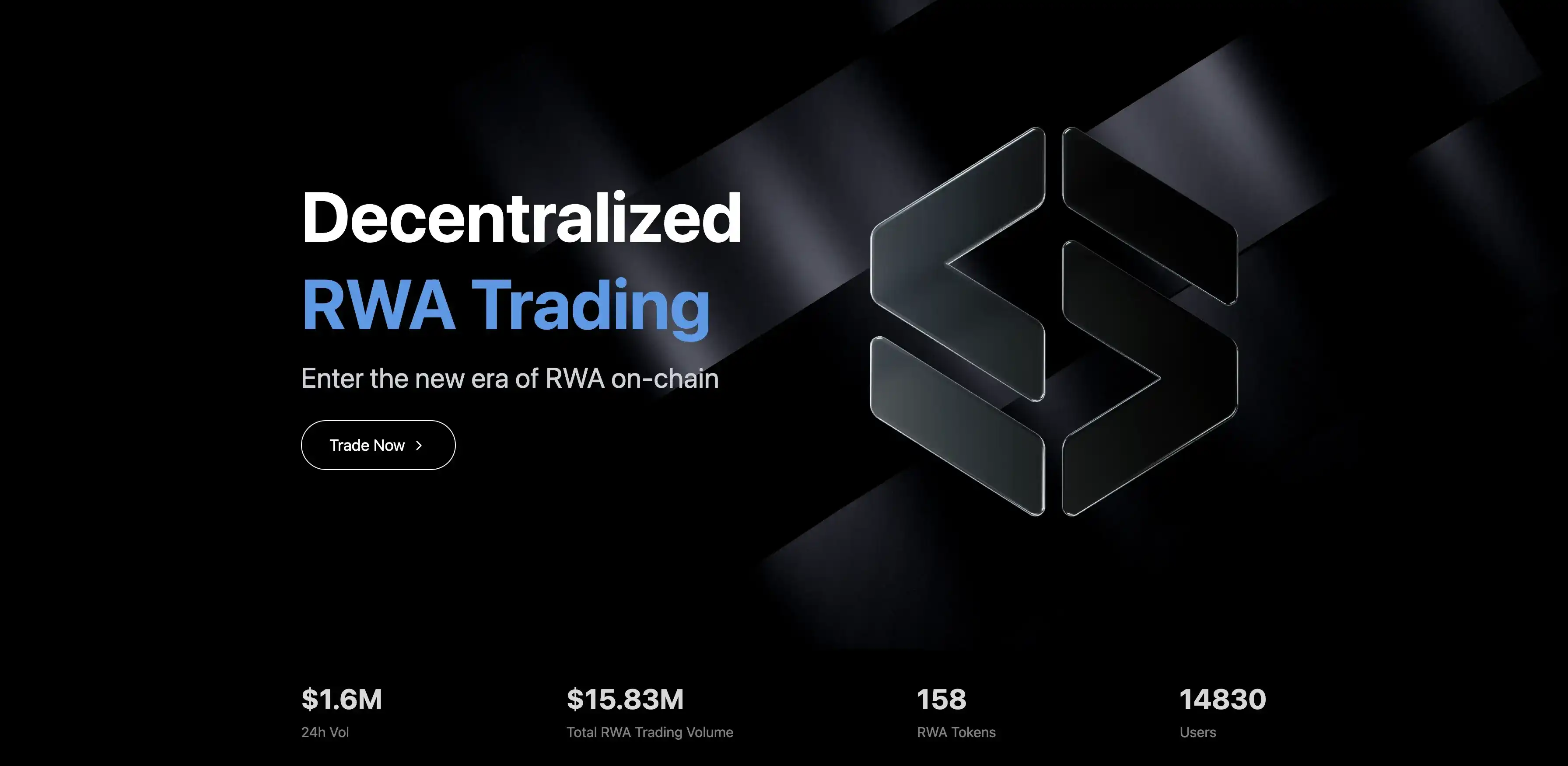
MSX is a community-driven DeFi platform focused on tokenizing U.S. stocks and other RWAs for on-chain trading. Through a partnership with Fidelity, the platform achieves 1:1 physical custody and token issuance. Users can use stablecoins like USDC, USDT, and USD1 to mint stock tokens such as AAPL.M and MSFT.M, and trade them 24/7 on the Base blockchain. All trading, minting, and redemption processes are executed by smart contracts, ensuring transparency, security, and auditability. MyStonks is committed to bridging the gap between TradFi and DeFi, providing users with a high-liquidity, low-barrier entry to on-chain U.S. stock investment, building the "Nasdaq of the crypto world".
Latest Update:
On January 13, MyStonks MSX announced a change to the RWA spot trading fee collection model effective immediately. After the adjustment, this section changed from the original "two-way fee" to a "one-sided fee." The specific implementation standard is that the buy side will maintain a 0.3% handling fee, while the sell side handling fee is reduced to 0. This means that when users complete a full trading cycle of "buy + sell," the comprehensive transaction cost will be substantially reduced by 50%. This fee policy is now effective across the entire MSX platform, covering all listed RWA spot trading pairs.
Previously, MyStonks MSX published a 2025 review article "Anchoring the Era Window, Co-building a New On-Chain U.S. Stock Ecosystem," reviewing the phased achievements of the year.
Related Links
《RWA Weekly Report Series》
Sorting out the latest insights and market data of the RWA sector.
《Deciphering Figure Q3: Why is it the Deserving Number One RWA Stock?》
Analyzing Figure's Q3 financial report, and evaluating from the recent updates to its revenue sources and business model whether its "blockchain-native" strategy constitutes a real moat, as well as its long-term investment value in the increasingly crowded RWA track.
《Institutional-Grade RWA Infrastructure 2026 Panorama: Five Protocols Restructure the $20 Billion Market》
The institutional RWA landscape in early 2026 shows an unexpected trend: there is no single winner because there is no single market.






