Russia May Block Global Crypto Exchanges Ahead Of New Regulatory Framework – Report

bitcoinist2026-02-19 tarihinde yayınlandı2026-02-19 tarihinde güncellendi

Özet

Russia is preparing to restrict access to global cryptocurrency exchanges by summer 2026 as part of a new domestic regulatory framework, according to industry experts. The move aims to shift trading activity from foreign platforms to Russian-based services. Analysts suggest that authorities may block overseas exchanges using methods similar to previous restrictions on platforms like Telegram and YouTube. However, experts warn that such measures could drive part of the market underground, increasing fraud and complicating regulation. Meanwhile, the European Union is considering broader sanctions on all Russia-related crypto transactions to prevent sanctions evasion, including a potential ban on digital ruble transactions.

Russia is preparing to restrict access to global crypto exchanges this summer, experts said, suggesting that authorities are planning to shift trading from foreign platforms to domestic ones under the upcoming regulatory framework.

Russia To Restrict Foreign Crypto Exchanges

On Tuesday, experts said Russia will likely block foreign crypto exchanges by summer 2026 as lawmakers advance the highly anticipated domestic framework, expected by July 1, to bring the industry out of the shadows.

According to a report by local news outlet RBC Crypto, industry participants believe authorities will soon begin restricting access to overseas exchanges, similar to the Telegram and YouTube block.

Nikita Zuborev, senior analyst at crypto exchange aggregator Bestchange.ru, told the news media outlet that this scenario is likely, asserting that as soon as the domestic market enters the new regulatory regime, “there is an almost 100% chance that the fight against major competitors will begin.”

“We expect that Roskomnadzor may begin mass blocking of websites of crypto exchanges and large exchangers not registered in Russia as early as this summer. Most likely, they will act according to the YouTube blocking model — they will delete DNS records in the Russian segment of the Internet and continue to fight against means of circumventing the blocks,” the analyst stated.

However, Zuborev cautioned that if global exchanges are not allowed to obtain licenses or to operate as agents of domestic exchanges or brokers, a part of the market will move underground, increasing fraud, complicating regulation, and resulting in higher commission fees.

Meanwhile, Dmitry Machikhin, lawyer and founder of BitOK, considers a “Belarusian scenario” highly possible. Notably, only companies operating under Belarus’ special regime can conduct cryptocurrency transactions, while individuals are prohibited from buying and selling digital assets on foreign platforms.

Machikhin noted that completely restricting operations is impossible, citing Binance as an example. The global exchange still has over 1 million Russian customers despite its departure from the country’s market. Therefore, the chances of a direct ban on transactions using foreign exchanges are low, the lawmakers added.

EU Explores Broader Sanctions

Ignat Likhunov, founder of Cartesius law agency, agreed with the other two experts, affirming, “It seems that blocking measures are being prepared in parallel with the creation of a ‘white’ zone, and conditions for ‘illegal’ exchangers and unfriendly foreign exchanges will deteriorate.”

He pointed out that the lack of “real levers of influence” over foreign exchanges, noting that the platforms don’t need to hurry to comply with any requirements of Russian legislation.

As a result, authorities will likely hold them accountable in absentia and block access to the foreign exchanges that enforce sanctions against Russia for various reasons, including economic or non-compliance with the law on data landing.

It’s worth noting that the European Union has been exploring implementing strict sanctions on all crypto transactions linked to Russia to limit sanctions evasion. As reported by Bitcoinist, the European Commission is strengthening its crackdown on the country’s use of digital assets to evade sanctions by considering measures to ban all Russia-related crypto transactions.

Legal documents show that the Commission has proposed a broader prohibition “instead of attempting to ban copycat Russian crypto entities spun out of already sanctioned platforms.” The proposal focuses on stopping the growth of successors to Russia-linked crypto exchange Garantex, while aiming at payment platforms such as A7 and its related ruble-pegged stablecoin A7A5.

The Commission also suggested adding 20 banks to the list of sanctioned entities and a ban on any digital ruble-related transactions.
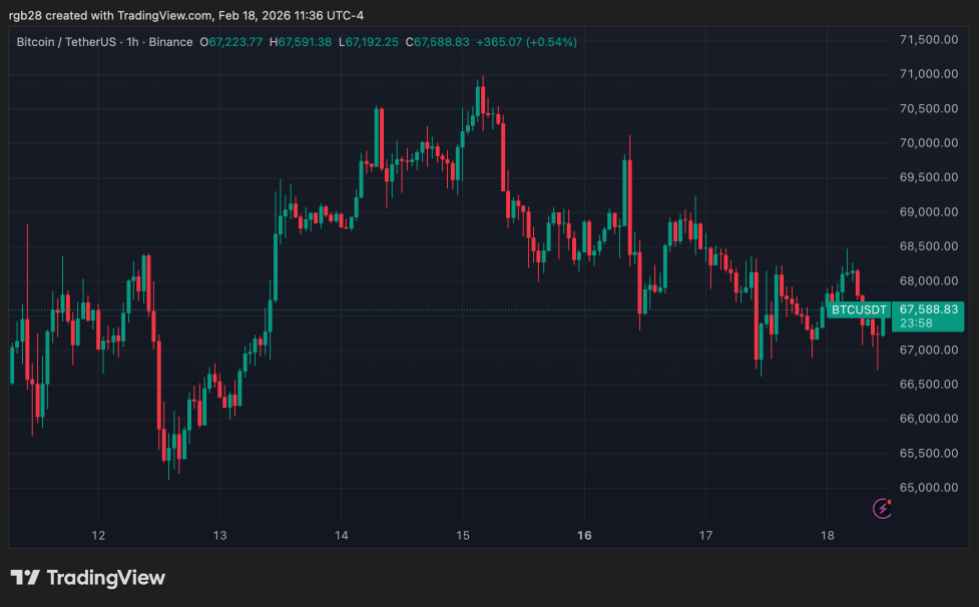
Bitcoin (BTC) trades at $67,588 in the one-week chart. Source: BTCUSDT on TradingView


İlgili Sorular

QWhat is Russia planning to do with global crypto exchanges according to the report?

ARussia is preparing to restrict access to global crypto exchanges, likely by blocking their websites, to shift trading activity to domestic platforms under a new regulatory framework expected by summer 2026.

QWhich Russian agency is expected to carry out the mass blocking of foreign crypto exchange websites?

ARoskomnadzor, Russia's federal executive body responsible for monitoring and controlling media and communications, is expected to begin mass blocking of these websites.

QWhat potential negative consequence did Nikita Zuborev warn about if global exchanges are not allowed to operate in Russia?

ANikita Zuborev warned that if global exchanges are not allowed to obtain licenses or operate as agents, a part of the market will move underground, leading to increased fraud, more difficult regulation, and higher commission fees.

QWhat alternative scenario, similar to another country's model, was suggested as a possibility for Russia's crypto regulation?

ADmitry Machikhin suggested a 'Belarusian scenario' is highly possible, where only companies operating under a special regime can conduct crypto transactions, while individuals are prohibited from using foreign platforms.

QWhat broader action is the European Union exploring regarding crypto transactions and Russia?

AThe European Union is exploring implementing strict sanctions to ban all crypto transactions linked to Russia to limit sanctions evasion, including a broader prohibition and a ban on any digital ruble-related transactions.

İlgili Okumalar

North Korean Hackers Loot $500 Million in a Single Month, Becoming the Top Threat to Crypto Security

North Korean hackers, particularly the notorious Lazarus Group and its subgroup TraderTraitor, have stolen over $500 million from cryptocurrency DeFi platforms in less than three weeks, bringing their total theft for the year to over $700 million. Recent major attacks on Drift Protocol and KelpDAO, resulting in losses of approximately $286 million and $290 million respectively, highlight a strategic shift: instead of targeting core smart contracts, attackers are now exploiting vulnerabilities in peripheral infrastructure. For instance, the KelpDAO attack involved compromising downstream RPC infrastructure used by LayerZero's decentralized validation network (DVN), allowing manipulation without breaching core cryptography. This sophisticated approach mirrors advanced corporate cyber-espionage. Additionally, North Korea has systematically infiltrated the global crypto workforce, with an estimated 100 operatives using fake identities to gain employment at blockchain companies, enabling long-term access to sensitive systems and facilitating large-scale thefts. According to Chainalysis, North Korean-linked hackers stole a record $2 billion in 2025, accounting for 60% of all global crypto theft that year. Their total historical crypto theft has reached $6.75 billion. Post-theft, they employ specialized money laundering methods, heavily relying on Chinese OTC brokers and cross-chain mixing services rather than standard decentralized exchanges. Security experts, while acknowledging the increased sophistication, emphasize that many attacks still exploit fundamental weaknesses like poor access controls and centralized operational risks. Strengthening private key management, limiting privileged access, and enhancing coordination among exchanges, analysts, and law enforcement immediately after an attack are critical to improving defense and fund recovery chances. The industry's challenge now extends beyond secure smart contracts to safeguarding operational security at the infrastructure level.

marsbit10 dk önce

North Korean Hackers Loot $500 Million in a Single Month, Becoming the Top Threat to Crypto Security

marsbit10 dk önce

Circle CEO's Seoul Visit: No Korean Won Stablecoin Issuance, But Met All Major Korean Banks

Circle CEO Jeremy Allaire's recent activities in Seoul indicate a strategic shift for the company, moving away from issuing a Korean won-backed stablecoin and instead focusing on embedding itself as a key infrastructure provider within Korea’s financial and crypto ecosystem. Despite Korea accounting for nearly 30% of global crypto trading volume—with a market characterized by high retail participation and altcoin dominance—Circle has chosen not to compete for the role of stablecoin issuer. Instead, Allaire met with major Korean banks (including Shinhan, KB, and Woori), financial groups, leading exchanges (Upbit, Bithumb, Coinone), and tech firms like Kakao. This approach reflects a broader industry transition: the core of stablecoin competition is shifting from issuance rights to systemic positioning. With Korean regulators still debating whether banks or tech companies should issue stablecoins, Circle is avoiding regulatory uncertainty by strengthening its role as a service and technology partner. The company is deepening integration with trading platforms, building connections, and promoting stablecoin infrastructure. This positions Circle to benefit regardless of which entity eventually issues a won stablecoin. Allaire also noted the potential for a Chinese yuan stablecoin in the next 3–5 years, underscoring a regional trend of stablecoins becoming more regulated and integrated with traditional finance. Ultimately, Circle’s strategy highlights that future influence in the stablecoin market will belong not necessarily to the issuers, but to the foundational infrastructure layers that enable cross-system transactions.

marsbit37 dk önce

Circle CEO's Seoul Visit: No Korean Won Stablecoin Issuance, But Met All Major Korean Banks

marsbit37 dk önce

SpaceX Ties Up with Cursor: A High-Stakes AI Gambit of 'Lock First, Acquire Later'

SpaceX has secured an option to acquire AI programming company Cursor for $60 billion, with an alternative clause requiring a $10 billion collaboration fee if the acquisition does not proceed. This structure is not merely a potential acquisition but a strategic move to control core access points in the AI era. The deal is designed as a flexible, dual-path arrangement, allowing SpaceX to either fully acquire Cursor or maintain a binding partnership through high-cost collaboration. This "option-style" approach minimizes immediate regulatory and integration risks while ensuring long-term alignment between the two companies. At its core, the transaction exchanges critical AI-era resources: SpaceX provides its Colossus supercomputing cluster—one of the world’s most powerful AI training infrastructures—while Cursor contributes its AI-native developer environment and strong product adoption. This synergy connects compute power, models, and application layers, forming a closed-loop AI capability stack. Cursor, founded in 2022, has achieved rapid growth with over $1 billion in annual revenue and widespread enterprise adoption. Its value lies in transforming software development through AI agents capable of coding, debugging, and system design—positioning it as a gateway to future software production. For SpaceX, this move is part of a broader strategy to evolve from a aerospace company into an AI infrastructure empire, integrating xAI, supercomputing, and chip manufacturing. Controlling Cursor fills a gap in its developer tooling layer, strengthening its AI narrative ahead of a potential IPO. The deal reflects a shift in AI competition from model superiority to ecosystem and entry-point control. With programming tools as a key battleground, securing developer loyalty becomes crucial for dominating the software production landscape. Risks include questions around Cursor’s valuation, technical integration challenges, and potential regulatory scrutiny. Nevertheless, the deal underscores a strategic bet: controlling both compute and software development access may redefine power dynamics in the AI-driven future.

marsbit1 saat önce

SpaceX Ties Up with Cursor: A High-Stakes AI Gambit of 'Lock First, Acquire Later'

marsbit1 saat önce

İşlemler

Spot
Futures
活动图片