Russia, Iran-Linked Groups Turn To Crypto For Crowdfunded Drone Purchases – Report

bitcoinist2026-03-31 tarihinde yayınlandı2026-03-31 tarihinde güncellendi

Özet

A recent Chainalysis report reveals that pro-Russia and Iran-affiliated groups are increasingly using cryptocurrency to fund purchases of commercially available drones and components, which have become central to modern conflict. These groups utilize crypto for both direct purchases from manufacturers and indirect acquisitions via third-party e-commerce platforms like Alibaba. Iran-linked entities, including the IRGC, have used crypto to buy drone parts, while pro-Russia militias have raised over $8.3 million in crypto donations since 2022 to purchase drones, often from Chinese manufacturers. The blockchain provides transparency into these transactions, highlighting how crypto is transforming conflict economics by enabling groups to crowdfund military equipment despite limited access to traditional finance.

A recent report has shared that Pro-Russia and Iran groups are turning to crypto to fund purchases of commercially available drones and related components, as the products become central to modern conflict.

Crypto-Funded Drone Purchases Linked To Russia, Iran

On Monday, blockchain analytics firm Chainalysis revealed that groups affiliated with Russia and Iran are utilizing crypto to fund the acquisition of low-cost military drones and their components.

The firm traced crypto flows from individual wallets linked to various paramilitary groups to the purchase of affordable drones and related components from vendors on e-commerce platforms.

According to the report, low-cost, commercially available drones have become central to modern conflict, enabling both state and non-state actors, including pro-Russia militias and Iran-backed terrorist organizations.

Most purchases use traditional financial channels, but Chainalysis noted that drone procurement networks are ⁠increasingly intersecting with the blockchain. As the firm explained, crypto can enter the drone procurement picture directly or indirectly. In the first scenario, a drone manufacturer openly accepts digital assets as payment on its website.

In the second scenario, electronics and dual-use component vendors that sell through third-party e-commerce platforms like Alibaba accept digital assets to sell drones and their parts to buyers whose identities and intended use are unclear.

The report found that Iran-linked groups have been using crypto to acquire drone components and sell military equipment, highlighting a wallet associated with Iran’s Islamic Revolutionary Guard Corps (IRGC) that purchased drone parts from a Hong Kong-based supplier.

As reported by Bitcoinist in January, Iran’s Ministry of Defence Export Center (Mindex), the state arms export arm, openly offered to accept crypto as payment for military hardware, including drones, air defense systems, warships, and ballistic missiles.

Paramilitary Groups ‘Crowdfund The Frontline’

Chainalysis also emphasized that the “most publicly visible crypto-drone nexus operates at the militia level, through open crowdfunding campaigns on social media platforms.”

The blockchain analytics firm has identified dozens of pro-Russia volunteer and paramilitary organizations asking for crypto donations for military equipment since Russia invaded Ukraine in ​2022.

Over the past four years, the pro-Russia groups have raised more than $8.3 million in these donations across various blockchains to purchase drones and associated components from global e-commerce platforms.

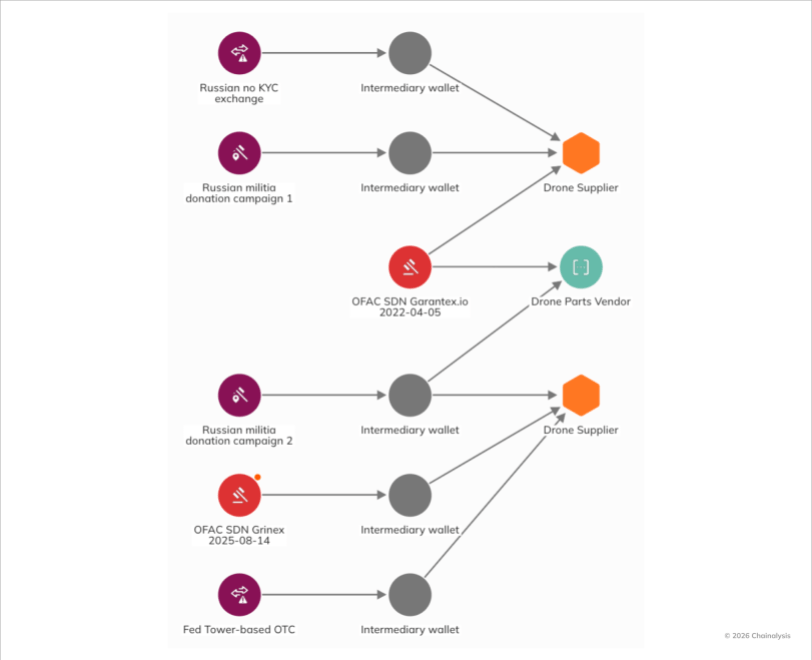
On-chain evidence shows Russian militia fundraising groups purchasing from a Hong Kong-based drone manufacturer and drone purchasers acquiring liquidity from Russian-language no-Know Your Client (KYC) exchanges, the sanctioned Russian exchanges Garantex and Grinex, and a Federation Tower-based OTC service.

To the firm, this strongly suggests that Russia-linked actors may have acquired drones from Chinese manufacturers for deployment in Ukraine. Chainalysis also matched crypto transactions between $2,200-$3,500 to the exact prices of drones and their components on ​e-commerce platforms.

Russian militia donation campaign wallets purchase drones via intermediaries. Source: Chainalysis

“The striking point is not the dollar figure, but the logic. At the militia level, low-cost commercial drones are among the most tactically significant items crowdfunded crypto can buy,” the report affirmed.

“At $2,200–$3,500 per unit, a single successful fundraising campaign translates directly into battlefield capability for groups that cannot access conventional finance,” it continued.

The firm underscored that the blockchain offers new opportunities to trace these flows and obtain a better understanding of how emerging technologies are “transforming the economics of conflict.”

“On the blockchain, there’s this incredible opportunity, once you have ‌identified the ⁠vendor to see the counterparty activity and make assessments that help clarify that utilization and the intent behind the purchase,” Andrew Fierman, Chainalysis’s head of national security intelligence, told Reuters
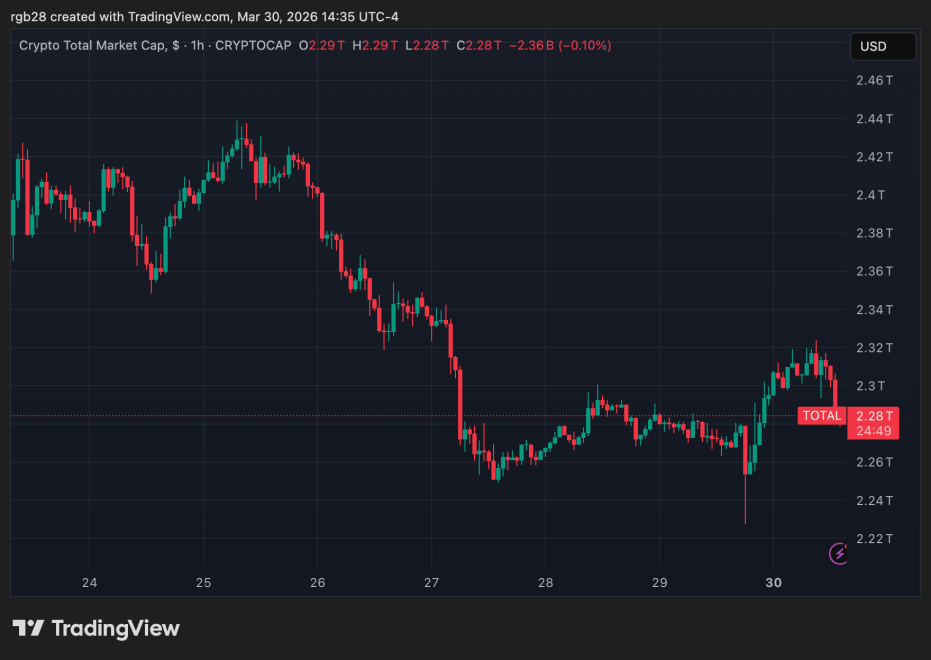
Total crypto market capitalization is at $2.28 trillion on the one-week chart. Source: TOTAL on TradingView


İlgili Sorular

QAccording to the report, how are pro-Russia and Iran-linked groups using cryptocurrency in relation to drone procurement?

AThey are using cryptocurrency to fund the acquisition of low-cost military drones and related components, often through crowdfunding campaigns on social media and purchases from vendors on e-commerce platforms.

QWhat are the two main scenarios described in which cryptocurrency enters the drone procurement process?

AThe first scenario is when a drone manufacturer openly accepts digital assets as payment on its website. The second is when electronics and dual-use component vendors on third-party e-commerce platforms accept crypto from buyers whose identities and intended use are unclear.

QWhich specific Iran-linked group was identified as using a crypto wallet to purchase drone parts, and from where?

AA wallet associated with Iran’s Islamic Revolutionary Guard Corps (IRGC) was used to purchase drone parts from a Hong Kong-based supplier.

QHow much money have pro-Russia groups raised through crypto donations for military equipment since the invasion of Ukraine, and what is its primary use?

APro-Russia groups have raised more than $8.3 million in crypto donations, which is primarily used to purchase drones and associated components from global e-commerce platforms.

QWhat does the report identify as the 'most striking point' about these crypto-funded drone purchases, and why?

AThe most striking point is not the dollar figure, but the logic. For militia-level groups that cannot access conventional finance, a single successful campaign raising $2,200–$3,500 can directly translate into significant battlefield capability by funding a low-cost commercial drone.

İlgili Okumalar

In-depth: The Foreign Guest Genspark

The article "The Foreign Guest: Genspark" investigates the identity and business practices of AI startup Genspark, which presents itself as a Palo Alto-based "AI Costco" offering a subscription bundle of over 70 models and numerous AI agent tools. Despite its official Silicon Valley narrative, Genspark's founding team has deep roots in Chinese tech giant Baidu, a history systematically downplayed in its branding. The company actively cultivates an image as an elite US firm, heavily publicizing partnerships and endorsements from OpenAI, Anthropic, and Microsoft, while distancing itself from the Chinese AI community and obscuring its connections to Chinese investors and open-weight models (like those from DeepSeek, Moonshot AI, and MiniMax) that power its services. Genspark's core strategy involves rapidly cloning and integrating successful AI product concepts (e.g., from Perplexity, Manus, Plaud) into its unified platform, supported by aggressive marketing, including Super Bowl ads and paid native content in publications like The Wall Street Journal. Critically, the article suggests a significant portion of its engineering and product development is conducted by a team in Beijing, operating outside its official US corporate structure. This duality allows Genspark to leverage Chinese talent and models for efficiency and cost reduction while constructing a public facade as a purely American success story. The piece concludes that Genspark's most effective agent is its own corporate identity, meticulously engineered to obscure its Chinese underpinnings and be perceived solely as a Silicon Valley company.

marsbit42 dk önce

In-depth: The Foreign Guest Genspark

marsbit42 dk önce

Debate: Korean Workers Fear Unemployment, While Musk Envisions a Society 'Without Work'?

While South Korean auto workers fear job losses from robotics, Elon Musk envisions a future where AI and robots render most work optional. This article explores the growing tension between immediate anxieties over automation and long-term visions of a post-work society. The piece begins with recent strikes at Hyundai's Korean plants, where unions, amid standard wage negotiations, also sought job guarantees against advancing robotics—specifically mentioning Boston Dynamics' Atlas. This reflects how anxiety about technological displacement is emerging even before robots are fully capable of replacing skilled labor on assembly lines. The author argues that while current robotics still struggle with the nuanced, experiential knowledge of veteran workers, the *perception* of imminent replacement is fueling social conflict prematurely. This modern "Luddite" sentiment is compared to the 19th-century English textile workers who smashed machines. Historically, Luddites weren't simply anti-technology; they were protesting the rapid devaluation of their skills and the unequal distribution of productivity gains. Similarly, today's workers ask who will bear the cost of transition and share in the new wealth created by machines. In contrast, figures like Elon Musk propose an optimistic endpoint: with AI and robotics driving extreme abundance, the link between work and survival could break. He suggests concepts like "Universal High Income" could allow society to share the technological bounty, transforming work from a necessity into a choice. The core challenge, however, lies in the transition. The author notes that technology's benefits diffuse slowly, while its disruptive costs—job losses, skill obsolescence—can be concentrated and immediate. The risk is a painful interim period where productivity gains are captured by a few before new social contracts, safety nets, and retraining systems are established. The conclusion calls for proactive governance. Just as past industrial revolutions gave rise to labor standards and social safety nets, the robotics era needs its own frameworks. These should address job transition support, distribution of productivity gains, safety liability, and ethical deployment. Embracing such "constraints" is not opposition to progress but a necessary step to ensure technology benefits society broadly. The discussion sparked by Hyundai's workers, therefore, is not premature but essential.

marsbit55 dk önce

Debate: Korean Workers Fear Unemployment, While Musk Envisions a Society 'Without Work'?

marsbit55 dk önce

İşlemler

Spot
活动图片