Running Gemma 4 Locally on iPhone Goes Viral: How Far Are We from the Zero Token Era?

marsbit2026-04-06 tarihinde yayınlandı2026-04-06 tarihinde güncellendi

Özet

Google's newly open-sourced Gemma 4 model, built on the same architecture as Gemini 3, has gained significant attention for its ability to run locally on mobile devices like the iPhone and Samsung Galaxy. With smaller versions such as E2B (2.3B parameters) and E4B (4.5B parameters), it supports native multimodal capabilities and offers a 128K context window. Users report impressive speeds—over 40 tokens per second on Apple chips with MLX optimization—making it feel "like magic." The model is accessible via Google’s official AI Edge Gallery app, ensuring ease of use and security. While Gemma 4 excels in tasks like text generation, coding, and image understanding, it struggles with more complex agent-based workflows, such as tool calling and structured outputs, where models like Qwen3-coder perform better. Despite some limitations in reasoning, Gemma 4’s local performance hints at a future where everyday AI tasks—chat, coding, reasoning—can be handled offline, reducing reliance on cloud-based token services. Although cloud models still lead in advanced reasoning and large-scale multi-agent tasks, the trend suggests that as hardware and quantization improve, on-device models will increasingly handle high-frequency simple tasks. This shift could disrupt the AI industry’s reliance on token sales and API subscriptions, pushing providers to focus on more complex, data-intensive capabilities. Gemma 4 is just the beginning of this transformation.

Machine Heart Editorial Department

Google's newly open-sourced model, Gemma 4, released a few days ago, gave the industry a huge surprise.
It adopts the same technological architecture as Gemini 3, supports native full-modality, ranked third globally on the Arena AI leaderboard, and comes in multiple model sizes. Several smaller models — E2B (2.3B effective parameters) and E4B (4.5B effective parameters) — can be deployed directly to run locally on mobile devices, with a context window of 128K. They can be described as a "Gemini alternative that fits in your pocket".

As expected, the model quickly became a new toy for mobile users after its release.

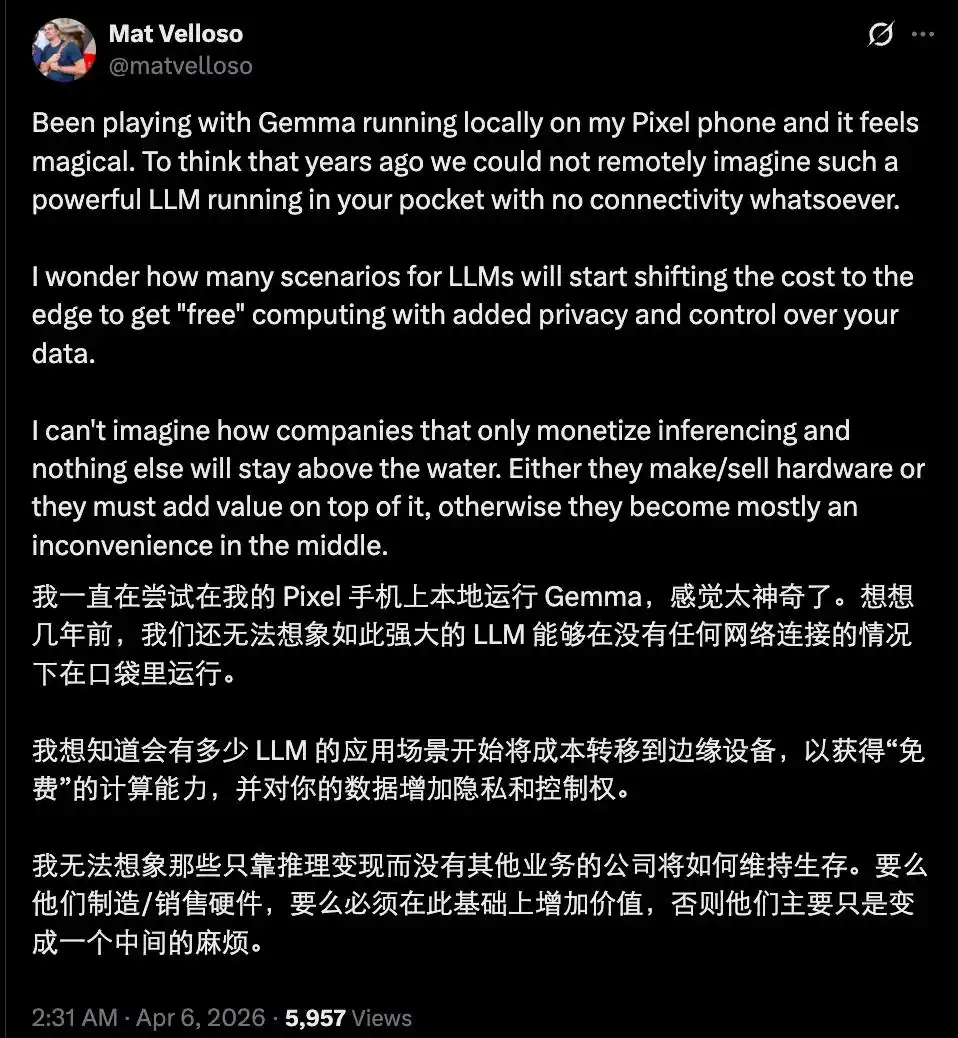
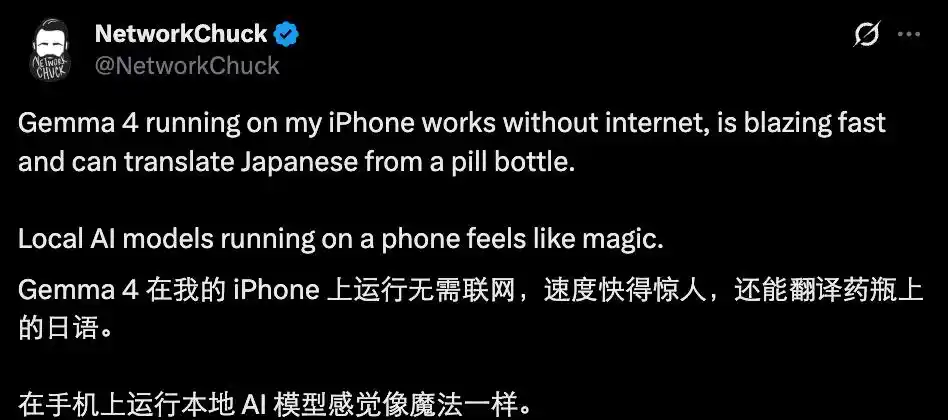
Among them, a post by an X user was viewed hundreds of thousands of times. In the post, he shared a video demonstrating how he ran Gemma 4 locally on an iPhone, including processing images, audio, and controlling the flashlight. He stated that Gemma 4 is incredibly fast, feeling like magic.
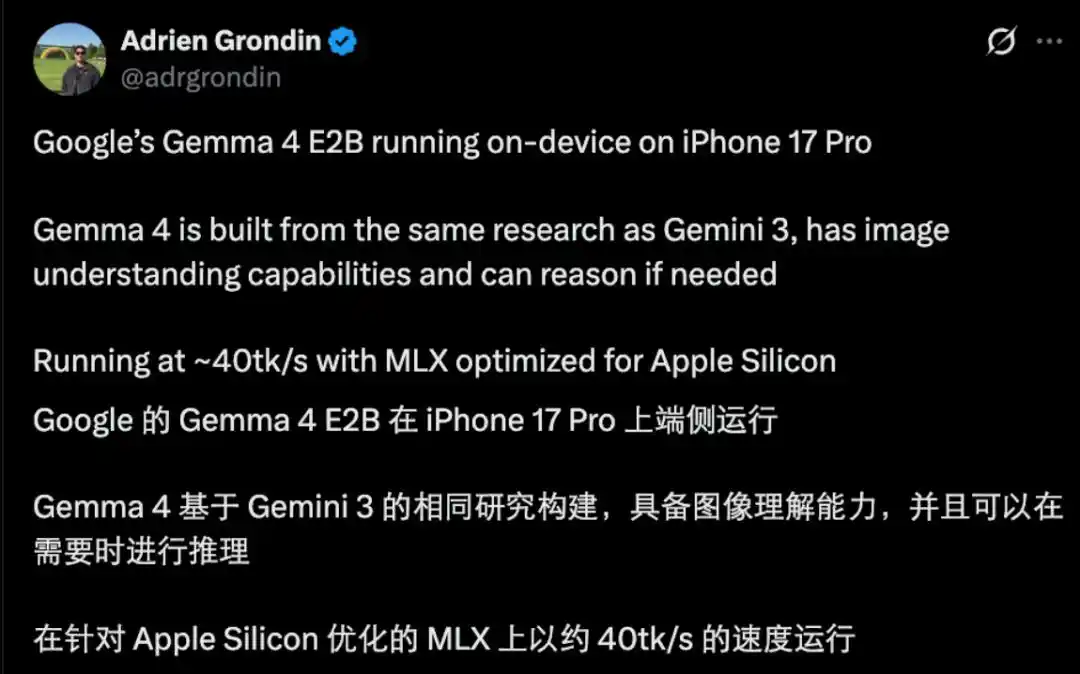
Someone quantified this speed on an iPhone 17 Pro, pointing out that if the phone uses Apple silicon, the model's inference speed can exceed 40 tokens per second with the help of MLX (Apple's machine learning framework) optimized for this chipset.
Others achieved similar speeds on a Samsung Galaxy, even with a 'thinking mode' enabled. This led people to exclaim that it's "unbelievably fast".
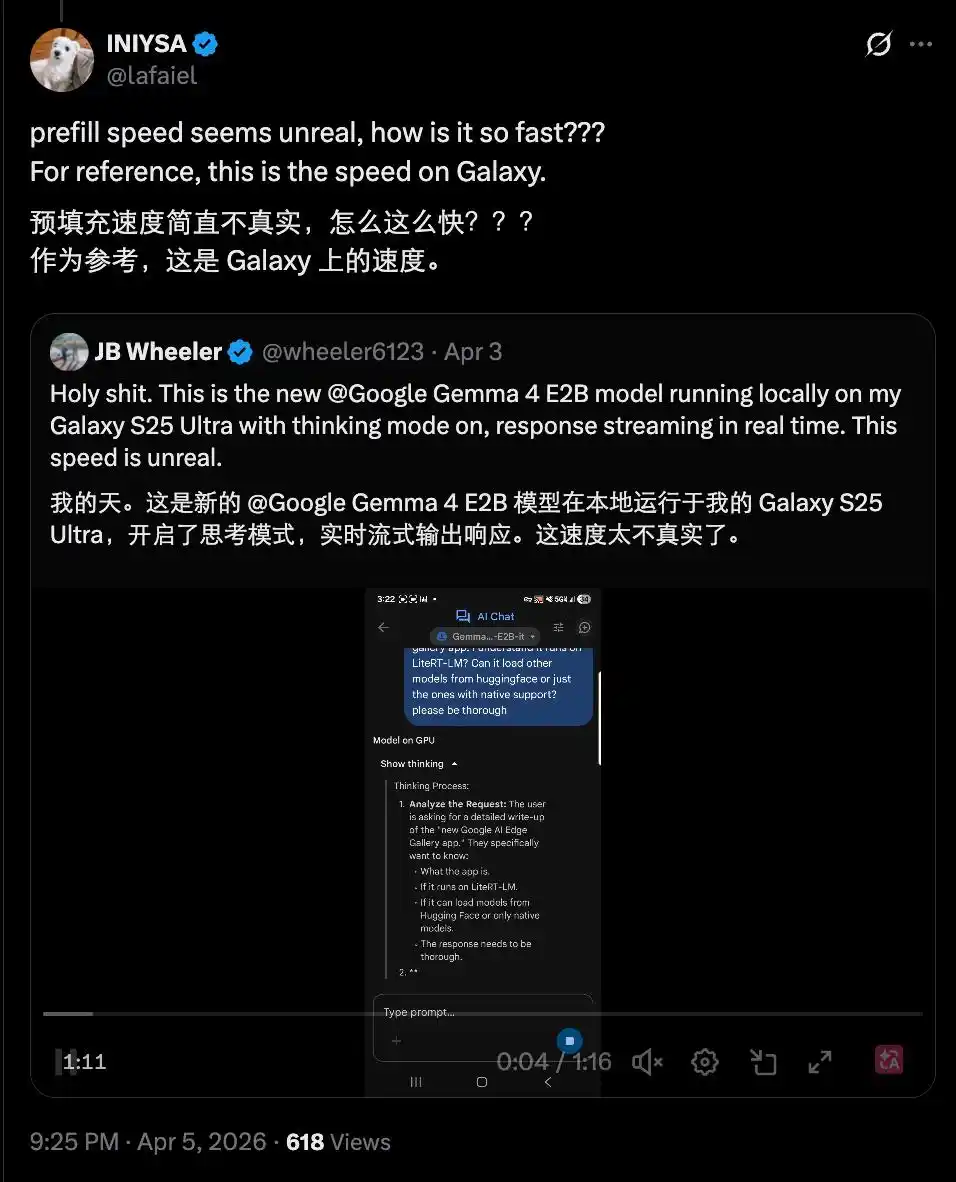
Such speeds make running AI models on mobile devices a viable option for the future, and are particularly useful in sensitive scenarios like healthcare.
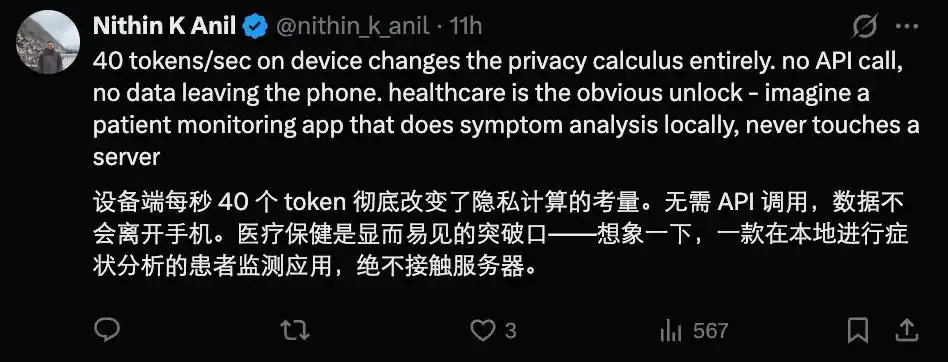
The 128k context window also makes these small models more attractive.

So how do you run it? It's actually very simple and not exclusive to geeks, because Google released an official App — Google AI Edge Gallery. Those who want to experience it on their phone can directly download this App, then download the desired model version, and open it to run.
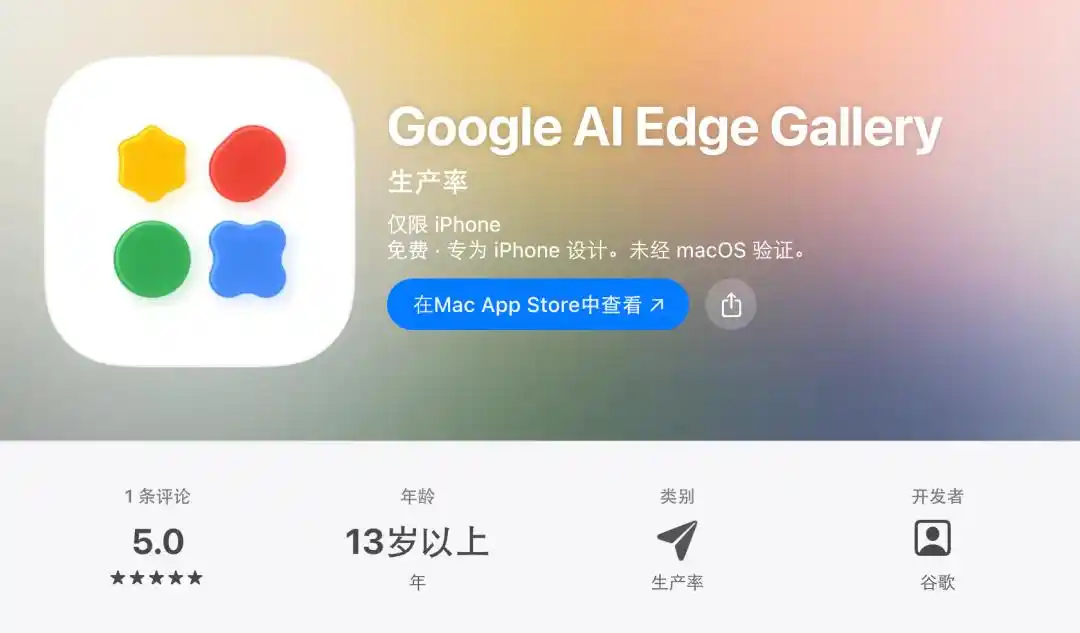
Moreover, since it's officially released by Google, security concerns are naturally less of an issue.

Beyond these small models running on phones, some have tried larger versions of Gemma 4 on more powerful hardware, such as running Gemma 4 Mixture-of-Experts 26B on a MacBook Pro with an M5 Pro chip.

For direct conversation, this model is still very fast, with smooth text generation and code explanation.

But when he actually tried to use Gemma 4 as a coding agent, problems arose. Because running an agent requires a large context (Gemma 4 26B has a 256k context window), complex prompts, and stable tool calls, Gemma 4 clearly couldn't handle it, often freezing, reporting errors, or outputting incorrect structures.

The turning point came when he switched the model to qwen3-coder. In the same environment, file creation, command execution, and multi-step tasks all ran normally. He believes the problem lies not with the agent framework, but with whether the model itself has been optimized for "tool calling + structured output". In this regard, Gemma 4 might not be sufficient, or perhaps this developer hasn't found the correct method yet.
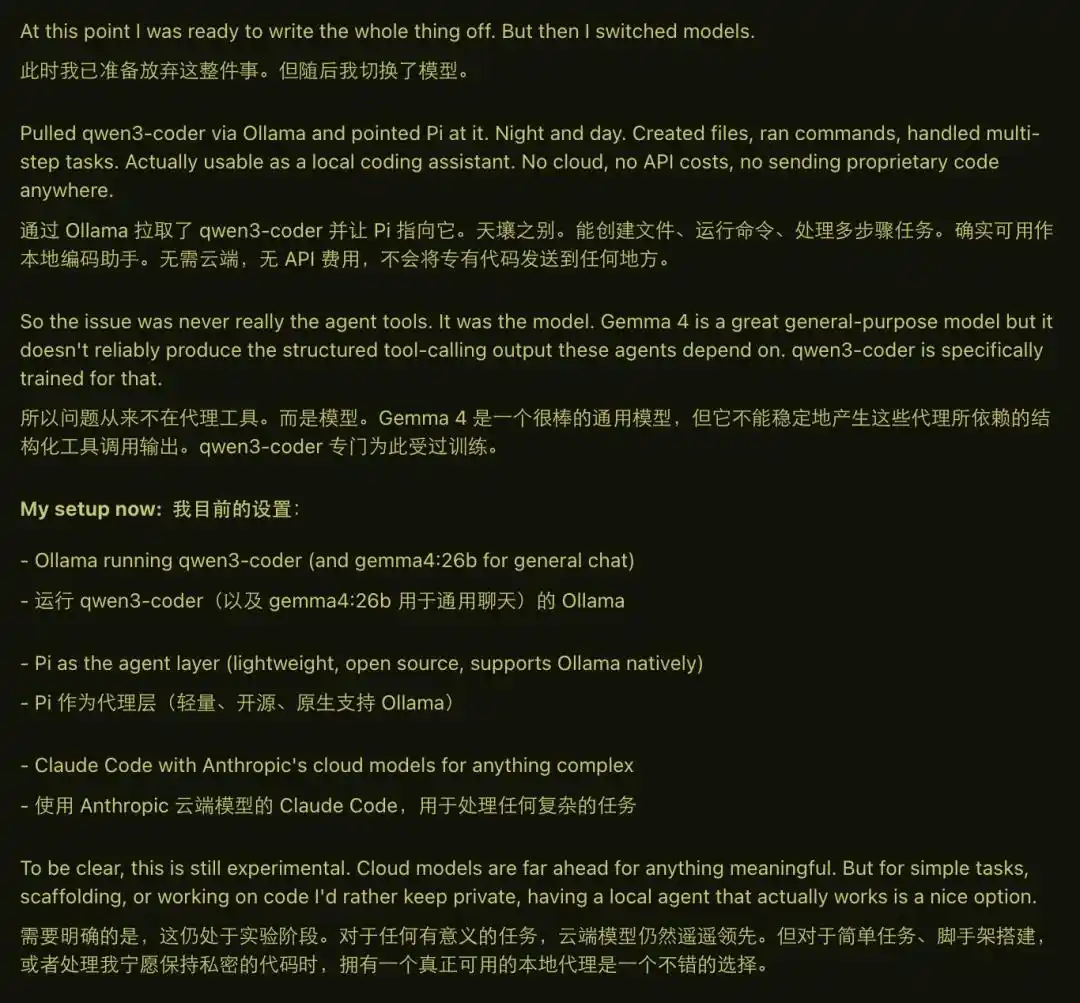
Additionally, some say that Gemma 4's intelligence level is still somewhat lacking.

Even so, the emergence of a "performance powerhouse" like Gemma 4 should not be underestimated. If in the future, a large number of daily queries, chats, simple reasoning, code generation, and image understanding tasks can all be run locally without needing to buy tokens, wouldn't vendors who sell tokens be in an awkward position?
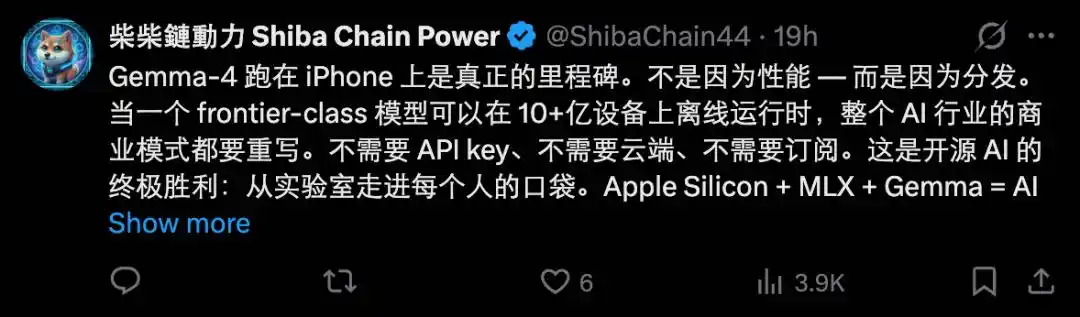
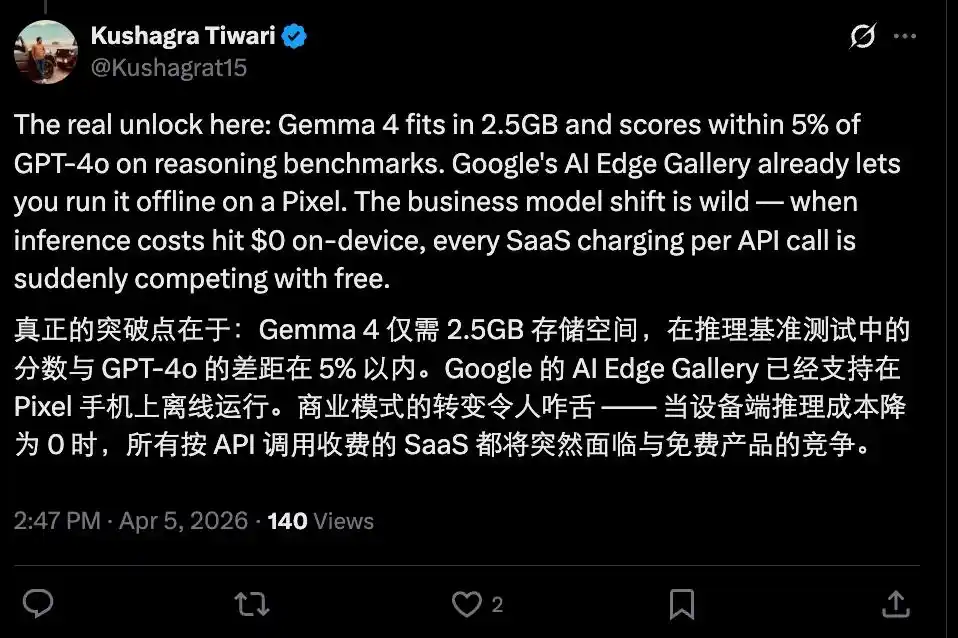
Of course, the current situation is not that pessimistic yet. After all, there is still a gap between the currently open-sourced models and the cutting-edge closed-source flagship models. Furthermore, most capable open-source models are still constrained by hardware capabilities and暂时 (zànshí - temporarily) haven't reached a usable level on the device side.

But the future trend is clear. In the short term, cloud-based closed-source models will still lead in cutting-edge complex reasoning and ultra-large-scale multi-agent collaboration. But in the long term, as hardware continues to advance and quantization techniques continue to optimize, on-device models will gradually encroach on the cloud's high-frequency simple tasks.

Those vendors who rely solely on selling tokens and API subscriptions will have to compete more fiercely on the "truly tough" parts — super-powered Agents, ultra-long reliable context, and specialized capabilities requiring massive real-time data.

Gemma 4 is just the beginning. The next surprise might be an on-device model that, in daily use, completely makes users unaware of the difference between "local" and "cloud". When that day comes, the entire AI industry's business model will undergo a real reshuffle.

This article is from the WeChat public account "Machine Heart" (ID: almosthuman2014), author: Machine Heart


İlgili Sorular

QWhat is the key feature of Google's newly open-sourced Gemma 4 model that makes it suitable for mobile devices?

AGemma 4 has smaller variants, E2B (2.3B effective parameters) and E4B (4.5B effective parameters), which are designed to run locally on mobile devices with a 128K context window.

QWhat speed was reported for running Gemma 4 on an iPhone 17 Pro with Apple's MLX framework?

AThe model's inference speed was reported to exceed 40 tokens per second on an iPhone 17 Pro using Apple's optimized MLX framework.

QWhat is the name of the official Google app that allows users to easily run Gemma 4 on their mobile devices?

AThe official app is called 'Google AI Edge Gallery', where users can download the model and run it directly.

QWhat was a significant limitation observed when using the larger Gemma 4 26B model as a coding agent?

AThe Gemma 4 26B model struggled with tasks requiring large context (256K), complex prompts, and stable tool calls, often leading to crashes, errors, or incorrect structured outputs.

QAccording to the article, what long-term impact could the advancement of on-device models like Gemma 4 have on the AI industry?

AOn-device models could gradually erode the market for cloud-based models on high-frequency simple queries, forcing API and token-selling companies to focus on more complex areas like super-powered Agents, ultra-long reliable context, and capabilities requiring massive real-time data.

İlgili Okumalar

ChatGPT Might Be Disappearing Soon

OpenAI announced at its "Intelligence at Work" event that its coding assistant, Codex, will be fully integrated into the ChatGPT app within weeks. This move marks a strategic shift from a conversational AI (Chat) towards a unified "agentic" platform capable of execution. Codex, originally launched to compete with Anthropic's Claude Code, has grown rapidly to 5 million weekly active users, with 20% being non-developers like analysts and designers. Its enterprise revenue now constitutes 40% of OpenAI's total. The integration is the first step in creating a super-app combining ChatGPT (interface), Codex (execution engine), and the Atlas browser (web access). OpenAI also unveiled new Codex features: specialized Agent plugins for six professional roles, an "Annotations" tool for direct document editing, and a "Sites" function to turn work into shareable web apps. Internally, this reflects a power shift; the Codex team now leads core product strategy. While the ChatGPT brand remains for its vast user base, the platform's future is focused on autonomous agents that perform tasks, not just chat. The article notes that competition with Claude Code pushed OpenAI's development, with Codex competing on cost-effectiveness and accessibility rather than raw coding quality. It concludes that the essence of "ChatGPT" is evolving from a chatbot into an AI agent platform, with the name potentially becoming a legacy symbol of its original function.

marsbit6 dk önce

ChatGPT Might Be Disappearing Soon

marsbit6 dk önce

WWDC26 Ultimate Preview: The All-New Siri is the Main Course, iOS 27 is Another Year of Refinements

Apple has confirmed WWDC26 will begin on June 8, with the keynote at 10 AM PT (1 AM Beijing Time, June 9). This year's focus is expected to shift significantly from routine OS updates to Apple's progress in AI, particularly a major overhaul of Siri. Reports indicate the highlight will be a new Siri, reportedly powered by Google's Gemini technology. This upgraded assistant is expected to appear as a lightweight bubble from the Dynamic Island and be accessible via a unified "Search or Ask" system-wide entry point. It aims to deeply integrate with iOS 27, iPadOS 27, and macOS 27, accessing personal data like messages, photos, and documents, with a potential standalone Siri app also in development. For iOS 27, leaks suggest incremental improvements rather than major redesigns. Key updates may include a redesigned, more customizable Camera app, enhanced photo editing tools within the Photos app, and potential early system optimizations for a future foldable iPhone. The update is also rumored to prioritize bug fixes, stability, and performance optimization. iPadOS 27 is anticipated to focus on improving productivity features like window management, file systems, and external display support to better utilize the iPad's hardware. macOS 27 is seen as a core platform for Apple Intelligence, likely receiving an optimized Siri, new AI features, and continued refinement of the "Liquid Glass" design language. Notably, macOS 27 may finally drop support for Intel-based Macs. The overarching theme for WWDC26 is whether Apple can effectively integrate AI across its ecosystem. The success of the new Siri and Apple Intelligence will be judged on their ability to move beyond standalone features and become a cohesive, context-aware system layer that understands user workflows across iPhone, iPad, Mac, and other devices, while maintaining Apple's emphasis on privacy and stability. The conference represents Apple's critical attempt to catch up and redefine the AI assistant experience after a perceived slow start in the generative AI era.

marsbit31 dk önce

WWDC26 Ultimate Preview: The All-New Siri is the Main Course, iOS 27 is Another Year of Refinements

marsbit31 dk önce

İşlemler

Spot
Futures

Popüler Makaleler

4 Nasıl Satın Alınır

HTX.com’a hoş geldiniz! 4 (4) satın alma işlemlerini basit ve kullanışlı bir hâle getirdik. Adım adım açıkladığımız rehberimizi takip ederek kripto yolculuğunuza başlayın. 1. Adım: HTX Hesabınızı OluşturunHTX'te ücretsiz bir hesap açmak için e-posta adresinizi veya telefon numaranızı kullanın. Sorunsuzca kaydolun ve tüm özelliklerin kilidini açın. Hesabımı Aç2. Adım: Kripto Satın Al Bölümüne Gidin ve Ödeme Yönteminizi SeçinKredi/Banka Kartı: Visa veya Mastercard'ınızı kullanarak anında 4 (4) satın alın.Bakiye: Sorunsuz bir şekilde işlem yapmak için HTX hesap bakiyenizdeki fonları kullanın.Üçüncü Taraflar: Kullanımı kolaylaştırmak için Google Pay ve Apple Pay gibi popüler ödeme yöntemlerini ekledik.P2P: HTX'teki diğer kullanıcılarla doğrudan işlem yapın.Borsa Dışı (OTC): Yatırımcılar için kişiye özel hizmetler ve rekabetçi döviz kurları sunuyoruz.3. Adım: 4 (4) Varlıklarınızı Saklayın4 (4) satın aldıktan sonra HTX hesabınızda saklayın. Alternatif olarak, blok zinciri transferi yoluyla başka bir yere gönderebilir veya diğer kripto para birimlerini takas etmek için kullanabilirsiniz.4. Adım: 4 (4) Varlıklarınızla İşlem YapınHTX'in spot piyasasında 4 (4) ile kolayca işlemler yapın.Hesabınıza erişin, işlem çiftinizi seçin, işlemlerinizi gerçekleştirin ve gerçek zamanlı olarak izleyin. Hem yeni başlayanlar hem de deneyimli yatırımcılar için kullanıcı dostu bir deneyim sunuyoruz.

380 Toplam GörüntülenmeYayınlanma 2025.10.20Güncellenme 2026.06.02

4 Nasıl Satın Alınır

Tartışmalar

HTX Topluluğuna hoş geldiniz. Burada, en son platform gelişmeleri hakkında bilgi sahibi olabilir ve profesyonel piyasa görüşlerine erişebilirsiniz. Kullanıcıların 4 (4) fiyatı hakkındaki görüşleri aşağıda sunulmaktadır.

活动图片