Roughnecks Halt BIP-110 Standard Mining Amid Ocean Hashrate Plunge

cryptonews.ru2026-08-09 tarihinde yayınlandı2026-08-09 tarihinde güncellendi

Özet

The mining group Roughnecks announced on August 9 that it is halting mining on the BIP-110 chain following a drastic 96.5% drop in the associated hash rate on the Ocean mining pool. The decision came shortly after the Bitcoin network split at block height 961,632, where the majority chain rejected the BIP-110 soft fork proposal. While Roughnecks successfully mined blocks 961,632 and 961,633 on the minority fork, it failed to attract significant additional hash power, leaving the chain stalled. The minority chain inherited Bitcoin's high mining difficulty, designed for a vastly larger network. With only a tiny fraction of the original hash rate, block generation slowed to a crawl, making the next difficulty adjustment—2,016 blocks away—potentially hundreds of days out of reach. This created an unsustainable economic feedback loop for miners. BIP-110, the "Reduced Data Temporary Softfork," aimed to temporarily restrict methods for embedding non-financial data (like Ordinals) in Bitcoin transactions. Its activation required 55% miner signaling over a difficulty period, but support peaked at only 2.5-2.6%. After the mandatory split, the dominant Bitcoin chain continued normally, quickly outpacing the minority fork by dozens of blocks. The outcome highlights the disconnect between node rules and mining economics. Software can enforce different rules, but a chain requires sufficient hash power to remain viable. Roughnecks characterized continued mining under these conditions as ...

The group announced the decision shortly before 04:00 UTC on August 9, following a team meeting around 03:40 AM. Roughnecks emphasized that this step was not easy, but insisted they do not view retreat as a defeat for BIP-110, calling it a "transition to the next phase." Furthermore, they recommended that anyone still mining on the BIP-110 chain under Bitcoin's current proof-of-work (PoW) algorithm suspend activity until further notice.

The timing of the decision leaves little doubt about the pressure behind it. Roughnecks mined BIP-110 blocks 961632 and 961633 after Bitcoin split at a mandatory signaling point on Saturday, but a third block did not follow. Meanwhile, Bitcoin's dominant chain continued adding blocks normally and quickly pulled ahead of the minority fork by dozens of blocks.

Another alarming signal was the sharp drop in the hashrate metric displayed by Ocean. On August 8, the pool's hashrate reached approximately 36 exahashes per second (EH/s), but by August 9, it had fallen to about 1.25 EH/s, corresponding to a decrease of roughly 96.5%.
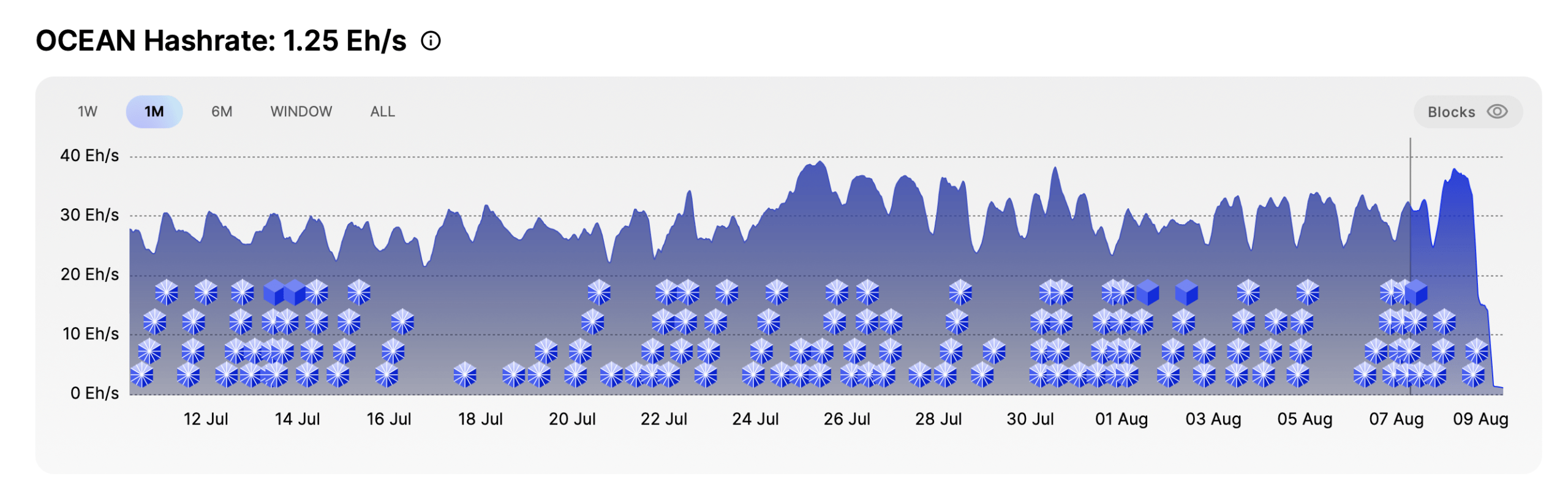
Ocean's hashrate over the past month, according to the Ocean web portal.

Ocean became the central mining platform associated with BIP-110 signaling, particularly due to its DATUM system, which allows individual miners to create their own block templates and choose whether to signal for the proposal.

Bitcoin Difficulty Became a Trap for Minority Chain

The issue facing the splinter chain is purely mechanical. When BIP-110 nodes rejected Bitcoin's non-signaling block No. 961632 and instead adopted Roughnecks' competing block, their new chain inherited Bitcoin's existing mining difficulty. This difficulty had just risen to approximately 127 trillion—a level calculated for the enormous computing power securing Bitcoin's dominant network.
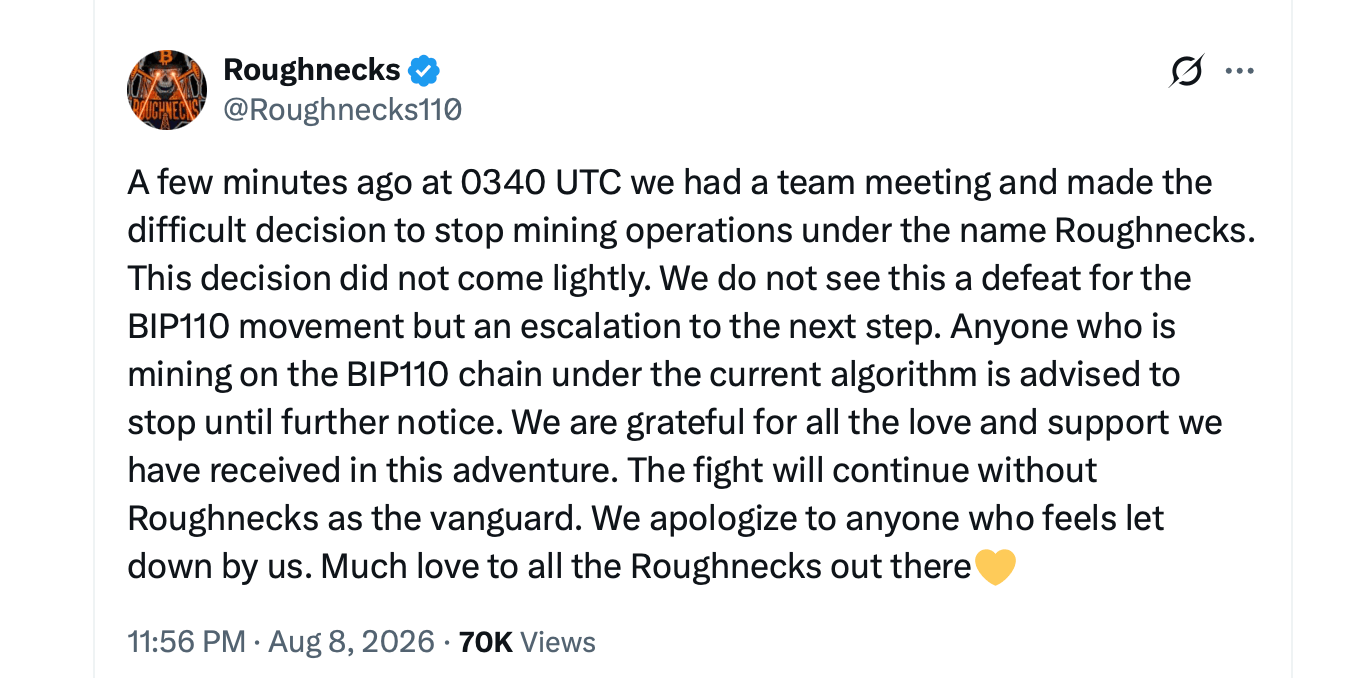
BIP-110 miners from Roughnecks announced cessation of work on X on August 8, 2026.

Difficulty determines how hard miners must work on average to find a valid block. Bitcoin typically adjusts this difficulty every 2,016 blocks to maintain a block generation rate of about one block every 10 minutes. The minority chain, possessing only a tiny fraction of Bitcoin's former hashrate, does not receive an immediate difficulty reduction. It must continue struggling with the same difficulty until the next adjustment point arrives.

This created a draining feedback loop for miners supporting BIP-110. Lower hashrate meant blocks appeared significantly slower, but slower block appearance also meant reaching the next difficulty adjustment point (after 2,016 blocks) became an increasingly distant prospect. According to monitoring service forecasts, given the sharply reduced mining power, completing the required period could take hundreds of days.

BIP-110 Never Won the Hashrate Battle

BIP-110, officially called "Reduced Data Temporary Softfork," was designed to temporarily restrict several methods used for placing non-financial data in Bitcoin transactions. Proponents argued these methods, including activities related to Ordinals and large data transfers, increased data storage and verification burdens while moving Bitcoin away from its primary monetary purpose.

The proposal's activation scheme was the decisive factor. BIP-110 required that 55% of miners vote for the proposal over a difficulty period covering 2,016 blocks. When this threshold was not met, nodes enforcing the proposal were programmed to reject non-signaling blocks at block height 961,632. Miner support never approached the required level, peaking at 2.5–2.6% before the mandatory period began.

This meant the split occurred with the overwhelming majority of Bitcoin's mining power on the other side. Antpool generated block No. 961632 without a signal, which was accepted by the main Bitcoin network, while BIP-110 nodes rejected it and followed Roughnecks' competing block linked to the Ocean network. Roughnecks found another block, number 961,633, but the anticipated transition of additional mining power never materialized into anything meaningful.

BIP-110 proponent, as well as Club Orange founder and CEO Matteo Pellegrini, along with several other supporters, appeared stunned by the outcome. "The lesson of BIP-110 is that 15-20% of nodes is not enough to change Bitcoin's consensus," Pellegrini wrote on X. Pellegrini's admission drew immediate criticism: several commenters suggested he revisit Satoshi Nakamoto's whitepaper, where the inventor of Bitcoin states:

"They vote with their CPU power, expressing their acceptance of valid blocks by working on extending them and rejecting invalid blocks by refusing to work on them. Any needed rules and incentives can be enforced with this consensus mechanism."

Two Blocks Reveal the Economics of a Minority Fork

The outcome clearly illustrates what happens when node rules and mining economics diverge. Software can reject blocks according to a different rule set, but those nodes still need miners willing to expend electricity and computational resources to build the alternative chain. Without sufficient hashrate, confirmation speed plummets, and the chain's utility deteriorates.

Roughnecks acknowledged this reality, characterizing continued mining under current conditions as largely wasteful, while asserting the broader BIP-110 campaign is not over. Potential next steps discussed within the initiative include various coordination strategies or even changing the proof-of-work (PoW) algorithm, though no replacement strategy was defined over this weekend.

For users running BIP-110-enforcing software, the immediate problem is more practical than philosophical. Their nodes follow a chain that has generated only two blocks since the split. As both chains recognize many of the same transactions, users also face potential complications with transaction replays if coins are spent without deliberately separating activity between the two networks.
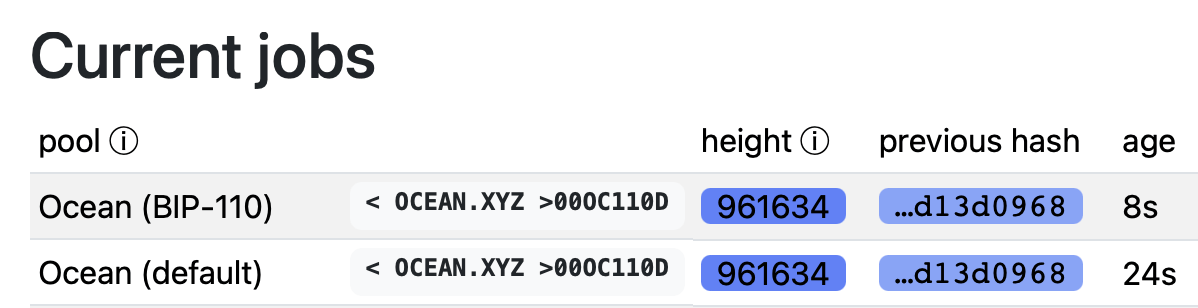
A small portion of hashrate associated with Ocean, as of 8:00 AM ET on August 9, 2026, is still mining the minority chain.

The next question is whether anyone can replace Roughnecks as a significant source of mining power. By the time of the group's announcement, BIP-110 had not yet locked in or activated its transaction limits on Bitcoin's dominant chain, Roughnecks had halted work under its banner, Ocean's displayed hashrate had plunged, and the minority chain remained stuck at two blocks.

Any revival now depends on an influx of new hashrate, a revised technical strategy, or another coordinated attempt to sustain the forked chain. Despite Roughnecks' decision to stop directing hash power to the minority chain, statistics as of 8:00 AM ET on August 9 still show a small fraction of SHA256 hashrate continuing to pursue BIP-110's block 961,634.


İlgili Sorular

QWhat was the main reason Roughnecks announced the cessation of BIP-110 standard mining?

ARoughnecks announced the cessation due to the severe drop in hash rate on the Ocean platform, which fell by approximately 96.5% from around 36 EH/s to about 1.25 EH/s between August 8th and 9th, making continued mining on the minority chain largely wasteful and unsustainable.

QWhat fundamental technical issue prevented the BIP-110 minority chain from competing effectively after the fork?

AThe BIP-110 minority chain inherited Bitcoin's existing high mining difficulty of ~127 trillion, which is calibrated for Bitcoin's massive hash power. With only a tiny fraction of that hash rate, block production slowed drastically, and the next difficulty adjustment (after 2,016 blocks) became a distant prospect, creating a debilitating feedback loop for miners.

QAccording to the article, what was the key factor in BIP-110's failure to gain activation in the Bitcoin network?

ABIP-110's activation mechanism required 55% of miners to signal support within a 2,016-block difficulty period. Support never came close to this threshold, peaking at only 2.5–2.6%, meaning the fork occurred with the overwhelming majority of Bitcoin's mining power on the other side.

QHow does the article illustrate the conflict between node rules and mining economics in a blockchain fork?

AIt illustrates that while node software can reject blocks based on different rules, those nodes still require miners willing to spend energy and computational resources to build the alternative chain. Without sufficient hash rate, block confirmation times slow dramatically, undermining the chain's utility and economic viability, as seen with the BIP-110 fork.

QWhat future possibilities does the article mention for the BIP-110 initiative after Roughnecks stopped mining?

AThe article mentions that possible next steps discussed include various coordination strategies or even a change to the Proof-of-Work (PoW) algorithm. However, no specific replacement strategy was defined at the time of the announcement. Any revival now depends on an influx of new hash rate or a revised technical strategy.

İlgili Okumalar

The Biggest Dark Horse in AI Payments Might Be Coinbase Giving Agents a Wallet

In the AI payments race, while most focus on traditional giants like Visa or AI platforms like OpenAI, Coinbase has quietly emerged as a key player. Data from 2026 shows over 90% of on-chain Agent transactions occur on Coinbase's Base network, with 99% settled in USDC and over 97% using the x402 protocol. Coinbase's pivotal move was launching "Agentic Wallets" in February 2026—a dedicated wallet infrastructure giving AI Agents their own financial identity. Unlike Visa or Stripe, which connect Agents to existing payment rails, Coinbase provides Agents with autonomous wallets to hold assets (like stablecoins), initiate transfers, and execute transactions under predefined rules. This solves core issues for machine-to-machine payments: high credit card fees for micropayments, the need for constant human authorization, and unclear transaction attribution. Coinbase's strength lies in its closed-loop ecosystem: the Base blockchain (low-cost, high-throughput), the x402 payment protocol, Agentic Wallets, and native assets like USDC. This integrated stack, built through years of infrastructure investment, positioned Coinbase to capture early Agent payment demand as the AI economy surged. The key insight is that AI payment adoption may depend less on whose standard wins and more on whose usable infrastructure is ready first. While debates over protocols and payment rails continue, real Agent transactions are already flowing—primarily through Coinbase's ecosystem. It may not be the ultimate winner, but for now, it's the frontrunner by being prepared.

marsbit18 dk önce

The Biggest Dark Horse in AI Payments Might Be Coinbase Giving Agents a Wallet

marsbit18 dk önce

Dialogue with Bitwise CIO: Bitcoin May Be Near Bottom, Who Will Drive the Next Rally?

In a recent podcast, Bitwise CIO Matt Hougan analyzed Bitcoin's current market cycle, suggesting it is near a bottom characterized by low volatility and investor indifference. He believes the next major price surge will be driven primarily by wealth management platforms, financial advisors, and family offices, who control trillions in assets and are now gaining access to Bitcoin ETFs. Hougan views Bitcoin as a long-dated, out-of-the-money call option on it becoming a global reserve asset. Its value increases with global monetary system volatility, making it a natural hedge against currency disorder. He outlined Bitcoin's adoption path: first as a global digital store of value (competing with gold), and potentially later as a check against fiat currency abuse by sovereign states. Addressing the muted price action despite institutional ETF inflows, Hougan explained that significant selling by long-term retail holders has offset buying pressure. However, he is optimistic as data shows retail selling has subsided, which, combined with continued institutional inflows, could propel prices higher. Hougan downplayed the future impact of Federal Reserve interest rates and MicroStrategy's actions on Bitcoin's price, arguing they are becoming less relevant. Instead, he pointed to runaway U.S. fiscal deficits and debt as the core long-term drivers. Finally, he discussed the transformative potential of asset tokenization, predicting all traditional assets will eventually trade 24/7 on blockchains. This will merge traditional and crypto markets, increasing efficiency but also introducing crypto-like features such as overnight volatility and easier access to leverage into traditional finance.

marsbit58 dk önce

Dialogue with Bitwise CIO: Bitcoin May Be Near Bottom, Who Will Drive the Next Rally?

marsbit58 dk önce

Dalio Warns of U.S. Bond Supply-Demand Imbalance: Gold and Bitcoin Could Become Hedge Assets in Debt Crisis

Ray Dalio warns of an unsustainable imbalance in US Treasury supply and demand, drawing parallels to the mechanisms of a "big debt cycle" described in his book. Key recent developments include Japan selling US bonds to support the yen, rising US long-term yields amid weak demand, and limited Treasury buybacks. Dalio explains that when debt service burdens become too large relative to income, and bond supply outstrips market demand, a crisis point approaches. Typically, central banks then print money to buy bonds, leading to currency devaluation and inflation. He simplifies the US government's position: with ~$5.5T in revenue, ~$7.5T in spending, a $2T deficit, and $32T in debt, annual debt service is roughly $1T in interest plus ~$10T in maturing principal needing refinancing. Without change, he estimates a potential debt crisis in roughly three years, give or take two. Dalio proposes a "3% three-part solution" to reduce the deficit to 3% of GDP through balanced spending cuts, tax increases, and naturally lower interest rates. He warns that Japan's high debt, often cited as sustainable, has led to poor bond returns and significant currency losses versus gold and the dollar. In response to questions, Dalio states that all reserve currencies eventually decline via this debt cycle mechanism. He advises investors to diversify globally, favor countries with strong finances and stable politics, underweight bonds, overweight gold, and allocate a small portion (e.g., 10-15%) to Bitcoin as hedges against government-created currency devaluation.

marsbit58 dk önce

Dalio Warns of U.S. Bond Supply-Demand Imbalance: Gold and Bitcoin Could Become Hedge Assets in Debt Crisis

marsbit58 dk önce

Mysterious "Whale" Sells $576 Million Worth of Bitcoin Amid BTC Price Approach to $80,000

An unidentified crypto "whale" sold 2,700 BTC (worth approximately $211.8 million) in a single transaction, bringing its total sales over three days to 7,700 BTC for roughly $576.6 million. This selling pressure occurs as Bitcoin trades near the $80,000 mark, having recently retreated from nearly reaching that level. While large holders often sell to realize profits during sharp rallies, on-chain data only confirms the movement of coins, not the motive. So far, these sales have had little impact on Bitcoin's upward momentum, with the asset posting double-digit gains recently and its strongest weekly increase since 2024. The rally was fueled by a U.S. Treasury Department announcement to at least double its long-term bond buyback operations starting September 9th, which lowered bond yields and pushed investors toward riskier assets like Bitcoin. This week's selling marks a reversal from a recent accumulation trend, where large holders had added about 43,000 BTC (worth ~$2.75B) over a 60-day period ending in mid-August, helping set the stage for the current price surge. As Bitcoin hovers around $80,000, traders are watching key factors: whether other major holders will follow suit and sell into strength, and if renewed institutional demand from ETFs can absorb the selling pressure. The outcome will likely determine Bitcoin's next major price move.

cryptonews.ru2 saat önce

Mysterious "Whale" Sells $576 Million Worth of Bitcoin Amid BTC Price Approach to $80,000

cryptonews.ru2 saat önce

İşlemler

Spot
活动图片