Rolling the Snowball in a Cold Market: How a Meme Coin Achieved 20x in 2 Days with an Automated Market-Making Mechanism?

比推2025-12-22 tarihinde yayınlandı2025-12-22 tarihinde güncellendi

Özet

**Summary: Snowball Meme Coin’s 20x Surge in 2 Days via Automated Market-Making Mechanism Amid a sluggish crypto market, the Meme token Snowball, launched on pump.fun on December 18, surged 20 times in value within two days, reaching a $10 million market cap—a rare success in the current bearish environment. Its core innovation lies in an automated market-making mechanism designed to create a "snowball effect." Typically, pump.fun tokens allow creators to collect a fee (0.5%–1%) from each transaction, often leading to devs cashing out and abandoning projects. Snowball redirects 100% of this creator fee to an on-chain market-making bot instead. This bot periodically: 1. Uses accumulated funds to buy back tokens, creating buy pressure. 2. Adds purchased tokens and corresponding SOL to the liquidity pool, improving depth. 3. Burns 0.1% of tokens per operation, inducing deflation. The fee rate fluctuates (0.05%–0.95%) based on market cap: higher fees at lower caps to accelerate fund accumulation, lower fees at higher caps to reduce transaction friction. The idea is that each trade fuels buy pressure and liquidity, not dev profits, theoretically creating a self-sustaining cycle: trading generates fees → fees fund buybacks → buybacks boost price → higher price attracts more trading. On-chain data shows 7,270 holders, with top 10 addresses holding ~20% of supply—relatively distributed. Trading volume reached $11 million in 24 hours, with buys slightly outpacing sells. By...

Author: David, Deep Tide TechFlow

Original Title: 20x in 2 Days, A Quick Look at the Automated Market-Making Mechanism of the New Golden Dog Snowball


The crypto market in December is as cold as the weather.

On-chain transactions have been dormant for a long time, and new narratives are hard to come by. Just look at the drama and gossip in the Chinese CT (Crypto Twitter) these past few days, and you'll know hardly anyone is playing in this market anymore.

But the English-speaking community has been discussing something new.

A Meme coin called Snowball launched on pump.fun on December 18th. In four days, its market cap surged to $10 million and is still hitting new highs; meanwhile, it's barely mentioned in the Chinese crypto circle.
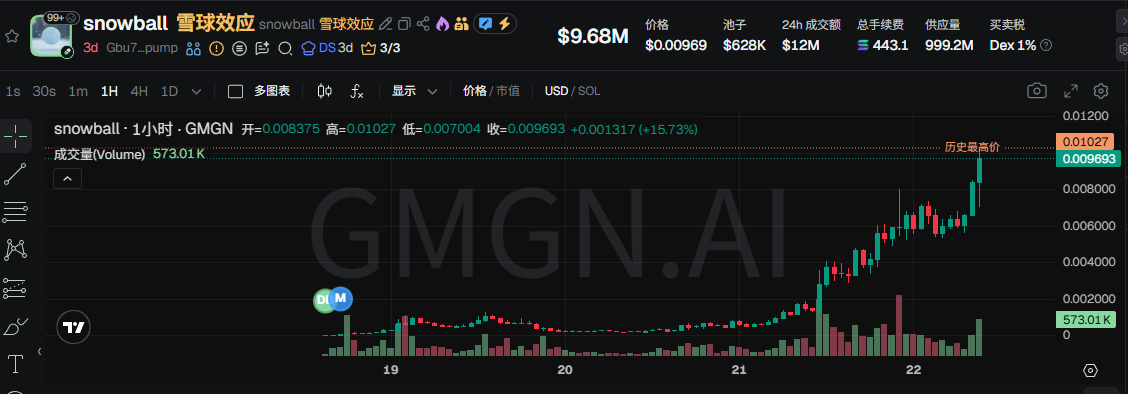
In the current environment where there are few new narratives and even Meme coins are considered unplayable, this is one of the few things that catches the eye and shows some localized wealth effect.

And the name Snowball itself, referring to the snowball effect, is the story it wants to tell:

A mechanism that allows the token to "roll and grow bigger by itself".

Turning Transaction Fees into Buy Pressure, Rolling the Snowball for Market Making

To understand what Snowball is doing, you need to first know how pump.fun tokens typically make money.

On pump.fun, anyone can create a token in minutes. Token creators can set a "creator fee," essentially taking a cut of every transaction into their own wallet, usually between 0.5% and 1%.

This money is theoretically meant for community building and marketing, but in practice, most Devs choose to: accumulate enough and then run.

This is part of the typical life cycle of a shitcoin. Launch, pump, harvest fees, rug. Investors aren't betting on the token itself, but on the developer's conscience.

Snowball's approach is to not take this creator fee money.

To be precise, 100% of the creator fees do not go into anyone's wallet but are automatically transferred to an on-chain market-making bot.

This bot performs three actions at regular intervals:

First, it uses the accumulated funds to buy tokens on the market, creating buy-side support;

Second, it adds the bought tokens and the corresponding SOL to the liquidity pool, improving trading depth;

Third, it burns 0.1% of the tokens with each operation, creating deflation.
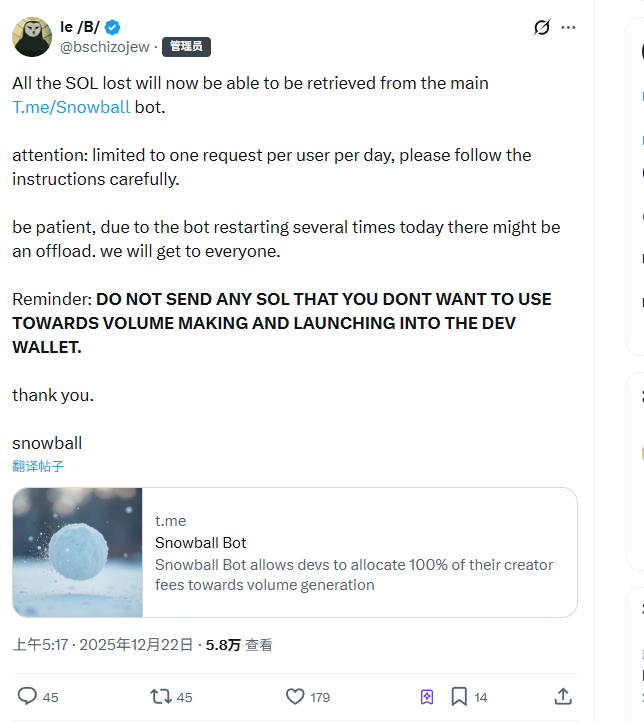
Simultaneously, the percentage of creator fees this coin charges is not fixed; it fluctuates between 0.05% and 0.95% based on market cap.

It takes a higher percentage when the market cap is low, allowing the bot to accumulate ammunition faster; it reduces the fee when the market cap is high, decreasing transaction friction.

To summarize the logic of this mechanism in one sentence: every time you trade, a portion of the money automatically becomes buy pressure and liquidity, instead of going into the developer's pocket.

Therefore, it's easy to understand this snowball effect:

Trading generates fees → Fees become buy pressure → Buy pressure pushes the price up → Higher price attracts more trading → More fees... theoretically, it can roll on its own.

On-Chain Data Situation

Now that the mechanism is explained, let's look at the on-chain data.

Snowball launched on December 18th, so it's been four days now. The market cap grew from zero to $10 million, with a 24-hour trading volume exceeding $11 million.

For a shitcoin on pump.fun, this performance is considered relatively long-lasting in the current environment.

In terms of token distribution, there are currently 7,270 holder addresses. The top ten holders together account for about 20% of the total supply, with the largest single holder holding 4.65%.
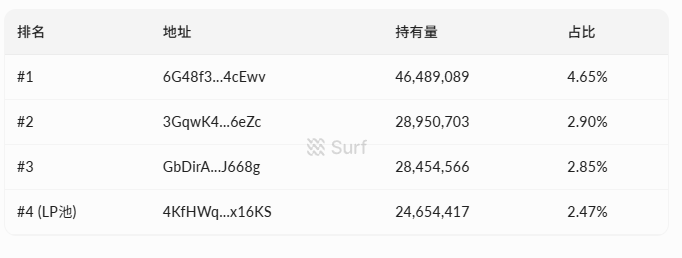
Data source: surf.ai

There's no address holding 20-30% of the supply; the distribution is relatively decentralized.

Regarding trading data, there have been over 58,000 transactions since launch, with 33,000 buys and 24,000 sells. The total buy volume is $4.4 million, and the total sell volume is $4.3 million, resulting in a net inflow of about $100,000. Buying and selling are basically balanced, with no one-sided selling pressure.

The liquidity pool holds about $380,000, half in tokens and half in SOL. For a market cap of this size, the depth isn't very thick, and large orders would still experience significant slippage.

Another noteworthy point is that Bybit Alpha announced listing the token less than 96 hours after launch, which to some extent confirms the short-term hype.

Perpetual Motion Meets a Cold Market

After browsing around, you can see that the English community's discussion about Snowball mainly focuses on the mechanism itself. Supporters' logic is straightforward:

This is the first Meme coin that locks 100% of creator fees into the protocol; developers can't run away with the money, making it structurally safer than other shitcoins, at least.

The development Dev is also playing into this narrative. The developer wallet, market-making bot wallet, and transaction logs are all public, emphasizing "verifiable on-chain."

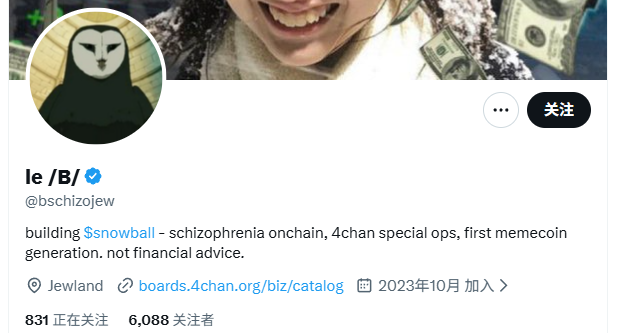
@bschizojew labels himself as "on-chain schizophrenia, 4chan special forces, first-generation Meme coin veteran," radiating a self-deprecating degen vibe that appeals to the crypto-native community.
But mechanism safety and making money are two different things.

The snowball effect relies on the premise that there is sufficient trading volume to continuously generate fees to feed the bot for buybacks. More trading means more ammunition for the bot, stronger buy pressure, higher prices, attracting more people to trade...

This is the ideal state where any Meme coin's so-called buyback flywheel spins up in a bull market.

The problem is, the flywheel needs external momentum to start.

What is the current crypto market environment? On-chain activity is sluggish, the overall heat around Meme coins has declined, and there's simply less capital willing to chase shitcoins. In this context, if new buy-side pressure doesn't keep up and trading volume shrinks, the fees the bot receives will become less and less, buyback strength will weaken, price support will diminish, and trading willingness will decline further.

The flywheel can spin forward, but it can also spin in reverse.

A more realistic problem is that the mechanism solves only one risk point—"developers taking the money and running"—but Meme coins face far more risks than that.

Whales dumping, insufficient liquidity, narratives going out of style—if any of these happen, 100% fee-based buybacks can only do so much.

Everyone is tired of being rugged. A Chinese community member summarized it quite well:

Play if you want, but don't get in over your head.

More Than One Snowball Rolling

Snowball isn't the only project telling this automated market-making story.

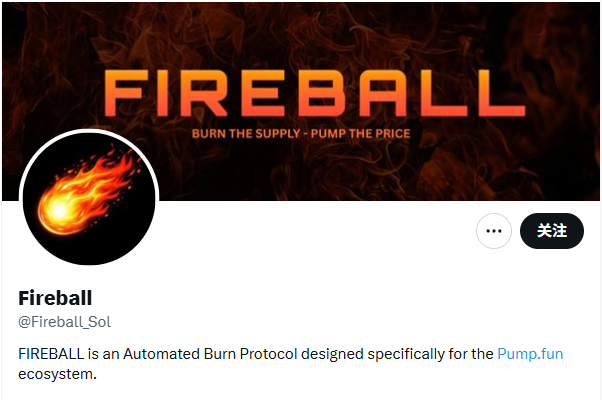
Within the pump.fun ecosystem, a token called FIREBALL is doing something similar: automatic buybacks and burns, packaging it as a protocol other tokens can plug into. But its market cap is much smaller than Snowball's.
This shows the market is currently reacting to the direction of "mechanism-based Meme coins."

The traditional玩法 of shilling, pumping, and community hype is finding it harder to attract capital. Using mechanism design to tell a "structurally safe" story might be one of Meme coins' recent strategies.

However, talking about artificially creating a mechanism isn't a new玩法 either.

OlympusDAO's (3,3) in 2021 was the most typical case, using game theory to package a staking mechanism and telling the story of "everyone profits if no one sells." It reached a peak market cap of billions of dollars. The ending, as everyone knows, was a death spiral, dropping over 90%.

Earlier, there was Safemoon's玩法 of "taxing every transaction and distributing it to holders," also a narrative of mechanism innovation, which ended with the SEC suing and charging the founder with fraud.

Mechanisms can be great narrative hooks, gathering capital and attention in the short term, but mechanisms themselves do not create value.

When external capital stops flowing in, even the most精巧designed flywheel will stop.

Finally, let's recap what this little golden dog is actually doing:

Turning Meme coin creator fees into an "automated market-making bot." The mechanism itself isn't complicated, and the problem it solves is very clear: preventing developers from directly taking the money and running.

Developers can't run away, but that doesn't mean you'll make money.

If after reading this you find the mechanism interesting and want to participate, remember one thing: it's first and foremost a Meme coin, and only secondly an experiment with a new mechanism.


Twitter:https://twitter.com/BitpushNewsCN

Bitpush TG Discussion Group:https://t.me/BitPushCommunity

Bitpush TG Channel: https://t.me/bitpush

Original article link:https://www.bitpush.news/articles/7597578

Trend Kriptolar

İlgili Sorular

QWhat is the core mechanism that allows Snowball to achieve its 'snowball effect'?

AThe core mechanism is that 100% of the creator fees from transactions are automatically sent to an on-chain market-making bot. This bot uses the accumulated funds to buy back tokens (creating buy pressure), add the purchased tokens and corresponding SOL to the liquidity pool (improving depth), and burn 0.1% of the tokens (creating deflation) at regular intervals.

QHow does the creator fee for the Snowball token work and how is it different from a typical pump.fun token?

AUnlike typical pump.fun tokens where the fee goes to the developer's wallet, Snowball's creator fee (which floats between 0.05% and 0.95% based on market cap) is entirely sent to an automated market-making bot. This prevents the developer from directly taking the money and running, as the funds are instead used to support the token's price and liquidity.

QWhat were some key on-chain metrics for Snowball four days after its launch?

AFour days after its launch on December 18th, Snowball reached a market cap of $10 million, with a 24-hour trading volume exceeding $11 million. It had 7,270 holder addresses, with the top 10 holders owning about 20% of the supply. The liquidity pool held approximately $380,000.

QAccording to the article, what is the major risk or prerequisite for the 'snowball effect' to work?

AThe major risk is that the 'snowball effect' relies on sufficient trading volume to continuously generate fees to fuel the market-making bot. If new buying pressure dries up and trading volume decreases, the bot's ability to support the price weakens, which could lead to a negative feedback loop where decreasing price support further reduces trading interest.

QHow does the article contextualize Snowball's mechanism within the history of crypto 'mechanism narratives'?

AThe article contextualizes it as part of a trend of 'mechanism-based meme coins' seeking to attract attention with structural innovation. It draws parallels to past projects like OlympusDAO's (3,3) staking mechanism and Safemoon's transaction tax redistribution, noting that while mechanisms can be a good short-term narrative, they do not create intrinsic value and can fail when external capital inflow stops.

İlgili Okumalar

The "Impossible Triad" Is Fundamentally a Pseudo-Problem

The article argues that blockchain's fundamental limitation is not the scalability trilemma (decentralization, scalability, security), which has been largely solved, but the lack of **privacy** and, until recently, clear **legitimacy**. Blockchain is described as a slow, expensive, globally shared computer whose core value is censorship resistance and verifiability. While ideal for native digital assets like money (e.g., stablecoins), its default transparency acts as a **tax**, exposing all transactions and enabling MEV extraction, which deters serious institutional capital. Simultaneously, its permissionless nature created regulatory ambiguity. The piece contends that **privacy** is the missing critical feature. It rejects the false choice between total transparency and complete anonymity. Modern cryptography (like zero-knowledge proofs) enables **compliant privacy**: users can prove facts (solvency, KYC status, compliance) without revealing the underlying sensitive data (specific holdings, identities). This preserves auditability for regulators and eliminates the leak of financial information. With recent regulatory progress (e.g., the GENIUS Act) addressing legitimacy, adding default, provably compliant privacy becomes a pure upgrade. It transforms blockchain from a costly, public ledger into a confidential settlement layer, finally bridging the gap to mainstream institutional and individual adoption of on-chain finance.

链捕手8 saat önce

The "Impossible Triad" Is Fundamentally a Pseudo-Problem

链捕手8 saat önce

Optical Chips: Collective Capacity Expansion

The global optical chip industry is experiencing a massive wave of expansion driven by surging AI data center demand. Major players across the US, Japan, Europe, and China are aggressively investing to ramp up production capacity. In the US, Coherent is expanding its 6-inch Indium Phosphide (InP) semiconductor fab in Texas, supported by CHIPS Act funding and a $2 billion strategic investment from NVIDIA. Lumentum is building a new factory for InP optical devices, and Nokia is scaling its advanced photonic chip packaging and testing capabilities. NVIDIA's investments aim to secure future supply of critical lasers and optical interconnect products for AI infrastructure. Japan's JX Advanced Metals, a leading InP substrate supplier, plans a multi-billion yen investment to increase its capacity 7-10 times, strengthening its grip on the crucial upstream materials market. In Europe, IQE and Tower Semiconductor settled a patent dispute and signed a multi-year InP epitaxial wafer supply agreement, highlighting that next-generation silicon photonics platforms will integrate high-performance InP components. STMicroelectronics and Sivers Semiconductors are also expanding silicon photonics production and partnerships. China is rapidly building out its domestic supply chain. Dongshan Precision's subsidiary, Source Photonics, announced a $12 billion project to expand optical chip and module production. Companies like Sanan Optoelectronics and Yunnan Germanium are scaling up InP chip manufacturing and substrate production, moving towards vertical integration from materials to modules. While debate continues around the exact future architecture—whether CPO (Co-Packaged Optics), NPO, or pluggables will dominate—analysts like Morgan Stanley argue the underlying driver is unchangeable: the explosive growth in bandwidth demand. This will inevitably increase the volume of optical engines, lasers, and related content per GPU, regardless of the final technical path. The competition for "more light" in the AI era has intensified into a global, full-chain capacity race.

marsbit10 saat önce

Optical Chips: Collective Capacity Expansion

marsbit10 saat önce

Stablecoins Finally Find Real Yield: An In-Depth Look at On-Chain Reinsurance Re | A Conversation with Re Founder Karan Saroya

Stablecoin Real Yield Found: A Deep Dive into On-Chain Reinsurance with Re's Karan Saroya As stablecoin supply exceeds $170 billion, the search for sustainable, non-speculative yield intensifies. Re, an on-chain reinsurance platform, provides an answer: connecting stablecoin capital to the trillion-dollar traditional reinsurance market. Re operates as a regulated reinsurer, accepting stablecoin deposits as collateral to back US insurance companies. These insurers pay premiums, generating yield that flows back to on-chain depositors. Currently supporting 35 insurers and underwriting $500 million, Re projects scaling to over $1 billion soon. Key insights from a Bankless podcast with founder Karan Saroya and investor Avichal of Electric Capital: 1. **Uncorrelated, Real-World Yield:** Re offers stablecoin holders access to reinsurance returns (targeting 12-14%+), an asset class entirely separate from crypto or equity markets. 2. **Operational Efficiency via Smart Contracts:** Re replaces traditional, labor-intensive capital fundraising with smart contracts, allowing a ~12-person team to compete with industry giants. 3. **Regulatory Leverage:** For every $1 of collateral, regulations allow backing $5-7 in written premiums. This leverage amplifies returns from the underlying risk-free rate. 4. **DeFi Integration:** Depositors receive receipt tokens, which can be used in protocols like Morpho for "looping," potentially pushing yields to 18-20%+. 5. **The "DeFi Mullet" Model:** A compliant front-end (regulated reinsurer) paired with a decentralized back-end (smart contracts, DeFi capital markets). 6. **RE Governance Token:** Modeled on Lloyd's of London, the token governs the central capital pool's allocation, counterparty acceptance, and parameters. 7. **Real Economic Impact:** Capital funds real-world productivity (factories, clinics, businesses) via insurance, moving beyond crypto's internal loops. The discussion highlights a pivotal moment: DeFi's supply-side infrastructure is now met by real demand for productive yield, potentially kickstarting a flywheel where vast on-chain stablecoin capital seeks these real-world returns.

链捕手11 saat önce

Stablecoins Finally Find Real Yield: An In-Depth Look at On-Chain Reinsurance Re | A Conversation with Re Founder Karan Saroya

链捕手11 saat önce

1996 or 1999? Walsh's First Test is 'How to View AI'

"1996 or 1999? Wall's First Big Test Is 'How to View AI'" Federal Reserve Chairman Wall's initial challenge is not whether to raise or cut rates, but a more fundamental judgment: what kind of boom is the current AI boom? This will determine the Fed's policy path and define his legacy. Economics is split between two opposing views, according to reporter Nick Timiraos. One sees imminent productivity gains that will increase supply and cool inflation, allowing the Fed to hold steady. The other argues that while productivity benefits are distant, demand shocks are here now, and waiting for data confirmation risks missing the intervention window, forcing sharper rate hikes later. Wall has signaled a leaning toward the first view, echoing 1996-era Alan Greenspan, who embraced strong, productivity-driven growth without fear of inflation. However, Wall faces a different macro environment than Greenspan did, with tariff pressures, expanding fiscal deficits, and diminishing globalization benefits, which could force more significant inflation pressures even if AI benefits materialize. Wall's logic, expressed before taking office, is that AI-driven productivity gains won't show in official data for years. If the Fed waits for confirmation, it might mistakenly tighten policy and choke off the very growth that could suppress inflation. This argues for using forward-looking narratives over lagging data. Chicago Fed President Austan Goolsbee presents a key counter-argument. He distinguishes between expected and unexpected productivity booms. A widely anticipated boom, like the current AI wave, can cause people to spend future wealth gains in advance, overheating the economy before productivity actually rises, thus requiring preemptive rate hikes. He cites rising costs for AI data centers as evidence of such overheating. Fed Governor Christopher Waller offers a rebuttal to Goolsbee, noting the "expected spending" mechanism only works if people can borrow against future income, which many households cannot do due to borrowing constraints. Wall also faces a paradox related to his desire to reduce the Fed's use of "forward guidance" (pre-announcing policy moves). This practice was established in 1999 when Greenspan began signaling hikes to avoid market shocks. If the economy follows a less optimistic path, Wall may be forced to choose between using the guidance he wants to abolish or risking market volatility by staying silent. The ultimate question defining Wall's first major test remains: Is this 1996 or 1999?

marsbit12 saat önce

1996 or 1999? Walsh's First Test is 'How to View AI'

marsbit12 saat önce

İşlemler

Spot
Futures

Popüler Makaleler

MEME 2.0 Nedir

Memecoin 2.0: Kripto Para Dünyasında $MEME 2.0'ın Yükselişi Giriş Kripto para dünyasının sürekli gelişen yapısında, yeni bir rakip olarak Memecoin 2.0 ortaya çıktı. $MEME 2.0 sembolüyle öne çıkan bu proje, meme coinlerinin kavramını heyecan verici bir yeni seviyeye taşıyor. Orijinal Memecoin'in bir yan ürünü olarak, bu proje, odağını geleneksel finansal teşviklerden, katılımcı ve eğlenceli bir deneyime kaydırarak kripto topluluğunun dikkatini çekmeyi başardı. Ethereum blockchain'inde faaliyet gösteren Memecoin 2.0, kripto alanında topluluk katılımını cesurca yeniden tanımlıyor. Memecoin 2.0, $MEME 2.0 Nedir? Memecoin 2.0, temelinde topluluk ruhunu ve meme kültürüyle ilişkilendirilen eğlenceyi öncelikli olarak benimseyen bir kripto para projesidir. Pratik kullanım alanlarına ve somut faydalara odaklanan geleneksel kripto paralardan farklı olarak, Memecoin 2.0 dijital para biriminin daha hafif yönünü benimseyerek kendini gösteriyor. Proje, herhangi bir fayda, yapılandırılmış bir yol haritası veya finansal getiri vaadi olmadan varlığını sürdürüyor ve bunun yerine memelere ve ortak keyfe odaklanmış canlı bir topluluk oluşturmayı hedefliyor. Bu sayede, çevrimiçi alanda meme kültürünün artan trendine hitap ederek dijital varlıklar dünyasında benzersiz bir oyuncu haline geliyor. Memecoin 2.0'ın Yaratıcısı, $MEME 2.0 Memecoin 2.0'ın kökenleri üzerine yapılan kapsamlı araştırmalara rağmen, yaratıcısının kimliği belirsizliğini koruyor. Bu anonimlik, birçok projenin sahne arkasında kalmayı tercih eden bireyler veya gruplar tarafından yönetildiği kripto topluluğunda alışılmadık bir durum değil. Yaratıcının kamuya açık bilgilere sahip olmaması, topluluk katılımına odaklanarak bireysel ünlülük yerine topluluğun önemini vurgulayan stratejik bir hamle olarak görülebilir. Memecoin 2.0 Yatırımcıları, $MEME 2.0 Memecoin 2.0 için yatırımcılar veya mali destek ile ilgili bilgiler sınırlıdır. Bu bilgi eksikliği projenin ya kendi kendini finanse ettiğini ya da geleneksel yatırım yapılarına kıyasla topluluğa odaklanmasının farklı bir destekçi türünü çektiğini öne sürebilir. Meme coinlerinin dünyası tipik olarak daha fazla taban katılımı içerdiği için bu yaklaşım, topluluk odaklı projelerin etikleriyle uyumlu bir yapı sergiliyor. Memecoin 2.0, $MEME 2.0 Nasıl Çalışır? Memecoin 2.0 tamamen Ethereum blockchain'inde faaliyet gösteriyor ve bu sayede güvenlik özelliklerinden ve ölçeklenebilirliğinden yararlanıyor. Ethereum'un güçlü yönlerinden faydalanarak, Memecoin 2.0 kullanıcı etkileşimleri için güvenli bir ortam sunarken, işlemlerin hem verimli hem de maliyet etkili olmasını sağlıyor. Memecoin 2.0'ın benzersiz özelliklerinden biri topluluk odaklı yapısıdır. $MEME 2.0 tokeninin değeri ve popülaritesi, kullanıcıların aktif katılımlarından geliyor, içsel faydadan ziyade. Bu tasarım, projenin kripto para biriminin eğlence yönüne odaklanmasını pekiştirerek, gülmenin ve topluluk etkileşiminin başarısını sağlayan gerçek para birimleri olduğunu ima eder. Ayrıca, proje, meme coinlerinin daha geniş ekosisteminin bir parçası olarak yer alıyor; burada her meme coininin değeri, kültür, trendler ve topluluk katılımına göre dalgalanıyor, geleneksel ekonomik prensiplerden ziyade. Memecoin 2.0'ın Zaman Çizelgesi, $MEME 2.0 Memecoin 2.0'ın evrimini ve kilometre taşlarını daha iyi anlamak için, tarihindeki önemli olayları vurgulayan bir zaman çizelgesi: 2024: Memecoin 2.0'ın ortaya çıkışı, orijinal Memecoin'in bir yan ürünü olarak kabul edilir ve Ethereum blockchain'inde faaliyet gösterirken meme coinlerinin gelişen bağlamında kendini konumlandırır. 13 Temmuz 2024: Memecoin 2.0, Ethereum ağında topluluk odaklı bir meme coin olarak resmi bir konum alır ve kullanıcıların katılımını ve büyümeye katkı sağlamasını teşvik eden eğlence odaklı yaklaşımını vurgular. Memecoin 2.0'a Dair Anahtar Noktalar, $MEME 2.0 Memecoin 2.0'ı tanımlayan birkaç kritik özellik: Topluluk Merkezli Yaklaşım: Memecoin 2.0'ın temel misyonu, memetik kültürden elde edilen ortak keyfi kullanarak eğlenceli ve katılımcı bir topluluk deneyimi yaratmaktır. Ethereum Üzerinde İnşa Edilmiş: Ethereum blockchain'inde faaliyet göstermek, projeye güvenlik ve ölçeklenebilirlik sağlayan temel bir altyapı sunar. Fayda veya Yol Haritası Yokluğu: Geleneksel kripto paralardan çarpıcı bir şekilde farklı olarak, Memecoin 2.0 herhangi bir faydalı özellik veya finansal getiri vaadinde bulunmamakta, topluluk katılımı ve sosyal etkileşime olan bağlılığını pekiştirmektedir. Memetik Kültüre Odağı: Mem fenomeninin mizahi ve kültürel yönlerini benimseyerek, Memecoin 2.0 kullanıcıların kripto ile çevrimdışı ve çevrimiçi etkileşimde bulunması için bir platform sağlar. Ek Bağlam: Meme Coinlerinin Önemi Meme coinler, kabaca mizah ve ticarete yönelik hafif bir yaklaşım tarafından yönlendirilen belirgin bir kripto para sınıfı olarak ortaya çıkmıştır. Bu paralar genellikle önemli bir fayda veya gelişim yol haritasından yoksundur ve kullanıcıları eğlence, topluluk etkileşimi ve kültürel relevans vaadiyle çeker. Daha geniş kripto ekosisteminde, meme coinler topluluk katılımının önemini yeniden canlandırırken, yalnızca kar odaklı yaklaşımlara karşı bir duruş sergiliyor. Memecoin 2.0 gibi projeler, eğlencenin finansal hedeflerle uyum sağlamasını sağlayarak, blockchain'i yaratıcılık ve sosyal etkileşim için bir oyun alanı haline getiriyor. Sonuç Memecoin 2.0, veya $MEME 2.0, topluluk katılımını katı finansal yapıların üzerinde önceliklendirerek yeni bir kripto para dalgasını temsil ediyor. Mizah ve sosyal etkileşime odaklanarak, meme kültürü etrafındaki ilgiden faydalanıyor. Ethereum blockchain'inde faaliyet göstererek, Memecoin 2.0, teknolojinin yeteneklerinden yararlanırken dijital para biriminin eğlence değerine olan bağlılığında kararlılığını koruyor. Kripto para alanı gelişmeye devam ederken, Memecoin 2.0, dijital varlıkların geleceğinin ortak deneyimlere, gülmelere ve sağlam topluluk bağlantılarına bağlı olabileceğinin bir kanıtı olarak hizmet ediyor. Kripto dünyası belirsiz olsa da, belki de neşe, geleneksel finansal kazanç kadar değerli olabilir.

139 Toplam GörüntülenmeYayınlanma 2024.04.04Güncellenme 2024.12.03

MEME 2.0 Nedir

MEME Nasıl Satın Alınır

HTX.com’a hoş geldiniz! Memeland (MEME) satın alma işlemlerini basit ve kullanışlı bir hâle getirdik. Adım adım açıkladığımız rehberimizi takip ederek kripto yolculuğunuza başlayın. 1. Adım: HTX Hesabınızı OluşturunHTX'te ücretsiz bir hesap açmak için e-posta adresinizi veya telefon numaranızı kullanın. Sorunsuzca kaydolun ve tüm özelliklerin kilidini açın. Hesabımı Aç2. Adım: Kripto Satın Al Bölümüne Gidin ve Ödeme Yönteminizi SeçinKredi/Banka Kartı: Visa veya Mastercard'ınızı kullanarak anında Memeland (MEME) satın alın.Bakiye: Sorunsuz bir şekilde işlem yapmak için HTX hesap bakiyenizdeki fonları kullanın.Üçüncü Taraflar: Kullanımı kolaylaştırmak için Google Pay ve Apple Pay gibi popüler ödeme yöntemlerini ekledik.P2P: HTX'teki diğer kullanıcılarla doğrudan işlem yapın.Borsa Dışı (OTC): Yatırımcılar için kişiye özel hizmetler ve rekabetçi döviz kurları sunuyoruz.3. Adım: Memeland (MEME) Varlıklarınızı SaklayınMemeland (MEME) satın aldıktan sonra HTX hesabınızda saklayın. Alternatif olarak, blok zinciri transferi yoluyla başka bir yere gönderebilir veya diğer kripto para birimlerini takas etmek için kullanabilirsiniz.4. Adım: Memeland (MEME) Varlıklarınızla İşlem YapınHTX'in spot piyasasında Memeland (MEME) ile kolayca işlemler yapın.Hesabınıza erişin, işlem çiftinizi seçin, işlemlerinizi gerçekleştirin ve gerçek zamanlı olarak izleyin. Hem yeni başlayanlar hem de deneyimli yatırımcılar için kullanıcı dostu bir deneyim sunuyoruz.

650 Toplam GörüntülenmeYayınlanma 2024.12.12Güncellenme 2026.06.02

MEME Nasıl Satın Alınır

Tartışmalar

HTX Topluluğuna hoş geldiniz. Burada, en son platform gelişmeleri hakkında bilgi sahibi olabilir ve profesyonel piyasa görüşlerine erişebilirsiniz. Kullanıcıların MEME (MEME) fiyatı hakkındaki görüşleri aşağıda sunulmaktadır.

活动图片