Robinhood vs. Coinbase: The Final Showdown of Financial Super Apps in 2026

比推2025-12-30 tarihinde yayınlandı2025-12-30 tarihinde güncellendi

Özet

The article analyzes the escalating competition between Robinhood and Coinbase to become the dominant financial "super app" by 2026. Robinhood is building a traditional, all-in-one platform for managing personal banking, spending, and investing. Its strategy focuses on product aggregation, targeting a younger demographic with its Robinhood Gold subscription (offering a credit card, high-yield cash, and IRA matching). Its revenue is diversified across options, crypto (21%), and net interest income (35%). Coinbase is also building a super app but with a crypto-native approach and a dual strategy. It aims to be a front-end for users' on-chain and off-chain financial lives (with new stock trading, prediction markets, and a DEX aggregator) while simultaneously acting as the essential backend infrastructure for traditional finance (TradFi) institutions. Its "Crypto as a Service" platform, custody for major ETFs, and stablecoin services form a robust B2B revenue stream, with subscription services now making up 41% of its income. While both are encroaching on each other's territories with plans for 24/7 trading and prediction markets, their core visions differ. Robinhood bets on being the primary platform for the great wealth transfer to a younger generation. Coinbase bets on the broader migration of the global economy on-chain, positioning itself as the indispensable infrastructure provider. Both face risks: Robinhood's costly incentives and Coinbase's stagnant user growth. Ulti...

Source: Bankless

Author: David Christopher

Compiled and Edited by: BitpushNews


The debate between Coinbase and Robinhood has been discussed many times by many observers—including us.

But the system update released by Coinbase on December 17th gives us a reason to revisit this topic in depth. The company announced the launch of 24/5 commission-free stock and ETF trading, native prediction market integration via Kalshi, and a decentralized exchange (DEX) aggregator providing instant access to millions of tokens—a clear step towards becoming an "everything app" that can rival the breadth of Robinhood.

These announcements clarify the future Coinbase is building and allow us to compare it more comprehensively with Robinhood. Their competitive goal is now unmistakable: to become the single platform for users to manage their entire financial lives. By mastering users' fund balances, they aim to master user behavior. But the way they are building this "super app" theory reveals two very different philosophies–and 2026 will test which foundation is more solid.

HOOD (Robinhood)

Robinhood is building the financial super app the old-fashioned way—by continuously stacking products until users can manage their entire financial lives on one platform.

In addition to stock, options, and cryptocurrency trading, Robinhood offers its 3.9 million Robinhood Gold subscription users a suite of products that give it functionality comparable to a digital neobank. This subscription service, which grew 77% year-over-year, bundles a 3% cash-back credit card, 3.25% cash interest, and a 3% IRA (Individual Retirement Account) match. Users' salaries, savings, investments, and daily spending are all concentrated in the same interface—a data advantage that traditional brokerages cannot match.

This positioning seems particularly relevant when you consider demographics—75% of Robinhood's 26.9 million funded customers are under the age of 44, a highly mobile-first and "financially conscious" user base. As argued by Omar Kanji of Dragonfly and others, this foundation helps position the company to be a major beneficiary of the expected over $10 trillion wealth transfer over the next decade, as older generations pass assets down to younger ones. These inheritors are likely to consolidate assets into the platforms they use every day—and Robinhood is making itself very suitable for daily use.

Beyond digital banking features, Robinhood's revenue sources are already quite diversified. Options trading remains its "cash cow." Cryptocurrency contributes 21% of total revenue. Net interest income accounts for 35% of revenue. And the prediction market business conducted through Kalshi has reached an annualized revenue of $100 million.

The data supports this:

  • Transaction-based revenue increased 129% year-over-year, primarily driven by cryptocurrency.

  • Q3 net profit reached a record $556 million—a 271% increase year-over-year.

  • Operating expenses have remained flat since September 2022.

COIN (Coinbase)

Coinbase is also building a super app—but with a distinct "crypto-native" flavor and an underlying Layer 2 ambition.

On the front end, Coinbase wants to be the single place for users to manage their on-chain and off-chain financial lives, although it is still primarily focused on the former for now. The December system update made this clear: 24/5 commission-free stock and ETF trading, prediction markets via Kalshi, and ongoing on-chain integrations for instant access to millions of tokens. Add in direct deposit, high-yield savings via USDC lending rates, borrowing up to $5 million against BTC (up to $1 million against ETH), and earning crypto rewards for spending with a debit card—the pieces of the super app are falling into place.

While cryptocurrency prices have fallen, the builders and deliverers are still in action.

However, Coinbase is not just building products for its own users. Its grander vision seems to be turning every product it offers into plug-and-play infrastructure that powers all other institutions coming on-chain.

The theory here is that TradFi giants like JPMorgan, Fidelity, and Morgan Stanley will not build their own crypto infrastructure. They will outsource to Coinbase because it's cheaper, they lack the technical expertise, and Coinbase has 13 years of proven security. Over 200 institutions are already using Coinbase's "Crypto as a Service" platform—meaning users might be trading crypto on the front end of a traditional bank, but Coinbase is handling everything behind the scenes.

This focus on infrastructure extends across the business. Coinbase holds Bitcoin and Ethereum for most major spot ETFs—a near-monopoly position in crypto custody. They are allowing institutions to leverage Coinbase's infrastructure to issue their own stablecoins. The acquisition of Echo brought financing and token issuance in-house. And the acquisition of Deribit captured about 90% of Bitcoin options open interest.

The revenue structure reflects this dual focus. Q3 2025 revenue was $1.8 billion, with subscription and service revenue hitting a quarterly record of $747 million (41% of total revenue). Stablecoin revenue from the USDC partnership contributed $354.7 million, up 44% year-over-year. Staking brought in $185 million. Custodial assets, driven by ETF inflows, exceeded $300 billion, with custody fees reaching approximately $143 million.
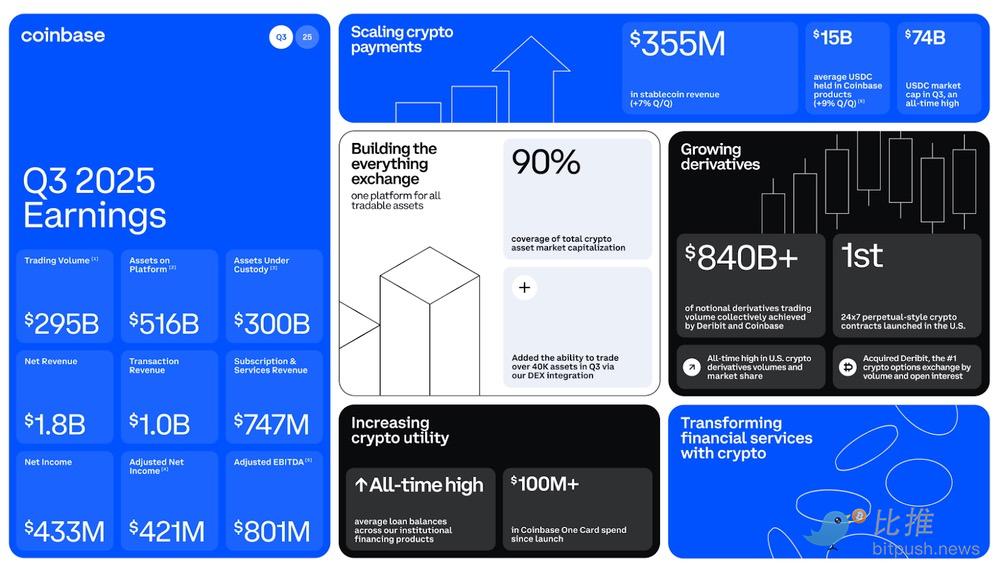
Robinhood's grand vision is to be the go-to place for handling all matters of personal financial life, while Coinbase is playing two games at once: building the best crypto super app for its own users, while simultaneously becoming the backend that powers the crypto products for everyone else.

Diverging Crypto Strategies

Both companies see cryptocurrency as core to their super app ambitions, but their approaches reflect their origins.

Robinhood treats cryptocurrency as just another asset class alongside stocks and options. It is a revenue driver that fits perfectly into the existing product suite. The acquisition of Bitstamp ($200 million) provided it with global licenses and institutional infrastructure. Tokenized equities—currently around 800 listed in the EU, including private companies like OpenAI and SpaceX—expand the product offering. The real test will be the success of the Robinhood Chain, which should make many of these tokenized equities more fungible (e.g., for loans), although we currently have few details on the extent of "DeFi" or other on-chain activities the chain will support.

Beyond that, Robinhood faces more immediate limitations, such as token selection. In the US, users have access to fewer than 50 tokens on the platform, while Coinbase offers nearly unlimited tokens indirectly (via Jupiter and Base) and directly supports over 200.

Coinbase's cryptocurrency approach is clearly different, offering everything from its own Layer 2 network to the various products mentioned in the previous section. It has set the standard for "crypto-specific" products to the point that it now seems to be pivoting to focus on building the rails for others to use. We see x402, aimed at becoming the industry standard for agent-to-agent (A2A) payments, and Coinbase's announcement that it will offer a "Stablecoin-as-a-Service" platform for companies to create whitelabel stablecoins, with Coinbase managing all the complexity. From issuance to trading to custody, Coinbase occupies every stage of the asset lifecycle.

2026 Outlook

The roadmaps for both companies are very aggressive—and increasingly overlapping.

Coinbase's December 2025 system update, with stock and ETF trading beyond traditional market hours (thanks to tokenization) and the announcement of stock perps launching next year, strongly encroached on Robinhood's territory. Native Kalshi integration brought prediction markets. Then there's Coinbase Business and Coinbase Tokenize, the former an all-in-one crypto-powered business operations platform, and the latter an "end-to-end" platform for institutional tokenization.

Robinhood's 2026 plans delve deeper into crypto infrastructure. Tokenized stocks will achieve 24/7 trading via Bitstamp in early 2026 and become withdrawable and composable in DeFi by late 2026. In prediction markets, Robinhood is moving from a distribution partner to launching its own market. The platform hopes to offer crypto staking, pending regulatory approval. It also has ambitions to "socialize" trading with Robinhood Social, an upcoming feed where traders can post content and display their actual trades and P&L. And of course, there's the Robinhood Chain.

The challenge for the Robinhood Chain will be building a developer ecosystem—an area where Base has already built momentum. Crypto-native culture is hard to manufacture artificially.

Conclusion

Perhaps a better framework here is "COIN and HOOD," rather than "COIN vs. HOOD." These two companies occupy different lanes, touching but not fully overlapping.

Robinhood is both a "super app" bet and a demographic wealth transfer bet. With 75% of its users under 44 and a full-stack digital bank keeping assets on the platform, the company is poised to become a new hub for deposits, spending, investing, and speculation.

Coinbase is a bet on a technological transition. It bets that the global economy is moving on-chain, and Coinbase will be the infrastructure layer that powers everyone else—from ETF custody to stablecoin backends to crypto-as-a-service for traditional banks.

Both face risks. Robinhood's generous Gold incentives (3% match, 3% cash back, 3.25% cash interest) are costly and have already shown vulnerability to rate cuts—the rate was recently 4-5% and is directly tied to the Fed rate. Adoption of tokenization depends on issuer decisions, which are beyond Robinhood's control. For Coinbase, user growth remains a significant risk, with its monthly active user count stagnating since 2021.

Moreover, both stocks may already be at high levels. Over the past few years, these two stocks have been major market winners—as of this writing, Coinbase (COIN) is up about 7x from its 2022 lows, and Robinhood (HOOD) is up 15x. Although they have pulled back from recent all-time highs, their valuations remain elevated after such staggering gains. This is worth investors pondering.

Ultimately, while both companies are building financial super apps—and encroaching on each other's turf in the process—their visions actually serve different goals.

  • Robinhood is committed to building an all-in-one financial platform—allowing users to manage all aspects of their financial life, from banking and daily spending to trading and investing, all in one place without leaving the platform.
    Coinbase focuses on building the infrastructure to get everyone on-chain—it does build a crypto super app for its own users, but more importantly, it is becoming the backend rails that financial institutions, fintech companies, and even traditional banks rely on when entering the crypto space.

One aims to be your financial home, the other aims to be the plumbing underneath everyone's financial home. Both could succeed.


Twitter:https://twitter.com/BitpushNewsCN

Bitpush TG Discussion:https://t.me/BitPushCommunity

Bitpush TG Subscription: https://t.me/bitpush

Original link:https://www.bitpush.news/articles/7599259

Trend Kriptolar

İlgili Sorular

QWhat are the key differences between Robinhood and Coinbase's approaches to building a financial super app?

ARobinhood is building a traditional financial super app by layering products like banking, stocks, options, and crypto into a single platform for daily financial management. Coinbase is building a crypto-native super app with a dual focus: creating a front-end app for users and providing backend infrastructure (like custody and 'crypto as a service') for other institutions entering the crypto space.

QWhat major product update did Coinbase announce on December 17th, and how does it compete with Robinhood?

ACoinbase announced 24/5 commission-free stock and ETF trading, native prediction market integration via Kalshi, and a DEX aggregator for instant access to millions of tokens. This update directly competes with Robinhood by expanding into traditional equity trading and broadening its product suite to become a more comprehensive 'everything app'.

QWhat is Robinhood's primary revenue driver and how has its business diversified?

AOptions trading remains Robinhood's 'cash cow.' Its business has diversified with crypto contributing 21% of total revenue, net interest income making up 35%, and its prediction market business (via Kalshi) generating an annualized $100 million in revenue.

QWhat is Coinbase's larger, second-layer ambition beyond its consumer super app?

ACoinbase's larger ambition is to become the backend infrastructure provider for the entire crypto economy. It aims to offer 'crypto as a service' to traditional financial institutions (TradFi), provide custody for major ETFs, allow institutions to issue their own stablecoins, and power on-chain finance through its various infrastructure products and acquisitions.

QWhat are the primary demographic and opportunities for Robinhood, according to the article?

A75% of Robinhood's 26.9 million funded customers are under the age of 44. This positions the company to be a major beneficiary of the anticipated $10+ trillion wealth transfer over the next decade, as younger generations are likely to consolidate inherited assets onto the modern, mobile-first platform they already use daily.

İlgili Okumalar

Bitcoin Mining Farms Are Becoming AI Factories

Bitcoin mines are transforming into AI factories. This shift is driven by the convergence of three key assets from the previous crypto cycle: infrastructure, talent, and capital. Crypto mining companies like Crusoe, CoreWeave, and Bitdeer are repurposing their core competency—securing power, land, and grid connections in remote locations—to build data centers for AI clients. These firms are signing multi-billion dollar, long-term contracts with companies like Anthropic, AWS, and Microsoft, as AI's demand for reliable, high-capacity compute surpasses the profitability of Bitcoin mining. Simultaneously, crypto entrepreneurs and engineers are applying their skills to new AI ventures. Examples include OpenSea's co-founder launching OpenRouter (an AI model aggregator), and former Coinbase engineers building Fal.ai (a generative media infrastructure platform). Their experience in building scalable, global software networks translates effectively to the AI space. Furthermore, capital accumulated during the crypto boom is now fueling AI. Figures like Jed McCaleb (co-founder of Ripple) funded Voltage Park, a large-scale GPU cloud provider. Notably, some crypto investments, like FTX's early bets on Anthropic and Cursor, have generated astronomical paper returns, demonstrating how high-risk crypto capital flowed into AI before it became mainstream. The transition is not just about repurposing hardware, but about redirecting critical resources—power infrastructure, distributed systems expertise, and venture funding—to the next technological frontier: artificial intelligence.

链捕手11 dk önce

Bitcoin Mining Farms Are Becoming AI Factories

链捕手11 dk önce

Morpho Launches Fixed-Rate Product Midnight: Lenders and Borrowers Set Their Own Rates, Ending the Era of Interest Rate Models

Morpho Launches Fixed-Rate Product Midnight: Lenders and Borrowers Set Their Own Rates, Ending the Era of Algorithmic Interest Models On-chain lending has grown to $60 billion but remains minuscule compared to traditional finance's $200 trillion annual credit volume. Morpho identifies the lack of fixed rates and maturity dates as key bottlenecks. Institutions need predictability, not the passive floating rates set by algorithmic models. Midnight allows lenders and borrowers to directly quote rates, set terms, and become price makers, not takers. Fixed-rate lending is now viable due to cheaper, faster blockchains and the entry of institutions demanding control and certainty over returns, costs, and duration. Morpho Blue previously gave users control over risk; Midnight adds control over interest rates. Past attempts at on-chain fixed-rate lending failed primarily because they were built on top of floating-rate pools (creating unpredictability) or lacked sufficient active participants. Midnight avoids these pitfalls as a standalone primitive with fixed rates at its core, built upon Morpho Blue's existing large and active user base. Midnight offers distinct value: institutions gain predictable term structures and full control; fintech companies can offer tailored fixed-rate products; lenders/borrowers achieve predictability and efficiency; and curators can now differentiate by configuring both risk and interest rates. Morpho Midnight is not a replacement for Morpho Blue. The Morpho network will now feature two complementary market structures: floating-rate/open-term (Blue) for flexibility and fixed-rate/fixed-term (Midnight) for predictability. Liquidity can flow between them. The launch will be gradual, prioritizing security. Initially, it will support direct lending on Base network with one trading pair (cbBTC/USDC) and limited maturity dates. Advanced features like auto-rollovers will be introduced later.

marsbit12 dk önce

Morpho Launches Fixed-Rate Product Midnight: Lenders and Borrowers Set Their Own Rates, Ending the Era of Interest Rate Models

marsbit12 dk önce

human.tech Launches Clean SDK for Privacy-First Web3 Apps

human.tech has launched the Clean SDK, a toolkit enabling developers to build privacy-first Web3 applications with transparent accountability. Released alongside Aztec's version 5, the SDK provides components for integrating zero-knowledge identity verification, sanctions screening, and private transactions, without developers handling sensitive user data or building compliance infrastructure from scratch. It uses zero-knowledge proofs and programmable verification to allow apps to confirm user legitimacy and sanctions compliance while keeping identities confidential. The first application built on the SDK, Shield, a privacy bridge to Aztec, also launched. It allows users to transfer assets privately while proving a unique human is behind each transfer and that funds have passed sanctions checks, as verified by a May 2026 audit. The SDK offers three core verification techniques: Proof of Innocence (sanctions screening against 23 sources), Proof of Personhood (simpler verification via Human Passport), and Proof of Clean Hands (higher-assurance zero-knowledge government ID checks). This allows apps to authenticate users and transactions without exposing personal data. Designed for Aztec builders, the SDK lets developers add programmable privacy to decentralized apps, eliminating the need to create their own verification and ZK infrastructure. Shield demonstrates its practical use for private bridges, but the SDK aims to enable a wider ecosystem of private, accountable financial apps and services. The launch addresses growing demand for infrastructure that balances privacy and accountability. The SDK avoids traditional identity databases, storing encrypted data off-chain, screening at both entry and exit points, and including a gated disclosure mechanism for legal requests. human.tech's products, including the Clean SDK, focus on using zero-knowledge technology to enable verifiable personhood and privacy in digital systems.

TheNewsCrypto48 dk önce

human.tech Launches Clean SDK for Privacy-First Web3 Apps

TheNewsCrypto48 dk önce

Unlocking $100 Million in Liquidity? Pump.fun's New Policy Tests the 5-Minute Pump Technique

Pump.fun, a popular meme coin launchpad, has introduced a new standard mechanism called BOOST. It aims to address a significant capital efficiency issue: when a newly launched token graduates from its initial bonding curve to a liquidity pool (LP), roughly 20% of its liquidity becomes permanently locked as "dead liquidity," estimated to waste over $100 million annually. Instead of locking these funds permanently, BOOST repurposes them. Upon a token's migration, approximately 20% of the settlement funds (e.g., 17.6 SOL or ~$2516 USDC) are used to buy back the token on the open market over a 5-minute period via a Time-Weighted Average Price (TWAP) mechanism. All purchased tokens are immediately burned. This creates a brief, systematic buy pressure immediately after migration, potentially generating a short-term price surge ("pump") while permanently reducing the token's circulating supply. The goal is to enhance the immediate post-launch trading experience, potentially increasing trader retention and sustainable protocol revenue, which funds ongoing token buybacks. However, concerns exist that this artificial 5-minute boost could lower the barrier for launching low-quality tokens and lead to steeper price crashes once the buy pressure stops, if followed by large sell-offs. The feature automatically applies to tokens migrating after July 21, 2024, but not to previously migrated tokens or those launched via the Mayhem AI Agent lab.

marsbit56 dk önce

Unlocking $100 Million in Liquidity? Pump.fun's New Policy Tests the 5-Minute Pump Technique

marsbit56 dk önce

İşlemler

Spot

Popüler Makaleler

SUPER Nasıl Satın Alınır

HTX.com’a hoş geldiniz! SuperFarm (SUPER) satın alma işlemlerini basit ve kullanışlı bir hâle getirdik. Adım adım açıkladığımız rehberimizi takip ederek kripto yolculuğunuza başlayın. 1. Adım: HTX Hesabınızı OluşturunHTX'te ücretsiz bir hesap açmak için e-posta adresinizi veya telefon numaranızı kullanın. Sorunsuzca kaydolun ve tüm özelliklerin kilidini açın. Hesabımı Aç2. Adım: Kripto Satın Al Bölümüne Gidin ve Ödeme Yönteminizi SeçinKredi/Banka Kartı: Visa veya Mastercard'ınızı kullanarak anında SuperFarm (SUPER) satın alın.Bakiye: Sorunsuz bir şekilde işlem yapmak için HTX hesap bakiyenizdeki fonları kullanın.Üçüncü Taraflar: Kullanımı kolaylaştırmak için Google Pay ve Apple Pay gibi popüler ödeme yöntemlerini ekledik.P2P: HTX'teki diğer kullanıcılarla doğrudan işlem yapın.Borsa Dışı (OTC): Yatırımcılar için kişiye özel hizmetler ve rekabetçi döviz kurları sunuyoruz.3. Adım: SuperFarm (SUPER) Varlıklarınızı SaklayınSuperFarm (SUPER) satın aldıktan sonra HTX hesabınızda saklayın. Alternatif olarak, blok zinciri transferi yoluyla başka bir yere gönderebilir veya diğer kripto para birimlerini takas etmek için kullanabilirsiniz.4. Adım: SuperFarm (SUPER) Varlıklarınızla İşlem YapınHTX'in spot piyasasında SuperFarm (SUPER) ile kolayca işlemler yapın.Hesabınıza erişin, işlem çiftinizi seçin, işlemlerinizi gerçekleştirin ve gerçek zamanlı olarak izleyin. Hem yeni başlayanlar hem de deneyimli yatırımcılar için kullanıcı dostu bir deneyim sunuyoruz.

219 Toplam GörüntülenmeYayınlanma 2024.12.11Güncellenme 2026.06.02

SUPER Nasıl Satın Alınır

Tartışmalar

HTX Topluluğuna hoş geldiniz. Burada, en son platform gelişmeleri hakkında bilgi sahibi olabilir ve profesyonel piyasa görüşlerine erişebilirsiniz. Kullanıcıların SUPER (SUPER) fiyatı hakkındaki görüşleri aşağıda sunulmaktadır.

活动图片













