Robinhood Gains a New Batch of Stock Investors, the Oldest is 1 Year Old, the Youngest is -3 Years Old

marsbit2026-04-08 tarihinde yayınlandı2026-04-08 tarihinde güncellendi

Özet

On April 6, the U.S. Treasury announced that Robinhood, in collaboration with BNY Mellon, has been selected as the broker and initial custodian for the "Trump Accounts" (also known as 530A accounts). Established under the "Big and Beautiful" Act authorized by former President Trump in June 2025, the program aims to create tax-advantaged investment accounts for children born between January 1, 2025, and January 1, 2029. Each account will receive an initial $1,000 from the federal government. Private donations, such as Michael Dell’s $6.25 billion contribution, will add $250 for eligible lower-income families. Families can also deposit up to $5,000 annually per child. Funds are restricted to low-cost index funds or ETFs tracking broad market indices like the S&P 500 and cannot be withdrawn until the child turns 18. With an estimated 14.4 million children eligible, the program could inject over $14.4 billion in government funds alone, growing significantly with private and family contributions. This creates a long-term, passively managed pool of capital potentially worth hundreds of billions of dollars. Robinhood stands to benefit significantly by gaining millions of young users who will be tied to the platform from birth, with their accounts converting to IRA-like structures upon adulthood. This provides Robinhood with a long-term client base, stable custodial assets, and entry into government-backed financial infrastructure, diversifying its business beyond its traditional ...

Author: Azuma, The Block

On April 6 local time, the U.S. Department of the Treasury officially announced the latest developments regarding 'Trump Accounts' — The Bank of New York Mellon (BNY) has been selected as the designated financial agent of the U.S. government, responsible for managing the initial accounts; Robinhood will cooperate with BNY, serving as the broker and initial custodian for the 'Trump Accounts'.

All parties will work together to support the Treasury's goal of ensuring that every eligible newborn American citizen can quickly and conveniently obtain a 'Trump Account'.

What is a 'Trump Account'?

The so-called 'Trump Account', also known as a 530A account, is a tax-advantaged investment account plan established on June 9, 2025, under the authorization of the 'Big and Beautiful' Act by then-President Donald Trump. It aims to set up government-funded savings accounts for children of U.S. citizens born between January 1, 2025, and January 1, 2029.

The initial funding for 'Trump Accounts' primarily comes from government appropriations, private donations, and family deposits. The federal government will provide $1,000 in initial funding for each account; Dell founder Michael Dell and his wife announced a donation of $6.25 billion in December last year, which will open accounts for 25 million children from families with a regional median income below $150,000, injecting $250 into each account; parents, friends, and other designated individuals can also deposit funds into specified accounts, but a maximum of $5,000 can be deposited per child per year.
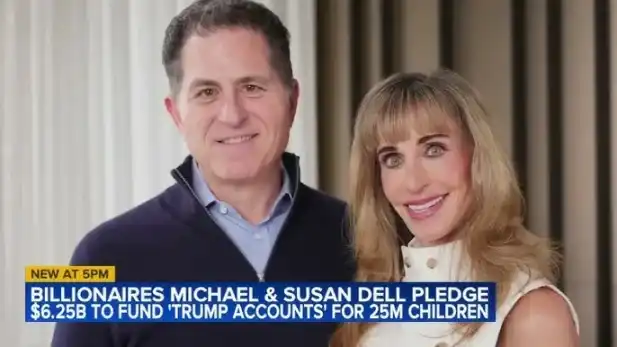
Odaily Note: Michael Dell couple, who donated $6.25 billion. Trump called this 'one of the most generous acts in American history'.

In terms of investment, 'Trump Accounts' will be limited to investing in low-cost investment funds or exchange-traded funds (ETFs) that track broad stock indices such as the 'S&P 500' index, and cannot be used to invest in specific industry or sector indices. The usage of funds is also restricted. Before the child turns 18 and becomes a legal adult on January 1 of that year, funds in the account cannot be withdrawn for any reason (unless the child passes away or the funds are transferred to another similar restricted account). After the child turns 18, the account will receive the same treatment as a traditional Individual Retirement Account (IRA).

According to the current plan, 'Trump Accounts' are tentatively scheduled to begin accepting initial deposits on July 4, 2026 (the 250th anniversary of the signing of the U.S. Declaration of Independence). This timing coincides with the run-up to the 2026 midterm elections and is expected to be a major policy 'trump card' for the Republican Party to win voters.

What is the Potential Scale?

According to statistics from Statista, since 2020, the annual number of births in the United States has fluctuated around 3.6 million.

Using this data as a benchmark, the planned coverage period from January 1, 2025, to January 1, 2029, is expected to include approximately 14.4 million newborn American children. If the federal government opens a $1,000 'Trump Account' for each child, this implies a massive fund of $14.4 billion; with potential private donations and family deposits, this number will continue to grow to hundreds of billions of dollars; if the plan continues to be promoted as a long-term initiative after 2029, its potential scale will be even more staggering.

Due to its operational characteristics of long-term lock-up, passive investment, and continuous new inflows, the 'Trump Account' will essentially become a long-term passive fund pool with a potential scale of hundreds of billions of dollars. Compared to a simple child welfare attribute, this更像是 establishing a long-term capital transmission channel between fiscal policy and the capital market, directly integrating the future generation into the stock market system.

The Biggest Beneficiary: Robinhood?

After the 'Trump Account' plan was announced, financial institutions such as JPMorgan Chase, Charles Schwab, and Robinhood began fierce competition for related services. With the U.S. Treasury Department officially designating Robinhood as the broker and initial custodian yesterday, Robinhood, which has obtained the 'entry ticket', is poised to become one of the most direct beneficiaries of this plan.

The most直观 benefit lies on the user side. According to the current policy coverage calculation, 'Trump Accounts' will correspond to tens of millions of newborn accounts, and the interaction portal for these accounts will be completed through a unified application — in other words, Robinhood will acquire a batch of potential users bound to the platform from birth. The oldest of these users is only 1 year old, and the youngest hasn't even been born yet... More importantly, these users are not one-time traffic but potential clients with an extremely long lifecycle. After the children turn 18, the accounts will convert into long-term investment accounts similar to IRAs, which means Robinhood has the opportunity to directly承接 these users into their adult investment behaviors and further extend into more business scenarios such as ETFs, options, and even crypto assets. From a lifecycle perspective, this is almost the longest possible user path a broker can obtain.

The benefits on the asset side are equally significant. The funds in 'Trump Accounts' have obvious long-term lock-up characteristics, hardly flowing out before the child reaches adulthood, while the investment scope is limited to index funds. This type of fund is extremely high-quality custody asset for brokers — low volatility, long retention, predictable scale. Furthermore, Robinhood's core label in the past has been a 'retail trading platform', with growth highly dependent on market conditions and trading activity. The 'Trump Account' introduces low-frequency, long-term, passive investment funds, which are closer to the capital attributes of traditional wealth management businesses. As the proportion of such funds increases, it will also enrich Robinhood's business diversity to a certain extent,补齐相对短板.

At the same time, the endorsement at the policy level also has symbolic significance. Participating in an account plan led by the Treasury Department brings Robinhood into the U.S. government's financial infrastructure system for the first time. This not only enhances its institutional credibility but also provides new narrative space for its future expansion into retirement accounts, long-term investment, and wealth management businesses.

From a political perspective, the 'Trump Account' is an important policy chip for the Republican Party facing the midterm elections; from a capital market perspective, this plan introduces an institutionalized long-term source of funds into the U.S. stock market. Robinhood happens to be at the intersection of both — as millions of newborns who have not yet entered society are 'automatically opening accounts', this policy design围绕选票 has also quietly laid a growth curve for Robinhood that could last for more than a decade.


İlgili Sorular

QWhat is the 'Trump Account' and what is its purpose?

AThe 'Trump Account', also known as a 530A account, is a tax-advantaged investment account plan established under the 'Big and Beautiful' Act. Its purpose is to provide government-funded savings accounts for children born between January 1, 2025, and January 1, 2029, who are U.S. citizens.

QWhich financial institutions were selected to manage the 'Trump Accounts' and what are their roles?

ABNY Mellon was selected as the designated financial agent to manage the initial accounts. Robinhood will partner with BNY Mellon, serving as the broker and initial custodian for the accounts.

QWhat are the sources of initial funding for a 'Trump Account' and what are the contribution limits?

AInitial funding comes from a $1000 federal grant, private donations (e.g., a $250 donation from the Michael Dell family for eligible children), and deposits from parents/friends, who can contribute up to $5000 per child per year.

QWhat is the potential scale of the 'Trump Account' program in terms of the number of children and total assets?

AThe program is expected to cover approximately 14.4 million children born during the eligibility period. With the $1000 federal grant alone, this represents $14.4 billion in assets, with the total potential size growing to hundreds of billions when including private and family contributions.

QWhy is Robinhood considered a major potential beneficiary of the 'Trump Account' program?

ARobinhood gains a long-term user base locked in from birth, with accounts converting to IRA-like accounts at age 18. It also acquires high-quality, long-term, passive assets that diversify its business beyond its traditional reliance on active retail trading, and receives a significant credibility boost from the government partnership.

İlgili Okumalar

U.S. Government Bans Foreign Nationals from Using Fable 5, Anthropic Issues Rebuttal

U.S. Government Bans Foreign Access to Fable 5, Anthropic Issues Rebuttal On June 12th, the U.S. government ordered AI company Anthropic to immediately suspend all foreign access—including foreign nationals within the U.S. and Anthropic's own foreign employees—to its newly released Fable 5 and Mythos 5 AI models, citing national security concerns. This forced Anthropic to temporarily disable access to both models for all users globally, as it cannot technically differentiate user nationality at scale. The models, released just three days prior, represent Anthropic's highest public capability tier. Fable 5 is the first publicly available model from the advanced "Mythos" family, while Mythos 5 is a less-restricted version for approved cybersecurity and critical infrastructure partners. The government's directive was reportedly triggered by claims from another company that it could "jailbreak" Mythos 5, raising alarm within the Trump administration. Anthropic, in a detailed public statement, strongly challenged this rationale. The company argues the demonstrated "jailbreak" is a narrow, non-generalized technique that merely involves identifying minor, known software vulnerabilities—a capability common to other publicly available models like OpenAI's GPT-5.5 and routinely used by cybersecurity defenders. Anthropic stated it has complied with the order but disagrees with the government's standard, warning that applying it industry-wide would halt all new frontier model deployments. The company criticized the lack of a transparent, fact-based legal process and expressed confidence the situation stems from a misunderstanding. It is working to restore access and will release more technical details within 24 hours. Other Anthropic models remain unaffected.

链捕手18 dk önce

U.S. Government Bans Foreign Nationals from Using Fable 5, Anthropic Issues Rebuttal

链捕手18 dk önce

The Revelation from the Raydium Theft Incident: New DeFi Vulnerabilities Lurking in Forgotten Old Contracts

**Raydium Exploit Reveals DeFi's Hidden Risk: Forgotten "Zombie" Contracts** A recent attack on Raydium's deprecated V3 AMM pools resulted in a loss of approximately $1.34 million. The hacker exploited pools that were no longer supported by Raydium's current UI or SDK but remained fully functional and accessible on-chain. This incident highlights a critical, often overlooked category of risk in DeFi: inactive or legacy smart contracts that projects fail to properly decommission. Since March 2025, there have been at least 8 publicly reported attacks targeting such abandoned contracts, with total losses around $10.8 million. Including older pools and deprecated features, the count rises to 10 incidents with roughly $22.5 million in losses. These "zombie contracts" represent a lifecycle management failure rather than a code vulnerability, yet they are typically misclassified under general "code bug" categories in security reports, masking the true scale of the problem. The root cause is that projects often merely document a contract as "deprecated" without taking essential technical steps to secure it: withdrawing remaining assets, disabling external call functions, and implementing ongoing monitoring. These forgotten, under-monitored components become prime targets for attackers. To address this, the industry needs to recognize "zombie contracts" as a distinct risk category and establish standardized decommissioning protocols. Essential steps should include: 1) a formal retirement announcement, 2) removal of all front-end integrations, 3) withdrawal of locked assets, 4) disabling key contract functions, 5) ongoing security monitoring, 6) clear user communication, and 7) a post-mortem analysis. The value of a DeFi project lies not only in its current TVL but also in the security of its historical codebase, which has now become a new attack surface.

Foresight News2 saat önce

The Revelation from the Raydium Theft Incident: New DeFi Vulnerabilities Lurking in Forgotten Old Contracts

Foresight News2 saat önce

Robots Begin to 'Consume Data': The Hidden Production Chain from Indian Data Factories to Billion-Dollar Humanoid Robots

Robots have started to 'consume data,' driving the formation of a new industrial supply chain focused on producing training data for embodied AI. Unlike large language models, which are trained on vast internet text corpora, embodied AI models face a 'data desert' in the physical world. This has created a massive demand for first-person perspective video data (Ego Data), captured by workers wearing cameras in places like Indian garment factories. Companies like Neocambrian AI are establishing 'data factories' where workers perform standardized tasks (e.g., sorting clothes, kitchen organization) to generate thousands of hours of video. Research, such as NVIDIA's EgoScale, demonstrates that scaling this human demonstration data predictably improves robot performance, particularly for dexterous manipulation. This has validated a training path combining large-scale human data for pre-training with smaller amounts of robot-specific data for fine-tuning. The value of different data types varies significantly, forming a 'data pyramid.' The base consists of low-cost, large-scale internet and Ego Data. Higher layers include more expensive motion-capture data (e.g., from data gloves), simulation/synthetic data, and the most costly and scarce layer: real robot teleoperation data. This demand has spawned a layered ecosystem of data suppliers: low-cost data factories, motion capture and alignment specialists, robot-native teleoperation service providers, simulation data companies, and platforms aiming for data standardization. Robot companies themselves are adopting a 'layered procurement' strategy: outsourcing generic Ego Data while building in-house capabilities for robot-specific adaptation data and the critical deployment/failure data generated in real-world applications. The industry is shifting focus from hardware and basic mobility to the data pipelines required for general-purpose capability. While parallels exist to data labeling companies like Scale AI in the LLM boom, the physical complexity of robot data—involving action success ambiguity and sim-to-real gaps—requires more integrated solutions for data collection, annotation, and a continuous feedback loop. The race is on to build the data engines that will teach robots to operate reliably in the unstructured real world.

marsbit4 saat önce

Robots Begin to 'Consume Data': The Hidden Production Chain from Indian Data Factories to Billion-Dollar Humanoid Robots

marsbit4 saat önce

İşlemler

Spot
Futures
活动图片




