Robinhood Gains a New Batch of Stock Investors, the Oldest is 1 Year Old, the Youngest is -3 Years Old

marsbit2026-04-08 tarihinde yayınlandı2026-04-08 tarihinde güncellendi

Özet

On April 6, the U.S. Treasury announced that Robinhood, in collaboration with BNY Mellon, has been selected as the broker and initial custodian for the "Trump Accounts" (also known as 530A accounts). Established under the "Big and Beautiful" Act authorized by former President Trump in June 2025, the program aims to create tax-advantaged investment accounts for children born between January 1, 2025, and January 1, 2029. Each account will receive an initial $1,000 from the federal government. Private donations, such as Michael Dell’s $6.25 billion contribution, will add $250 for eligible lower-income families. Families can also deposit up to $5,000 annually per child. Funds are restricted to low-cost index funds or ETFs tracking broad market indices like the S&P 500 and cannot be withdrawn until the child turns 18. With an estimated 14.4 million children eligible, the program could inject over $14.4 billion in government funds alone, growing significantly with private and family contributions. This creates a long-term, passively managed pool of capital potentially worth hundreds of billions of dollars. Robinhood stands to benefit significantly by gaining millions of young users who will be tied to the platform from birth, with their accounts converting to IRA-like structures upon adulthood. This provides Robinhood with a long-term client base, stable custodial assets, and entry into government-backed financial infrastructure, diversifying its business beyond its traditional ...

Author: Azuma, The Block

On April 6 local time, the U.S. Department of the Treasury officially announced the latest developments regarding 'Trump Accounts' — The Bank of New York Mellon (BNY) has been selected as the designated financial agent of the U.S. government, responsible for managing the initial accounts; Robinhood will cooperate with BNY, serving as the broker and initial custodian for the 'Trump Accounts'.

All parties will work together to support the Treasury's goal of ensuring that every eligible newborn American citizen can quickly and conveniently obtain a 'Trump Account'.

What is a 'Trump Account'?

The so-called 'Trump Account', also known as a 530A account, is a tax-advantaged investment account plan established on June 9, 2025, under the authorization of the 'Big and Beautiful' Act by then-President Donald Trump. It aims to set up government-funded savings accounts for children of U.S. citizens born between January 1, 2025, and January 1, 2029.

The initial funding for 'Trump Accounts' primarily comes from government appropriations, private donations, and family deposits. The federal government will provide $1,000 in initial funding for each account; Dell founder Michael Dell and his wife announced a donation of $6.25 billion in December last year, which will open accounts for 25 million children from families with a regional median income below $150,000, injecting $250 into each account; parents, friends, and other designated individuals can also deposit funds into specified accounts, but a maximum of $5,000 can be deposited per child per year.
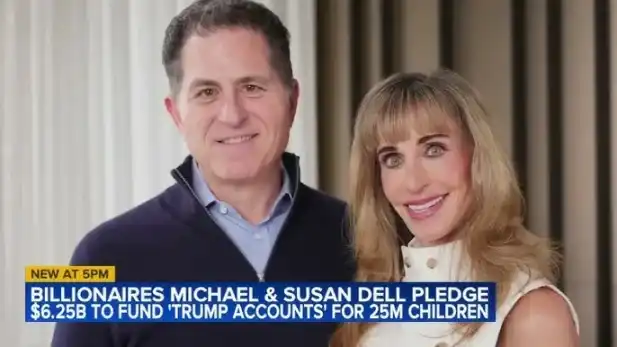
Odaily Note: Michael Dell couple, who donated $6.25 billion. Trump called this 'one of the most generous acts in American history'.

In terms of investment, 'Trump Accounts' will be limited to investing in low-cost investment funds or exchange-traded funds (ETFs) that track broad stock indices such as the 'S&P 500' index, and cannot be used to invest in specific industry or sector indices. The usage of funds is also restricted. Before the child turns 18 and becomes a legal adult on January 1 of that year, funds in the account cannot be withdrawn for any reason (unless the child passes away or the funds are transferred to another similar restricted account). After the child turns 18, the account will receive the same treatment as a traditional Individual Retirement Account (IRA).

According to the current plan, 'Trump Accounts' are tentatively scheduled to begin accepting initial deposits on July 4, 2026 (the 250th anniversary of the signing of the U.S. Declaration of Independence). This timing coincides with the run-up to the 2026 midterm elections and is expected to be a major policy 'trump card' for the Republican Party to win voters.

What is the Potential Scale?

According to statistics from Statista, since 2020, the annual number of births in the United States has fluctuated around 3.6 million.

Using this data as a benchmark, the planned coverage period from January 1, 2025, to January 1, 2029, is expected to include approximately 14.4 million newborn American children. If the federal government opens a $1,000 'Trump Account' for each child, this implies a massive fund of $14.4 billion; with potential private donations and family deposits, this number will continue to grow to hundreds of billions of dollars; if the plan continues to be promoted as a long-term initiative after 2029, its potential scale will be even more staggering.

Due to its operational characteristics of long-term lock-up, passive investment, and continuous new inflows, the 'Trump Account' will essentially become a long-term passive fund pool with a potential scale of hundreds of billions of dollars. Compared to a simple child welfare attribute, this更像是 establishing a long-term capital transmission channel between fiscal policy and the capital market, directly integrating the future generation into the stock market system.

The Biggest Beneficiary: Robinhood?

After the 'Trump Account' plan was announced, financial institutions such as JPMorgan Chase, Charles Schwab, and Robinhood began fierce competition for related services. With the U.S. Treasury Department officially designating Robinhood as the broker and initial custodian yesterday, Robinhood, which has obtained the 'entry ticket', is poised to become one of the most direct beneficiaries of this plan.

The most直观 benefit lies on the user side. According to the current policy coverage calculation, 'Trump Accounts' will correspond to tens of millions of newborn accounts, and the interaction portal for these accounts will be completed through a unified application — in other words, Robinhood will acquire a batch of potential users bound to the platform from birth. The oldest of these users is only 1 year old, and the youngest hasn't even been born yet... More importantly, these users are not one-time traffic but potential clients with an extremely long lifecycle. After the children turn 18, the accounts will convert into long-term investment accounts similar to IRAs, which means Robinhood has the opportunity to directly承接 these users into their adult investment behaviors and further extend into more business scenarios such as ETFs, options, and even crypto assets. From a lifecycle perspective, this is almost the longest possible user path a broker can obtain.

The benefits on the asset side are equally significant. The funds in 'Trump Accounts' have obvious long-term lock-up characteristics, hardly flowing out before the child reaches adulthood, while the investment scope is limited to index funds. This type of fund is extremely high-quality custody asset for brokers — low volatility, long retention, predictable scale. Furthermore, Robinhood's core label in the past has been a 'retail trading platform', with growth highly dependent on market conditions and trading activity. The 'Trump Account' introduces low-frequency, long-term, passive investment funds, which are closer to the capital attributes of traditional wealth management businesses. As the proportion of such funds increases, it will also enrich Robinhood's business diversity to a certain extent,补齐相对短板.

At the same time, the endorsement at the policy level also has symbolic significance. Participating in an account plan led by the Treasury Department brings Robinhood into the U.S. government's financial infrastructure system for the first time. This not only enhances its institutional credibility but also provides new narrative space for its future expansion into retirement accounts, long-term investment, and wealth management businesses.

From a political perspective, the 'Trump Account' is an important policy chip for the Republican Party facing the midterm elections; from a capital market perspective, this plan introduces an institutionalized long-term source of funds into the U.S. stock market. Robinhood happens to be at the intersection of both — as millions of newborns who have not yet entered society are 'automatically opening accounts', this policy design围绕选票 has also quietly laid a growth curve for Robinhood that could last for more than a decade.


İlgili Sorular

QWhat is the 'Trump Account' and what is its purpose?

AThe 'Trump Account', also known as a 530A account, is a tax-advantaged investment account plan established under the 'Big and Beautiful' Act. Its purpose is to provide government-funded savings accounts for children born between January 1, 2025, and January 1, 2029, who are U.S. citizens.

QWhich financial institutions were selected to manage the 'Trump Accounts' and what are their roles?

ABNY Mellon was selected as the designated financial agent to manage the initial accounts. Robinhood will partner with BNY Mellon, serving as the broker and initial custodian for the accounts.

QWhat are the sources of initial funding for a 'Trump Account' and what are the contribution limits?

AInitial funding comes from a $1000 federal grant, private donations (e.g., a $250 donation from the Michael Dell family for eligible children), and deposits from parents/friends, who can contribute up to $5000 per child per year.

QWhat is the potential scale of the 'Trump Account' program in terms of the number of children and total assets?

AThe program is expected to cover approximately 14.4 million children born during the eligibility period. With the $1000 federal grant alone, this represents $14.4 billion in assets, with the total potential size growing to hundreds of billions when including private and family contributions.

QWhy is Robinhood considered a major potential beneficiary of the 'Trump Account' program?

ARobinhood gains a long-term user base locked in from birth, with accounts converting to IRA-like accounts at age 18. It also acquires high-quality, long-term, passive assets that diversify its business beyond its traditional reliance on active retail trading, and receives a significant credibility boost from the government partnership.

İlgili Okumalar

Arthur Hayes Steps Up Purchases of This Altcoin, Investing $2 Million Over the Past Five Days!

Arthur Hayes, the founder of BitMEX, has significantly increased his investment in $ENA, the native token of the Ethena ecosystem, by purchasing approximately 2 million dollars' worth over the past five days. His most recent transaction involved acquiring 10.9 million $ENA tokens, valued at around $985,000, bringing his total recent purchases to 22.64 million tokens. This buying activity has drawn renewed investor attention to Ethereum-based projects and the DeFi sector. Hayes is known for his macroeconomic analyses and positive outlook on the crypto market. His substantial investment in $ENA is being interpreted as a sign of his confidence in the long-term prospects of Ethereum and specific DeFi projects. Ethena is noted for developing synthetic dollar products on the blockchain, with its $ENA token used for governance and within its ecosystem. While such large-scale purchases by prominent figures are seen as a key market indicator, experts caution that they alone are insufficient to drive price increases. Multiple factors, including overall market conditions, liquidity, investor demand, and macroeconomic events, continue to influence price movements. Analysts suggest Hayes's actions may reflect sustained interest from institutional and large investors in Ethena, but they emphasize that investment decisions should not rely solely on whale activity. A thorough evaluation of a project's fundamentals, utility, and broader market trends remains essential.

cryptonews.ru34 dk önce

Arthur Hayes Steps Up Purchases of This Altcoin, Investing $2 Million Over the Past Five Days!

cryptonews.ru34 dk önce

AI Takes Over the Lab? Latest Research from USTC Puts It to the Test in the Real Physical World

This study from the University of Science and Technology of China presents a real-world stress test for AI in scientific research. Researchers developed a machine-readable, modular laboratory for catalysis, consisting of 45 automated workstations. They evaluated 48 configurations combining 6 agent frameworks and 9 large language models (LLMs) across 32 expert-defined research tasks, conducting 4,608 tests. The key findings reveal a significant gap between AI's planning ability and reliable physical execution. Only 3.3% of all generated workflows (151 out of 4,608) could be executed without human correction. The best-performing agent/LLM combination achieved a 28.1% success rate. In a five-round closed-loop experiment, the AI could adjust local parameters based on results but failed at higher-level scientific replanning, such as redesigning analytical methods or correcting persistent critical omissions. Maintaining logical integrity for long-sequence workflows (over 30 steps) also proved challenging. The research distinguishes three often-conflated AI capabilities: generating plausible experimental plans, creating physically executable workflows, and performing evidence-driven strategic replanning. Results show the first does not guarantee the second, and parameter tuning is not equivalent to scientific reasoning. The platform serves as both a "testing ground" to quantify AI's scientific aptitude and a potential "training ground." By forming a "plan-execute-feedback-replan" loop with real-world feedback, it can expose AI shortcomings and generate data for iterative improvement, moving toward true end-to-end autonomous discovery.

marsbit39 dk önce

AI Takes Over the Lab? Latest Research from USTC Puts It to the Test in the Real Physical World

marsbit39 dk önce

İşlemler

Spot
活动图片