Robinhood Chain's First Breakout Hit Is a Meme Cat: Retail Investors Dig Out CashCat's 'Original Name,' CEO Jumps on the Trend

marsbit2026-07-08 tarihinde yayınlandı2026-07-08 tarihinde güncellendi

Özet

Robinhood Chain launched its mainnet on July 1st, promoting tokenized U.S. stocks as its core feature. However, the first asset to gain significant traction was a meme token called CASHCAT, which surged over 1700% in 24 hours, reaching a market cap of $120 million. The token's narrative stems from Robinhood's early history: CEO Vlad Tenev revealed the company's initial working name was "CashCat." CASHCAT has no official ties to Robinhood and declares itself as "pure cat" with zero utility. Tenev added fuel by tweeting on July 8th that the chain is "great for memes," which the community saw as implicit approval. The hype has attracted copycat tokens on other chains like Solana and impersonator accounts promoting scams. The article highlights the extreme volatility and risks associated with this new, illiquid meme token on a fledgling blockchain, cautioning investors to verify contracts and treat any investment as high-risk speculation.

Author: Claude, Shenchao TechFlow

Shenchao Introduction: One week after the Robinhood Chain mainnet launch, while the officially promoted stock token hasn't gone viral yet, a Meme cat called CASHCAT has taken off first, with its price surging over 1700% in 24 hours at one point and its market cap exceeding $120M. Its entire narrative boils down to one sentence: the working name for Robinhood during its startup phase was CashCat. CEO Tenev himself shared this history and even tweeted a meme on the day of the surge. Meanwhile, copycat tokens and fake 'Roaring Kitty' shilling accounts are already in position.
Attracting traffic and retail investor attention still depends on Memes.

Robinhood spent a year paving the way for its own blockchain, pitching tokenized stocks as the core story. However, the first truly viral asset on the chain turned out to be a cartoon cat holding cash.

According to GMGN monitoring, on July 8th, the market capitalization of the Meme token CASHCAT on Robinhood Chain exceeded $120 million, with a 24-hour increase of over 1700%. In the following hours, readings from different data platforms continued to rise. According to CoinGecko data, CASHCAT primarily trades on the Uniswap V3 deployed on Robinhood Chain, with the CASHCAT/WETH pair seeing a 24-hour trading volume of approximately $28 million. For a new chain that has only been live for a week and has very few ecosystem applications, this cat is the current traffic itself.

Seventh Day Post-Mainnet Launch, The First Viral Asset Is a Meme

First, some background.

On July 1st, Robinhood officially launched the public mainnet for Robinhood Chain at an event in London. This is an Ethereum Layer 2 based on Arbitrum technology, unveiled by CEO Vlad Tenev and crypto business head Johann Kerbrat. The official positioning of this chain is quite 'serious'. Its core product, Stock Tokens, tracks the price performance of over 200 US stocks and ETFs and is open to users in over 120 jurisdictions (excluding US users). DeFi protocols like Uniswap and 1inch were deployed on day one, and Robinhood pledged to cover all Gas fees for the first 90 days.

According to the official script, the protagonists of this chain should have been tokenized stocks and RWA (Real World Assets). However, the script didn't follow the plan. In the first week after the mainnet launch, the most actively traded pair on the chain wasn't any stock token, but CASHCAT. Retail investors set the tone for this 'retail broker's chain' first.

A clear warning for holders: CASHCAT's current trading depth is concentrated on a single trading pair within a single DEX. Liquidity is thin on a new chain, price readings vary significantly across platforms, and both slippage and wick risk upon entry/exit are far higher than for Memes on mature chains.

Archaeology of the 'Original Name', Tenev Himself Told the CashCat Story

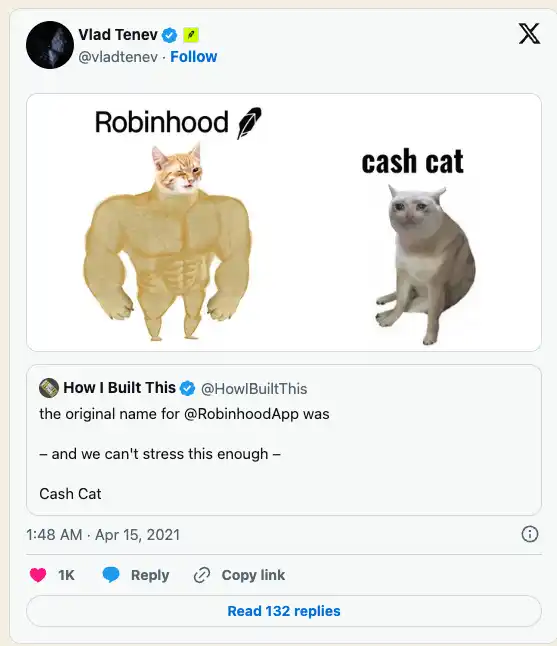
CASHCAT's success relies on a real piece of company history.

In early interviews, Tenev recalled the company naming process: "The original working name was actually CashCat, but everyone felt it wasn't powerful enough. My wife would introduce me to her friends by saying, 'They're the Robin Hoods of finance, doing things for the little guy.' That's how the name Robinhood stuck." This account has been cited in numerous company retrospectives after the GameStop saga, making it verifiable 'archaeological material.' This is the biggest difference between CASHCAT and other cat/dog coins built on fabricated stories.

The token's structure is as simple as it gets. According to the project's website, the total supply is 1 billion tokens, with zero buy/sell taxes. The liquidity pool tokens have been fully burned, and it self-identifies as "zero utility, one hundred percent cat." The website also explicitly states that the project has no affiliation with Robinhood, calling it "fan fiction with a ticker."

The narrative is real, the product is unrelated. Readers need to distinguish these two facts: Robinhood's history provides this cat with viral material, but the company does not endorse it. The token's value is built entirely on attention, with no safety net when that attention fades.
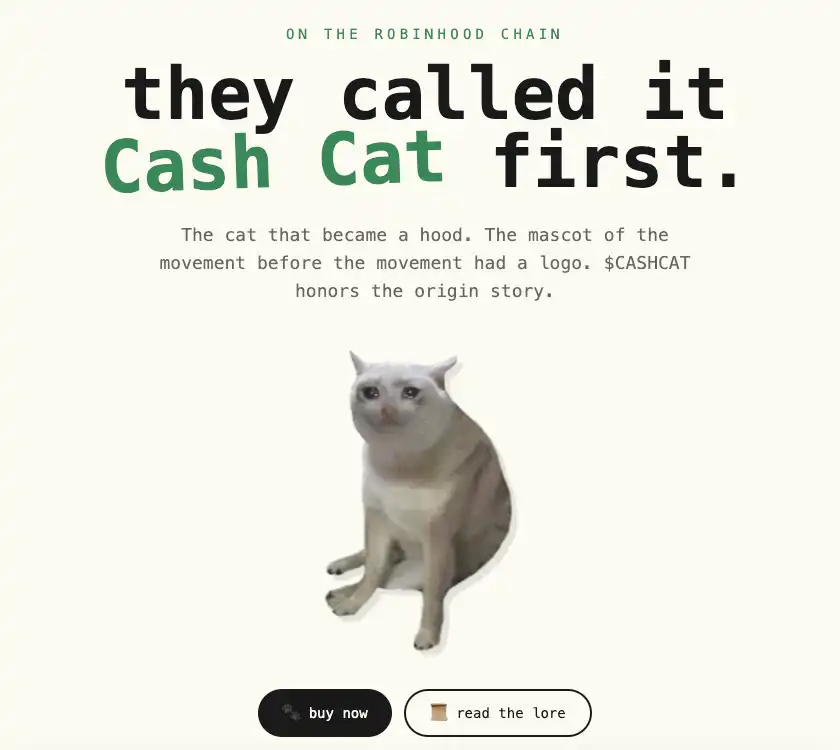
Tenev Tweets Meme, Market Interprets It as Semi-Endorsement

What truly pushed the frenzy to its peak was Tenev himself.

On July 8th, Tenev posted on X (formerly Twitter): "We're making Robinhood Chain the best RWA public chain... but it runs Memes really well too." The post garnered over 500,000 views within hours. While he didn't mention CASHCAT by name, the timing coincided with the day of the massive surge. The community interpreted it as implicit approval, if not an assist, for the Meme frenzy on the chain.

There's a layer of historical irony here. During the 2021 GameStop short squeeze, Robinhood was thrust into Congressional hearings for restricting retail buys of GME, becoming the 'villain' in the retail narrative. Five years later, this company's blockchain completes its cold start, precisely relying on the Meme culture that retail investors excel at, with the object of speculation being the name the company itself discarded. The CASHCAT website even specifically plays on this irony: "Cash Cat doesn't do options, and it doesn't do PFOF (Payment for Order Flow)."
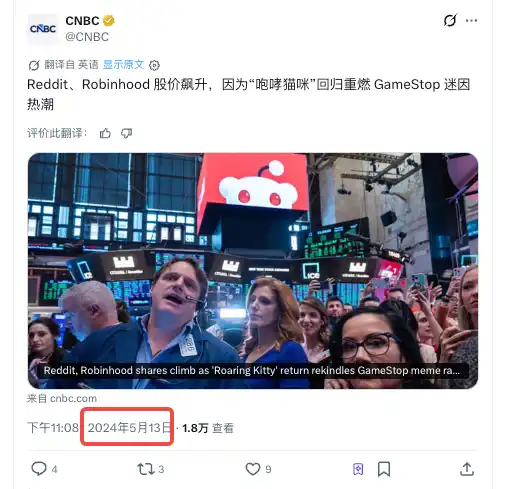
For traders, it's necessary to heavily discount the actual value of this tweet. A playful tweet from Tenev and an official Robinhood endorsement are separated by an entire compliance department. The company has no commitments regarding custody, listing, or providing liquidity for the Meme token. The effectiveness of such sentiment catalysts typically lasts only hours.

Copycat Tokens and Fake 'Roaring Kitty' Accounts Are Already in Position

Once the heat arrived, the tools to hunt retail investors followed.

First, cross-chain copycat tokens. According to aggregated monitoring information from CoinGecko, an identically named CASHCAT has already been deployed on the Solana chain. The original contract is deployed on Robinhood Chain with an address starting with 0x020b and ending with 18b4; identically named tokens on other chains are unrelated to the original.

Second, impersonator accounts shilling. For example, an X account with the handle "RK" and a username highly similar to GameStop saga protagonist 'Roaring Kitty' Keith Gill tweeted, "CASHCAT is the first major Meme on Robinhood chain," and included a Solana contract address in the post.

New chain, new Meme, fake accounts, cross-chain copycats—this combination has claimed victims in every past Meme cycle. If you still decide to participate now, at least do these three things: verify the contract address, use only official or reputable cross-chain bridges, and keep your position size to lottery-ticket levels.

CASHCAT's current total value is just a good story plus a wave of attention, neither of which has a retention mechanism.


Trend Kriptolar

İlgili Sorular

QWhat is CASHCAT, and why did it become the first viral asset on Robinhood Chain after its mainnet launch?

ACASHCAT is a meme token featuring a cartoon cat holding cash. It became the first viral asset on Robinhood Chain, launched on July 1, due to its connection to Robinhood's early history. The name 'CashCat' was Robinhood's original working name before it adopted 'Robinhood,' a fact shared by CEO Vlad Tenev. The token's price surged over 1700% in 24 hours, capturing significant market attention and liquidity on the new chain.

QWhat historical anecdote about Robinhood gives CASHCAT its narrative foundation?

AThe narrative foundation for CASHCAT comes from an anecdote shared by Robinhood CEO Vlad Tenev. He revealed that the company's original working name during its early days was 'CashCat,' but it was changed to 'Robinhood' because the latter was perceived as more powerful and aligned with the idea of 'stealing from the rich to give to the poor.' This true piece of company history differentiates CASHCAT from other meme tokens with fabricated backstories.

QHow did Robinhood CEO Vlad Tenev's actions on social media contribute to the hype around CASHCAT?

AOn July 8, Vlad Tenev posted on X, stating, 'We're building Robinhood Chain to be the best RWA public chain... but it runs Memes pretty well too.' Although he didn't mention CASHCAT by name, the timing coincided with the token's massive price surge. The community interpreted the post as a tacit endorsement or acknowledgment of the meme token activity on the chain, significantly fueling the hype and market speculation.

QWhat are the key risks associated with trading CASHCAT as highlighted in the article?

AThe article highlights several key risks: 1) The token's trading is concentrated on a single DEX (Uniswap V3) and a single trading pair (CASHCAT/WETH) on the new Robinhood Chain, leading to thin liquidity. 2) This results in high slippage, price volatility, and significant differences in price readings across data platforms. 3) The token's value is based solely on a historical narrative and market attention, with no underlying utility or backing from Robinhood, making it highly susceptible to rapid value loss when hype fades.

QWhat fraudulent activities emerged following CASHCAT's price surge, and what precautions should investors take?

AFollowing the surge, fraudulent activities included: 1) The deployment of fake 'CASHCAT' tokens on other blockchains like Solana, which are unrelated to the original Robinhood Chain token. 2) Impersonator accounts on social media, such as one mimicking 'Roaring Kitty' (Keith Gill), promoting these fake tokens. Investors are advised to: verify the correct contract address (the original starts with 0x020b and ends with 18b4), use only official or reputable cross-chain bridges, and limit their investment to an amount they are prepared to lose ('lottery ticket' sized positions).

İlgili Okumalar

Just Now, Sam Altman Blasts Dario Amodei as 'Anti-Human', Secret Model Exposed the Same Day

Just now, Sam Altman strongly criticized Dario (Amodei, co-founder of Anthropic), denouncing his "doomsday marketing" as "anti-human dictator rhetoric." This came alongside the accidental exposure of OpenAI's next-generation model, codenamed "gpt-nathree," hinting at the imminent release of GPT-6 Astra. The leak occurred when an OpenAI employee's public GitHub commit mentioned the codename. Combined with previous leaks of "gpt-mewfour," it suggests these are iterative checkpoints for OpenAI's upcoming agent model, Astra. Astra is known for multi-agent collaboration and long-duration task handling, having reportedly solved previously unsolved mathematical problems. Meanwhile, two new Anthropic model codenames, "claude-marshmallow-eap" and "claude-melon-eap," were also exposed but are believed to be iterations of the Claude 5 series, not a new flagship. In a wide-ranging podcast interview, Altman admitted he was wrong about the speed of AI-driven disruption, acknowledging societal inertia slows adoption. He fiercely criticized rivals' marketing that simultaneously promises immense benefits (like curing cancer) and warns of existential risk, calling it a dangerous "benevolent dictator" narrative that seeks to concentrate power. He emphasized that people are the ultimate purpose of AI. Altman also revealed OpenAI's unconventional, consensus-defying path: spending four and a half years in the "dark" without a public product before ChatGPT's breakthrough, driven by scaling laws rather than early customer feedback. He concluded that even with superintelligent AI, genuine human connection will remain irreplaceably valuable.

marsbit20 dk önce

Just Now, Sam Altman Blasts Dario Amodei as 'Anti-Human', Secret Model Exposed the Same Day

marsbit20 dk önce

The 'Saving U.S. Treasuries' Baton Pass: Bessent Fumbled Last Week, This Week It's Wash's Turn

"Rescuing US Treasuries" Relay: After Bessent's Miss, All Eyes Are on Walsh Last week, US Treasury Secretary Bessent's announcement to at least double long-term Treasury buybacks failed to sustainably lower yields, which quickly rebounded. The market response saw a drop in the dollar alongside surges in gold and Bitcoin, interpreted as a "pressure release valve" for anxiety. The focus now shifts to Fed Chairman Walsh's upcoming Jackson Hole speech. Markets are highly sensitive to his message, seeking clarity on the Fed's policy response to stubborn inflation and worsening fiscal conditions. Analysts warn that a lack of new guidance could disappoint markets and worsen the sell-off in long-dated bonds. Analysts question the scale of Bessent's operations, noting they are too small relative to the overall debt market and do not constitute quantitative easing. A key issue is the Fed's massive holdings of long-term bonds, which distorts the market. With the Fed holding low-yielding short-term bonds that are losing money relative to its policy rate, discussion is growing around a potential Fed-led "Operation Twist." This would involve selling short-term bonds to buy long-term ones, aiming to lower long-end yields without expanding the balance sheet. The upcoming PCE inflation data will set the stage for Walsh's speech. However, the window for action is narrowing amid political pressures. A critical threshold is the 30-year yield at 5%; holding above it could increase stress on the dollar and leveraged sectors. Overall, the article suggests that without coordinated Fed action to anchor inflation expectations, Treasury interventions may ultimately fail, with investors increasingly looking to assets like gold as hedges.

marsbit50 dk önce

The 'Saving U.S. Treasuries' Baton Pass: Bessent Fumbled Last Week, This Week It's Wash's Turn

marsbit50 dk önce

Hyperliquid's Compliance Journey: From Permissionless to Permissioned via HIP-3

Hyperliquid’s Compliance Path: From Permissionless to Permissioned HIP-3 Hyperliquid currently blocks U.S. access because its permissionless, on-chain infrastructure conflicts with U.S. market structure laws, which restrict futures trading to registered exchanges, clearinghouses, and brokers. Through its Hyperliquid Policy Center (HPC), the project is advocating for regulatory modernization, proposing that regulated entities be allowed to build products on HyperCore (its exchange and clearing layer) while fulfilling their compliance obligations. The platform’s modular stack separates roles like a traditional exchange (DCM), clearinghouse (DCO), and broker (FCM), but reconstructs them on-chain with code. This enables permissionless access, self-custody, and 24/7 global trading, but clashes with U.S. rules requiring KYC, specific margin models, and custodial arrangements. To resolve this, HPC is engaging with U.S. regulators (CFTC, SEC) to seek clarity that deploying on-chain software does not itself trigger licensing, and to establish exemptions allowing non-custodial wallets to route users to regulated derivatives. Recent political signals suggest openness to this approach. On the technical side, Hyperliquid Labs has introduced permissioned HIP-3 deployers on testnet. These allow regulated entities to launch markets, perform KYC, and whitelist compliant users. While these create separate order books, whitelisted market makers can bridge liquidity between them, ensuring deep, shared liquidity across the same L1. Features like payload-based “PA” permissions enable DEX-level account controls (e.g., reduce-only orders), mirroring traditional broker authorities. The strategy is not to open the native, permissionless front-end to U.S. users, but to position Hyperliquid as neutral infrastructure that U.S. regulated firms can use while meeting their legal duties. This paves a compliant path for U.S. investor access while preserving the protocol’s core, permissionless nature.

marsbit1 saat önce

Hyperliquid's Compliance Journey: From Permissionless to Permissioned via HIP-3

marsbit1 saat önce

Two Funding Rounds in Three Months: The Chinese Version of Palantir is on Fire

Investment Community AI has learned that Beijing Zhongshu Ruizhi Technology Co., Ltd., a domestic industrial-grade causal intelligence and high-reliability decision-making AI company, has recently completed a strategic financing round worth hundreds of millions of RMB. This round saw participation from China Internet Investment Fund, Suzhou Chuangtou National Social Security Fund, Financial Street Capital, ICBC Capital, Kunlun Capital, among others, with existing shareholders also increasing their investment. This follows a Series B funding round in the hundreds of millions completed just three months prior. The rapid succession of two major funding rounds signifies strong market recognition of the company's underlying original technology and scaled commercial implementation. Often referred to as the "Chinese version of Palantir," Zhongshu Ruizhi is entering a new phase of accelerated technological iteration, widespread scenario replication, and scaled performance release, mirroring the explosive growth of China's AI market. Founded in April 2020 by Dr. Han Han, a Tsinghua University Ph.D. and former core drafter of national AI policies, the company is mission-driven to "move AI from the digital world to the physical world." It focuses on the high-reliability, strong-decision industrial AI track and enterprise-grade AI Agent full-stack infrastructure. The team tackles the challenge of applying AI to China's vast and complex industrial and energy systems by developing a new intelligent operating system from scratch. Its core technological breakthrough lies in three proprietary底层 technologies: meta-causal cognitive theory, causal models, and a dynamic ontology engine. These address critical pain points of generative large models in industrial settings—such as AI hallucinations, insufficient reasoning, lack of temporal logic, unverifiable decisions, and multi-source rule conflicts—thereby providing trustworthy, explainable, and executable智能决策 capabilities. Commercially, Zhongshu Ruizhi has achieved scaled deployment, serving over 50 central state-owned enterprises and industrial groups in sectors like power, petroleum, and aerospace, with implementations in more than 800 highly complex production scenarios. The company reported doubled revenue in 2025, demonstrating strong self-sufficiency and a viable business model—a rarity among new-generation AI firms. The latest funds will be allocated towards advancing foundational theoretical research, replicating successful application models to expand market presence (including overseas), and attracting top-tier talent. Lead investor China Internet Investment Fund highlighted that in the current shift from general AI capability contests to deep industrial empowerment, industrial-grade causal intelligence is crucial for building China's modern digital foundation and fostering new quality productive forces. They expressed support for the company's efforts to define decision-making paradigms and trustworthy standards for industrial intelligence, aiming to secure a rule-making voice in the global physical AI arena.

marsbit1 saat önce

Two Funding Rounds in Three Months: The Chinese Version of Palantir is on Fire

marsbit1 saat önce

İşlemler

Spot

Popüler Makaleler

CAT Nasıl Satın Alınır

HTX.com’a hoş geldiniz! Simon's Cat (CAT) satın alma işlemlerini basit ve kullanışlı bir hâle getirdik. Adım adım açıkladığımız rehberimizi takip ederek kripto yolculuğunuza başlayın. 1. Adım: HTX Hesabınızı OluşturunHTX'te ücretsiz bir hesap açmak için e-posta adresinizi veya telefon numaranızı kullanın. Sorunsuzca kaydolun ve tüm özelliklerin kilidini açın. Hesabımı Aç2. Adım: Kripto Satın Al Bölümüne Gidin ve Ödeme Yönteminizi SeçinKredi/Banka Kartı: Visa veya Mastercard'ınızı kullanarak anında Simon's Cat (CAT) satın alın.Bakiye: Sorunsuz bir şekilde işlem yapmak için HTX hesap bakiyenizdeki fonları kullanın.Üçüncü Taraflar: Kullanımı kolaylaştırmak için Google Pay ve Apple Pay gibi popüler ödeme yöntemlerini ekledik.P2P: HTX'teki diğer kullanıcılarla doğrudan işlem yapın.Borsa Dışı (OTC): Yatırımcılar için kişiye özel hizmetler ve rekabetçi döviz kurları sunuyoruz.3. Adım: Simon's Cat (CAT) Varlıklarınızı SaklayınSimon's Cat (CAT) satın aldıktan sonra HTX hesabınızda saklayın. Alternatif olarak, blok zinciri transferi yoluyla başka bir yere gönderebilir veya diğer kripto para birimlerini takas etmek için kullanabilirsiniz.4. Adım: Simon's Cat (CAT) Varlıklarınızla İşlem YapınHTX'in spot piyasasında Simon's Cat (CAT) ile kolayca işlemler yapın.Hesabınıza erişin, işlem çiftinizi seçin, işlemlerinizi gerçekleştirin ve gerçek zamanlı olarak izleyin. Hem yeni başlayanlar hem de deneyimli yatırımcılar için kullanıcı dostu bir deneyim sunuyoruz.

226 Toplam GörüntülenmeYayınlanma 2024.12.13Güncellenme 2026.06.02

CAT Nasıl Satın Alınır

TRUMP CAT Nedir

Trump Kedi Ailesi, $Trump Kedi: Çözülmemiş Bir Gizem Giriş Kripto projeleri ve web3 yeniliklerinin sürekli evrilen manzarasında, merak uyandıran bir fenomen ortaya çıkmıştır—bu, kripto para birimi ve internet meme kültürü arasında bir çizgide duruyor gibi görünüyor. Bu, “Trump Kedi Ailesi” olarak adlandırılan, aynı zamanda “$Trump Kedi” olarak da bilinen esrarengiz bir kavramdır. Kripto meraklıları arasında merak uyandırabilirken, gerçeklik, bir kripto projesinin standart tanımından oldukça uzakta görünmektedir. Bu makale, Trump Kedi Ailesi kavramını keşfetmeyi, etrafındaki bağlamı aydınlatmayı ve kripto alanındaki durumunu netleştirmeyi amaçlamaktadır. Trump Kedi Ailesi, $Trump Kedi Nedir? İlk bakışta, “Trump Kedi Ailesi"nin meşru bir kripto para birimi veya web3 projesine atıfta bulunduğu düşünülebilir. Ancak, daha derin bir inceleme yapıldığında, terimin geleneksel bir kripto girişiminin unsurlarını taşımadığı ortaya çıkmaktadır. Bunun yerine, “Trump Kedi"nin, eski ABD Başkanı Donald Trump'ın Haiti göçmenleriyle ilgili yaptığı tartışmalı açıklamaların ardından patlayan viral meme kültürü ile ağırlıklı olarak ilişkilendirildiği görülmektedir. Medya kapsamı, sayısız meme, mizahi yorumlar ve bir sosyal yorum dalgasını tetikledi. Bu memeler, Trump'ın diyalogları etrafında dönen çeşitli mizah biçimlerini, genellikle komik ve bazen absürt senaryolar içinde kedileri kullanarak tasvir etmektedir. Teknolojik ilerlemeleri veya finansal işlemleri ele almayı amaçlayan yapılandırılmış bir proje yerine, “Trump Kedi Ailesi” kavramı ağırlıklı olarak internet mizahı alanında var olmaktadır. Trump Kedi Ailesi, $Trump Kedi'nin Yaratıcısı Kimdir? “Trump Kedi Ailesi"nin arkasında kimin olduğu araştırıldığında, tanımlanabilir bir yaratıcı veya kurucu figürün olmadığı anlaşılmaktadır. Fenomenin, belirli bir proje hedefi olan tek bir vizyonerden ziyade, kolektif internet ifadesinden kaynaklandığı görünmektedir. Bu anonimlik, onun çoğu bilinen kripto projesine benzer yapılandırılmış bir girişimden ziyade bir meme olarak statüsünü daha da vurgulamaktadır. Trump Kedi Ailesi, $Trump Kedi'nin Yatırımcıları Kimlerdir? “Trump Kedi Ailesi"nin saygın bir kripto projesinin özelliklerine uymadığından, yatırım sorusu gereksiz hale gelmektedir. Bu isimle bir projeyi destekleyen herhangi bir kuruluş veya organizasyon bulunmamaktadır. Bunun yerine, meme kültürüne katkıda bulunan bireysel katılımcılar—hobi sahipleri, sanatçılar ve sosyal medya kullanıcıları, “Trump Kedi” terimi etrafındaki yorumları ve mizahlarıyla interneti kolektif olarak doldurmaktadır. Dijital insan iletişimi içindeki bu organik büyüme, daha çok sosyal bir yorum yansıtmaktadır, finansal bir yatırım manzarasından ziyade. Trump Kedi Ailesi, $Trump Kedi Nasıl Çalışır? “Trump Kedi Ailesi"nin nasıl çalıştığını anlamak isteyen biri için cevap, standart kripto projelerinden beklenenden oldukça farklıdır. Bu fenomenin içindeki operasyonel mekanizmalar, teknolojik yenilikler veya benzersiz özellikler yoktur. Bunun yerine, çevrimiçi viral yayılma yoluyla var olmaktadır, yayılmak için sosyal medya platformlarına dayanarak. “Nasıl” sorusu, kültür ve iletişim alanında yer almakta—özünü sosyal etkileşim dinamiklerinden almakta, kurulu kripto protokolleri veya blok zinciri işlevselliklerinden değil. Eğer “Trump Kedi"yi benzersiz kılan bir şey varsa, o da mizah yoluyla bir siyasi diyalogu dramatize etme şeklidir. İnsanlar, siyasi figürler ve toplumsal sorunlar hakkında duyguları iletmek için ilgi çekici görseller, iç şakalar ve yaratıcı hikaye anlatımı kullanmaktadır. Memelerin gücü, geleneksel iletişimi aşarak karmaşık düşünceleri geniş bir şekilde yankılanan bir biçimde kapsar, ancak ölçülebilir başarı veya yapılandırılmış hedefler açısından belirsiz kalır. Trump Kedi Ailesi, $Trump Kedi Zaman Çizelgesi Eylül 2024: Donald Trump'ın Haiti göçmenleri hakkında yaptığı açıklamaların, evcil hayvanları tükettiğine dair iddiaların çevrimiçi olarak yankı bulması, çeşitli platformlarda memelerin ve parodik yorumların patlak vermesine yol açar. Devam Eden Etki: Bu dönemin ardından, “Trump Kedi” fenomeni, sosyal medya kullanıcılarının mizahı kullanarak siyasi konuşmaların ve olayların absürtlüğünü ele alması, eleştirmesi veya sadece kutlamasıyla devam eden bir yaşam sürmektedir. “Trump Kedi Ailesi” geleneksel bir projenin resmi yapısına sahip olmadığından, zaman çizelgesi esasen anekdot gözlemlerinden oluşmakta, tanınmış kripto girişimlerinde sıkça bulunan dikkate değer kilometre taşlarından yoksun kalmaktadır. Ana Noktalar Meme Kültürü: Yapılandırılmış bir kripto girişimi yerine, “Trump Kedi” daha çok internet memelerinin evrilen manzarasıyla uyum içindedir. Terimin Kökeni: “Trump Kedi"nin kökeni, Başkan Trump'ın Haiti göçmenleriyle ilgili yorumlarına doğrudan ilişkilidir ve geniş çapta mizahi temsili tetiklemiştir. Proje Çerçevesinin Yokluğu: Terim, herhangi bir tanımlanmış proje hedefi, yaratıcı veya yatırımcı ile uyumlu değildir, onu bir kripto projesinden ziyade yeni bir kültürel deneyim olarak işaret etmektedir. Sonuç Özetle, “Trump Kedi Ailesi, $Trump Kedi” üzerine yapılan araştırma, internet meme kültürüne kök salmış bir fenomeni ortaya çıkarmaktadır, kripto para veya web3 sektörlerinde tanınan bir proje yerine. Terim etrafındaki viral etki, kolektif kullanıcı etkileşiminden doğmakta, modern dijital söylemi yansıtmaktadır, yapılandırılmış bir girişim veya stratejik öngörü ile değil. Bir sonraki büyük kripto projesini arayanlar için ne kadar merak uyandırsa da, “Trump Kedi Ailesi”, insanlığın yaratıcılığının, mizahının ve dijital çağdaki siyasete karşı sıklıkla absürt ilişkisini bir kanıtı olarak hizmet etmektedir.

300 Toplam GörüntülenmeYayınlanma 2025.01.22Güncellenme 2025.01.22

TRUMP CAT Nedir

Tartışmalar

HTX Topluluğuna hoş geldiniz. Burada, en son platform gelişmeleri hakkında bilgi sahibi olabilir ve profesyonel piyasa görüşlerine erişebilirsiniz. Kullanıcıların CAT (CAT) fiyatı hakkındaki görüşleri aşağıda sunulmaktadır.

活动图片