Robinhood Chain Goes Viral in One Week: Memes Bring Traffic, Stablecoins Boost TVL

marsbit2026-07-10 tarihinde yayınlandı2026-07-10 tarihinde güncellendi

Özet

Robinhood Chain, a new Arbitrum-based Layer 2 blockchain, has seen explosive growth in its first week. This surge was driven by a combination of viral memecoin trading and a major stablecoin deposit, though the latter contributes the most to its Total Value Locked (TVL). Active addresses soared from near zero to nearly 200,000, with daily DEX volume peaking at nearly $400 million. The integration of the Solana-based launchpad Pump.fun significantly lowered the barrier for memecoin trading, fueling activity with tokens like CASHCAT, which saw a 1320% price surge. Contrary to the public focus on memes, the primary driver of the chain's TVL, which reached approximately $234 million, was a ~$50 million deposit of Ethena's USDG stablecoin into the Morpho lending protocol. This single event caused a 160% TVL increase. Morpho underpins Robinhood's Earn product, offering yield on stablecoins. While the chain was originally launched with a focus on tokenized Real-World Assets (RWAs), this segment remains a minor part of the ecosystem at around $12.8 million. The initial growth is thus characterized by speculative memecoin trading and yield-seeking stablecoin deposits, while its core RWA narrative is still in early development.

Written By: The Defiant Team

Compiled By: Saoirse, Foresight News

This week, a combination of Memecoin hype, integration with the Pump.fun platform, and an application announcing its migration from Solana to this new, just-week-old blockchain have collectively driven a surge in on-chain activity for Robinhood Chain. Notably, however, the largest single inflow of funds on the chain came from stablecoin staking, not Memecoin trading.

According to a network dashboard data published by Entropy Advisors on Dune Analytics: this Layer-2 network built on Arbitrum has seen its cumulative address count approach 200,000, with a total protocol value locked (TVL) of approximately $234 million.

The public chain officially opened mainnet access to the public on July 1st, meaning nearly all of this growth has occurred within its first week of operation, and on-chain activity has continued to accelerate in recent days.
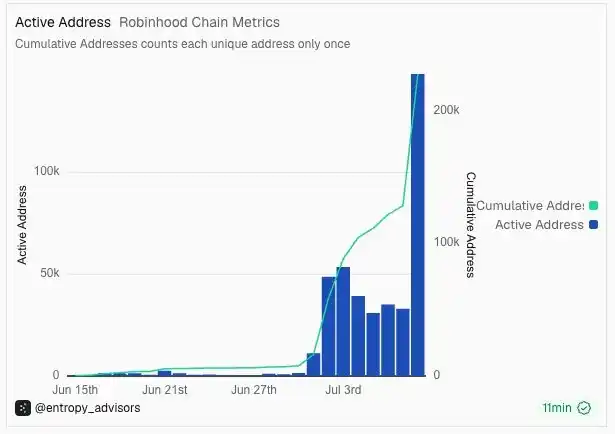
Robinhood Active Address Count. Data Source: Dune Analytics

CEO Makes a Complete 180-Degree Turn in Official Stance

The strategic shift began at the highest level of management. On the evening of July 7th, CEO Vlad Tenev posted on platform X: 'We built Robinhood Chain to be the best public chain for real-world assets (RWA)... But this chain is also great for memecoins.'

This statement overturned his view from just days earlier. On July 2nd, the day the mainnet launched, he stated in a CNBC interview that memecoins were largely a dead end. In his view, tokens lacking practical application value struggle to sustain long-term, and tokenized real-world assets represent a more sustainable path for the crypto industry.

When Robinhood formally launched the mainnet at its London keynote presentation 'Robinhood Presents: The World is Flat,' it consistently positioned the chain as infrastructure for tokenized stocks and various real-world assets; integrations with Uniswap, Chainlink, Alchemy, and BitGo were completed on launch day.

Pump.fun Channels a Large Number of Traders

On July 8th, the token launch platform Pump.fun, born in the Solana ecosystem, announced support for trading Robinhood Chain tokens, significantly lowering the barrier for traders to participate in the chain's Memecoins.

The platform's official account posted on platform X: 'You can now trade Robinhood Chain tokens on the Pump.fun app! No cross-chain bridge needed, seamless trading with SOL, the platform supports all popular Robinhood chain tokens.'

Pump.fun co-founder Alon Cohen stated that this update was merely an extension of the platform's existing multi-chain trading tools, not an independent new business line. He posted: 'Pump.fun is not just for launching platform-native tokens, it supports all cross-chain trading. You can trade Robinhood tokens now, zero fees via the Solana route.'

World Project Migrates Out of Solana Ecosystem

Robinhood Chain successfully lured project resources from the Solana ecosystem. The on-chain prediction market World launched on Solana on July 1st, usable directly within the Phantom wallet. Now, the project's official team has announced a full migration to this new public chain.

The project team announced on platform X on July 8th: 'World has decided to migrate from Solana to Robinhood Chain.' The team stated this strategic adjustment was made after careful evaluation over the past 24 hours and expressed gratitude to the Solana Foundation and community.

CASHCAT Ignites Memecoin Rally

The hottest token currently is CASHCAT, named after Robinhood's early stock trading-era mascot 'Cash Cat,' with the token trading on Uniswap V3 deployed on Robinhood Chain.

CoinGecko data shows that on July 8th, CASHCAT traded around $0.1373, marking a 24-hour surge of 1320%, with a market cap approaching $137 million and a 24-hour trading volume of approximately $194 million; the price fluctuated between $0.0089 and $0.1475 during the day.

User Base Expands Rapidly from Zero

Setting aside the Memecoin rally, on-chain monitoring data shows growth across all fronts of the ecosystem. Active addresses during the June testnet phase were nearly zero, but daily active addresses surged to tens of thousands in early July, with cumulative unique addresses nearing 200,000.

Decentralized exchange trading volume has performed impressively, with the single-day peak on July 7th approaching $400 million, with the vast majority of trades executed via Uniswap V3, V4, and PancakeSwap V3. Simultaneously, on-chain fees remain low, with Gas prices around 0.021 Gwei and an average transaction fee of just $0.005.
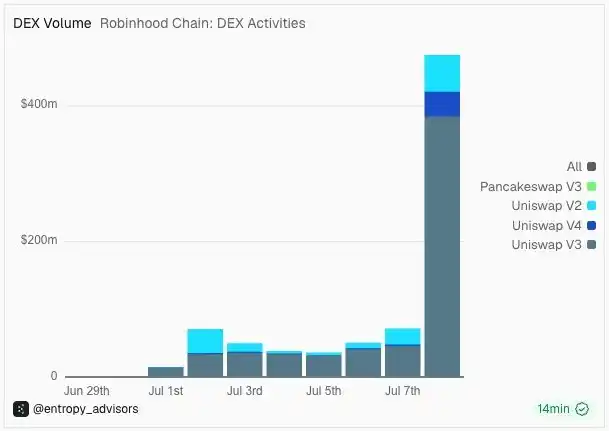
Robinhood Chain DEX Trading Volume. Data Source: Dune Analytics

Core Driver of TVL Surge is Ethena Stablecoin, Not Memecoins

Although market attention is focused on Memecoin speculation, the most critical factor driving the surge in Robinhood Chain's total value locked (TVL) was a deposit of stablecoin funds. Ethena injected approximately $50 million into the USDG pool managed by Steakhouse Financial within the lending protocol Morpho. Morpho is the underlying protocol for Robinhood's on-chain savings product, Robinhood Earn, which can offer an annualized yield of about 7% for USDG.

DefiLlama data shows this capital inflow directly propelled the protocol's TVL to a single-day increase of over 160%. Morpho hosts the vast majority of statistically trackable DeFi liquidity on the chain, with stablecoins (primarily USDG) constituting the bulk of on-chain asset value.
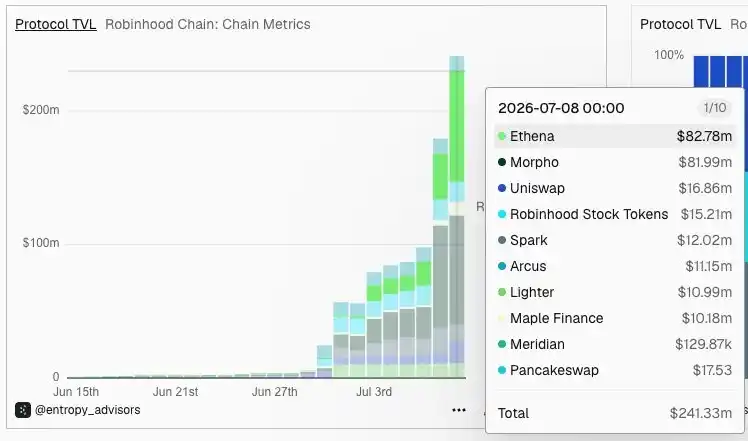
Robinhood Chain Total Value Locked. Data Source: Dune Analytics

The data reflects two parallel development paths for the public chain: institutional stablecoin capital and lending business solidify the underlying capital base; the retail Memecoin frenzy fueled by Pump.fun continues to drive up transaction counts and active users. Confusing the relationship between the two would severely overstate the contribution of Meme trading to the total value locked metric.

RWA Business Remains a Minimal Proportion

Despite Robinhood Chain's emphasis on the RWA narrative, the current scale of its tokenized real-world asset business is extremely low. The total value of tokenized assets like U.S. Treasuries, stocks, ETFs, and commodities is only about $12.8 million, far less than the TVL supported by stablecoins and lending funds.

The stock tokens launched by Robinhood are tokenized debt certificates that track the price of U.S. stocks and ETFs but do not grant holders shareholder voting rights. The products are available in over 120 countries globally and are not offered to users within the United States.

This gap summarizes the state of Robinhood Chain in its first week: speculative trading and stablecoin deposits seeking yield provide the initial liquidity and on-chain activity, while the chain's initially planned core sector—tokenized securities business—remains in a slow starting phase.


Trend Kriptolar

İlgili Sorular

QWhat are the key factors driving the rapid increase in activity on Robinhood Chain within a week of its launch?

AThe key factors are the Meme coin trading frenzy, integration with the Pump.fun platform, and the migration of the World project from Solana. Additionally, a significant inflow of stablecoin capital into the Morpho lending protocol provided a major boost to Total Value Locked (TVL).

QHow did CEO Vlad Tenev's public stance on Meme coins change after the launch of Robinhood Chain?

AInitially, shortly after the mainnet launch on July 2nd, Vlad Tenev stated on CNBC that Meme coins were 'basically dead' and emphasized tokenized real-world assets (RWA) as a more sustainable path. However, by July 7th, he reversed this stance on X, declaring that Robinhood Chain was also 'really good for Meme coins.'

QWhat is the significance of the integration with Pump.fun for the Robinhood Chain ecosystem?

AThe integration with Pump.fun significantly lowered the barrier for traders to participate in Meme coin trading on Robinhood Chain. It allows users to trade Robinhood Chain tokens directly on Pump.fun without needing a cross-chain bridge, using SOL with zero transaction fees through Solana channels.

QAccording to the data, what is the primary driver behind the surge in Robinhood Chain's Total Value Locked (TVL), and why is this distinction important?

AThe primary driver of the TVL surge was a large stablecoin deposit, specifically around $50 million from Ethena into the USDG pool on the Morpho lending protocol. This is important because it highlights that the foundational capital and scale of the chain come from institutional stablecoin and lending activity, not from the more visible Meme coin trading frenzy, which would otherwise exaggerate the contribution of speculation to the TVL metric.

QWhat does the current data reveal about the state of Robinhood Chain's originally intended core business of Real World Assets (RWA) compared to its current activity?

AThe data shows that the tokenized real-world asset (RWA) business, such as tokenized US treasuries, stocks, and ETFs, is currently minimal, with a total value of only about $12.8 million. This is vastly overshadowed by the capital from stablecoin deposits and lending. The article concludes that while speculative trading and yield-seeking stablecoins are driving initial liquidity and activity, the chain's core RWA narrative is still in its very early stages.

İlgili Okumalar

Strategy's Accounting Gimmick: The Cap on BTC Sales Far Exceeds $1.25 Billion

The article, originally from Bankless, discusses how MicroStrategy's (MSTR) recent Bitcoin (BTC) sales reveal a much larger potential selling capacity than the widely reported $1.25 billion "reserve-building" cap. On July 7, MicroStrategy disclosed a sale of 3,588 BTC (~$216M) to pay dividends for its STRAT (STRC) preferred shares and replenish its USD Reserve. Crucially, the company stated this sale did not count against its stated $1.25 billion "reserve-building capacity." The analysis explains that MicroStrategy's "BTC Monetization Plan," part of its broader "Digital Credit Capital Framework," actually outlines three main purposes for selling BTC, only one of which has the $1.25B cap: 1. **Building the USD Reserve** (capped at $1.25B). 2. **Covering preferred share/ debt costs** (replenishing the reserve after payments). 3. **Funding buybacks** (up to $10B for preferred shares and $10B for MSTR common stock). The key nuance is the accounting distinction between "building" the reserve (selling BTC before making payments) and "replenishing" it (selling BTC after using reserve funds for payments). While functionally the same—converting BTC to cash for obligations—only "building" counts against the publicized $1.25B limit. This means sales for "replenishing" and the $20B+ buyback pool allow for total potential sales exceeding $30B. The article frames this as part of MicroStrategy's shift from a simple "buy and hold" Bitcoin narrative to an "active capital management" model, where BTC becomes a balance-sheet tool to manage pressures between its common stock, preferred shares, dollar reserve, and Bitcoin holdings. This creates complex trade-offs and potential conflicts of interest. The conclusion warns investors that the $1.25B figure is not a total sales ceiling. Understanding terms like "build," "replenish," and "repurchase" in MicroStrategy's disclosures is now critical, as the company navigates a new, more complex role as an actively managed entity rather than a passive Bitcoin accumulator.

Odaily星球日报15 dk önce

Strategy's Accounting Gimmick: The Cap on BTC Sales Far Exceeds $1.25 Billion

Odaily星球日报15 dk önce

The Networking Game in Silicon Valley's Elite Circles: Those with Connections Get $50 Million, While the Truly Talented Can't Raise Money?

"Silicon Valley's Meritocracy to Relationship Game: How Networks Now Trump Talent." The article argues that Silicon Valley has shifted from a meritocracy to a "kingmaker" system where connections and background outweigh true ability. Key factors driving this change include: 1. **AI-Distorted Expectations:** Unprecedented growth curves (e.g., Anthropic) have led VCs to seek only "sure things" or pattern-match against past successes. 2. **Capital Concentration:** LP funds are concentrated in a few large, multi-stage funds, pushing VCs to overpay for hot deals to secure capital. 3. **VC Professionalization:** The industry has become a standardized career path, attracting conformist "NPCs" rather than independent thinkers. The long IPO timeline incentivizes safe, consensus bets for career advancement over risky, fund-returning outliers. This consensus capital fuels consensus founders. Startups are now a standard career option, with accelerators pressuring uniform ideas (e.g., 81% AI). Founders from elite schools (Stanford, OpenAI) easily raise millions based on pedigree, not proof. Large funds preemptively back "centrally cast" teams with $10-50M war chests to dominate categories, sidelining outsiders. The "kingmaker" strategy has downstream effects: it encourages aggressive, sometimes fraudulent, revenue reporting and allows founders to sell significant secondary shares early, attracting grifters. The author predicts a mean reversion. History shows the hottest trends rarely produce the most valuable companies. They advocate backing underestimated outsiders with "a chip on their shoulder" over anointed insiders, believing true meritocracy will ultimately win. "Those chasing the herd are set up for slaughter."

marsbit31 dk önce

The Networking Game in Silicon Valley's Elite Circles: Those with Connections Get $50 Million, While the Truly Talented Can't Raise Money?

marsbit31 dk önce

From 2 Million Monthly Active Users to Zero: Zapper's Demise in the "Maturation" of DeFi

From 2M MAU to Zero: The Demise of Zapper in a Maturing DeFi Landscape On July 8, 2026, Zapper co-founder Seb Audet announced the platform's full shutdown. Once a DeFi star with 2 million monthly active users, $13B in processed transactions, and $16.5M in funding, Zapper's journey ends. Born in 2020 from the merger of DeFiZap and DeFiSnap, Zapper rode the "DeFi Summer" wave. It became essential for users to track complex, multi-protocol yield farming positions across chains. At its peak, it supported 14 chains, 450+ protocols, and 7000+ tokens, with its signature "Zap" feature simplifying multi-step DeFi actions. However, sustainable revenue never materialized. Its primary model—taking small fees from DEX aggregation—faced fierce competition and squeezed margins. Meanwhile, maintaining its extensive, real-time data indexing system was costly. Crucially, the DeFi ecosystem matured, with activity and liquidity concentrating in fewer top protocols. The core demand for a complex, multi-protocol dashboard waned as user behavior simplified. Zapper attempted multiple pivots that failed to gain traction: an NFT-based points system (2021), a social app called Chainchat (2023), and plans for a ZAP token and open protocol (2024). These efforts reflected a persistent "blockchain-native" mindset focused on creating new C端 (consumer) needs rather than addressing existing pain points or bolstering its revenue-generating products. The article contrasts Zapper with DeBank, which successfully narrowed its asset-tracking focus while developing Rabby Wallet—a revenue-stabilizing, competitive product. Zapper's story serves as a cautionary tale for tooling projects: over-immersion in a purist vision, coupled with an inability to adapt business models to market shifts—like the consolidation of DeFi activity—can be fatal, even for once-dominant platforms.

marsbit55 dk önce

From 2 Million Monthly Active Users to Zero: Zapper's Demise in the "Maturation" of DeFi

marsbit55 dk önce

Goldman Sachs Bans It, Google Bans It Too: The Gray Zone of Prediction Markets Is Shrinking Fast

Goldman Sachs has updated its personal trading policy, prohibiting employees from trading event contracts on prediction markets involving specific companies (including whether Goldman itself might restructure or initiate acquisitions in a quarter), election outcomes, financial market performance (including Bitcoin prices), macroeconomic data, geopolitical events, and regulatory results for pending M&A deals. Sports and entertainment bets remain allowed. Violations can lead to dismissal or account closure, and the firm may reclaim profits over $200 or donate them to charity. This follows a CFTC case against a Google engineer who allegedly used non-public data to profit $1.2 million on Polymarket. Simultaneously, Google's Chrome Web Store updated its policy, banning extensions that facilitate real-money trading on prediction market outcomes, effective August 1, 2026. While not affecting platforms' websites or mobile apps directly, this restricts a key user access channel. These actions occur amid growing regulatory pressure on prediction markets. The CFTC is investigating Polymarket for alleged misconduct, and a consumer group has filed a lawsuit. Over 30 countries, including Argentina, have blocked access. Despite this, trading volume has hit record highs, and major investments continue, such as ICE's $2 billion stake in Polymarket. The core debate remains whether prediction markets are financial instruments or gambling. CFTC argues for federal oversight as derivatives, while some states seek to regulate them under gambling laws. Multiple fronts—federal probes, political pressure, internal corporate bans, and platform restrictions—are narrowing the operational space for these markets.

Foresight News1 saat önce

Goldman Sachs Bans It, Google Bans It Too: The Gray Zone of Prediction Markets Is Shrinking Fast

Foresight News1 saat önce

İşlemler

Spot

Popüler Makaleler

ONE Nasıl Satın Alınır

HTX.com’a hoş geldiniz! Harmony (ONE) satın alma işlemlerini basit ve kullanışlı bir hâle getirdik. Adım adım açıkladığımız rehberimizi takip ederek kripto yolculuğunuza başlayın. 1. Adım: HTX Hesabınızı OluşturunHTX'te ücretsiz bir hesap açmak için e-posta adresinizi veya telefon numaranızı kullanın. Sorunsuzca kaydolun ve tüm özelliklerin kilidini açın. Hesabımı Aç2. Adım: Kripto Satın Al Bölümüne Gidin ve Ödeme Yönteminizi SeçinKredi/Banka Kartı: Visa veya Mastercard'ınızı kullanarak anında Harmony (ONE) satın alın.Bakiye: Sorunsuz bir şekilde işlem yapmak için HTX hesap bakiyenizdeki fonları kullanın.Üçüncü Taraflar: Kullanımı kolaylaştırmak için Google Pay ve Apple Pay gibi popüler ödeme yöntemlerini ekledik.P2P: HTX'teki diğer kullanıcılarla doğrudan işlem yapın.Borsa Dışı (OTC): Yatırımcılar için kişiye özel hizmetler ve rekabetçi döviz kurları sunuyoruz.3. Adım: Harmony (ONE) Varlıklarınızı SaklayınHarmony (ONE) satın aldıktan sonra HTX hesabınızda saklayın. Alternatif olarak, blok zinciri transferi yoluyla başka bir yere gönderebilir veya diğer kripto para birimlerini takas etmek için kullanabilirsiniz.4. Adım: Harmony (ONE) Varlıklarınızla İşlem YapınHTX'in spot piyasasında Harmony (ONE) ile kolayca işlemler yapın.Hesabınıza erişin, işlem çiftinizi seçin, işlemlerinizi gerçekleştirin ve gerçek zamanlı olarak izleyin. Hem yeni başlayanlar hem de deneyimli yatırımcılar için kullanıcı dostu bir deneyim sunuyoruz.

477 Toplam GörüntülenmeYayınlanma 2024.12.12Güncellenme 2026.06.02

ONE Nasıl Satın Alınır

Tartışmalar

HTX Topluluğuna hoş geldiniz. Burada, en son platform gelişmeleri hakkında bilgi sahibi olabilir ve profesyonel piyasa görüşlerine erişebilirsiniz. Kullanıcıların ONE (ONE) fiyatı hakkındaki görüşleri aşağıda sunulmaktadır.

活动图片