Risk Assets' Night of Terror: The Whole World Is Watching the US-Iran Conflict

marsbit2026-01-29 tarihinde yayınlandı2026-01-29 tarihinde güncellendi

Özet

Global markets experienced a sharp selloff amid escalating tensions between the U.S. and Iran, with investors bracing for potential military conflict. Risk assets, including tech stocks and cryptocurrency-related equities, saw significant declines. Major indices like Nasdaq 100 and S&P 500 dropped, while gold and silver also fell unexpectedly. Cryptocurrencies, including Bitcoin and Ethereum, retreated from recent highs. The U.S. has deployed the USS Lincoln aircraft carrier to the Middle East, with a second carrier, the USS George Bush, potentially en route. Military analysts suggest that an attack on Iran may be imminent once both carrier groups are positioned. The U.S. has also conducted regional military exercises and deployed anti-missile systems to protect allies like Israel. Domestically, the U.S. faces a potential government shutdown due to partisan disagreements over immigration enforcement and budget allocations, adding to economic uncertainty. The situation remains highly volatile, with global markets pricing in the risk of a major geopolitical event.

The US fleet deployed to Iran is much larger than the one sent to Venezuela some time ago, which also means this asset plunge is more severe.

A few hours ago, Trump and the Iranian side began exchanging fierce rhetoric frequently. Meanwhile, rumors circulated in communities that the US aircraft carrier "Lincoln" and its strike group deployed in the Middle East had entered a "total blackout" communication shutdown, indicating that action against Iran might be imminent.

Every financial market investor is on edge.

First, look at US stocks. The Nasdaq 100 quickly widened its decline to 2%, the S&P 500 fell more than 1%, and the Dow Jones was not spared either, dropping 0.5%. The hardest hit were all assets highly tied to risk appetite; cryptocurrency-related stocks were practically crushed. MSTR once fell nearly 10%, COIN dropped over 4%, while HOOD, SBET, BMNR, and CRCL all saw significant pullbacks.

Even the so-called safe-haven assets, gold and silver, were also falling. Spot gold fell through three whole hundred thresholds in just half an hour, plummeting over $400 from the high, now trading near $5,155. Silver was even more dramatic, plunging 8% intraday, directly knocked down from $121 to just over $108.

The crypto market couldn't escape either. As US stocks opened, Bitcoin began to decline, sliding from $88,000 to around $83,000; Ethereum briefly fell below $2,800, SOL lost $118, and BNB also dropped below $865.

This means global capital has already priced in the worst-case scenario: war is about to begin.

What the US Prepared Before the Last "Strike"

Put the cards on the table first, then decide whether to flip it. This seems to be the consistent approach of the US government.

Looking back at the recent action against Venezuela, we can see the series of US signals before a formal attack: weeks before launching a series of attacks on Venezuelan vessels, the US had already amassed significant military assets in the Caribbean. The official statement at the time was that these ships were suspected of smuggling drugs to the US, but no clear evidence was ever provided.

The real outcome is known to all: on January 3rd, US forces directly intervened, taking Venezuelan President Maduro from Caracas.

It is said that the US aircraft carrier was already in position then; typically, 5 to 7 days before正式动手 (formal action begins), the US military's core strike forces are all in designated waters, waiting only for an "opportune moment."

Before Iran was attacked in June 2025, it was exactly the same rhythm. Days before the operation began, media caught abnormal movements of US military equipment. On June 21st, the US suddenly deployed 6 B-2 stealth bombers to Guam, later casually explaining it was a feint to maintain surprise advantage. But those familiar with US military operational logic understand that strategic assets of this level are never just for "drills." Meanwhile, two carrier strike groups led by the USS Carl Vinson and USS Lincoln had already been提前部署 (pre-deployed) in the Arabian Sea. The Arleigh Burke-class guided-missile destroyer USS Thomas Hudner was also moved to the eastern Mediterranean.

Thus, the deployment of carriers at sea, the mobilization of strategic bombers and heavy strike capabilities in the air, and the deployment of air defense systems are the three hallmark features of US military preparations before conflict.

And now, similar signals are gradually replaying.

Is a Second Aircraft Carrier on the Way?

"We have a massive fleet heading in that direction, maybe we won't need to use it." After Trump said this, US Central Command later confirmed on social platform X that a nuclear-powered aircraft carrier, the "Lincoln," had been sent to the Middle East.

This carrier left San Diego last November and had been performing missions in the South China Sea. Now, it has a new combat objective—Iran.

The Lincoln is one of the US Navy's core assets and one of the ten nuclear-powered aircraft carriers. It doesn't run on diesel but is driven by a nuclear reactor, theoretically capable of operating continuously for decades without refueling. It is equipped with highly advanced missile systems, radar, and sensors, essentially a floating combat command center at sea.
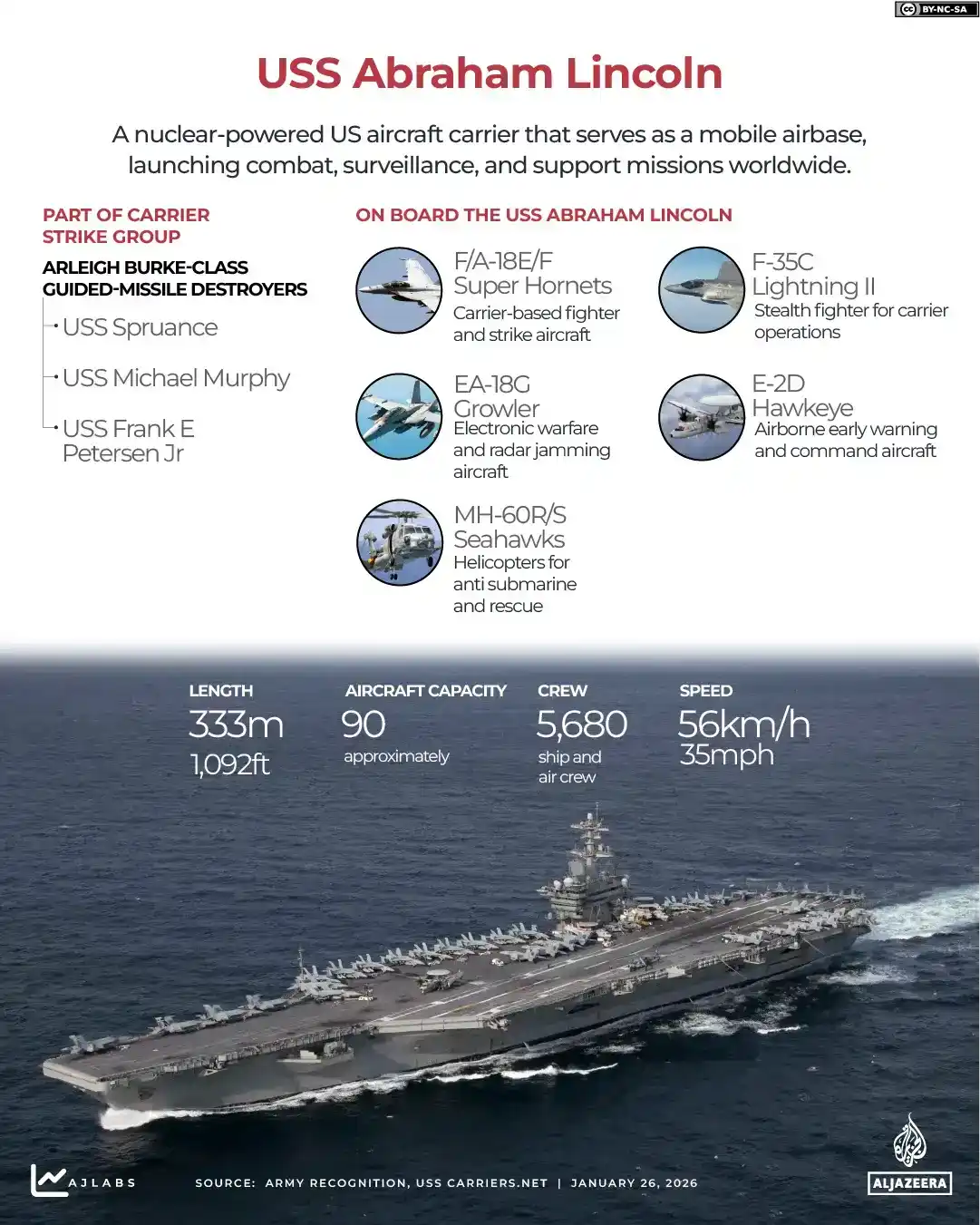
The Lincoln's whereabouts were originally highly classified, but because it had to pass through the Strait of Malacca, one of the world's busiest shipping lanes, it had to turn on its transponder to avoid collisions. It was this brief "lighting up" that allowed the outside world to confirm it had crossed the Indian Ocean on January 23rd. Subsequently, the transponder was turned off, and its location disappeared again. But based on speed calculations, it has now basically reached near the theater and entered a standby state.

After passing through the Strait of Malacca, the transponder was turned off again, and the carrier disappeared from radar. The rest can only be estimated by speed. But according to speed calculations, the Lincoln has now basically arrived near the theater and is in position.

At the same time, a second carrier seems to be on the way.

The "George Bush" set sail from the US East Coast on January 13th. It is widely believed that it will likely cross the Atlantic, enter the Mediterranean via the Strait of Gibraltar. Although it cannot be ruled out as just combat readiness training, at this point in time, few really believe it's a coincidence. Most military analyses speculate that the purpose of the George Bush's deployment is to "raise the stakes" in the Middle East situation.
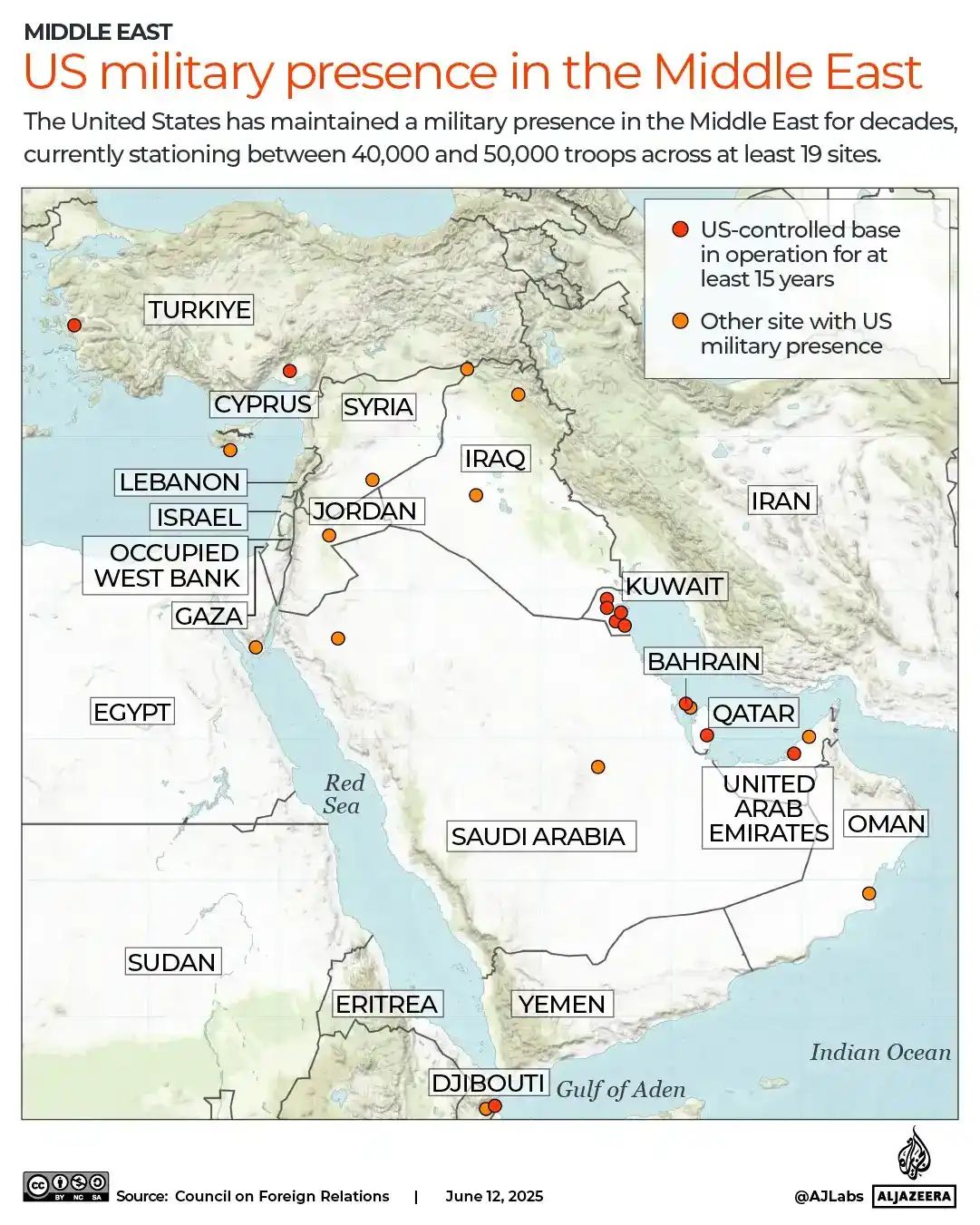
The judgment of many military analysts is also consistent: the truly "suitable" time to start fighting is likely after the second carrier strike group is in place. One carrier can certainly fight, but two mean air superiority, strike frequency, and fault tolerance are maximized. Since the best window for attack missed in early January when Iran protested, the difference between waiting a day and a week is not significant. Rather than acting hastily, it's better to wait for the second carrier strike group to arrive, pile up military strength in the Middle East to the highest level, and then strike decisively.

But as of now, the Bush has not been photographed passing through key straits. Based on speed estimates, it has not yet fully entered a combat-ready position.

After discussing carrier deployment, the air side is not idle either. US Air Force Central Command has announced multi-day combat readiness exercises in its area of responsibility, covering over 20 countries in the Middle East, Asia, and Africa. The term "exercise" itself is very flexible.

Of course, where there is offense, there must be defense.

Especially US protection of Israel. According to the Wall Street Journal, the US is also sending additional "Patriot" and "THAAD" anti-missile systems to the Middle East. After air defense systems are deployed, the real timeline for war often begins. But the specific timing is almost impossible for outsiders to know.

Some analyses even look further afield: Trump's obsession with Greenland is not just about resources. There are critically important US radar early warning facilities there, key nodes in preventing long-range ballistic missile surprise attacks. Controlling these places is essentially about creating defensive depth for larger-scale conflicts.

Israel has clearly entered the same timeline. On January 25th local time, Israeli Defense Forces Northern Command Chief Rafi Milo publicly stated that the IDF is preparing for the chain reaction after possible US military action against Iran. Earlier, Haaretz had cited defense sources saying the IDF had全面提高警戒级别 (raised alert levels across the board) in response to "a possible US attack within days."

Against this background, the US's real target appears increasingly clear. If it acts, the target is likely not just a limited strike but directly aimed at the Iranian regime itself. Precisely because of this, the US格外强调 (places great emphasis on) "everything being ready." A failed strike would mean long-term consumption, a political risk no US administration is willing to bear.

The Internal and External Troubles of the US Government's "Partial Shutdown"

Beyond military risks, domestic pressure is also building in the US simultaneously.

Lüdong's editors believe that the US government's "partial shutdown" before the end of the month is also an important reason for today's decline.

Each fiscal year, the US Congress must pass 12 appropriation bills. If no agreement is reached, the government shuts down. The current temporary funding bill expires on January 31st, and Congress has only two working days left. Informal vote counts in the Senate already show that the procedural vote to advance the appropriation bill failed. A partial or full government shutdown has almost become a high probability event.

And now, with only 2 working days left, a partial government shutdown is basically certain. The US Senate's informal vote count结果显示 (showed) that the procedural vote held that day failed to advance the government funding bill already passed by the House.

The budget disagreement between the two parties is mainly over the Department of Homeland Security. The main event is: Minnesota, a long-time Democratic stronghold, was recently exposed to one of the largest welfare fraud cases in US history, involving up to $9 billion. For more details, see related reading: "Is the US Government Shutting Down Again, Will Crypto Be Hit Again?" The editor will only briefly mention the points of disagreement here:

Many organizations involved are closely linked to the local Democratic political ecosystem. Evidence suggests that funds obtained by these welfare fraud organizations have flowed into Democratic campaign donations.

Minnesota itself is also a highly immigrant state, with large populations of Somali and other immigrant groups. The Minnesota Attorney General's office said that among the 92 defendants charged in this case, 82 are Somali Americans. This highly intertwines issues of immigration enforcement, welfare distribution, and public safety,恰好踩中了 (exactly stepping on) the core issues of long-standing opposition between the Democratic and Republican parties, and is also a policy promise repeatedly emphasized by Trump and the Republicans in the campaign.

Thus, Trump strengthened immigration enforcement in Minnesota. However, the sudden increase in enforcement intensity quickly led to serious consequences. Two incidents occurred where federal immigration enforcement officers accidentally shot and killed local residents, leading to large-scale protests and riots, even requiring the National Guard to maintain order. The Democrats quickly seized this opportunity, using the fatal shootings by ICE in Minnesota as ironclad evidence of the agency's out-of-control enforcement methods.

The Democrats' logic is clear: ICE caused two deaths in Minnesota, proving the agency's enforcement methods have serious problems. Without substantial reform of ICE and adding strict restrictions, why should we continue to fund it? Democrats demand reducing ICE's scale or at least attaching strict restrictions.

The Republican stance is diametrically opposed: The Minnesota welfare fraud case involves $9 billion, most defendants are Somali,恰恰说明 (precisely illustrating) the need to strengthen, not weaken, immigration enforcement. ICE is a key force in combating illegal immigration and welfare fraud; it must be fully funded.

Internal strife has no resolution, while external risks are simultaneously heating up. Whether war will truly happen, no one can give a definite answer. But Lüdong's editors hope for world peace.


Trend Kriptolar

İlgili Sorular

QWhat are the three key characteristics of US military deployment before a potential conflict with Iran, as mentioned in the article?

AThe three key characteristics are: 1) Deployment of aircraft carriers at sea, 2) Mobilization of strategic bombers and heavy strike capabilities in the air, and 3) Deployment of air defense systems.

QAccording to the article, which specific US Navy carrier has been confirmed to be heading to the Middle East, and what is its significance?

AThe USS Lincoln, a nuclear-powered aircraft carrier, has been confirmed by US Central Command to be heading to the Middle East. It is significant as one of the US Navy's core assets, acting as a floating command center with advanced missile systems, radar, and sensors.

QWhat major domestic US issue is cited in the article as a significant contributor to the market downturn, and when is its deadline?

AA potential partial US government shutdown is cited as a major contributor. The deadline for the temporary funding bill is January 31st, with only two working days left for Congress to reach an agreement.

QHow did the prices of traditional safe-haven assets like gold and silver react to the rising US-Iran tensions, as described in the article?

AContrary to their typical 'safe-haven' status, both gold and silver prices fell sharply. Spot gold dropped over $400, breaking through three key hundred-dollar levels to around $5,155. Silver plummeted by 8% intraday, falling from $121 to just over $108.

QWhat is the core political disagreement between Democrats and Republicans that is causing the budget impasse and potential government shutdown?

AThe core disagreement is over funding for the Homeland Security Department, specifically Immigration and Customs Enforcement (ICE). Democrats want to cut funding or add strict restrictions following fatal shootings by ICE officers in Minnesota. Republicans argue for full funding, linking it to combating a massive $90 billion welfare fraud case in the same state, which involved many Somali-Americans.

İlgili Okumalar

After Three Consecutive Quarters of Decline, Can the Crypto Market Find a Window for Stabilization in Q3?

The cryptocurrency market has just concluded its worst-performing quarter since 2022, with total capitalization dropping 12.6% to $2.1 trillion. All core metrics indicate capital is leaving the sector, not just rotating within it. Bitcoin fell 14.2% and Ethereum dropped 25.4% in Q2, breaking their previous correlation with US tech stocks. A key driver is the reversal in US spot Bitcoin ETF flows, which saw a net outflow of approximately $4.67 billion in Q2, including a record monthly outflow near $4.5 billion in June. While recent data suggests long-term holders are accumulating again, sustained ETF outflows mean continued selling pressure. Market focus is now singularly on the Federal Reserve. The upcoming July FOMC meeting is seen as the most critical event for Q3. A dovish signal could support Bitcoin reclaiming a $68,000-$84,000 range, while a hawkish stance might establish a new trading band around $50,000-$56,000. Additionally, regulatory uncertainty persists, with the progress of the crucial *CLARITY Act* stalling in the Senate, reducing its perceived 2026 passage probability to 40-45%. Despite the broad downturn, a few sectors showed growth. Prediction markets saw nominal volume surge 48.7% year-over-year to $113.8 billion, and tokenized collectibles transaction volume rose 143% quarterly to $1.4 billion. The Real-World Asset (RWA) tokenization sector also continued steady growth, now representing ~$28.1 billion in on-chain value. The market's foundation for an extreme crash appears limited, with Bitcoin price hovering near its 200-week moving average. However, the trading paradigm has shifted from narrative-driven speculation to decisions based on price action, policy developments, and interest rate expectations, making a broad sentiment-driven rally unlikely in the near term.

marsbit1 saat önce

After Three Consecutive Quarters of Decline, Can the Crypto Market Find a Window for Stabilization in Q3?

marsbit1 saat önce

BIT Trading Moment: BTC Still Suppressed by Weekly 200 EMA, Rejection May Restart Decline; Storage and Semiconductors that Surged Last Night Begin Falling in Evening Trading

**Crypto & Stock Market Wrap: Bitcoin Tests Resistance, Stocks Retreat After AI Surge** Bitcoin consolidates around $66,000, facing key resistance near $68,000—an area seen as a major psychological and technical hurdle where previous rallies have failed. Analysts note the cryptocurrency is caught between its 200-week moving average (~$63,333) and 200-week EMA (~$68,328). A clear break above $68k is needed to signal a stronger bullish trend, while a rejection could lead to a retest of $63k support. Market sentiment remains cautious, with low futures open interest pointing to a low-liquidity rebound rather than a full bull market. Bitcoin spot ETFs saw another $203 million inflow. US stock futures pointed lower after a strong Tuesday session led by a massive rebound in semiconductors and memory stocks. The rally was fueled by renewed optimism about AI-driven hardware demand, with Micron, SanDisk, and SK Hynix surging. However, those gains reversed in pre-market trading. Super Micro Computer (SMCI) soared over 20% after hours on strong guidance and a record backlog. Other standouts included Rocket Lab and nuclear energy plays Oklo and X-Energy. Rising oil prices (Brent above $91) and climbing Treasury yields (10-year near 4.64%), however, are reigniting inflation concerns and acting as a headwind for equities. In Asia, markets were mixed. South Korea's KOSPI pared early gains to close slightly higher as semiconductor stocks like SK Hynix gave back initial surges. Japan's Nikkei edged lower as the yen hit a fresh 38-year low against the dollar, raising fears of potential market intervention. Key events to watch include the Samsung Galaxy launch, AMD's AI event, and a slew of major tech earnings from Alphabet, Tesla, and IBM after the close on Wednesday, followed by the ECB meeting and Intel's earnings on Thursday.

marsbit2 saat önce

BIT Trading Moment: BTC Still Suppressed by Weekly 200 EMA, Rejection May Restart Decline; Storage and Semiconductors that Surged Last Night Begin Falling in Evening Trading

marsbit2 saat önce

Former CFTC Chairman, Circle President Tarbert: Preaching Long-Termism While Cashing Out $30 Million Himself

Former CFTC Chairman and Circle President Heath Tarbert has consistently advocated for a long-term vision in public, urging patience from investors as Circle’s stock price has fallen significantly from its peak. However, it has been revealed that since Circle’s IPO, Tarbert has continuously sold his CRCL shares through pre-arranged trading plans, cashing out approximately $30 million, without making any public market purchases. This contrast between his public messaging and personal actions has drawn criticism. Tarbert joined Circle in July 2023 as Chief Legal Officer, leveraging his regulatory experience to help guide the company through its IPO and expansion. Despite promoting stablecoins as long-term infrastructure, he established a 10b5-1 trading plan just before Circle went public, leading to substantial stock sales over the following year. In March 2026, he initiated another plan to sell more shares. His career trajectory highlights a pattern of moving between high-level regulatory roles and influential positions in the financial sector. After resigning as CFTC Chairman in early 2021, he joined Citadel Securities as Chief Legal Officer just 27 days later, during a period of intense regulatory scrutiny for the firm. He later joined Circle, aiding its efforts to navigate regulatory challenges for its public listing. While Tarbert's expertise in policy and compliance is valuable to companies like Circle, his actions—advocating long-term confidence while personally divesting—raise questions about the alignment between his public statements and his private financial decisions, leaving investors who followed his advice to bear the market risks.

marsbit2 saat önce

Former CFTC Chairman, Circle President Tarbert: Preaching Long-Termism While Cashing Out $30 Million Himself

marsbit2 saat önce

Gate Research Institute: The 'Wall Street-ization' Wave of Crypto Financial Products – Competition or Integration?

The article titled "Gate Research Institute: Are Crypto Financial Products Sparking a 'Wall Street' Wave—Competition or Convergence?" explores the evolving relationship between the crypto ecosystem and traditional finance (TradFi). The piece begins by reflecting on Bitcoin's original 2009 vision of decentralization, disintermediation, and moving away from banks. It then contrasts this with the 2024 landscape, where key crypto assets like Bitcoin are increasingly held through Wall Street products like ETFs issued by giants like BlackRock. The article questions whether this signifies that TradFi is systematically taking over the rights to issue, price, custody, and distribute crypto financial assets. The core argument is that this is not a zero-sum takeover but rather a bidirectional convergence where each side addresses the other's weaknesses. Crypto offers 24/7 global markets, programmable settlement, and open access but lacks compliant channels, institutional-grade custody, deep fiat liquidity, and mainstream distribution. TradFi possesses these but is constrained by legacy systems, limited operating hours, and slow settlement. Two primary convergence paths are highlighted: * **Path A (CEX to TradFi):** Exemplified by Gate, which has progressed from offering tokenized stocks and CFDs to providing direct, real stock trading (US, Hong Kong, South Korea) within its platform, using USDT. * **Path B (TradFi to Crypto):** Exemplified by Robinhood, which has integrated crypto trading, acquired exchanges like Bitstamp, and is moving traditional assets like stocks onto the blockchain via tokenization and its own Layer 2. Both paths are ultimately competing to become the next-generation, unified financial account—a "super account" where users can seamlessly trade cryptocurrencies, stocks, ETFs, RWA (Real World Assets), and tokenized treasury products in one interface. The growth of RWA and tokenized treasuries (e.g., BlackRock's BUIDL) is presented as the asset-layer fusion, providing stable, yield-bearing assets on-chain and acting as a bridge between the two worlds. In conclusion, the "Wall Street-ization" of crypto is framed as a mutual transformation. Decentralized ideals persist in the protocol layer, while at the application layer, a more efficient, global, and accessible unified capital market is emerging from this convergence. The future competition lies not between crypto exchanges and stockbrokers, but between platforms vying to offer the most comprehensive asset coverage, liquidity, and user experience within a single account.

marsbit2 saat önce

Gate Research Institute: The 'Wall Street-ization' Wave of Crypto Financial Products – Competition or Integration?

marsbit2 saat önce

İşlemler

Spot

Popüler Makaleler

NIGHT Nasıl Satın Alınır

HTX.com’a hoş geldiniz! Midnight (NIGHT) satın alma işlemlerini basit ve kullanışlı bir hâle getirdik. Adım adım açıkladığımız rehberimizi takip ederek kripto yolculuğunuza başlayın. 1. Adım: HTX Hesabınızı OluşturunHTX'te ücretsiz bir hesap açmak için e-posta adresinizi veya telefon numaranızı kullanın. Sorunsuzca kaydolun ve tüm özelliklerin kilidini açın. Hesabımı Aç2. Adım: Kripto Satın Al Bölümüne Gidin ve Ödeme Yönteminizi SeçinKredi/Banka Kartı: Visa veya Mastercard'ınızı kullanarak anında Midnight (NIGHT) satın alın.Bakiye: Sorunsuz bir şekilde işlem yapmak için HTX hesap bakiyenizdeki fonları kullanın.Üçüncü Taraflar: Kullanımı kolaylaştırmak için Google Pay ve Apple Pay gibi popüler ödeme yöntemlerini ekledik.P2P: HTX'teki diğer kullanıcılarla doğrudan işlem yapın.Borsa Dışı (OTC): Yatırımcılar için kişiye özel hizmetler ve rekabetçi döviz kurları sunuyoruz.3. Adım: Midnight (NIGHT) Varlıklarınızı SaklayınMidnight (NIGHT) satın aldıktan sonra HTX hesabınızda saklayın. Alternatif olarak, blok zinciri transferi yoluyla başka bir yere gönderebilir veya diğer kripto para birimlerini takas etmek için kullanabilirsiniz.4. Adım: Midnight (NIGHT) Varlıklarınızla İşlem YapınHTX'in spot piyasasında Midnight (NIGHT) ile kolayca işlemler yapın.Hesabınıza erişin, işlem çiftinizi seçin, işlemlerinizi gerçekleştirin ve gerçek zamanlı olarak izleyin. Hem yeni başlayanlar hem de deneyimli yatırımcılar için kullanıcı dostu bir deneyim sunuyoruz.

343 Toplam GörüntülenmeYayınlanma 2025.12.08Güncellenme 2026.06.02

NIGHT Nasıl Satın Alınır

Tartışmalar

HTX Topluluğuna hoş geldiniz. Burada, en son platform gelişmeleri hakkında bilgi sahibi olabilir ve profesyonel piyasa görüşlerine erişebilirsiniz. Kullanıcıların NIGHT (NIGHT) fiyatı hakkındaki görüşleri aşağıda sunulmaktadır.

活动图片












