Ripple, Stellar Show Up In New Epstein Files, Ex-CTO Schwartz Reacts

bitcoinist2026-02-03 tarihinde yayınlandı2026-02-03 tarihinde güncellendi

Özet

Newly released Jeffrey Epstein documents include a 2014 email from Blockstream co-founder Austin Hill that mentions Ripple and Stellar. In the email, Hill reportedly complained to Epstein and others about investors supporting competing projects, framing backers of Ripple or Stellar as "enemies/opponents" to his Bitcoin-centric ecosystem. Former Ripple CTO David Schwartz publicly responded, stating he knows of no direct connections between Epstein and either Ripple, XRP, or Stellar. He emphasized there is no evidence that anyone from these projects met with Epstein or his close associates. Schwartz criticized the "enemy/opponent" mindset as harmful to the entire crypto space and dismissed the notion of deeper involvement as speculative conspiracy. He also addressed a question about Ripple's for-profit structure versus Stellar's non-profit, revealing he had opposed the non-profit model early on, believing it seemed dishonest and borderline illegal. At the time of reporting, XRP was trading at $1.64.

Ripple and Stellar were pulled into a fresh round of social-media speculation this weekend after newly surfaced emails from the Epstein document release appeared to reference the two projects in a 2014 investor dispute. Former Ripple CTO David Schwartz pushed back publicly, saying he knows of no direct links between Epstein and either network, and framed the episode as another example of tribal politics bleeding into crypto.

Schwartz Reacts After Epstein Docs Mention Ripple, Stellar

The spark came from a screenshot circulating on X that shows an email chain in which Austin Hill (co-founder of Blockstream) complained to a group of high-profile recipients, including Epstein, about investors allocating capital across competing projects. According to Schwartz, the document “is an email from Austin Hill to Jeffrey Epstein explaining that Hill felt that support for Ripple or Stellar made someone an enemy/opponent,” adding that Hill likely shared similar views “to many other people.”

As the image spread, some posts characterized the mere inclusion of Ripple and Stellar in the email as evidence of deeper involvement. Schwartz responded with a message that tried to separate inflammatory framing from what the document actually shows.

“I don’t know of any connections between Jeffrey Epstein and Ripple, XRP, or Stellar. [I don’t know of] any evidence anyone at Ripple or Stellar ever met with Epstein or anyone closely connected to him,” he wrote. “There are some indirect ties between Epstein and people connected to Bitcoin in various ways, but that’s probably true of most very wealthy people.”

Source: X @JoelKatz

Schwartz’s first post on the thread captured the mood of the day, both suspicion and a reluctance to feed it. “I hate to be a conspiracy theorist, but I wouldn’t be at all surprised if this is just the tip of a giant iceberg,” he wrote while linking to the DOJ-hosted file. He later argued the more corrosive issue was the “enemy/opponent” mindset, writing that “we really are all in this together and this kind of attitude hurts everyone in the space.”

In the underlying 2014 email described in the source material, Hill is portrayed as objecting to backers funding multiple “horses” at once, treating support for Ripple or Stellar as hostile to the bitcoin-centric “ecosystem” he was building at Blockstream. Reports summarizing the chain say it was sent to Joichi Ito, Epstein, and Reid Hoffman, and included language that investors in both camps were “backing two horses in the same race.”

The resurfaced email also revived an older fault line in how early projects structured themselves. In response to a user asking about Ripple versus Stellar’s nonprofit posture, Schwartz said the idea was debated early on and that he opposed it.

“We discussed it in the early days. I was strongly against it because it seemed dishonest and borderline illegal to have a non-profit whose success was so tied to the gains of private parties,” he wrote. “It felt, at least to me, like Walmart creating a non-profit to help educate people about how much money they could save by shopping at Walmart.”

At press time, XRP traded at $1.64.
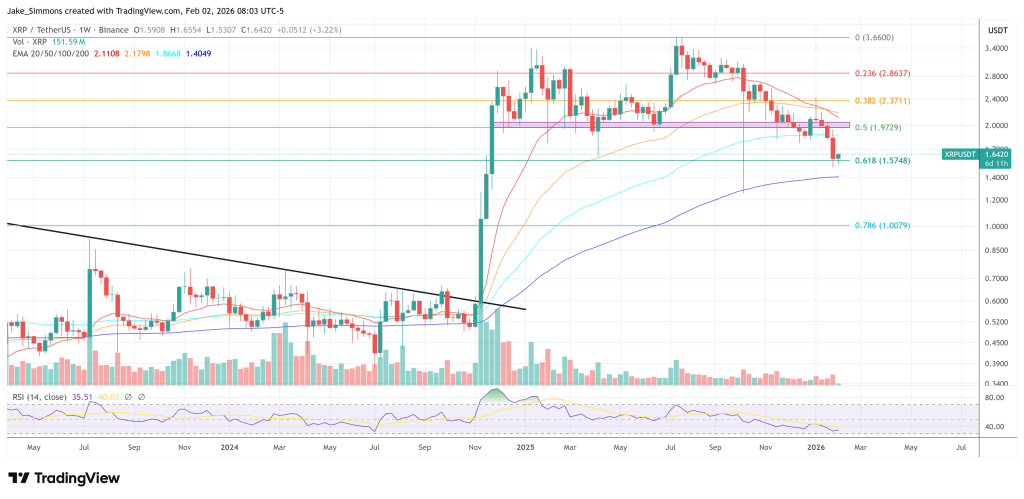
XRP holds above the 0.618 Fib, 1-week chart | Source: XRPUSDT on TradingView.com

İlgili Sorular

QWhat sparked the recent social-media speculation involving Ripple and Stellar?

AThe speculation was ignited by a screenshot of a 2014 email chain from the Epstein document release, in which Blockstream co-founder Austin Hill complained to Jeffrey Epstein and others about investors allocating capital across competing projects like Ripple and Stellar.

QHow did former Ripple CTO David Schwartz respond to the allegations of connections between Epstein and Ripple/Stellar?

ADavid Schwartz publicly stated that he knows of no direct connections between Jeffrey Epstein and Ripple, XRP, or Stellar, and that he was unaware of any evidence that anyone at Ripple or Stellar had ever met with Epstein or anyone closely connected to him.

QWhat was the main complaint in Austin Hill's 2014 email as described in the article?

AIn the email, Austin Hill objected to investors funding multiple competing projects simultaneously, characterizing support for Ripple or Stellar as being hostile to the bitcoin-centric 'ecosystem' he was building at Blockstream, and referred to it as 'backing two horses in the same race.'

QWhat did David Schwartz identify as the more corrosive issue in the crypto space, beyond the Epstein speculation?

ASchwartz argued that the more corrosive issue was the 'enemy/opponent' mindset, stating that 'we really are all in this together and this kind of attitude hurts everyone in the space.'

QWhat was David Schwartz's stated position on Ripple adopting a non-profit structure in its early days?

ASchwartz said he was strongly opposed to the idea of Ripple becoming a non-profit because he felt it seemed dishonest and borderline illegal to have a non-profit whose success was so tied to the gains of private parties, comparing it to 'Walmart creating a non-profit to help educate people about how much money they could save by shopping at Walmart.'

İlgili Okumalar

The Value Distribution of Stablecoins

**Summary: The Value Distribution of Stablecoins** The article argues that stablecoins are evolving from mere trading tools into broader channels for dollar access. It divides the stablecoin ecosystem into four layers to analyze how value is distributed: 1. **Issuance Layer:** Mints stablecoins, holds reserve assets, and captures the spread between reserve yield and user costs (e.g., Tether, Circle). This layer currently earns the largest profit margin. 2. **Infrastructure Layer:** Connects stablecoins to the traditional financial system, handling fiat on/off-ramps, banking integration, compliance (KYC/AML), and asset management (e.g., Bridge, BVNK). This is the "unglamorous" but critical work, building the essential bridges between crypto and real-world finance. 3. **Acquiring/Distribution Layer:** Integrates stablecoins into merchant systems, manages payment flows, and provides enterprise financial software (e.g., Stripe, Coinbase). They act as the access point for businesses. 4. **Application Layer:** The end-users and businesses that ultimately use stablecoins for payments, settlements, or as a store of value. They benefit from convenience but have little pricing power. The core thesis is that while the issuance layer currently dominates profits, the often-overlooked **infrastructure layer holds significant long-term potential**. The real challenge and barrier to mass adoption is not the on-chain transfer of stablecoins (which is simple), but the complex "last mile" integration into existing business workflows, banking systems, and regulatory frameworks across different countries. Companies in this layer are currently in a "land grab" phase, investing heavily to build networks, secure bank partnerships, and establish compliance pathways. While their position is currently pressured by the profitable issuers above and distribution platforms below, the article suggests that if stablecoins become a default financial rail for businesses, the infrastructure providers who have done the hard work of integration will ultimately gain strong pricing power and become entrenched, essential players.

marsbit4 saat önce

The Value Distribution of Stablecoins

marsbit4 saat önce

The Value Distribution of Stablecoins

The Value Distribution of Stablecoins The article argues that stablecoins are evolving from a mere trading tool into a broad "dollar channel." It analyzes the industry's value chain through four layers: 1. **Issuance Layer (e.g., Tether, Circle):** The top layer that mints stablecoins, holds reserve assets, and captures the thickest interest rate spread. 2. **Infrastructure Layer (e.g., Bridge, BVNK):** Connects stablecoins to the traditional financial system, handling critical but complex "dirty work" like fiat on/off-ramps, banking integration, compliance (KYC/AML), and cross-border settlement. 3. **Acquiring/Distribution Layer (e.g., Stripe, Coinbase):** Embeds stablecoins into merchant systems, manages payment flows, and integrates with enterprise software. 4. **Application Layer:** End-users and businesses that ultimately use stablecoins for payments, settlement, or storing value. The author posits that while the issuance layer currently captures the most profit, the most overlooked and potentially critical layer is infrastructure. The core challenge for stablecoin adoption isn't the on-chain transfer (which is simple), but bridging the gap between blockchain and the real-world financial system. This involves solving practical problems for businesses: fiat conversion, reconciliation, tax handling, and user onboarding. Infrastructure companies are currently in a difficult "land-grab" phase—building networks, securing banking relationships, and achieving compliance country-by-country. They face pressure from both the profitable issuance layer above and distribution platforms below. However, the author suggests this layer is building a crucial moat. Once stablecoins become a default business rail, the infrastructure players who have done the hard work of integration may gain significant, durable value and pricing power.

链捕手4 saat önce

The Value Distribution of Stablecoins

链捕手4 saat önce

How to Do Research Well: Deliberately Practice the Real Skills That Matter

No one truly teaches you how to do research. You're often given a desk, a pre-selected problem, and vague instructions to "create something new." Consequently, many people reverse-engineer the job based on visible outputs—papers, posts, announcements—learning only how to *appear* like a researcher rather than how to *become* one. True research capability is built from stacking small, trainable skills, nearly all of which can be developed through deliberate practice. **Pick Your Own Problem:** Most researchers absorb problems from advisors or trends, lacking the underlying reasoning. Choosing a problem you genuinely care about, as John Schulman advises, leads to original work. Develop "taste" like a muscle: predict experiment outcomes, guess paper results from methods, and track which findings remain important over time. **Upgrade Your Inputs:** Relying on shared reading lists (arXiv hot lists, filtered group chats) leads to unoriginal conclusions. Undervalued old literature often holds crucial insights (e.g., MoE, LSTM, backpropagation). Richard Sutton's "The Bitter Lesson" or Claude Shannon's 1952 talk on creative thinking are more predictive than lengthy modern surveys. Breadth matters as much as depth: draw from neuroscience, mechanism design, hardware knowledge, and honest statistics. Read papers directly, especially appendices and limitations sections. **Write Everything Down:** As Paul Graham noted, writing exposes flaws in seemingly mature ideas. Writing is the cheapest defense against self-deception. Following Feynman's principle, Darwin programmatically wrote down facts contradicting his theory to combat memory bias. Maintain a detailed log of hypotheses, setups, predictions, results, and updated understandings. Reviewing past logs fosters essential humility.

marsbit6 saat önce

How to Do Research Well: Deliberately Practice the Real Skills That Matter

marsbit6 saat önce

İşlemler

Spot
Futures
活动图片





