Ripple Exec Pushes Central Banks To Back Regulated Stablecoins

bitcoinist2026-01-20 tarihinde yayınlandı2026-01-20 tarihinde güncellendi

Özet

Ripple's UK & Europe policy director, Matthew Osborne, urges central banks to embrace regulated stablecoins as a stabilizing force rather than treat them as a threat. He argues that with proper oversight and access to official infrastructure, stablecoins can complement the existing financial system, particularly in cross-border payments and multi-chain markets. Osborne cites their growing adoption, with market value exceeding $300 billion and transaction volumes surpassing Visa and Mastercard combined. He calls for central banks to extend safety net features, such as allowing issuers to hold reserves in central bank accounts and providing liquidity insurance, to reduce vulnerability to shocks. The choice, he concludes, is between resisting stablecoins and risking uncontrolled growth or integrating them into the regulated financial framework.

Ripple’s UK & Europe policy director Matthew Osborne is urging central banks to stop treating stablecoins as an external threat and instead fold well-regulated issuers into core safeguards, arguing that oversight plus access to official infrastructure can make stablecoins a net stabiliser for payments and settlement.

Writing for the Official Monetary and Financial Institutions Forum on 19 January 2026, Osborne said stablecoins have moved well beyond a niche experiment, citing a market value “in excess of $300bn” and annual transaction volumes that he wrote now surpass Visa and Mastercard combined. He argued momentum could accelerate in the US after the Genius Act, which he said would introduce federal rules and allow banks to issue stablecoins.

The Ripple exec framed the shift as already visible among central banks themselves. He pointed to the European Central Bank’s recent recognition of stablecoins’ benefits for cross-border payments and its view that tomorrow’s financial system will host multiple forms of money. He also cited the Bank of England’s stance that stablecoins could support “faster, cheaper retail and wholesale payments” as part of a “multi-money” system underpinned by central bank money.

Ripple Exec: Bring Stablecoins Into The Safety Net

At the centre of his case is the claim that stablecoins should be treated as an incremental evolution rather than an adversarial replacement. “Regulated stablecoins could play a key role in financial markets alongside other forms of money,” Osborne wrote. “First, stablecoins are more likely to complement the existing financial system than replace it. This is evolution, not revolution.” He then added: “The solution lies in central banks channelling stablecoin momentum, not fighting it.”

Osborne argues central bank money will remain essential as a risk-free settlement asset and safe store of value, but its relative role could shift in digital markets. He pointed to atomic settlement, where legs of a transaction settle simultaneously and conditionally, as reducing the traditional need to use central bank money purely to mitigate settlement risk.

Where stablecoins could be structurally preferred, he wrote, is in cross-border flows and multi-chain markets. “Cross-border payments are one example, given that stablecoins can move value anywhere in the world in seconds,” the Ripple exec said.

“In contrast, central bank money is likely to be less suitable for cross-border payments given access may be geographically limited and adoption of on-chain central bank money is far from universal around the world.” He also argued stablecoins are likely to exist across more blockchain networks than central bank money, making same-chain settlement between tokenized assets and cash more achievable while interoperability remains uneven.

Central banks have repeatedly warned that stablecoins could pull funds from bank deposits, weakening bank credit creation and potentially amplifying stress events. Osborne pushed back, arguing the risk is overstated because markets already accommodate instruments backed by highly liquid assets, money market funds, e-money, and “narrow banks”, without causing sustained deposit runs.

His bigger point is that regulation, while necessary, is insufficient without a backstop. “But regulation alone is not enough,” Osborne wrote. “Stablecoin issuers lack access to the safety net that gives bank deposits their resilience. Without it, even well-managed stablecoins are more vulnerable to shocks – as seen when USDC temporarily lost its peg following exposure to Silicon Valley Bank in 2023.”

He argued central banks should consider extending elements of that safety net, including allowing well-regulated stablecoin issuers to hold part of their backing assets in central bank accounts, offering liquidity insurance against market-wide shocks, and granting more direct payment-system access to reduce tiering risk.

The Ripple exec closed by positioning the choice for central banks as strategic: resist stablecoins and risk the market scaling beyond official influence, or “bring them inside the tent,” shaping development through prudential oversight and infrastructure access as tokenized settlement rails mature.

At press time, XRP traded at $1.9216.
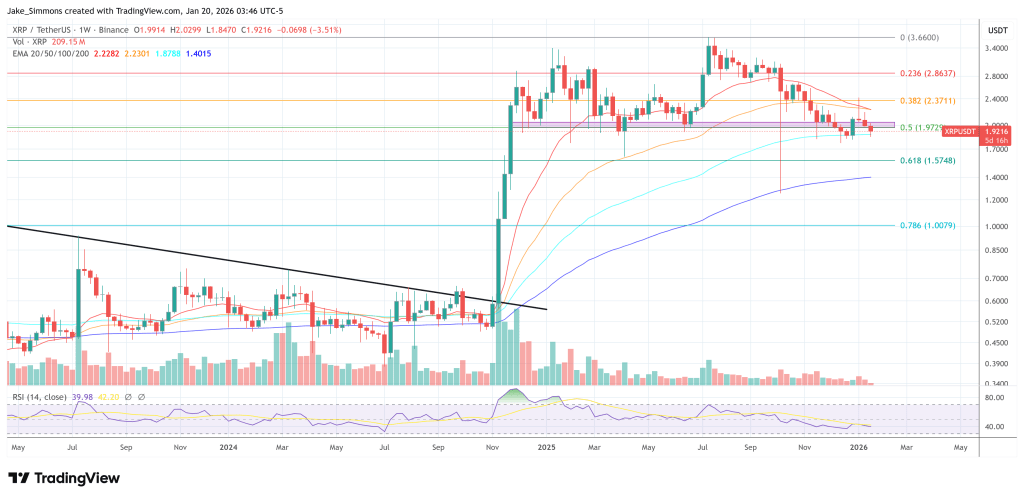
XRP holds above the 100-week EMA, 1-week chart | Source: XRPUSDT on TradingView.com

İlgili Sorular

QWhat is the main argument made by Ripple's Matthew Osborne regarding stablecoins and central banks?

AMatthew Osborne argues that central banks should stop treating stablecoins as a threat and instead integrate well-regulated stablecoin issuers into core financial safeguards, as they can act as a net stabilizer for payments and settlement.

QAccording to the article, what recent US legislation could accelerate stablecoin adoption?

AThe article states that stablecoin momentum could accelerate in the US after the Genius Act, which would introduce federal rules and allow banks to issue stablecoins.

QWhat two specific benefits of stablecoins for cross-border payments does Osborne highlight?

AOsborne highlights that stablecoins can move value anywhere in the world in seconds and are likely to exist across more blockchain networks than central bank money, making them more suitable for cross-border flows.

QWhy does Osborne claim that 'regulation alone is not enough' for stablecoins?

AHe claims regulation is insufficient because stablecoin issuers lack access to the safety net (like central bank accounts and liquidity insurance) that gives bank deposits their resilience, making them vulnerable to shocks even if well-managed.

QWhat strategic choice does Osborne present to central banks at the end of his argument?

AHe presents central banks with the choice to either resist stablecoins and risk the market scaling beyond official influence, or to 'bring them inside the tent' by shaping their development through prudential oversight and infrastructure access.

İlgili Okumalar

Dalio Warns: AI Boom Shows Signs of a Bubble, Day of Reckoning Will Be the Time of Burst

Ray Dalio, founder of Bridgewater Associates, warns that the current artificial intelligence investment boom shows classic signs of a bubble, which he expects will eventually burst. In a Bloomberg Television interview, he noted that great technological revolutions often lead to capital inflows that create bubbles, making it difficult for investors and companies to calibrate their spending accurately—either overspending to capture market share or underspending and losing their competitive position. This caution comes amid significant rallies in AI-related assets, particularly chipmakers, driven by soaring demand for data centers and high-bandwidth chips, raising debates about overheating valuations. In contrast, Nvidia CEO Jensen Huang recently asserted that investors embracing the AI wave would see "crazy" returns and dismissed concerns over return on investment for data center spending as outdated. Dalio, however, focuses on the risks in the profit realization phase. He argues that bubbles tend to show signs of破裂 when markets transition from investment to the need for tangible returns, describing the burst as a process of converting paper wealth into cash. While acknowledging AI's intrinsic value, he expressed concern over the future profitability of some AI companies, suggesting the market is repeating a familiar pattern. The 76-year-old billionaire, who fully exited Bridgewater in 2025, has a net worth estimated at $21.5 billion according to the Bloomberg Billionaires Index.

marsbit17 dk önce

Dalio Warns: AI Boom Shows Signs of a Bubble, Day of Reckoning Will Be the Time of Burst

marsbit17 dk önce

Privacy Coin Crisis of Confidence! ZEC Plunges Over 56% in a Single Day

Zcash (ZEC), a leading privacy-focused cryptocurrency, experienced a severe crash on June 5th, plummeting over 56% in a single day and erasing nearly two months of gains. The flash crash was triggered by the disclosure of a critical zero-knowledge proof vulnerability within Zcash's Orchard privacy pool, which had existed since the pool's launch in May 2022. The flaw theoretically allowed an attacker to forge unlimited ZEC undetectably due to the pool's privacy features. The vulnerability was discovered on May 29th by independent security researcher Taylor Hornby during a proactive audit commissioned by Shielded Labs, utilizing AI-assisted analysis. The Zcash development team responded swiftly, implementing an emergency soft fork to disable Orchard transactions on June 2nd and executing a permanent hard fork fix (NU6.2) on June 3rd. Despite the technical fix, a major crisis of confidence emerged. The core issue is that Orchard's privacy design makes it cryptographically impossible to prove whether the vulnerability was exploited over the past four years, casting permanent doubt on the historical supply integrity of ZEC. While Shielded Labs argues exploitation was unlikely, the inability to provide definitive proof has severely damaged market trust. This sentiment was exacerbated when BitMEX co-founder Arthur Hayes, a prominent ZEC supporter, announced he was selling his entire position. He stated that privacy assets require "perfect security" rather than "probable safety." The combined effect of the disclosure and Hayes's exit ignited widespread panic selling, leading to massive liquidations and significant price decline. Analysts note the event highlights a fundamental tension within privacy coins: the conflict between verifiable supply and cryptographic privacy.

链捕手19 dk önce

Privacy Coin Crisis of Confidence! ZEC Plunges Over 56% in a Single Day

链捕手19 dk önce

İşlemler

Spot
Futures
活动图片





